
The harsh truth: most medical schools see older applicants as a risk first, and a potential asset second. They’ll never say that on a webinar. But behind closed doors, that’s exactly how the conversation starts.
Let me walk you through how that “risk” calculation actually happens when you’re not in the room. I’ve sat in on those meetings, I’ve heard the off‑hand comments, and I know what gets an older applicant quietly moved to the “no” pile versus the “we can make this work” pile.
If you’re 26, 30, 35, 40 and aiming for medicine, you’re not playing the same game as the 21‑year‑old biochem major. Same application. Different rules.
What “Risk” Really Means To Admissions
First, you have to understand their mindset. “Risk” is not about whether they like you. It’s about whether you’re going to make them look bad on their spreadsheets later.
Schools track outcomes. Aggressively. They care about:
- Step exam pass rates
- On‑time graduation
- Match rates
- Attrition (who drops out, who takes leaves, who needs remediation)
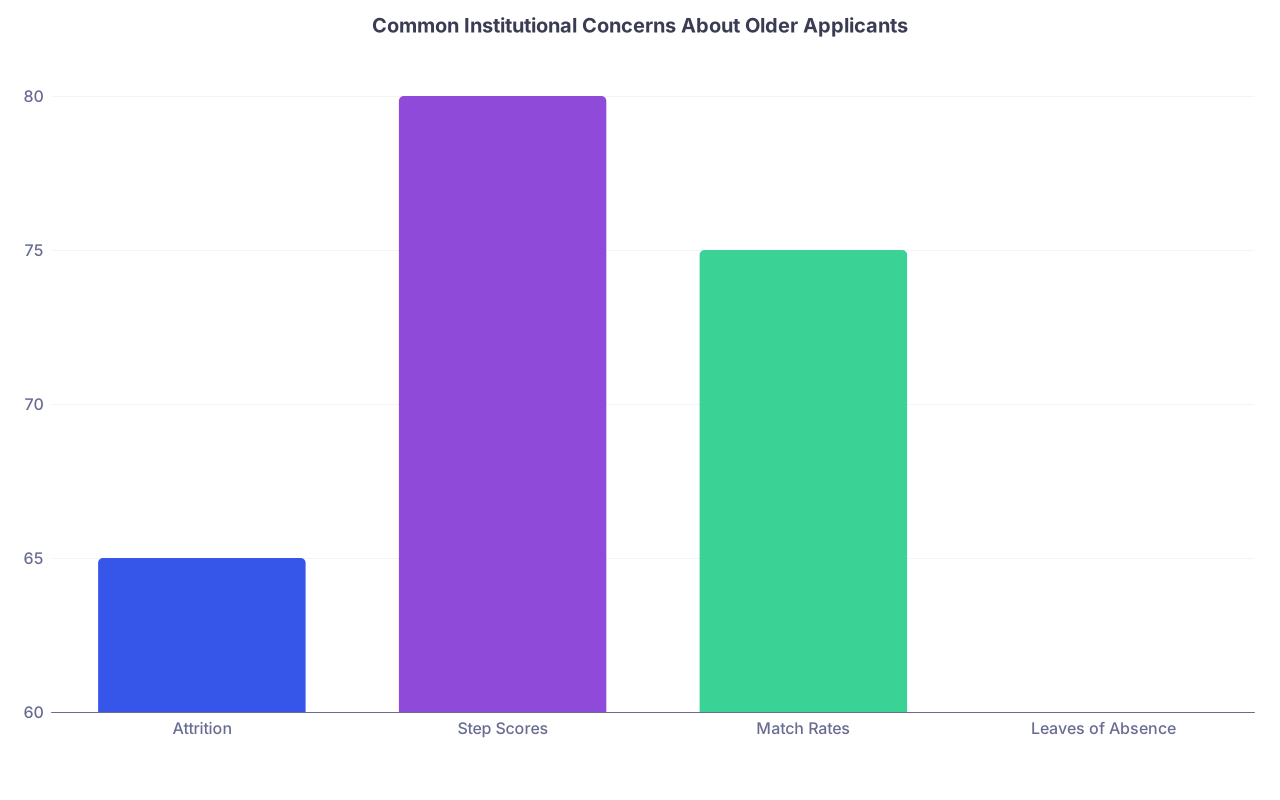
| Category | Value |
|---|---|
| Attrition | 65 |
| Step Scores | 80 |
| Match Rates | 75 |
| Leaves of Absence | 60 |
When they look at an older applicant, they’re running a mental algorithm:
“Is this person more likely than a traditional applicant to:
– struggle academically?
– burn out?
– need time off for health/family?
– not finish?
– struggle to match competitively because of age?”
They don’t say it that bluntly in the minutes. But that’s the quiet calculus.
Here’s the uncomfortable part: some of this comes from real data, and some of it is pure bias and laziness.
The three buckets of “risk” for older applicants
When your file hits the table, people are subconsciously sorting you into three risk buckets:
- Academic risk – “Can this person handle a firehose curriculum after years away from school?”
- Stamina / life‑load risk – “Will this person’s real life blow up in the middle of second year?”
- Career trajectory risk – “Is there enough runway for them to become a practicing physician, advance, and reflect well on the school?”
If you’re older, you start with a penalty in each bucket. Your entire job is to erase those penalties before they ever discuss you.
Let’s break down how each one is judged behind those closed doors.
Academic Risk: The “Can They Still Do This?” Question
I’ve watched this play out more times than I can count. An older applicant comes up. First thing someone says:
“Okay, what’s the recent coursework look like?”
Not the old GPA. Not the story. Not the personal statement.
Recent. Coursework.
If you graduated 6+ years ago, nobody trusts that transcript on its own. They want proof you still have the horsepower.
How they actually review your numbers
Here’s how an older applicant’s academics get dissected in real life:
Original undergrad GPA
They glance at it. 2.9 from 2012? 3.3 from 2010? They do not automatically toss you… if there’s an answer to the next question.Recent science work
This is what really matters. SMP, DIY post‑bacc, formal post‑bacc — that’s your second GPA.
The critical questions in the room:- “How many credits?” (10 credits = not enough. They’re thinking 25–40+ science credits.)
- “Trend?” (Upward, flat, or still messy?)
- “Rigor?” (Community college night classes only? Or upper‑level hard sciences at a 4‑year or reputable online program?)
I’ve heard: “Yeah, but this is all CC, and it’s like 12 credits over 3 years. I don’t buy that as evidence.” That applicant did not get an interview.
MCAT as a reality check
The MCAT is their “do I trust this comeback story?” filter.Weak undergrad + strong recent post‑bacc + solid MCAT = “less risky” older applicant.
Weak undergrad + weak/mediocre MCAT = “we’ll pass; too risky.”
Let me be concrete: if your old GPA is mediocre and your MCAT is 505–507, most mid‑tier MD schools will quietly see you as a high academic risk and move on. They know older students rarely have room to fail and come back; one academic stumble is often game over.
Strong MCAT (511–515+) and a consistent 3.7–4.0 recent science trend changes the whole tone of the conversation. Suddenly the comments shift:
“Yeah they’re 33, but they crushed their recent coursework and MCAT. I’m not worried about the academics.”
The age concern doesn’t vanish. But it stops being the first objection.
What older applicants do wrong academically
Here’s where many older applicants shoot themselves in the foot:
- They do a light “refresh”: a couple of classes, maybe one semester. Adcoms see that as you dipping a toe, not proving you can swim.
- They spread classes out too much: 1–2 classes a term for years. That doesn’t mimic med school pace. It screams, “I’m not sure I can handle a heavy load.”
- They avoid upper‑level rigor: no physiology, no biochem, no anatomy, no higher‑level biology. Committees notice.
Your goal is to make a cranky 58‑year‑old basic science PhD on the committee say, “Fine. They can handle it.”
That’s the bar.

| Step | Description |
|---|---|
| Step 1 | Older Applicant File |
| Step 2 | Check MCAT & Recent Coursework |
| Step 3 | Check Recent Science Trend First |
| Step 4 | Low Academic Risk |
| Step 5 | Moderate/High Academic Risk |
| Step 6 | Reject or Hold File |
| Step 7 | Old GPA Strong? |
| Step 8 | MCAT >= Target? |
| Step 9 | Strong Recent GPA & Rigor? |
Life‑Load Risk: The “Will Their Life Blow Up?” Question
This one never appears in the official rubric, but it absolutely gets discussed in the room.
Translation: “Is their life too complicated for this insanity we call medical school?”
Common quiet concerns about older applicants:
- Spouse or partner with rigid job
- Young kids
- Caregiving for parents or relatives
- Full‑time job during pre‑reqs (this can cut both ways)
- Major financial obligations, debt, or entrepreneurship
Here’s how the conversation actually sounds:
- “They’ve got three kids under 8 and they’re the primary caregiver — how’s that going to work during clerkships?”
- “They’re working full time and taking two classes at a time. Sure, they’re getting A’s, but can they handle a full‑time load without the job?”
- “They’ve already had one career change and a couple of job jumps… will they stick with this when it gets rough?”
None of this is written in the selection criteria. But it comes up. A lot.
How you defuse life‑load risk up front
You need to show, not just tell, that your life is structurally ready for this.
In your application and interviews, you want them thinking:
“This person has already stress‑tested their life and built systems around this goal.”
The older applicants who get nods in the room have usually done things like:
- Taken a near‑full course load while working and/or with family duties and still performed well.
- Have clear, concrete descriptions of support systems: spouse work flexibility, childcare plans, extended family, financial runway.
- Have already made sacrifices: reduced work hours, relocated, downsized, etc.
The weak version is vague optimism: “I know it will be hard, but we’re very committed and we’ll make it work.”
The strong version: “During my post‑bacc I worked 30 hours a week, took 12–14 credits per semester, and we used evening childcare three days a week. My partner has already arranged to switch to remote work once I start medical school. We’ve moved closer to family who will assist with school pickups.”
That kind of detail calms anxious committee minds.
Career Trajectory Risk: The “Runway” Problem
This is the part no one says out loud in public, but it definitely shapes how older applicants are evaluated.
Schools think in terms of return on investment. Not your tuition. Their reputation.
They invest in you for four years, then residency, then fellowship, then career. They want:
- Graduates who match well
- Alumni who get faculty positions, leadership roles, publications
- People who’ll be practicing long enough to contribute to their metrics and networks
Here’s the unspoken math in some people’s heads:
- Start med school at 37
- Graduate at 41
- Finish residency at 44–45
- Maybe fellowship to 47–48
- Then family, health, retirement, burnout risk
They won’t put an age cap in writing. But you will absolutely hear, behind closed doors:
- “They’re 40. How many years will they realistically practice?”
- “If they want surgery, is that fair to them? To the program?”
- “Will residency programs view them as high‑risk later?”
Some schools are more age‑friendly, especially DO programs and some community‑focused MD schools. Others are quietly rigid. I’ve seen older superstar applicants get passed over purely because one or two powerful voices on the committee were uncomfortable with the runway.
How you counter the runway objection
You will not convince everyone. But you can shift the narrative from “short runway” to “high‑yield runway.”
You want them thinking: “Yes, they’ll start later, but they’ll hit the ground with more maturity, fewer detours, and a clearer sense of purpose than many 24‑year‑olds.”
You do that by:
- Showing long‑term commitment to something already: previous career progression, staying power, leadership roles. Not bouncing every 12–18 months.
- Being specific about realistic specialties you’re considering (and showing you understand their demands). “I’m drawn to internal medicine and psychiatry” lands very differently from “I’m keeping all options open including neurosurgery.”
- Highlighting how your prior career shortens your learning curve: former RN, PA, paramedic, military, engineer, teacher — show how those years compress your adaptation time.
They want reassurance that you’re not going to change your mind at 3 a.m. on surgery call at age 42 and walk away. Give them that reassurance explicitly.
Bias, Politics, and What Actually Gets Said In The Room
Let’s stop pretending this is purely data‑driven. It isn’t.
There are three types of people in these rooms when an older applicant comes up:
The data‑focused pragmatist
“What do our numbers say about older applicants? How have they done historically here?”The quietly biased traditionalist
“Medical training is a young person’s game. I’m just being realistic.”The champion of non‑trads
Usually someone who came to medicine late themselves, or has seen older students excel.
Which one has power at that school matters more than you think.
I have heard:
- “We had a 39‑year‑old a few years back who needed multiple leaves. It was a mess. I’m hesitant to go through that again.”
- “Our two best residents on the wards right now both started med school in their 30s. They’re rock solid. I’m very comfortable with this age.”
Same profile. Different interpretation. That’s the political reality.

You can’t control who’s in the room. But you can influence how easy it is for your champions to defend you.
They need ammunition:
- Clean, upward academic trend
- Strong, recent MCAT
- Clear life logistics
- Credible specialty ideas
- Coherent story that doesn’t sound like a midlife crisis
You want the person on your side to be able to say:
“Look, they’ve already done X, Y, Z. They’re basically the prototype of the older student who does well here. We’re not taking a big risk.”
If your file leaves too many unanswered questions, the cautious voices usually win.
How Schools Informally “Score” Risk For Older Applicants
Most schools don’t have a formal “age” category. But older applicants get informally graded in a way younger ones don’t.
Imagine three mental sliders for you:
- Academics
- Life‑load
- Runway / career
Each can be Low, Moderate, or High risk.
Someone, consciously or not, is doing this:
- Low–Low–Low: “Let’s interview. Age is a non‑issue.”
- Low–Low–Moderate: “Still fine. Interview.”
- Any “High”: “We need a really compelling reason to take this chance.”
- Multiple “Moderates”: “Good candidate, but we have safer options.”
This is why some very impressive older applicants keep getting ghosted pre‑interview. On paper, they look strong. But inside the room, the discussion quietly circles back to some version of:
“Why this, why now, and can they really carry this load for the next decade?”
If your materials don’t answer that, you get silently filtered out.
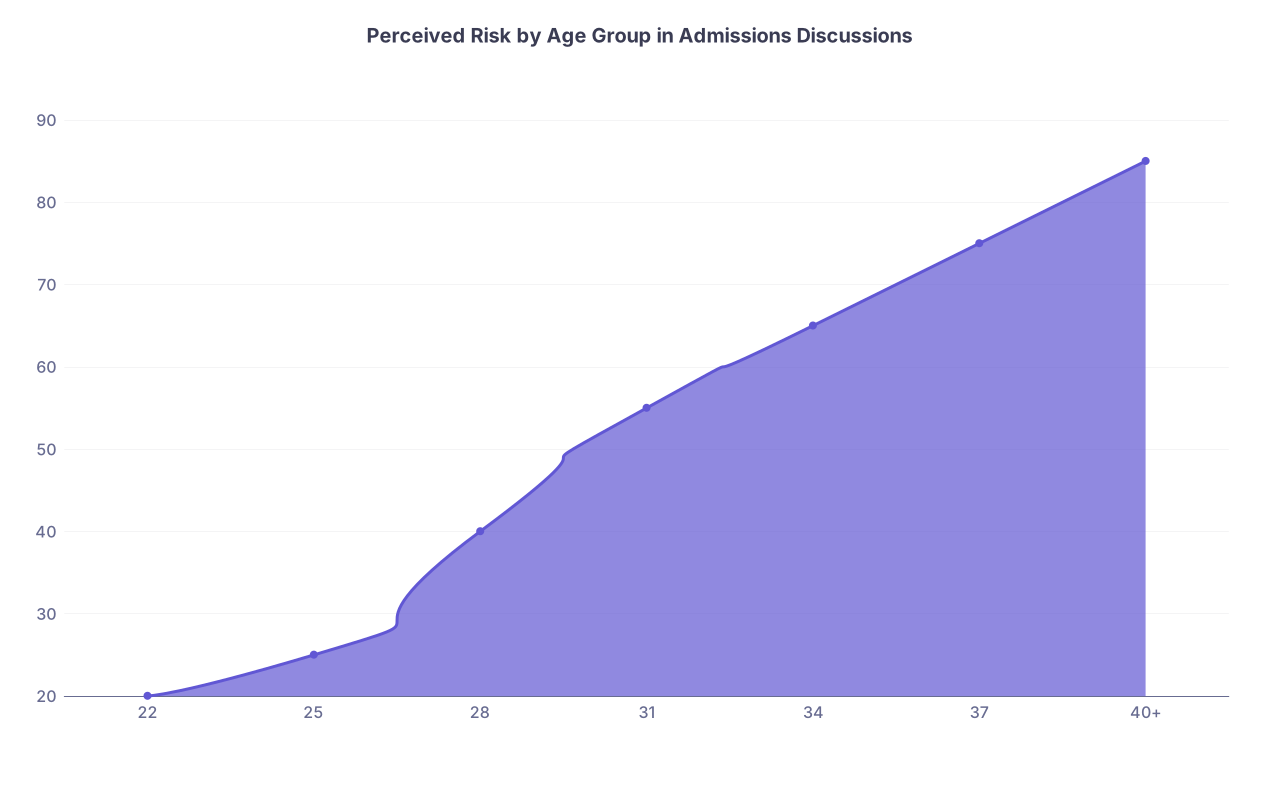
| Category | Value |
|---|---|
| 22 | 20 |
| 25 | 25 |
| 28 | 40 |
| 31 | 55 |
| 34 | 65 |
| 37 | 75 |
| 40+ | 85 |
How To Make Yourself A “Low‑Risk” Older Applicant
Let me spell this out bluntly. If you’re older, here’s what changes the tone of the conversation in your favor.
1. Over‑prove academics
Not “just enough.” Overkill.
- 30–40+ recent science credits with A/A‑ minus grades, ideally at a 4‑year or rigorous program.
- MCAT that is above the school’s median, not barely at the bottom of the range.
- Clear upward trend if you had a rough undergrad decade ago.
You are not aiming to “meet” the bar. You’re trying to erase doubt.
2. Show life‑load stress‑testing
You don’t just mention you have support. You demonstrate you’ve already functioned under med‑school‑like conditions.
Think:
“During my last year of post‑bacc, my weekly schedule looked like X. I balanced Y and Z, and I still performed academically at this level.”
You want committee members thinking, “Okay, they’ve already lived something close to this.”
3. Present a mature, coherent career story
Your story cannot sound like, “I got bored and now I’m trying medicine.”
You need:
- A longstanding thread connecting your prior life to medicine: patient‑facing work, long‑term volunteering, health‑adjacent roles.
- Clear evidence this isn’t a whim: years of exposure, not six months of shadowing after a bad week at work.
- A plausible, grounded path: “Given my age, background, and interests, I could see myself in X or Y fields, where my prior skills in A/B/C would actually be useful.”
This directly attacks the “runway” and “impulsiveness” concerns.
4. Choose schools strategically
Some schools are simply more welcoming to older students. They have:
- Visible non‑traditional students in their class photos
- Public stories of older grads
- DO programs, newer MD schools, and schools with strong primary care/community missions tend to be friendlier
I’ve watched older applicants waste cycles chasing hyper‑prestige schools that quietly prefer the 22‑year‑old Ivy pipeline. Meanwhile, those same applicants could have been very competitive at places that actually like having a few 30‑somethings around.
| Signal | What You Look For |
|---|---|
| Class profiles | Visible students in 30s/40s, non-trad spotlights |
| Website stories | Articles about career-changers, veterans, parents |
| Mission fit | Emphasis on diversity of experience, community focus |
| DO vs MD | Many DO schools openly embrace non-trad backgrounds |
5. Stop apologizing for your age
This one matters more than you think.
Older applicants who come across as defensive, apologetic, or overly anxious about being “behind” trigger doubt. Committees wonder if you’ll carry that same insecurity into training.
Older applicants who are matter‑of‑fact, grounded, and comfortable with their timeline — those are the ones that committees start to view as assets.
You want your tone — in writing and in person — to say:
“Yes, I’m older. That’s not a liability; it’s context for why I’ll do well.”

Final Reality Check
Here’s what people in those rooms rarely admit publicly:
- Yes, older applicants are scrutinized differently. You’re being evaluated on risk management far more than the 21‑year‑old applicant.
- No, you can’t talk your way out of that. You have to build your application to directly address academic, life‑load, and runway concerns before they ever come up.
- The right preparation and framing can flip you from “risky bet” to “mature, low‑maintenance, high‑yield admit” in the eyes of the very same committee.
You’re not too old. But you are being judged on a different scale. Once you accept that, you can stop playing the traditional applicant’s game and start building the file that actually gets a “yes” behind closed doors.
FAQ
1. Is there an age where most schools will basically stop considering you, even if they won’t say it?
Informally, once you’re approaching your 40s, more schools start getting skittish, especially for highly competitive specialties. That doesn’t mean it’s impossible — people do get in at 40+ — but the burden of proof on academics, stability, and realistic career plans becomes very high. You need to be strategic about school list and specialty expectations.
2. Does having kids hurt my chances as an older applicant?
It depends how you present it. Kids by themselves are not the issue; unstructured chaos is. If your file and interviews show that you’ve already handled real workload plus parenting with solid performance and you have a concrete support system in place, many committee members actually view that as evidence of maturity and time management. Vague assurances with no specifics, on the other hand, absolutely raise risk flags.
3. Should I address my age directly in my personal statement?
You don’t need to say “I am 36,” but you should absolutely own your non‑traditional path. Ignoring the gap makes people fill it in with their own theories. Briefly frame your timeline, show continuity toward medicine, and demonstrate that you understand what the next decade realistically looks like. The goal is not to apologize for your age; it’s to make your trajectory look intentional, tested, and sustainable.