
Last cycle I watched a 41-year-old applicant walk into an interview room at a well-known East Coast med school. The student interviewer whispered to me, “She’s older than my mom.” Two hours later, that same applicant was at the top of the committee’s “must-accept” list. Not because of her age. Because of what her age meant—and what she backed it up with.
You want to know what admissions committees really think when they open a file and see a birth year that starts with “1984”? I’ll tell you. And I won’t sugarcoat it.
The First Reaction: Curiosity… and Risk Assessment
Let’s start with the moment your file hits the screen.
Nobody is gasping, “Wow, forty, impossible!” They’ve seen 36, 42, 51. Every cycle. What they do immediately think is: “Is this person a good risk for us and our match stats?”
Yes, “risk.” That’s the internal word. They will not put it in the brochure, but they say it in closed-door meetings.
Here’s the mental checklist that quietly flips on when they see a 40‑year‑old applicant:
- Are they physically and cognitively likely to get through four years of med school + residency?
- Are they going to have serious competing responsibilities (kids, aging parents, finances) that can derail training?
- Are they here because of a mid-life crisis or because they’ve been building toward this for a long time?
- Are they bringing something to the class that justifies the nontraditional profile?
No one will say this to your face, but a 22‑year‑old with a 3.8 and a 518 is a much “safer” institutional bet than a 40‑year‑old with similar stats. The younger applicant has fewer question marks. You have question marks baked in by default.
That doesn’t mean you lose. It means you’re not playing on the same field as the typical applicant. And pretending otherwise is how older applicants sabotage themselves.
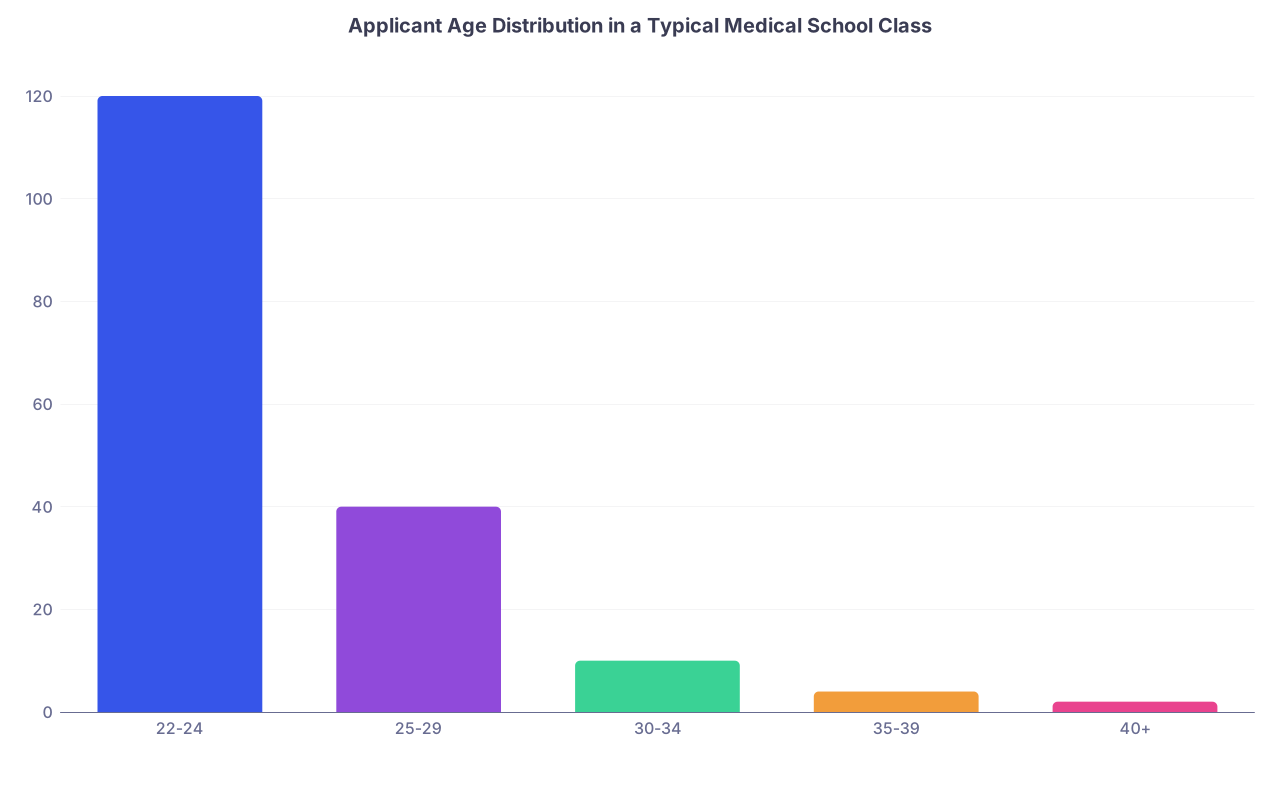
| Category | Value |
|---|---|
| 22-24 | 120 |
| 25-29 | 40 |
| 30-34 | 10 |
| 35-39 | 4 |
| 40+ | 2 |
At most MD schools, the 40+ crowd per class is 0–3 students. DO schools and certain state schools may be a bit more flexible, but the general pattern holds: you’re a statistical outlier from day one.
Admissions sees “40” and immediately lumps you into a different mental category: high-risk, potentially high-reward. Your job is to prove you’re the second part of that phrase, not the first.
The Three Stereotypes You’re Fighting Against
Here’s the part nobody tells you: committees have mental “archetypes” for older applicants. I’ve heard them used in ranking meetings, almost verbatim.
1. The Midlife Crisis Applicant
This is the nightmare stereotype that scares committees the most.
The file usually looks like this: solid career (often unrelated to clinical work), decent but not stellar prereq record, shadowing slapped together in 6–12 months, personal statement dripping with “I’ve always wanted to be a doctor” but no real paper trail before age 38 to support that claim.
The unspoken thought in the room:
“So you woke up at 39, hated your job, and now medicine is your reinvention project. Are you going to bail when it gets miserable?”
If your journey looks abrupt on paper—no meaningful clinical exposure 5–10 years ago, no gradual build—many reviewers will quietly vote “no” unless there’s something exceptional about your stats or background. They simply don’t trust that you’re in it for the long haul.
2. The “Rescue Me from My Life” Applicant
This version is more common than you’d like to believe. Messy CV, multiple careers, intermittent employment, vague “family reasons” gaps, and a narrative that sounds more like escape than pursuit.
When a file gives off “please let med school fix my life” energy, the committee recoils. They see future professionalism issues. Burnout. Attrition. They’ve been burned before.
I’ve heard comments like:
“We’re not a rehab for bad decisions.” “This person needs therapy, not an MD.”
Cruel? Yes. Real? Also yes.
3. The Adult Professional They Secretly Love
And now the opposite.
This is the 40‑year‑old who makes half the room lean forward and say, “If they can hack the academics, they’d be fantastic here.”
Patterns I’ve seen on those files:
- A coherent, successful prior career (nursing, engineering, military, finance, teaching, you name it) that shows progression and stability.
- A long-smoldering connection to medicine that’s documented: volunteer work, part-time EMT, clinical research assistant years ago, committee work in healthcare-related orgs.
- A personal statement that reads like, “I’ve tested every other path. This is not an impulsive pivot; it’s the only direction that still makes sense—and here’s the proof.”
When they believe you’re the third type, age becomes a feature, not a bug.
Your framing—on paper and in person—decides which bucket they put you in.
What They Scrutinize Way Harder Because You’re 40
You don’t get the benefit of the doubt. That’s the blunt truth. They’re less forgiving of sloppiness because “You’ve been an adult for 20 years.”
There are four parts of your application that suddenly matter more than they do for the 23‑year‑old.
1. Academic Recency and Rigor
If your last real science course was in 2007, committees start twitching.
Their questions:
- Can this person handle modern, fast-paced medical curricula?
- Are they going to fail physiology because they’re rusty?
- Are they prepared for Step 1/Step 2 style reasoning, not just cookbook undergrad exams?
I’ve sat in meetings where someone said, “On paper they’re smart, but their last science was 15 years ago. We can’t take that risk unless they show something recent.”
The older you are, the less your original undergrad GPA matters, and the more recent, rigorous performance matters. This is why post-bacc or fresh upper-level science work isn’t “optional” for you. It’s your proof of concept.
If you want the internal monologue to flip from “rusty risk” to “ready to grind,” you need A-level work in the last 2–3 years in courses like biochem, physiology, upper-level bio, maybe some stats.
2. MCAT as a Cognitive Stress Test
For a traditional applicant, a 510 is “pretty good.” For a 40‑year‑old, a 510 is often read as, “Ok, cognitively intact, can still learn at a high level.”
Nobody will write that, but I’ve heard the subtext: “If they’re 40 and can pull a 515, that reassures me they’ll survive Step.”
Your MCAT is no longer just a comparison score; it’s them checking your brain aging narrative against reality. Brutal, but that’s literally how it’s used.
If you’re older and you want to quiet the room, your target isn’t “good enough,” it’s “decisively competent.” That usually means:
- MD: Aiming 510+ at absolute minimum; 515+ makes people relax.
- DO: 505+ workable, higher is better, especially if GPA is older.
Weak MCAT + old age + old prerequisites = multiple quiet “no” votes in committee even if no one trashes you out loud.
3. Life Logistics and Stability
You know what 22‑year‑olds rarely get asked in interviews?
“How will you support your kids during 80‑hour clinical weeks?”
“What will you do if your spouse gets relocated?”
“How will you pay off this debt when you’re 50?”
Yet I’ve seen these questions—worded more politely—come up again and again for older applicants.
The committee is silently running a risk simulation:
- Two young kids + no partner support + med school across the country = high chance of problems.
- Stable partner with flexible job, strong family support, detailed childcare plan = much safer.
They don’t need you to have a perfect life. They do need to believe you’ve actually thought through the logistics like an adult. When it’s obvious you haven’t, reviewers get nervous.
4. Professionalism Trail
At 40, you’ve had bosses, subordinates, performance reviews, maybe HR issues.
They are very interested in:
- Why you left jobs.
- Whether your narrative of your career matches your letters.
- Any pattern of conflict, flakiness, sudden career changes without clear rationale.
Letters of recommendation from your professional life hit harder than yet another professor saying you got an A in orgo. If a former supervisor says, “This is the most reliable person I’ve ever worked with,” that carries more weight coming from a real-world context.
On the flip side, any whiff of drama in your background sends up a red flag much faster than it does for a clueless 21‑year‑old.
What They Secretly Like About 40‑Year‑Old Applicants
Here’s the part you can use to your advantage: in committee discussions, positive comments about older applicants are often stronger, more enthusiastic, and more decisive than for the average 23‑year‑old.
When a mature applicant is strong, they’re often very strong.
Things they love:
Classroom dynamic.
Faculty quietly appreciate having a few adults in the room. You ask sharper questions, you don’t melt down over every quiz, and you’re usually less entitled. I’ve heard, “They’ll raise the level of discussion in small groups” as a reason to accept a 38‑year‑old.
Professional habits.
Showing up early. Meeting deadlines. Communicating like someone who’s had real jobs. People underestimate how much committees crave this. They’re tired of students who email like it’s a text chat.
Patient relatability.
Older applicants often have a natural presence with patients—especially older patients. You’re not a kid in a white coat; you feel like a peer. That matters to schools that lean heavily on community medicine, primary care, or longitudinal clinics.
Interesting backstories.
The truth: your file is more fun to read when you’ve actually lived a life. The ex-EMT firefighter, the former teacher who worked with disabled kids, the software engineer who led global teams—those stories grab attention in a sea of “I volunteered at the hospital and did some research.”
If you can be competent and interesting at 40, you become a value add, not a charity admit.

What Makes Committees Say “Yes” to a 40‑Year‑Old
Let me be blunt: age alone does not kill you. Age + weak execution does.
When committees say yes to someone 40+, I see the same pattern over and over.
A Coherent, Long-Building Narrative
You don’t get to say, “I’ve always wanted to be a physician” if:
- You did zero clinical volunteering before age 38.
- You never once shadowed until last summer.
- Your prior life shows no proximity to healthcare, service, or sustained interest in the field.
For you, the believable story isn’t “always wanted it” but “kept circling back to it.”
The narrative that works:
“I started in X career, which taught me A, B, and C. Over the years, I kept getting pulled toward medicine through [specific experiences]. I tested that interest with [ongoing clinical roles, volunteering, shadowing]. When those experiences didn’t go away—and actually grew stronger—I committed fully, went back for prereqs, crushed them, took the MCAT, and here I am.”
They want to see evidence that this thread has run through your life for years, even if it was in the background. Not an overnight conversion.
Fresh, Strong Academics
I’ll say it again because this is where many older applicants die quietly in screening.
If you’re 40 with:
- A 3.1 from 2006,
- No science since then,
- A 503 MCAT,
- A few scattered A’s in community college classes from 3 years ago…
you’re asking them to take a leap of faith they just won’t take, especially at MD programs.
The older your foundation, the more aggressively you must re-prove yourself:
- Formal post-bacc with heavy science and near-straight A’s
- Or a DIY post-bacc with clear rigor (not just “easy A” classes)
- Or a strong SMP (special master’s program) with medical-school-adjacent curriculum
They are looking for data that you can sit in a dense, fast-paced medical lecture and not drown. If your file gives them that data, age fades as an objection.
A Serious, Grown-Up Plan for the Next 10–15 Years
They know your timeline: you’ll be 44–45 finishing med school, 47–50 finishing residency depending on length, maybe older for fellowship.
Here’s what reassures them in interviews and secondaries:
- You’ve thought clearly about specialty choice tradeoffs. (No, you don’t need to lock it in, but saying “I want to be a pediatric neurosurgeon” at 40 without any nuance will make people raise eyebrows.)
- You have a realistic financial plan: savings, spouse income, loan plan, repayment timeline.
- You can articulate how this career transition fits with your family responsibilities, not in a hand-wavy way, but concretely.
If you walk into an interview and it’s obvious you’ve hand-waved the next decade—“We’ll see what happens”—you lose points. Hard.
Humility Without Apology
This is subtle but huge.
The 40‑year‑olds who do best are the ones who can say, in effect:
“Yes, I’ll be older than most of my classmates. That doesn’t entitle me to anything. It just means I bring a different set of experiences. I’m ready to be a beginner again—and I know how to work hard, learn fast, and be a good teammate.”
What committees can’t stand is older applicants who radiate:
- “I was a senior manager, I shouldn’t have to…”
- “These kids are so immature…”
- Or the opposite: “I’m so behind, poor me, please feel bad for my debt at 50.”
They want quiet confidence and willingness to start at the bottom again. If they believe you’ll mesh with a cohort ten to fifteen years younger without constant friction, they stop worrying about age as a social problem.

Schools That Actually Mean It When They Say They Like Nontraditionals
Another unspoken truth: some schools will smile politely at your “nontraditional” status and then rank you at the bottom every time. Others genuinely like having a few older students each year.
Patterns I’ve seen:
- Many DO schools are more welcoming to 30s and 40s applicants, especially those with strong life experience and decent academics.
- State schools with strong missions to serve nontraditional populations or rural communities often value older applicants who’ve lived in those communities.
- Certain MD programs have a track record: you’ll see multiple 30+ students in each class photo, and sometimes one or two 40+. That’s not an accident.
You’re not imagining it if you feel more love from some schools than others. Adcom cultures vary. Some are rigidly prestige/metrics-focused. Others genuinely believe a mixed-age cohort is an asset.
The insider move? Build your school list with that reality in mind. Do not blindly apply to only hyper-elite programs that quietly prefer the “classic” trajectory unless your stats and narrative are absolutely undeniable.
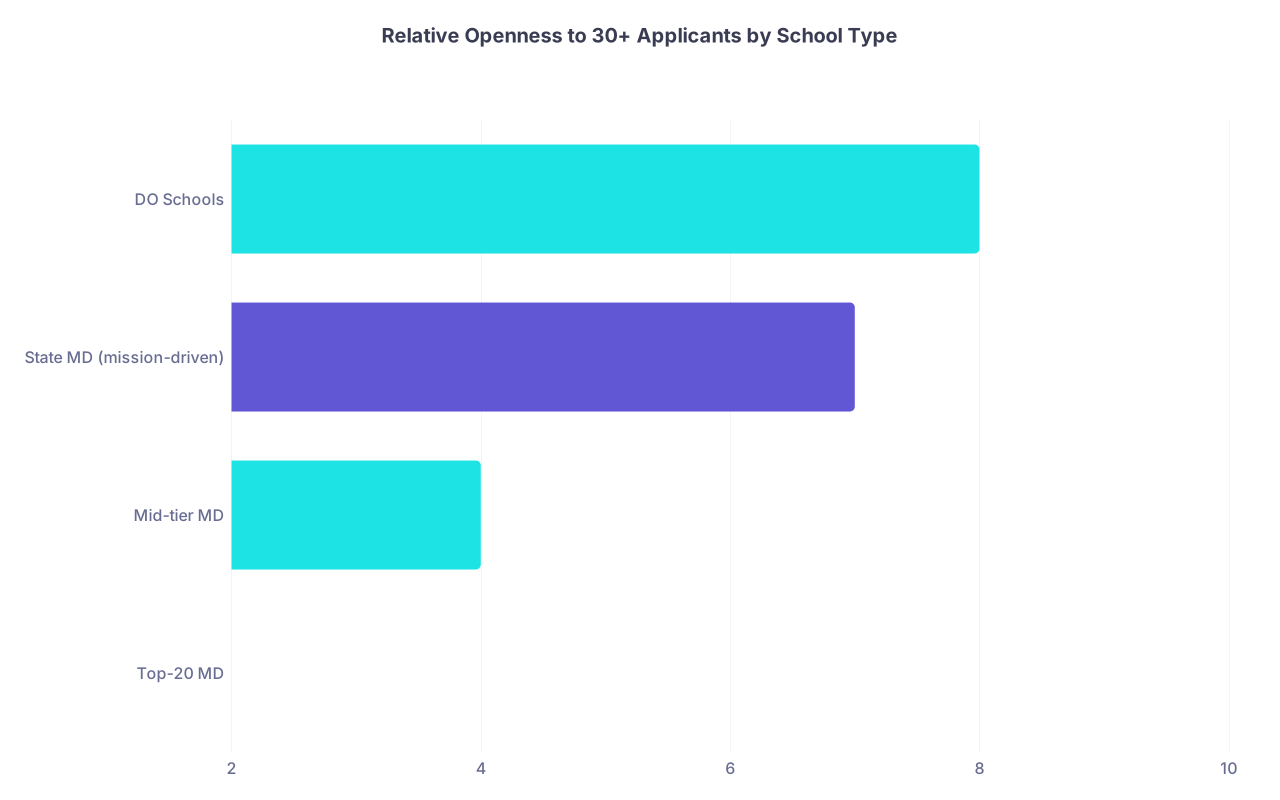
| Category | Value |
|---|---|
| Top-20 MD | 2 |
| Mid-tier MD | 4 |
| State MD (mission-driven) | 7 |
| DO Schools | 8 |
(Scale 1–10: 1 = strongly resistant, 10 = very welcoming. Not hard numbers, but a fair reflection of how discussions usually sound behind closed doors.)
How to Present Yourself So Committees Think “Asset,” Not “Liability”
Let me finish with what actually changes minds when your age makes them hesitate.
Own your age without making it the main character.
Don’t write an entire personal statement about “being 40.” Acknowledge your path, then move quickly to what you’ve done, what you’ve learned, and why medicine now.Show, don’t insist, that you understand medicine.
Hours of real clinical exposure, not just observation. Evidence that you’ve seen the ugly parts—death, bureaucracy, exhaustion—and still want in. Older applicants who’ve actually worked in hospitals or clinics have a massive edge.Make your prior career work for you.
Translate it. If you led teams, talk about communication under stress. If you did engineering, talk about systematic problem-solving. Don’t try to pretend your past doesn’t exist; tie it directly to how you’ll function as a physician.Eliminate avoidable sloppiness.
Late primary application, half-hearted secondaries, generic answers—these scream, “I don’t actually understand how competitive this is.” At 40, you need to look more prepared and more serious than the average 23‑year‑old, not less.Sound like someone they’d want to work with at 3 a.m.
That’s the real litmus test. The attending on the committee is asking: “If this person were my intern at 45, would I be glad or annoyed?” Everything you say and write should tilt that answer toward “glad.”
If you strip away the brochure language, admissions committees are asking three blunt questions about a 40‑year‑old applicant:
- Can you do the work now, at full speed, and pass our board exams?
- Will you actually make it through training, logistically and psychologically, or fall apart halfway?
- Are you bringing enough maturity, stability, and unique value that you’re worth the institutional risk?
You don’t need perfection to get a “yes.” You do need to stop pretending you’re just another applicant. You’re not. And if you build your application with that reality in mind, your age stops being an apology and starts becoming a weapon.