
The hardest part about coming back from service isn’t physics or organic chemistry. It’s swallowing your pride, starting over, and sitting in a classroom next to 19‑year‑olds who’ve never done anything real in their lives—and still performing like the grade depends on your future. Because it does.
If you’re returning from military or government service and thinking seriously about an MD path, you’re not “behind.” You’re just in a different race with different rules. Let’s walk through the situation like an operations plan: where you are, what you need, and how to execute.
Step 1: Get brutally clear on your starting point
Do not sign up for classes or an MCAT course yet. First, you need an honest audit of where you stand. Not vibes. Data.
Here’s what you pull together:
- All prior college transcripts (community college, 4‑year, online, all of it)
- Standardized test history if relevant (SAT/ACT, GRE, etc.)
- Your DD‑214 or equivalent separation paperwork
- A rough list of your roles and responsibilities during service (leadership, deployments, clearances, instruction/training roles)
- Any medical/research/technical experience (medic, corpsman, intel analyst, cyber, engineering, etc.)
Then you do three things:
Calculate your AMCAS-style GPA (or let a premed advisor do it). That means:
- Cumulative GPA
- BCPM (biology, chemistry, physics, math) GPA
If your GPA is below ~3.4 overall or BCPM is weak, you’re probably looking at a structured repair (post‑bacc or SMP). No, “but my service” doesn’t erase a 2.9.
Map your prerequisite coverage:
- 1 year gen chem with lab
- 1 year biology with lab
- 1 year physics with lab
- 1 year orgo with lab (or orgo + biochem depending on school)
- 1 semester biochem (for almost all MD schools now)
- Math and English/writing (varies, but you’ll need some)
Be real about your math/science rust. If the last time you saw a derivative was before your first deployment, pretend you know nothing. That humility will save you pain later.
Here’s what this audit might tell you:
- Scenario A: You had a solid STEM degree before service, GPA ~3.5+, most prereqs done, just old.
- Scenario B: You had weak grades or a non‑STEM degree before service and never took the hard sciences.
- Scenario C: You barely did college, enlisted right out of high school, and are starting almost from scratch.
Different starting point, different plan. We’ll hit each.
Step 2: Pick the right academic path for your exact situation
This is where a lot of veterans and former government folks go wrong. They treat course planning like a shotgun blast: random community college classes, online courses everywhere, then surprise when med schools shrug.
You pick a path based on two numbers:
- Current GPA
- How much hard science you already have
| Scenario | GPA Range | Science Background | Best Path |
|---|---|---|---|
| A | ≥ 3.5 | Strong STEM & prereqs | DIY or light formal post-bacc, MCAT focus |
| B | 3.0–3.4 | Mixed/weak science | Formal post-bacc or structured DIY, grade repair |
| C | < 3.0 or very old | Little/no science | Fresh structured post-bacc, maybe later SMP |
If you already have a solid STEM background (Scenario A)
You mostly need to:
- Update knowledge
- Show recent A‑level performance in sciences
- Crush the MCAT
Concrete moves:
- Take 2–4 upper‑division sciences at a 4‑year school: biochem, physiology, cell biology, genetics.
- Make sure you can handle 12–15 credits while working/with family. If you overload and tank, you dig a new hole.
- Use these recent grades as your “proof of concept” for med schools: “Yes, I’ve been out, but I can still perform at a high level.”
If your prior GPA is mediocre or your science base is shaky (Scenario B)
You do not “sprinkle in” a few classes and hope the 3.1 magically becomes a 3.7 in their minds. It won’t. You need a pattern of excellence after your weak period.
Two main options:
- Formal post‑bacc (career‑changer or academic enhancer programs, some with linkages)
- DIY post‑bacc at a 4‑year institution, carefully planned, heavy on sciences
You’re aiming for:
- 30–40+ credits of mostly upper‑level sciences
- GPA in this new work: ~3.7+ (preferably higher)
- Consistent A’s, especially in BCPM courses
This is where your service mindset helps. Treat each semester like a deployment: limited time, high stakes, no excuses, everyone depends on you (in this case, Future You).
If you’re almost starting from scratch (Scenario C)
Here’s your play:
Use your GI Bill (or equivalent) strategically: enroll in a degree program where you can:
- Fulfill all med school prereqs
- Build a strong upward trend
- Graduate with a major that interests you and gives backup options (e.g., biology, public health, engineering, or even something non‑science with heavy science electives)
First year back:
- Consider a math refresher (pre‑calc, calc I, statistics depending on your background)
- Build up discipline with 12–15 credits, not 20
- Prove to yourself and on paper that you can earn A’s
Second/third year:
- Core prereqs: bio, chem, physics, orgo, biochem
- Add some upper‑level sciences if you can handle it
You’re not “late.” You’re building a full new academic story. That takes time. Rushing it is how people end up with a second bad transcript.
Step 3: Use your benefits and structure like an adult, not a confused freshman
You have tools 20‑year‑olds don’t. Use them.
Common resources:
- Post‑9/11 GI Bill / Voc rehab (Veterans)
- Federal employee tuition assistance (if still working)
- Yellow Ribbon programs
- School‑level veteran services offices
- Pre‑health advising (sometimes separate from general advising)
You should:
Meet with the campus veteran services office before you enroll. Ask blunt questions:
- Which majors work best for premed here?
- Any faculty particularly veteran‑friendly?
- How does priority registration work?
- How have other vets done here aiming for med school?
Meet with the pre‑health advisor early. Not to be validated. To get constraints:
- Which med schools do most students here get into?
- How do they view community college credits?
- Any linkage or committee letter policies that affect your timeline?
And then you combine both: what med schools expect + what your benefits cover + your family/financial reality.
If you have dependents or a mortgage, you don’t pretend you’re a full‑time dorm student. You plan:
- Course load that maintains benefits but doesn’t destroy your GPA
- Part‑time work (VA, contractor, etc.) that doesn’t overlap with your heaviest weeks (like orgo midterm weeks)
- Realistic graduation / application timeline (often 3–5 years from “start over” to med school matriculation)
Step 4: Translate your service into premed currency (without sounding like a movie poster)
Here’s the uncomfortable truth: med schools do not automatically know what a squad leader, intel analyst, or case officer actually did. If you just list titles, most of it flies right over their heads.
Your job is to convert your service into experiences and competencies they recognize:
- Leadership with lives and outcomes at stake
- Teaching and mentorship
- Rapid adaptation under stress
- Work with diverse or underserved populations
- Exposure to healthcare systems (if you had it)
On your application and in interviews, you do not:
- Give war stories for shock value
- Center the trauma
- Sound like you think your service makes you “more deserving” than anyone else
You do:
- Use concrete examples. “Led a 10‑person team on X missions; responsible for planning, safety, and execution.”
- Show growth. “Initially struggled with X, learned Y, now apply that to Z.”
- Connect dots to medicine. “The first time I saw inadequate follow‑up care for [population], I realized prevention and continuity matter just as much as acute care.”
You already know how to brief an O‑6 or SES: bottom line up front, clear, professional, no drama. That tone works extremely well with admissions committees.
Step 5: Fill the “premed boxes” efficiently (while still living your life)
There are some non‑negotiables for MD applicants:
- Clinical exposure
- Shadowing
- Service/volunteering
- Some combination of leadership / teamwork / communication
You likely already have leadership and teamwork in spades. What you may lack is domestic clinical exposure in the context admissions committees recognize.
Here’s how to get what you need without burning out.
Clinical experience
You need direct patient exposure. Hospitals, clinics, hospice, EMT, scribe, etc.
Target: 150–500+ hours over a couple of years, preferably longitudinal (not just one 3‑month spurt).
If you were a medic/corpsman/military nurse:
- Yes, your experience counts. But you still want some civilian clinical time to show you understand U.S. healthcare systems and peacetime care.
- Get letters from supervising clinicians who can speak to:
- How you interact with patients
- Clinical judgment and humility
- Team function in a non‑military hierarchy
If you weren’t clinical in service:
- Entry roles that work well:
- Medical assistant (some clinics will train)
- ED tech / patient care tech
- Hospital volunteer with patient contact
- Medical scribe
- Don’t chase 6 different roles. Pick 1–2 and commit.
Shadowing
You’re aiming for:
- 40–100 hours total
- Mix of primary care and at least one other specialty
- Spread over time, not a single week of 80 hours
Use veteran networks:
- Ask your VA providers if they know any physicians open to shadowing (permission required).
- Leverage alumni networks: “I’m a veteran returning to school to pursue medicine. Would Dr. X be open to letting me observe a clinic day?” You’d be surprised how many say yes.
Volunteering and community work
You’ve probably done service on a macro scale. Admissions still want to see patient‑facing or people‑facing service in your current life.
Examples that make sense for former service members:
- Working with veterans’ groups (PTSD support, re‑integration, homelessness)
- Tutoring underserved students in STEM
- Homeless outreach, free clinics, food banks
Do not overthink this. Better: 2 years at 3 hours/week with one organization than 15 random one‑offs.
Step 6: MCAT as a mid‑career professional, not a stressed sophomore
Your MCAT score will either prove your academic readiness or raise questions about it—especially if your undergrad record is mixed.
You approach MCAT prep like a training cycle:
- Phase 1: Content review (2–3 months if you’ve taken prereqs recently, 4–6 months if rusty)
- Phase 2: Heavy practice + full‑length exams (2–3 months)
- Phase 3: Fine‑tuning weak areas, test‑day simulation, logistics (1 month)
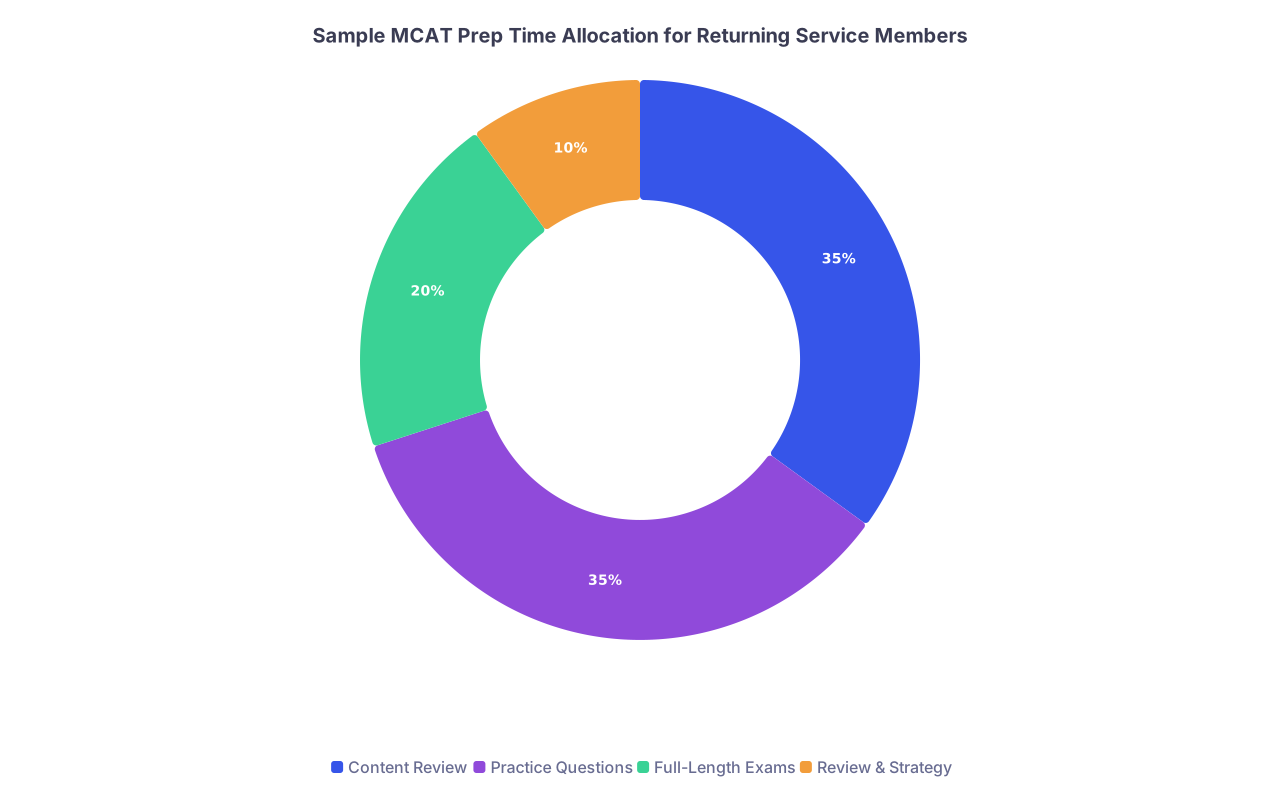
| Category | Value |
|---|---|
| Content Review | 35 |
| Practice Questions | 35 |
| Full-Length Exams | 20 |
| Review & Strategy | 10 |
What you do differently from the 20‑year‑old crowd:
- You schedule around real responsibilities:
- For example: 2 hours early morning, 1–2 hours late evening, longer blocks on weekends
- You protect those hours like mission time. No phone, no email, no “just one quick thing.”
- You use your discipline for consistency, not for punishment. Studying until 2am while working full‑time and taking orgo is how you fry your brain and score poorly.
Target score? Depends on your GPA and school list. Rough guide:
- Strong GPA (3.6+): aim 510–515+ to be solid for a broad range of MD programs
- Lower GPA but strong recent trend: the higher the better; 515+ starts to counterbalance old academic baggage
You take the MCAT once if at all possible. Retakes are expensive—in money and in time.
Step 7: Build a story and timeline that actually makes sense
Here’s where people try to rush because they feel old. They apply before they’re competitive, get slapped with rejections, and then dig out from that for years.
Let me say it clearly:
Being 30, 35, or even 40 at matriculation is not the problem. Being underprepared is.
A common solid timeline for someone leaving service:
Year 0: Still in service / just separating
- Audit transcripts, meet advisors
- Start or continue college courses strategically
- Light volunteering/clinical if possible
Years 1–2: Back in school
- Crush prereqs or post‑bacc with A’s
- Build clinical and volunteering longitudinally
- Begin light MCAT prep toward end of this window
Year 3: MCAT + application year
- Take MCAT early in the year (Jan–April)
- Submit primaries early (June)
- Secondaries + interviews as they come
- Continue clinical/volunteer work throughout
Year 4: Matriculation (if accepted)
- Or re‑apply with strengthened app if needed
You may compress this by a year if you already have most prereqs and just need MCAT + a bit of recent coursework. You may extend it if family/work obligations are heavy. That’s fine. The only wrong move is slamming everything into 12 months and hoping.
To keep the big picture straight, it helps to literally map your phases.
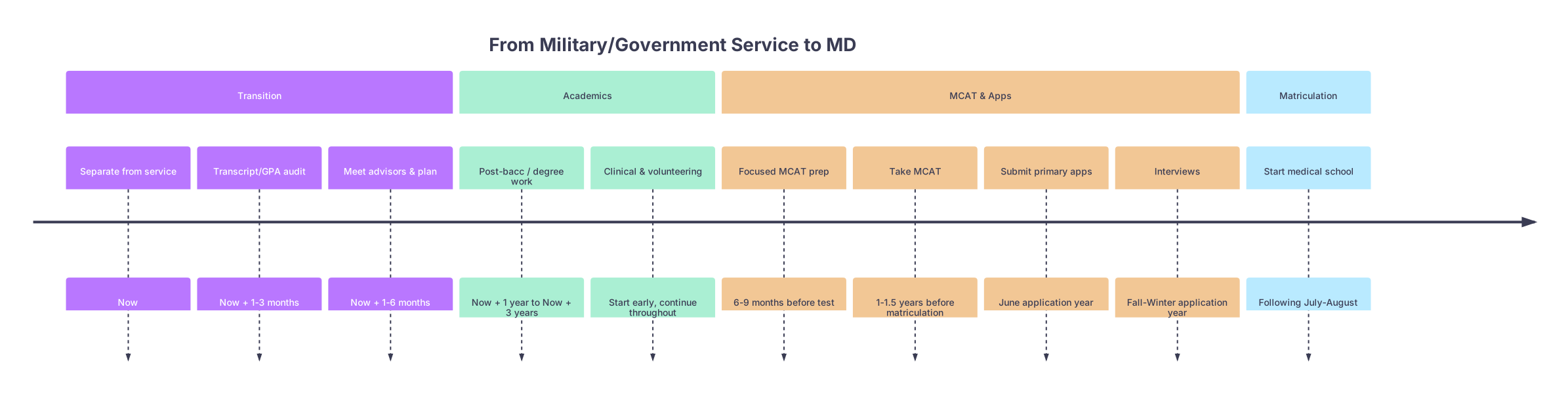
| Period | Event |
|---|---|
| Transition - Separate from service | Now |
| Transition - Transcript/GPA audit | Now + 1-3 months |
| Transition - Meet advisors & plan | Now + 1-6 months |
| Academics - Post-bacc / degree work | Now + 1 year to Now + 3 years |
| Academics - Clinical & volunteering | Start early, continue throughout |
| MCAT & Apps - Focused MCAT prep | 6-9 months before test |
| MCAT & Apps - Take MCAT | 1-1.5 years before matriculation |
| MCAT & Apps - Submit primary apps | June application year |
| MCAT & Apps - Interviews | Fall-Winter application year |
| Matriculation - Start medical school | Following July-August |
Step 8: Handle the mental shift from service culture to premed culture
This part gets ignored, but I’ve seen it sink good candidates.
You are moving from:
- Clear structure and rank
- Team achievements
- Direct impact, often urgent and concrete
Into:
- Ambiguous expectations
- Individual competition
- Delayed gratification
Common traps:
- Resentment of classmates who “haven’t done anything yet”
- Impatience with academic bureaucracy
- Over‑sharing service stories in class or essays
- Underestimating how much you need to learn how to be a student again
Concrete ways to handle it:
- Find other non‑trads or veterans on campus. Peer support matters.
- Keep some identity anchors outside of “premed”: family, hobbies, veteran community.
- If you have PTSD, TBI, depression, or anxiety from service, get treatment. Quiet suffering doesn’t impress adcoms; functional stability does.
Your experience can be a massive asset—maturity, resilience, communication—if you’ve actually processed it. If you haven’t, med school will rip those wounds open at the worst possible time.
Step 9: Letters of recommendation and how to leverage your past life
You need letters from:
- Science faculty who’ve taught you recently
- Possibly non‑science faculty
- Supervisors from service or current work (optional but often powerful)
- Clinicians if they know you well enough to say something meaningful
Tips:
- Do not rely only on old professors from 8 years ago. Their letters scream “no recent data.”
- When you approach a letter writer, don’t just say “Can you write me a letter?” Ask: “Can you write me a strong, detailed letter for medical school?”
- Give them:
- Your CV/resume
- Short personal statement draft or bullet points
- Transcript (if it helps)
- Specific examples of times you worked with them (reminds them what to mention)
Your CO saying you were the best NCO in the brigade helps only if they can connect that to traits relevant to medicine: judgment under pressure, ethical standards, teachability, communication with diverse teams.
Step 10: Where your service actually does give you an edge
Some people will tell you “med schools love veterans.” That’s half true. Here’s the real version:
Your service helps you when:
- You already look academically capable (recent strong grades + solid MCAT)
- You can articulate how those experiences shaped your motivation for medicine
- You show you can function in civilian collaborative environments without pulling rank
Your service does not magically erase:
- A string of F’s and D’s you never recovered from
- A 495 MCAT you “didn’t have time” to study for
- A complete lack of clinical exposure
But if you do the work to fix those, then yes, being a veteran or former government professional can push you over the line at many schools. Not as charity. As value added to their class.
If you remember nothing else
Fix the fundamentals first. Strong recent science grades and a competitive MCAT are non‑negotiable, no matter how impressive your service record is.
Plan like an operation, not a sprint. Map out a 3–5 year arc: coursework, clinical work, MCAT, application. Rushing because you “feel old” is how people blow their shot.
Translate, don’t perform. Take your real experiences—leadership, hardship, responsibility—and convert them into clear, grounded stories that show why you’ll be a serious, stable, teachable physician.
You’ve already done harder things than this. Now you just have to prove it on paper, in a classroom, and across a few long exam days.