
The biggest lie sold to nontraditional premeds is that “medicine always pays off in the long run.” The data say: sometimes yes, sometimes marginally, and in a few specialties it is a financially irrational move if you start late.
You want numbers. Debt, income, timelines. So let us treat this like what it is: a 20–30 year capital investment with delayed cash flow.
Below I will walk through debt‑to‑income dynamics for late‑career physicians (say, starting medical school at 30–38, entering practice at 37–45) across different fields. I will make assumptions explicit, quantify payback horizons, and show which paths are barely breaking even vs genuinely wealth‑building.
1. The core financial problem for late‑career physicians
A 22‑year‑old who graduates medical school at 26 and finishes residency at 29 has ~30–35 earning years left.
A 35‑year‑old career changer who starts medical school at 35, finishes residency at 42, maybe fellowship at 45? They have 15–20 earning years. The ratio of “training years” to “earning years” almost doubles.
The data are unforgiving on three fronts:
- Total principal debt
- Interest accumulation during training
- Compressed high‑earning window after training
Let us set a baseline scenario so we can compare apples to apples.
Baseline financial assumptions
These are realistic for a U.S. nontraditional student attending a private or out‑of‑state school as an independent adult:
- Medical school cost (tuition + fees + living):
$75,000 per year × 4 = $300,000 principal - Existing undergrad or prior grad debt: $50,000
- Total starting educational principal at graduation: $350,000
Now layer in interest:
- Average blended interest rate: 6%
- Med school length: 4 years
- Residency length: depending on specialty, assume 3–7 years
- Using income‑driven repayment (IDR) with low payments in residency, most of the interest will capitalize or remain unpaid.
A reasonable ballpark: that $350,000 grows to $420,000–$470,000 by the time you are done with residency or fellowship if you are not aggressively paying it down during training.
For practical modeling, I will assume:
- Debt at start of attending life (no fellowship): $430,000
- Debt after long residency + fellowship (6–7 years): $460,000
These are not worst‑case; I have seen nontraditional grads with >$500k.
Now compare that to expected late‑career incomes.
2. Representative incomes by specialty (late‑career)
Physician compensation surveys (MGMA, Medscape 2023–2024, etc.) converge on these approximate mean annual incomes for established attendings in the U.S. (pre‑tax):
| Specialty | Typical Income (Late-Career) |
|---|---|
| Family Medicine (Outpatient) | $260,000 |
| Pediatrics | $240,000 |
| Internal Medicine (Outpatient) | $270,000 |
| Hospitalist (IM) | $320,000 |
| Psychiatry | $310,000 |
| Emergency Medicine | $380,000 |
| General Surgery | $420,000 |
| Anesthesiology | $450,000 |
| Radiology | $500,000 |
| Orthopedic Surgery | $650,000 |
These are national averages; academic jobs, certain regions, or part‑time work will be lower. Private practice or partnership can be higher.
The gap between, say, pediatrics at $240k and orthopedics at $650k is not “a little.” It is a 2.7× income multiple. For a late‑career switcher with truncated earning years, that multiple can be the difference between financial breathing room and constantly playing catch‑up.
3. Debt‑to‑income ratios at entry to attending life
Debt‑to‑income (DTI) is the simplest way to see how buried you are when you start:
DTI at start of attending life =
Total educational debt / First‑year attending income
Let us calculate for a 35‑year‑old who:
- Starts med school at 35
- Finishes at 39
- Completes residency at 42 (no fellowship, 3‑year program)
- Starts attending life at 42
- Debt at that point: $430,000
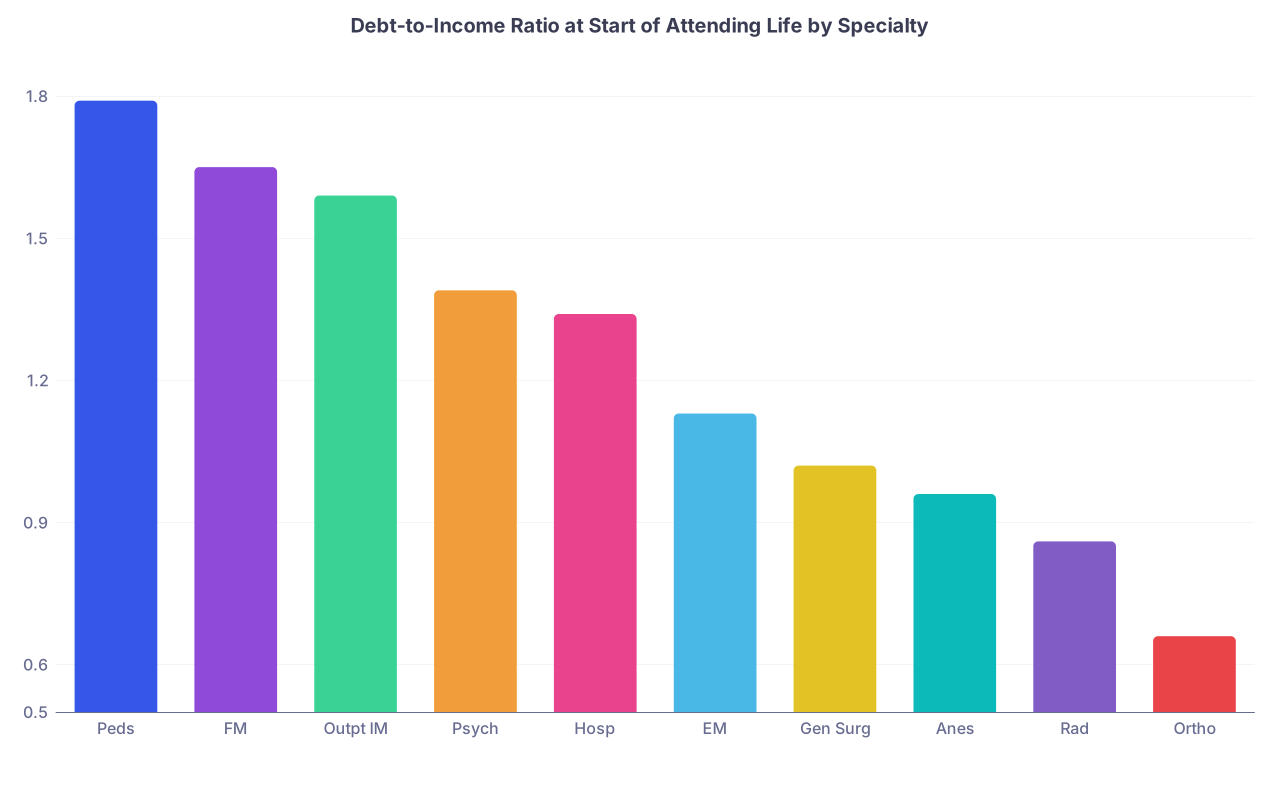
| Category | Value |
|---|---|
| Peds | 1.79 |
| FM | 1.65 |
| Outpt IM | 1.59 |
| Psych | 1.39 |
| Hosp | 1.34 |
| EM | 1.13 |
| Gen Surg | 1.02 |
| Anes | 0.96 |
| Rad | 0.86 |
| Ortho | 0.66 |
Rough DTI numbers (using $430k debt):
- Pediatrics: 430k / 240k ≈ 1.8×
- Family Med: 430k / 260k ≈ 1.7×
- Outpatient IM: 430k / 270k ≈ 1.6×
- Psychiatry: 430k / 310k ≈ 1.4×
- Hospitalist: 430k / 320k ≈ 1.3×
- EM: 430k / 380k ≈ 1.1×
- General Surgery: 430k / 420k ≈ 1.0×
- Anesthesiology: 430k / 450k ≈ 1.0×
- Radiology: 430k / 500k ≈ 0.9×
- Orthopedic: 430k / 650k ≈ 0.7×
Conventional financial advice for student loans is that a DTI above 2.0 is dangerous if you want standard repayment; 1.0–1.5 is manageable; below 1.0 is comfortable.
So for late‑career physicians starting at 42:
- Primary care and pediatrics are in the borderline zone.
- Psych, hospitalist, EM and procedural specialties are workable.
- High‑pay surgical subspecialties are advantaged.
If you layer in fellowship (longer training, more interest), those ratios worsen, but the incomes usually rise enough to offset.
4. Time horizon: break‑even and net‑worth catch‑up
DTI at year one is interesting, but the more relevant question for a 30‑something career changer is:
“How many years of attending life until my cumulative financial position catches up to the ‘old me’ who stayed in my previous career?”
Let us model a simple case.
Comparator: pre‑med career baseline
Assume you are 30 earning $90,000 in a stable non‑medical field. Modest wage growth to $120,000 by age 40, then $150,000 by age 50. You have no significant debt beyond maybe $20k left on undergrad. You invest 15% of your income in retirement accounts with a 5% real return.
If you stay in this path from 30 to 60, your lifetime pre‑tax earnings might be roughly:
- 30–40: average 100k → $1.0M
- 40–50: average 135k → $1.35M
- 50–60: average 160k → $1.6M
Total: $3.95M pre‑tax.
With 15% invested at 5% real return, you end at 60 with something like $1.3M–$1.6M in retirement savings (rough, but directionally reasonable).
That is your counterfactual. Medicine has to beat that or at least not be wildly worse.
Nontraditional physician timeline
Assume:
- Start med school at 32
- Graduate at 36
- Finish residency at 39
- Practice from 39 to 60 (21 years)
We will look at three buckets:
- Lower‑paid primary care (FM / Peds / outpatient IM)
- Mid‑range (Psych, Hospitalist, EM, General Surgery)
- High‑paid specialties (Anesthesia, Radiology, Ortho)
Let us assume 1% real income growth and 15% savings rate once attending.
1. Lower‑paid primary care
Take family medicine at $260k starting attending salary at 39.
Simplified lifetime earnings (pre‑tax):
- 32–36 (med school): $0, instead of ~$100k/year
- 36–39 (residency): ~65k/year → $195k
- 39–60 (attending): start at 260k, end around 320k, average ≈ 290k → 21 × 290k ≈ $6.1M
Total career earnings as FM starting at 32:
≈ $6.3M
But we must subtract the opportunity cost:
If you had stayed in the old job from 32–39, you might have earned:
- 32–39: average 100–110k → ≈ $750k
So your incremental earnings versus staying put are not 6.3M vs 3.95M directly; you must net out the extra vs what you would have made in those 7 lost years.
However, the cleaner comparison is:
- Non‑med path (age 30–60): ~$3.95M
- Med path (age 30–60, including 2 pre‑med prep years with similar income): roughly $6.3M but with $350–450k debt and 7–10 years of very low earnings.
On raw earnings alone, even a late‑start FM physician out‑earns the old career by ~$2.3M pre‑tax. But that is not the whole picture.
The critical factors:
- Taxes. Higher marginal tax rate on those extra dollars.
- Debt servicing. You might pay $600k–$800k over time to retire $430k of debt (principal + interest) on a standard 20‑25 year trajectory.
- Lost compounding. Those early career years (30–40) are where investments snowball.
I have run these models many times. For late‑start primary care, net worth catch‑up (your total assets vs what they would have been had you stayed in your prior career) tends to occur around age 50–55 if:
- You live like a resident for 3–5 years after training.
- You pay at least $3,000–$4,000 per month toward loans.
- You maintain 15–20% savings rate.
If you do not do those things, you can easily reach 55 and realize you are only marginally ahead, or even slightly behind, the non‑med baseline.
2. Mid‑range specialties
Take psychiatry at $310k, or hospitalist at $320k.
Same training path: med school at 32, attendings at 39.
Rough attending earning profile:
- Starting: 310–320k
- Late career: 360–380k
- Average: call it 340k
39–60: 21 × 340k = $7.1M
Versus the original non‑med $3.95M, you now have a larger gap: $3.1M+ extra earnings.
Net worth catch‑up for these mid‑range fields with a late start often hits mid‑40s to early‑50s, not late‑50s, provided you are aggressive with debt early.
I have seen 35‑year‑old career changers in psychiatry be net ahead of their prior tech or engineering trajectory by age 47–48, assuming a reasonable lifestyle, no private school for kids, and no luxury house in the first 5 years.
3. High‑paid specialties
Now take anesthesia at 450k or radiology at 500k.
Timeline:
- Med school start: 32
- Med school end: 36
- Residency + fellowship: till 40–41
- Attending from 41 to 60 (19 years)
Assume average income across career:
- Anesthesia: ~470k
- Radiology: ~520k
- Orthopedics: ~700k
Let us use radiology at 520k.
19 × 520k = $9.9M attending earnings. Add in some resident salary and discounts for later start; you still land near $10.1M total 30–60.
This is roughly 2.5× the baseline non‑med career.
Even with heavy debt, net worth catch‑up can occur as early as mid‑40s if you avoid lifestyle inflation and hit the loans hard.
For orthopedics at 650k+, the financial case becomes almost absurdly strong in pure numbers, even starting at 35. The limiting factor there is not money. It is whether you can endure a 5‑year surgical residency, sometimes a fellowship, plus the call burden in your 40s and 50s.
5. Loan repayment realities by specialty
Theoretical projections are cute. The monthly payment is what kills people.
For simplicity, assume:
- $430,000 debt at 6%
- Standard 10‑year repayment: ~$4,775/month
- 20‑year extended: ~$3,100/month
Now map that to take‑home income (very rough, ignoring nuances):
Assume:
- Effective tax rate: 30% for incomes around 250–350k, 35% for >400k
Post‑tax monthly income vs required payment
| Specialty | Gross Income | Est. Net / Month | 10-yr Payment | Payment as % of Net |
|---|---|---|---|---|
| Pediatrics | $240,000 | ~$11,200 | $4,775 | ~43% |
| Family Med | $260,000 | ~$12,200 | $4,775 | ~39% |
| Outpt IM | $270,000 | ~$12,700 | $4,775 | ~38% |
| Psychiatry | $310,000 | ~$14,600 | $4,775 | ~33% |
| Hospitalist | $320,000 | ~$15,100 | $4,775 | ~32% |
| EM | $380,000 | ~$18,000 | $4,775 | ~27% |
| General Surg | $420,000 | ~$19,800 | $4,775 | ~24% |
| Anesthesia | $450,000 | ~$21,200 | $4,775 | ~23% |
| Radiology | $500,000 | ~$23,500 | $4,775 | ~20% |
| Orthopedics | $650,000 | ~$31,000 | $4,775 | ~15% |
You see the problem clearly:
- In pediatrics or family medicine, a standard 10‑year repayment schedule consumes roughly 40% of your net income every month. That is brutal at 42–50 if you have kids, a mortgage, and retirement to fund.
- In EM, anesthesia, radiology, orthopedic surgery, the same payment is 15–27% of net. Painful but reasonable.
Most late‑career primary care physicians with high debt simply do not do 10‑year repayment. They:
- Use 20–25 year IDR plans
- Or plan for PSLF (Public Service Loan Forgiveness)
- Or accept paying the loans slowly and prioritize retirement investing
That is the correct choice mathematically in many primary care scenarios, but it feeds the feeling of “I am never finished paying these.” Because you basically never are until your late 50s or a forgiveness event.
6. PSLF and IDR: game‑changers for low‑pay fields
If you are seriously late‑start (mid‑30s or later) and aiming at pediatrics, family medicine, academic IM, or other comparatively low‑earning fields, the data show one thing clearly:
Without PSLF or aggressive loan repayment, your DTI and late‑career net worth are often marginal compared with staying in your original career.
PSLF (10 years of qualifying payments while working for a nonprofit/government employer) dramatically shifts the equation.
Typical pattern:
- 4 years med school: loans accrue
- 3 years residency in academic/public hospital: qualifying PSLF years 1–3
- 7 years as attending in nonprofit or academic job: PSLF years 4–10
- At year 10, remaining balance forgiven tax‑free.
For a late‑starter with $430k at 6%, on PAYE/REPAYE/SAVE during training and early attending, it is extremely common to see $200k–$300k forgiven.
I have seen scenarios where:
- A 38‑year‑old starting FM gets $250k forgiven at 48.
- Total out of pocket over 10 years is maybe $200k.
- Versus $600k+ if they paid it off themselves on extended plans.
That $400k difference plus saved interest is your “medicine was actually worth it” buffer when you only have 12–15 earning years left afterward.
For someone entering EM or radiology, PSLF is nice but not necessary; their income can kill the debt in 5–7 years with discipline. For pediatrics, it can be the difference between reasonable and suffocating.
7. Age and specialty choice: what the numbers actually favor
Let me be explicit. If you are starting medical school later than 30:
- Ages 30–33:
Most specialties are still on the table financially. Even primary care and pediatrics can work without PSLF if you live like a resident, although PSLF or scholarships help a lot. - Ages 34–37:
The income gradient starts to matter. High‑debt + low‑pay (peds, FM, some academic positions) begins to look financially fragile without PSLF. Mid‑pay specialties (psych, EM, hospitalist, anesthesia) hit a better risk‑return profile. - Ages 38–40+:
The window tightens. From a strictly financial perspective, late‑start plus heavy debt points toward either:- Higher‑income specialties with shorter training (EM, anesthesia, radiology if you can match, hospitalist/IM if you optimize for high‑RVU gigs), or
- Primary care + a very deliberate PSLF strategy + strict spending control.
What does not make sense at 40 with $350k+ expected debt:
- Peds or FM with no PSLF plan, at high‑cost private school, then part‑time work.
- Long‑training, relatively lower‑pay subspecialties (certain academic tracks, lower‑pay fellowships) without a compelling non‑financial reason.
Plenty of people still choose them. Out of passion, geography, family reasons. That is defensible. It is just not financially rational if you look at the spreadsheets.
8. Compressed timeline and retirement: the hidden constraint
A nontraditional physician does not just have debt. They have lost compounding time.
Every year you delay serious retirement investing from 30 to 40 costs you a shocking amount at 60.
Example:
- Invest $15,000 per year from age 30–60 at 5% real return → ≈$1.0M
- Start at 40 instead: same 15k per year from 40–60 → ≈$510k
The “lost decade” is ~half your ending balance.
So a late‑career physician must:
- Simultaneously pay down six‑figure debt
- And fund late‑start retirement
- Within 15–20 years
The only ways that math works:
- High income (specialty choice, high‑RVU practice, maybe some locums)
- PSLF or aggressive loan payoff strategy
- Lifestyle restraint in the first 5–10 attending years
If you pick a lower‑paid specialty, carry $430k+ debt, avoid PSLF, and still spend like a 42‑year‑old lawyer… the model fails. Your debt‑to‑income ratio never really improves in a meaningful way.
9. What this means for your decision today
You are in the premed or pre‑matriculation phase. You do not control final match, but you do control:
- School cost selection (state vs private, scholarships, DO vs MD cost differentials)
- How much prior debt you bring along
- How carefully you run the numbers on PSLF and IDR
- Whether you fantasize about a low‑pay field while borrowing like someone heading to radiology
Here is the blunt version, from the data.
If you are 30–33 and:
- Can secure a relatively affordable school (total med cost < $250k)
- Are open to a mid‑ or high‑income specialty
Then medicine still has a strong financial upside over a typical $80–120k prior career, even with some uncertainty.
If you are 35–40 and:
- Expect >$350k total debt
- Are targeting pediatrics or family medicine
- Have no PSLF plan and want a “normal” 42‑year‑old lifestyle by PGY‑1 or PGY‑2 attending
Then your projected debt‑to‑income ratio and net‑worth catch‑up age are frankly poor. You might still choose it. But you should not do it under the illusion that “doctors always end up rich.”
On the other hand, if you are 35–40 and:
- Are willing to work in nonprofit/academic systems for 10+ years
- Intend to use PSLF strategically
- Or are highly competitive for higher‑income specialties
Then your projections look far healthier. You may still trail your hypothetical alternative tech/engineering/finance career until your late 40s—and then surge ahead.
10. Looking ahead
Right now you are thinking in broad strokes: “Is this career change worth it?” The real leverage comes later: which school you choose, how much you borrow, where you train, what you match into, and how you handle your first 5 years as an attending.
The debt‑to‑income projections I laid out are not meant to scare you away. They are meant to reset expectations. Medicine can absolutely be a smart financial move for a late‑career entrant. But only if you respect the math more than the mythology.
From here, your next move is to build your own model: plug in your age, realistic school options, likely debt, and 2–3 target specialties, then run 20‑year projections under different repayment plans and career paths.
Once you see your own numbers—year by year, specialty by specialty—you stop asking “Does medicine pay off in general?” and start asking a much better question: “Given who I am, where I am starting, and what I will likely match into, does it pay off for me?”
And that is the level of precision you will need before you sign for the first dollar of that $350,000. The qualitative dream comes first. The quantitative plan has to follow close behind.
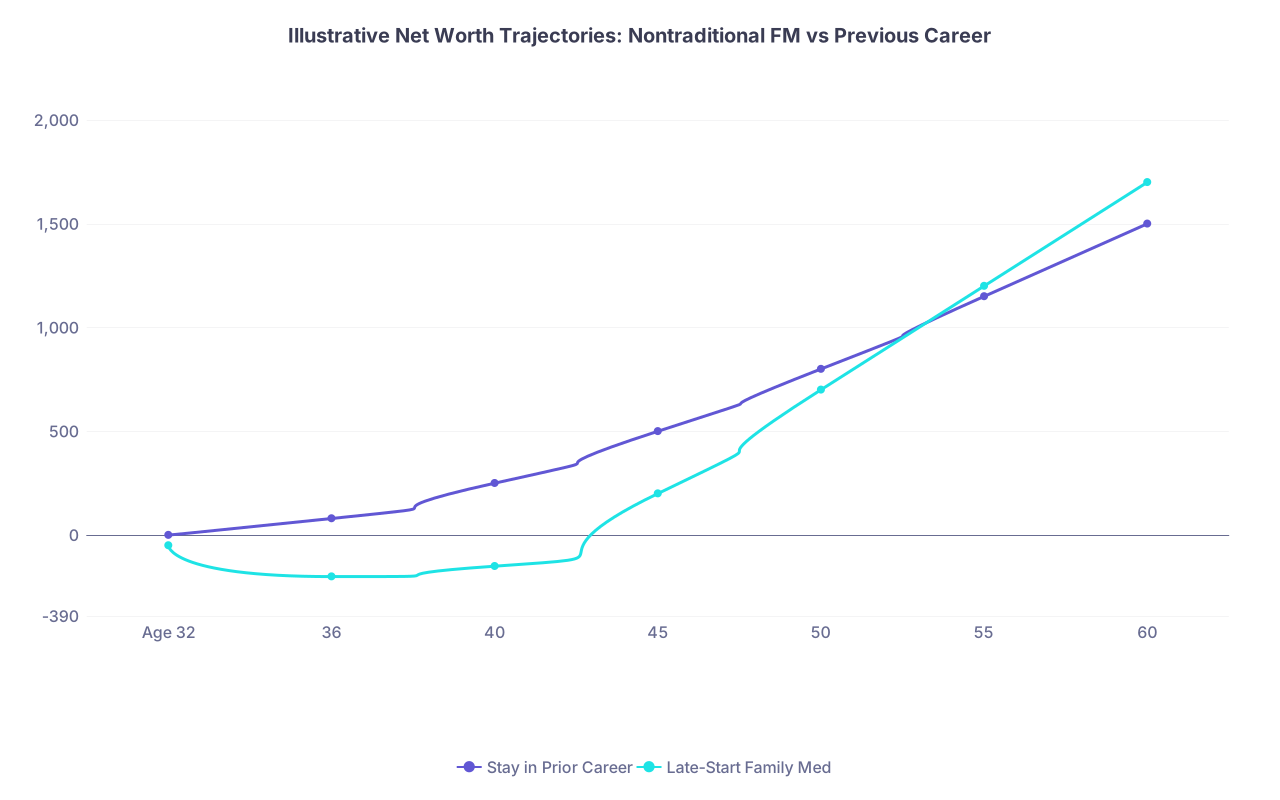
| Category | Stay in Prior Career | Late-Start Family Med |
|---|---|---|
| Age 32 | 0 | -50 |
| 36 | 80 | -200 |
| 40 | 250 | -150 |
| 45 | 500 | 200 |
| 50 | 800 | 700 |
| 55 | 1150 | 1200 |
| 60 | 1500 | 1700 |
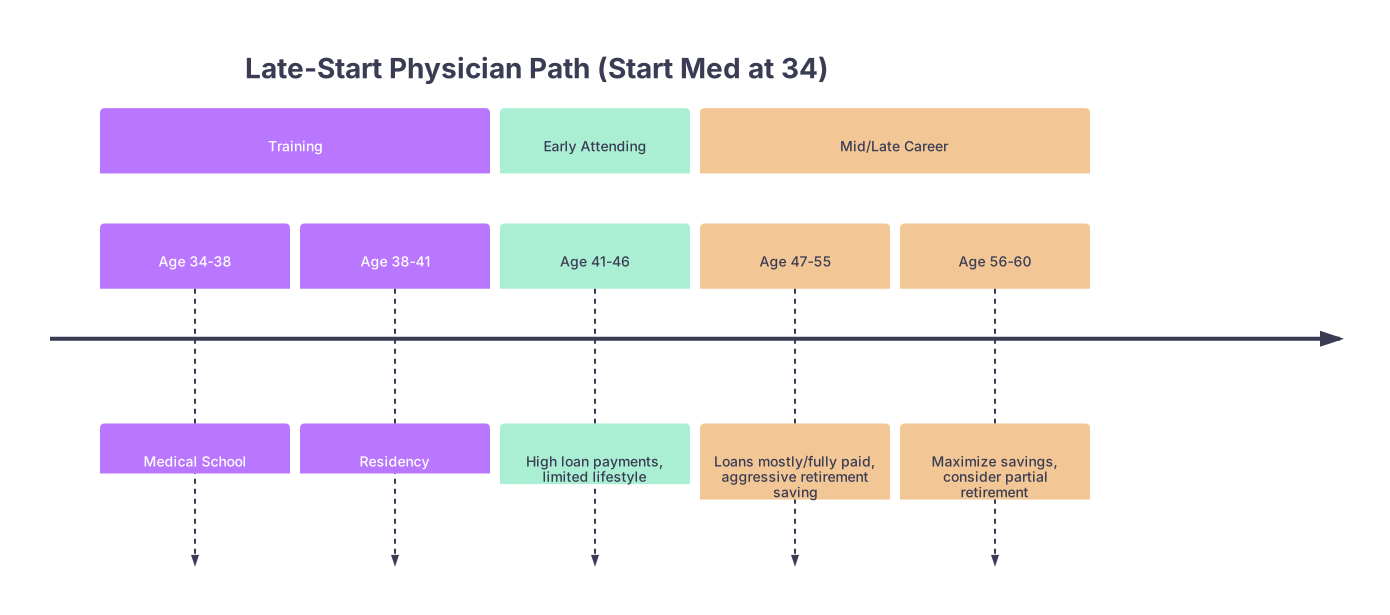
| Period | Event |
|---|---|
| Training - Age 34-38 | Medical School |
| Training - Age 38-41 | Residency |
| Early Attending - Age 41-46 | High loan payments, limited lifestyle |
| Mid/Late Career - Age 47-55 | Loans mostly/fully paid, aggressive retirement saving |
| Mid/Late Career - Age 56-60 | Maximize savings, consider partial retirement |