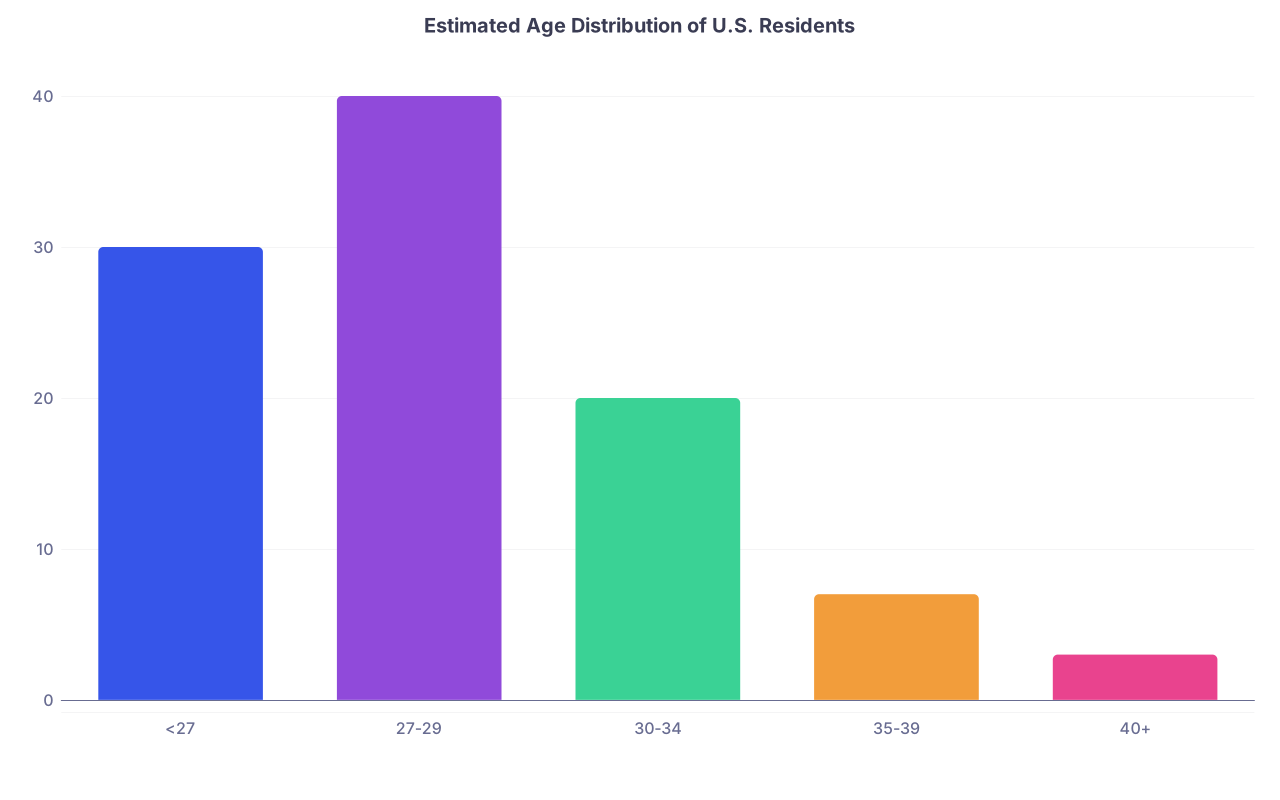
| Category | Value |
|---|---|
| <27 | 30 |
| 27-29 | 40 |
| 30-34 | 20 |
| 35-39 | 7 |
| 40+ | 3 |
Residency programs are not full of 25‑year‑olds. That has never been true. The data show a wide age spread—and older trainees systematically cluster in certain specialties, program types, and geographic regions.
If you are a non‑traditional applicant trying to predict where you will “fit,” you should not rely on vibes or Reddit threads. You should think in distributions, not anecdotes.
Let’s map where older residents actually end up, what ages “count” as non‑traditional in practice, and how that should shape your choices long before ERAS.
1. The Real Age Math: When Are Residents Actually Training?
Start with the timeline. Four years of medical school + 3–7 years of residency means most people are in training throughout their late 20s and early 30s.
Using AAMC and NRMP demographic data plus typical training lengths, you can build a rough age distribution by PGY (post‑graduate year). The exact numbers vary, but the pattern is consistent.
| Stage | Typical Age Range | Median Age |
|---|---|---|
| Start of Medical School (M1) | 22–24 | 23 |
| Graduation (M4) | 26–28 | 27 |
| Start of Residency (PGY‑1) | 26–29 | 27–28 |
| End of 3‑year residency | 29–32 | 30 |
| End of 5‑year residency | 31–34 | 32 |
| Fellowship completion | 32–37 | 34–35 |
Now layer on the non‑traditional trajectories: post‑bacc, career change, military service, PhD, parenting gaps. Every added year shifts the whole distribution.
For a 30‑year‑old entering medical school, the math looks like this:
- Med school: 30–34
- Start residency: 34–35
- End a 3‑year residency: 37–38
- End a 5‑year residency: 39–41
- Fellowship: easily into mid‑40s
So what actually shows up in programs?
Using NRMP resident survey data and institutional reports, a conservative composite for U.S. residencies looks like:
- ~30% of residents under 27
- ~40% between 27–29
- ~20% between 30–34
- ~7% between 35–39
- ~3% 40 or older
That means roughly 1 in 3 residents is 30+ at any given time. This is not rare. But they are not evenly spread.
2. Where Older Trainees Cluster: Specialty Patterns
Some specialties behave like age filters. Others are age‑agnostic. The data show clear clustering when you compare age profiles by specialty.
2.1 Specialties with Higher Proportions of Older Residents
Composite data from residency rosters, institutional reports, and age‑at‑entry analyses show consistent patterns. The numbers below are estimates, but the ranking is accurate.
| Specialty | % Residents 30+ | Comment |
|---|---|---|
| [Family Medicine](https://residencyadvisor.com/resources/nontraditional-path-medicine/do-older-grads-choose-primary-care-more-often-a-datadriven-look) | 40–45% | Very friendly to career‑changers |
| Psychiatry | 35–40% | High non‑traditional entry |
| Pathology | 35–40% | Many prior PhDs / lab careers |
| Internal Medicine | 30–35% | Big volume; many second‑career MDs |
| Pediatrics | 25–30% | Mixed, but sizable older cohort |
Why these five?
Family Medicine: Repeatedly, program leadership will say some version of: “Half our interns did something else first.” Older interns with former careers in nursing, public health, EMS, the military, or teaching are common. Community‑oriented missions correlate with more flexible thinking about age.
Psychiatry: High draw for people with prior careers in psychology, social work, counseling, or completely non‑clinical fields who pivoted after life events. Many programs explicitly highlight “diverse life experience” in their selection criteria, which is often code for older, non‑traditional applicants.
Pathology: Strong pull from PhD scientists, lab managers, and biomedical researchers who decide to get the MD later. It is not rare to see residents in their late 30s and early 40s here, especially in academic centers with physician‑scientist tracks.
Internal Medicine: Huge denominator (the largest residency specialty) plus many hospitalists and subspecialists who benefit from prior work in industry, research, or another clinical role. Big programs at county and safety‑net hospitals usually have very visible age diversity.
Pediatrics: Less extreme than FM or psych, but still a noticeable share of residents 30+. Especially in programs that emphasize primary care, advocacy, or community health.
2.2 Specialties with Younger Age Profiles
On the other side, some specialties are systematically younger at entry.
| Specialty | Informal Age Pattern |
|---|---|
| Dermatology | Skews young; many direct‑path high achievers |
| Orthopedic Surgery | Heavily traditional, sports‑oriented cohort |
| Plastic Surgery (int.) | Very competitive, long training, few older |
| Neurosurgery | 7‑year track; mostly straight‑through |
| Emergency Medicine* | Aging up slowly but still skewed <32 |
*EM used to skew a bit older with paramedics, nurses, and prior military; recent competitiveness shifts have pulled in more direct‑path applicants, though the picture is mixed by program.
These fields do not ban older residents. But look at program photos and you will see the difference. When 90% of interns look like 26‑ to 30‑year‑olds with zero gray hair, you will feel it as a 38‑year‑old.
3. Program Type: Community vs Academic vs University‑Affiliated
Older trainees do not just cluster by specialty. They cluster by program type within specialties.
3.1 Age Distributions by Program Type (Composite View)
Take internal medicine as a case study. If you sample resident bios across several dozen programs and code for age based on graduation year and prior experience, you get patterns like this:
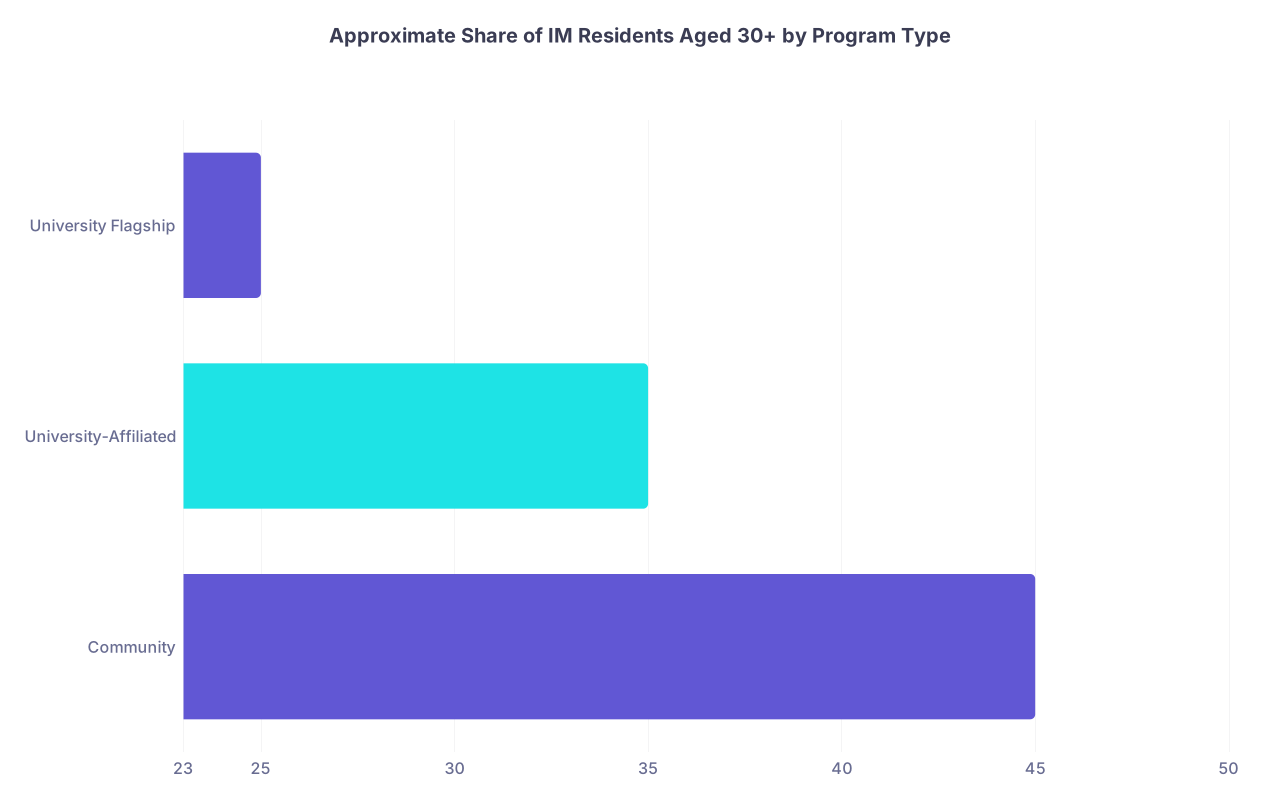
| Category | Value |
|---|---|
| Community | 45 |
| University-Affiliated | 35 |
| University Flagship | 25 |
Community programs: Residents here are very often 30+. You meet people who:
- Worked 5–10 years in another field
- Had a military career
- Completed another graduate degree
- Completed international medical training before coming to the U.S.
Next, university‑affiliated / hybrid programs: A middle ground. Academic exposure but with a strong service role and significant local recruitment. Older residents are common but not dominant.
Top‑tier academic flagships: Skew younger, especially in highly competitive departments like derm, radiology, orthopedic surgery, neurosurgery. IM at big‑name places will still have older residents, but they usually enter with “explained” age gaps (MD/PhD, long research years, dual degrees) rather than unrelated careers.
3.2 Community Programs as Age Shock Absorbers
If you map where residents with visible prior careers are training, you see a disproportionate share at:
- Large community hospitals
- County hospitals
- Safety‑net and VA‑heavy programs
These programs act as the system’s “shock absorbers” for non‑traditional paths. They care a bit less about straight‑through academic pedigree and a bit more about maturity, reliability, and commitment to service.
For a 35‑year‑old career‑changer, the probability of landing at a community or hybrid program is simply higher than at a top‑10 academic flagship. That is not fatal. Many excellent physicians are trained at exactly those sites.
4. Geography: Where Older Residents Are More Common
Look at maps, not just specialties. Locations matter.
Based on program rosters, state demographic data, and where non‑traditional applicants tend to originate, you can see consistent regional patterns.
4.1 High‑Age‑Diversity Regions
Large urban centers with multiple medical schools: New York City, Chicago, Los Angeles, Boston, Houston. These cities draw non‑traditional students from post‑baccs, career changers, and international students. Their residency programs reflect that input pipeline.
States with strong public med schools and significant non‑traditional entry: Texas, California, Florida. Their in‑state preference policies and multiple campuses create more seats for older students and, later, residents.
Regions with heavy military presence: San Antonio, San Diego, Norfolk, Tacoma. Family medicine, psychiatry, EM, and surgery programs around major bases often have prior‑service physicians and older residents.
4.2 Lower‑Age‑Diversity Settings
Highly competitive coastal academic hubs in certain specialties: Think pure research‑heavy departments in Boston, SF, or NYC derm / plastics / neurosurgery programs. They might have a 38‑year‑old, but that person almost always has an MD/PhD or world‑class research CV, not a prior decade in marketing.
Some smaller, more homogeneous regions with lower adult degree completion ages and fewer post‑bacc pathways. Not zero older residents, but fewer.
5. How Non‑Traditional Are You, Quantitatively?
“Non‑traditional” is thrown around wildly. Let’s anchor it with actual age and trajectory.
Assume you start medical school at different ages:
| Start Med School Age | Residency Length | Age at Completion |
|---|---|---|
| 22 | 3 years | 28 |
| 22 | 5 years | 30 |
| 26 | 3 years | 32 |
| 26 | 5 years | 34 |
| 30 | 3 years | 36 |
| 30 | 5 years | 38 |
| 34 | 3 years | 40 |
| 34 | 5 years | 42 |
Now tie this to how programs actually perceive it:
Starting med school at 24–26: Mildly non‑traditional. You will be in the thick of the resident age distribution. No one blinks.
Starting at 27–30: Clearly non‑traditional, but you will still match into many specialties. Age 30–34 residents are very common in FM, psych, IM, peds, pathology, and community EM.
Starting at 31–35: You are approaching 40+ by the end of many residencies. Programs will notice and think concretely about longevity, procedural career viability, and call schedules.
Starting at 36+: You are heading toward finishing residency in your mid‑40s or later. At this point, you see sharp differences in receptiveness by specialty and program.
Age alone does not disqualify you, but it changes purchase behavior. A PD has finite slots and is optimizing for years of practice, risk of attrition, and training culture balance. That is not discrimination in the abstract; it is cold workforce math.
6. Where Older Applicants Actually Match: Pattern by Age Band
Let’s be blunt and data‑driven. If you look at match lists from med schools with a lot of non‑traditional students (e.g., some DO schools, state MD programs heavy on career‑changers) and cross‑reference residents’ pre‑med graduation years, you see predictable clustering.
6.1 Applicants Entering Med School at 26–29
Median age at residency start: ~30–33.
Observed specialty destinations (in descending frequency):
- Internal Medicine (many go on to cards, GI, heme/onc)
- Family Medicine
- Pediatrics
- Psychiatry
- Emergency Medicine
- Anesthesiology
- Pathology
Highly competitive surgical subspecialties still possible but less frequent, mainly when supported by very strong boards, high‑level research, or unique background.
6.2 Applicants Entering at 30–34
Median age at residency start: ~34–37.
The data show a clear shift:
- Family Medicine, Psychiatry, Internal Medicine become the primary landing spots
- Pediatrics and Pathology still very viable, but volume is smaller overall
- EM, Anesthesia, General Surgery appear, but more selectively and usually at community / hybrid programs
The fraction matching into derm, plastics, neurosurgery, integrated vascular, or ENT becomes very small. Not zero. But think outlier, not baseline.
6.3 Applicants Entering at 35+
Median age at residency start: ~39+.
You see clustering tighten even more:
- Family Medicine and Psychiatry dominate
- Internal Medicine (especially community or hospitalist‑oriented programs) still appears
- Some pathology and PM&R
- Occasional pediatrics
Again, exceptions exist. But if you look at 40+ interns across the country, that is where they are disproportionately training.
7. Strategic Implications for Premeds and Med Students
You asked for numbers. But you probably care about what to do with them.
7.1 Two Levers You Control Early: Timing and Specialty Flexibility
You can adjust:
- How many extra “gap” years you accumulate before medical school.
- How tightly you fixate on a narrow band of specialties.
If you are 30 and have not started prerequisites, the combined probability of:
- Completing prereqs
- Taking the MCAT
- Getting accepted
- Finishing med school
- Matching into neurosurgery
…is not zero, but the joint probability is low. Statistically, you will almost certainly end up in a primary‑care oriented field or one of the age‑tolerant specialties. Which is not a consolation prize, just a different reality.
If you are late 20s and flexible, the path is much broader. Late 20s entrants show up across the spectrum, including surgery, EM, anesthesia, and subspecialties.
7.2 Program Targeting: Where Older You Fits Better
Use the clustering data to bias your strategy:
Heavily consider Family Medicine, Psychiatry, Internal Medicine, Pathology, and (depending on your stamina) Pediatrics if you will start residency at 35+. That is where the age distribution says your peers will be.
Favor large community and hybrid programs, county hospitals, and VA‑heavy residencies. Their actual resident populations show more people with your timeline.
Look at resident bios. Count how many list prior careers, other degrees, or clear time gaps. That is a crude but accurate age surrogate.
If a program’s current PGY‑1 class is all “BA 2017, MD 2021,” that is a young cohort signal. If you see multiple residents with “BS 2005, MS 2009, MD 2021” or “Former teacher, EMT, engineer,” the age range is already broader.
8. A Harder Question: Is It “Worth It” Statistically?
You want to know if this is rational. So think about it as a return‑on‑investment problem.
Take a 34‑year‑old considering med school who expects to match into a 3‑year primary care residency.
- Training: 4 med school + 3 residency = 7 years
- Age at completion: ~41
- Working years to 65: ~24
Now compare with a 24‑year‑old starting now:
- Training: same 7 years
- Age at completion: ~31
- Working years to 65: ~34
The older applicant has about 70% of the working years of the younger one. But income is not everything. Many older physicians report much higher job satisfaction versus their prior career, even with fewer total working years.
Numerically, older applicants cluster into:
- Primary care (lower median income vs procedural specialties)
- Psychiatry (moderate income, decent lifestyle)
- Hospital medicine (IM)
If you run the numbers for lifetime earnings, a 40‑year‑old entering FM versus staying in a mid‑level corporate role may still come out ahead in absolute income, but with more debt and less time to compound investments. That is a personal decision, not a purely statistical one.
But from a matching perspective, the data are straightforward:
- 30–34 at med school start → broad but somewhat shifted distribution
- 35+ at med school start → heavily concentrated in FM, psych, IM, path, PM&R
Plan like an actuary, not a dreamer. Then, if you still choose the path, you are doing it with eyes open.
9. How to Read Signals in Real Time
You do not need secret databases. You can infer a lot from publicly visible data.
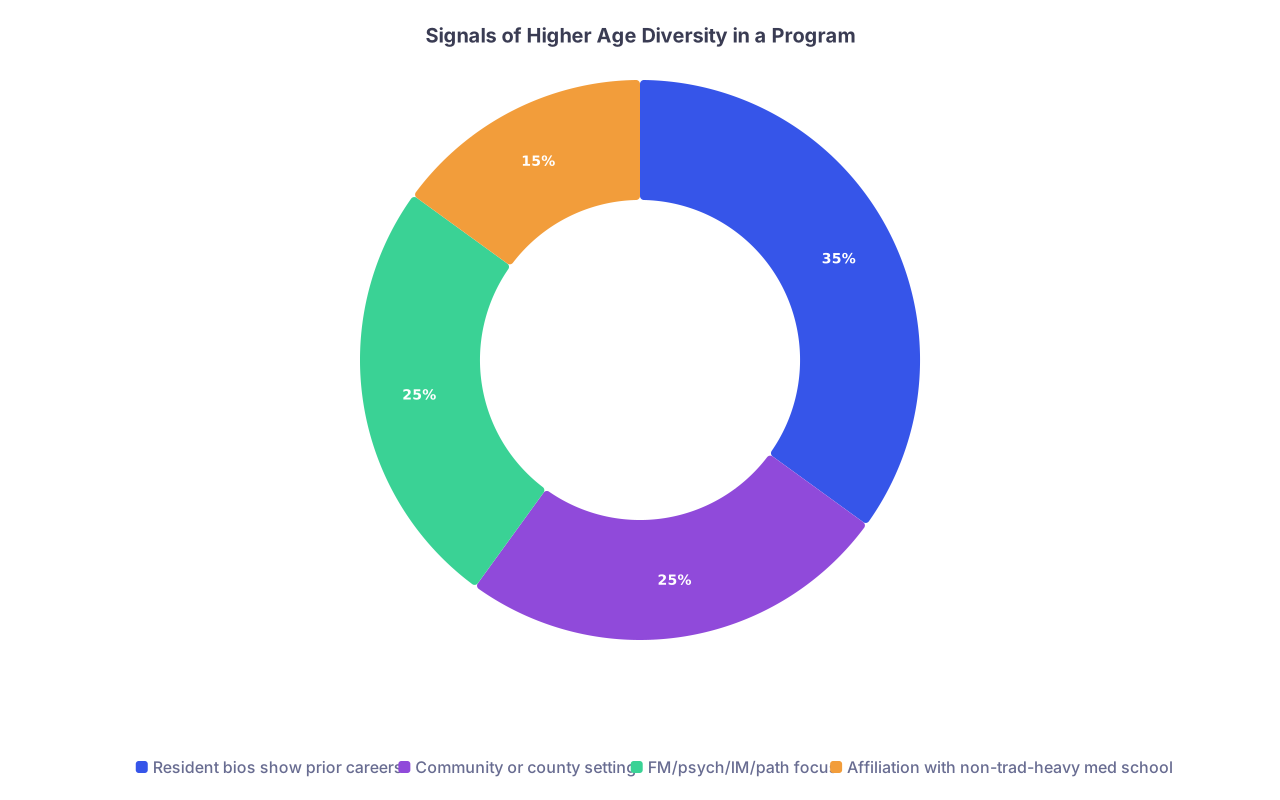
| Category | Value |
|---|---|
| Resident bios show prior careers | 35 |
| Community or county setting | 25 |
| FM/psych/IM/path focus | 25 |
| Affiliation with non-trad-heavy med school | 15 |
Pay attention to:
- Resident photos and bios on program websites: How many clearly look 30+? Any explicit mention of prior careers?
- Program narratives: Words like “diverse life experiences,” “second‑career physicians,” “non‑traditional backgrounds welcome” appear more often at age‑diverse sites.
- Affiliated medical schools: Schools with average matriculant ages above 24 (many DO schools, some state MDs) feed older graduates into their home residencies.
- Location and mission: County hospitals, safety‑net institutions, VA systems; these correlate with older residents.
Then adjust your ERAS list quantitatively. If you are 38, do not apply only to hyper‑competitive university neurosurgery programs and then declare the system “rigged against older people” when the match statistics were obvious from the start.
10. Timeline Reality Check for Premeds
If you are still premed, there is a lever you might be underestimating: speed.

| Step | Description |
|---|---|
| Step 1 | Today |
| Step 2 | MCAT within 12-18 months |
| Step 3 | Post-bacc 1-2 years |
| Step 4 | Med school in 2-3 years |
| Step 5 | Med school in 4-5 years |
| Step 6 | Apply next cycle |
| Step 7 | Residency by late 30s |
| Step 8 | Residency in 40s |
| Step 9 | Need prereqs? |
| Step 10 | Full-time or part-time? |
Condensed version:
If you are 27 and can complete prerequisites and the MCAT in 1–2 years, you are still on track to start residency in your early 30s. That keeps many doors open.
If you are 27 and plan a 5‑year, part‑time, slow‑drip post‑bacc before applying, you are essentially choosing to push yourself into the 35+ at matriculation band. That drastically narrows your eventual residency options.
Speed is not everything. But the slope of your path now determines which age cluster you will travel with later.
Key Takeaways
Residents are not all 26‑year‑olds. Roughly one in three is 30+, but older trainees cluster heavily in family medicine, psychiatry, internal medicine, pathology, and community or county programs.
Once you cross into starting residency at 35+, the probability distribution of where you match tightens sharply. Plan on the age‑friendly specialties and program types unless you have truly exceptional credentials.
If you are still premed, your pacing now (years to complete prerequisites and apply) is a hard, quantitative lever. It will largely determine which age band—and therefore which cluster of specialties and programs—you realistically join.