
It is 10:30 p.m. You just closed yet another spreadsheet / contract markup / redlined term sheet, and instead of feeling satisfied, you are Googling “how to go to medical school from engineering / law / MBA.” Your undergrad transcript is a decade old (or feels like it). Your schedule is insane. And now every website is screaming “take the prerequisites” with almost no detail on which ones, where, and how to avoid blowing up your GPA, your sanity, or your finances.
Let me be specific: if you are coming from engineering, law, or business, your path through prerequisites is fundamentally different from the typical biology major. Different constraints. Different strengths. Different landmines.
This is about designing a deliberate prerequisite plan that fits your background—and gets you into medical school—instead of playing course-selection roulette.
Step 1: Clarify the Target – What Medical Schools Actually Require
First, anchor on reality. Med schools are not mysterious about basic course requirements. They are just painfully inconsistent in the details.
Most U.S. MD programs require, in some form:
- 1 year (2 semesters) of general biology with lab
- 1 year of general chemistry with lab
- 1 year of organic chemistry with lab (sometimes 1 orgo + 1 biochem instead)
- 1 year of physics with lab
- 1 semester of biochemistry
- 1–2 semesters of English / writing-intensive coursework
- 1 semester of statistics (increasingly preferred)
- Some social/behavioral science (psychology/sociology for MCAT if not formal courses)
But how this overlaps with your existing degree is very different for:
- Engineers (especially chemical, biomedical, mechanical, electrical)
- Lawyers (humanities / social science heavy, minimal hard science)
- MBAs (business / econ / finance backgrounds, often out of school for years)
To make this concrete:
| Course Area | Typical Engineering Grad | Typical Lawyer | Typical MBA |
|---|---|---|---|
| General Biology | Usually missing | Missing | Missing |
| General Chemistry | Often covered | Missing | Sometimes 1 semester (pre-MBA) |
| Organic Chemistry | Sometimes 1, rarely 2 | Missing | Usually missing |
| Physics | Usually covered (calc-based) | Missing | Maybe 1, usually not with lab |
| Biochemistry | Often missing | Missing | Missing |
| English / Writing | Minimal but present | Usually strong | Present |
| Stats | Often present | Variable | Often present (quant focus) |
You need to reverse-engineer from schools back to courses.
- Pick 10–15 realistic target schools (mix of state, mid-tier, a few reaches).
- Check their prerequisite pages carefully—look for words like “require,” “strongly recommend,” “college-level,” and “lab.”
- Identify the strictest pattern, not the loosest.
- Your plan must meet or exceed that strict pattern.
If you do not do this, you will absolutely end up with a “missing 1 semester of upper-division biology with lab” problem the year you apply. I see it every cycle.
Step 2: Strategy by Background – Engineers, Lawyers, MBAs
Let me break this down by who you are now, not who you were at 19.
Engineers: High Quant, Patchy Bio
Typical profile:
- Strong math, physics, and often general chemistry
- Sometimes one organic chem, almost never full biology sequence
- GPA may be “average-looking” (3.3–3.5) but from a brutal curriculum
- Working full time in a demanding role (design, software, consulting, etc.)
Your main issues:
- Biology deficit – both courses and actual comfort with life sciences
- Perception – adcoms may see you as brilliant but not obviously “people-focused”
- GPA repair – if your engineering GPA is mediocre, your science GPA may need fresh A’s
Your priority sequence usually looks like this:
- General Biology I & II with labs
- Organic Chemistry (complete any missing semesters)
- Biochemistry
- Any missing physics or general chemistry (if your original courses are very old or do not match med school labeling)
- At least one upper-division biology (e.g., physiology, cell biology, or microbiology) to prove modern competence
Engineers have one major advantage: you can withstand heavy course loads if you have time. But with a job, do not stack 3 heavy sciences with labs in one term unless you want your GPA to implode.
Lawyers: Strong Verbal, Minimal Science
Typical profile:
- Excellent writing, argumentation, reading-heavy background
- LSAT mindset: logic games, rhetoric, policy
- Hard sciences often limited to one or two random undergrad requirements, if that
- Full-time work that is time-intensive and unpredictable (court dates, transaction closings)
Your main issues:
- You are essentially starting from scratch in science.
- You need to demonstrate you can handle hard science at speed, not just “got by” in a DIY slow path.
- MCAT sciences will be brutal unless your coursework is thorough.
Your priority sequence:
- General Chemistry I & II with lab
- General Biology I & II with lab
- Physics I & II with lab
- Organic Chemistry I & II with lab
- Biochemistry
- At least one upper-level biology (physiology or cell biology is ideal for MCAT)
This is essentially a formal post-bacc pattern, whether or not you enroll in a branded program. You should strongly consider:
- A structured post-bacc at a reputable institution, OR
- A well-planned, full-time, 1–2 year period of taking nothing but science
The common mistake I see lawyers make: stringing one science course per semester over 5–6 years while working full-time at a firm. It proves very little about your ability to manage med school density.
MBAs: Quant/Business Heavy, Variable Science
Typical profile:
- Undergrad in business, econ, or something adjacent
- Some math and stats, maybe a little econ-based quantitative reasoning
- Rarely completed full hard science sequences
- Often a few years into a business, consulting, tech, or startup career
Your main issues:
- Patchy science – maybe a random bio or chem, not enough for med schools
- You need a clean story to explain pivot from business to medicine
- You must show you can handle a hard science course load, not just analytics
Your priority sequence:
- Full general chemistry sequence with lab
- Full general biology sequence with lab
- Organic Chemistry I & II with lab
- Physics I & II with lab (unless clearly done with labs earlier)
- Biochemistry
- At least one upper-level biology (nice to have, sometimes essential)
You likely fall between engineer and lawyer in terms of how “from scratch” you are. The more you can compress prerequisites into 1–2 intense years with strong grades, the more convincingly you demonstrate readiness.
Step 3: Where You Take These Courses Actually Matters
Here is where people get cute and make mistakes.
“Can I take everything online?”
“Will community college classes hurt me?”
“Do I need a formal post-bacc?”
Med schools look at three things here:
- Rigor of institution
- Consistency and recency
- Pattern of coursework (night classes scattered vs focused block)
Let me be blunt.
- Taking all your prerequisites at an unselective community college while working a high-paying job and living 5 minutes from a solid 4-year university is going to raise eyebrows.
- Taking some prerequisites at a CC due to cost or access, especially early ones, is fine if later you demonstrate mastery at a higher level.
- Purely online, no-lab sequences for core chem/bio/physics are still viewed skeptically by many MD programs, though there was temporary flexibility around COVID.
Better approach:
- If you are near a state university or reputable private university that admits non-degree students, take the majority of your med-school prerequisites there.
- Use community college strategically for scheduling or initial courses if needed (e.g., Gen Chem I at CC, Gen Chem II and all organic at a 4-year).
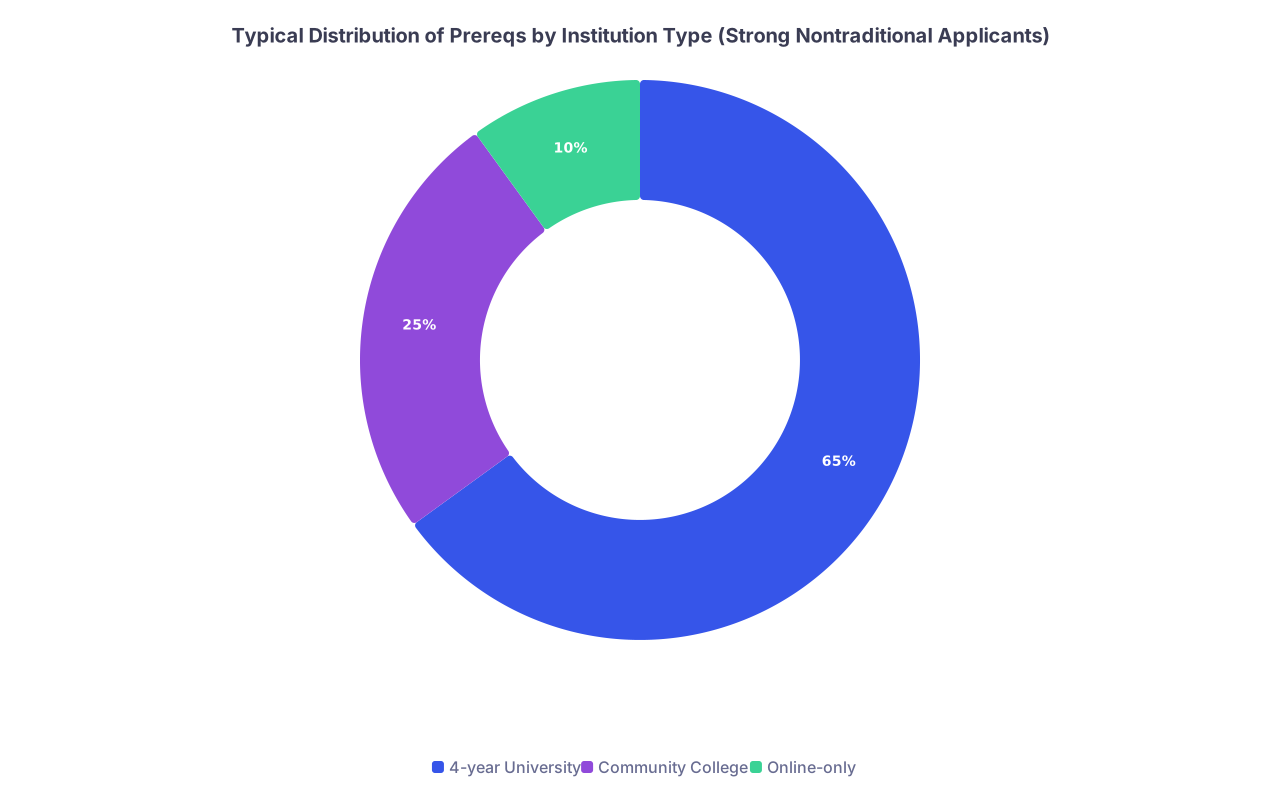
| Category | Value |
|---|---|
| 4-year University | 65 |
| Community College | 25 |
| Online-only | 10 |
Formal post-bacc programs help when:
- You are coming from law / business with zero science
- You want advising + committee letter + structured schedule
- You need to finish everything in 12–24 months and want med schools to recognize the rigor
They are not magic. I have seen engineers and MBAs do just as well crafting their own post-bacc at a state school.
Step 4: Integrating MCAT Needs into Your Course Plan
MCAT is not “just test prep” for nontraditional students. The exam is built almost directly on undergraduate coursework. If your prerequisites are weak or badly sequenced, your MCAT ceiling drops.
At minimum, before a serious MCAT attempt you should have completed:
- General biology I & II
- General chemistry I & II
- Organic chemistry I & II (or at least I and full biochemistry)
- Physics I & II
- Biochemistry (non-negotiable now)
- Intro psychology and sociology (or enough self-study at MCAT-level depth)
The sequencing matters.
Here is a layout that tends to work for people starting from scratch (lawyers, many MBAs):
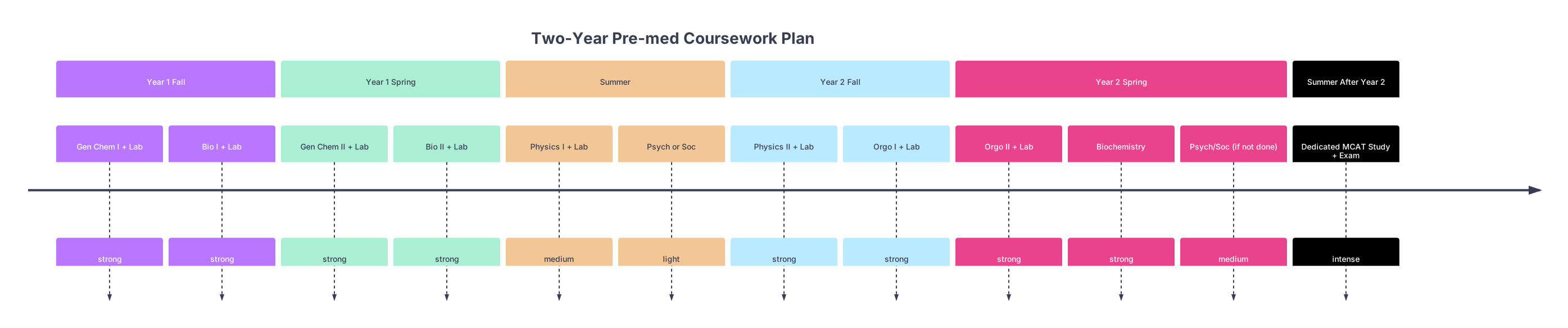
| Period | Event |
|---|---|
| Year 1 Fall - Gen Chem I + Lab | strong |
| Year 1 Fall - Bio I + Lab | strong |
| Year 1 Spring - Gen Chem II + Lab | strong |
| Year 1 Spring - Bio II + Lab | strong |
| Summer - Physics I + Lab | medium |
| Summer - Psych or Soc | light |
| Year 2 Fall - Physics II + Lab | strong |
| Year 2 Fall - Orgo I + Lab | strong |
| Year 2 Spring - Orgo II + Lab | strong |
| Year 2 Spring - Biochemistry | strong |
| Year 2 Spring - Psych/Soc (if not done) | medium |
| Summer After Year 2 - Dedicated MCAT Study + Exam | intense |
Engineers often can compress because they already have physics and some chemistry; their main constraint is time outside work.
Do not try to:
- Take MCAT before you have had biochemistry. That is self-sabotage.
- Run MCAT prep while taking 3 heavy lab sciences for the first time. You are not a superhero; you just look like someone who did not plan.
Build in a dedicated 3–4 month MCAT window once your core science is done or nearly done. Protect that time.
Step 5: Course Selection Nuances by Background
Now the part people actually care about: exactly which courses and how many.
For Engineers
You probably have:
- Calculus I–III
- Differential equations
- Physics I & II (often calc-based, which is fine)
- General chemistry I & II (especially for chemical / biomedical engineers)
You should verify:
- Did your physics and chem courses include labs and are they labeled clearly on your transcript? If not, you might need standalone labs or, in messy cases, retake the sequence.
- Are your biology courses essentially zero or one random intro? Then you need the full year of bio with labs.
You should add:
- General Biology I & II with labs, at a solid 4-year institution if possible
- Biochemistry (upper-division, not “survey for non-science majors”)
- One human-focused advanced bio: human physiology, cell biology, or genetics
I strongly recommend at least one class that looks more “clinical adjacent” (e.g., physiology) to show you are not just a math robot.
Pitfalls I have seen:
- Engineers assuming their sophomore “Materials Science for Engineers” will count as general chemistry. It will not.
- Relying on 12-year-old courses without any recent science. Med schools want recency, especially if your academic life has been purely technical or business since.
For Lawyers
Assume you must rebuild your academic identity.
You are trying to prove that your 3.8 in philosophy / political science plus a JD from a good school translates into actual ability to survive medical school. That means dense, recent, A-level performance in hardcore sciences.
I would structure it like this:
Year 1:
- Fall: Gen Chem I + Lab, Bio I + Lab (and nothing else heavy)
- Spring: Gen Chem II + Lab, Bio II + Lab
- Optional Summer: Physics I + Lab, Psych
Year 2:
- Fall: Physics II + Lab, Orgo I + Lab
- Spring: Orgo II + Lab, Biochemistry, Soc (if needed)
Adjust for your work schedule, but fight to keep your first year limited to two sciences per term so you can get A/A– grades. First impressions matter.
Courses to avoid: “Chemistry for nursing majors,” “Survey of biology for non-majors.” You need the pre-med / majors track, not watered-down variants.
For MBAs
You are in between.
If you had, say, one semester of general chemistry and a stats class during undergrad, and now an MBA, your plan might be:
- Finish general chemistry sequence + labs
- Full biology sequence + labs
- Full physics sequence + labs
- Orgo I & II + lab
- Biochemistry
- One extra upper-level bio if grades have been solid and time allows
One nuance for MBAs: your quant signals are often strong (GMAT, graduate-level finance, statistics), but med schools care far more about science-specific endurance. So stacking 2–3 sciences while working during at least one term can be useful, if you can maintain performance.
Step 6: GPA Strategy – Repair, Reinvention, and Damage Control
Nontraditional students fall into three broad GPA categories:
- Strong base GPA (3.7+) from earlier degree
- Middling GPA (3.2–3.6)
- Damaged GPA (<3.2)
Your prereq strategy changes significantly across these.
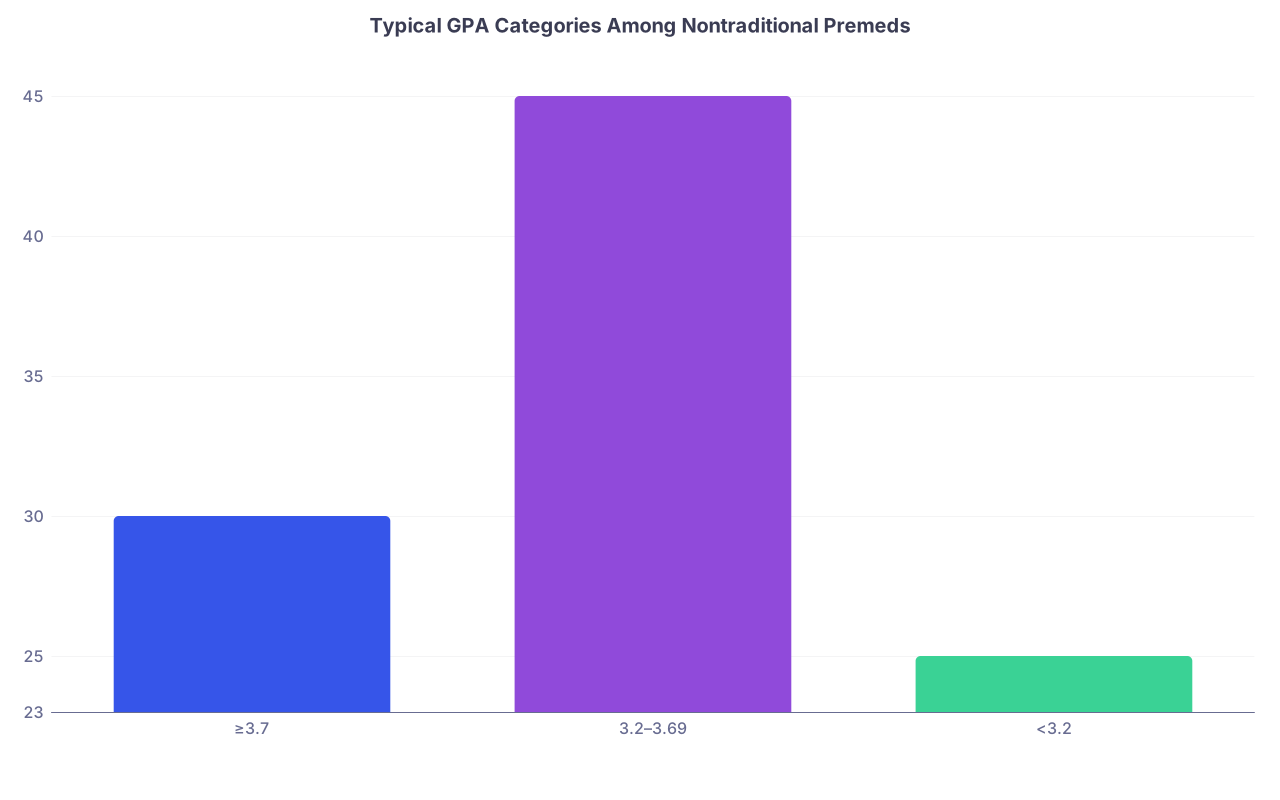
| Category | Value |
|---|---|
| ≥3.7 | 30 |
| 3.2–3.69 | 45 |
| <3.2 | 25 |
If your prior GPA is strong (≥3.7)
You cannot coast, but you have more flexibility.
- Aim to protect that GPA with As and A–s in prerequisites.
- A few B+ grades will not destroy you if the overall pattern remains strong.
- Focus on optimizing MCAT and building clinical experiences; the prereqs are more about checking boxes and demonstrating recency.
If your prior GPA is middling (3.2–3.6)
This is where a lot of engineers and MBAs live.
You need your post-bacc / prerequisites to be a clear upward trend. Something like:
- 30–40 credits of heavy science at 3.7+
- No more than one or two B-range grades, and definitely no Cs
If you spread courses too thin (one at a time), med schools may question if you can handle full-time medical school rigor. If you overload and pull B–/C+ work, you confirm their worst fears.
Balance is real here. A good pattern is:
- Semesters with 2 sciences + possibly 1 light/non-science
- Maybe one “stress-test” term with 3 sciences after you have proven yourself
If your prior GPA is <3.2
You are in reinvention territory.
This usually means:
- 40–60+ credits of pure, upper-level science and prerequisites
- Near-straight As in that block
- Possibly targeting DO programs and/or formal reinvention-friendly post-baccs or SMPs (special master’s programs) later
From law, this is less common. From engineering or early business, more so.
In this case, every course choice matters. Do not take unnecessary fluff. Prioritize courses heavily weighted by med schools: biology, chemistry, physics, biochem, physiology, microbiology.
Step 7: Timing with Work, Life, and Application Cycle
You are not a 20-year-old with summer breaks. You have a job, obligations, and maybe a family.
So you need to align three timelines:
- Science course availability
- Your realistic weekly time budget
- MCAT + application deadlines
A typical “from scratch” nontraditional who wants to apply once and not reapply often ends up doing:
- 2 years of part-time to full-time prerequisites
- MCAT right after finishing biochem
- Apply that summer for the next year’s matriculation
If you start haphazardly—one course this term, skip next term, two more next year—you will push your timeline out 4–5 years and still not have a coherent story.
You want your transcript to show:
- Recent, contiguous academic engagement
- Increasing load / rigor over time, not decreasing
- Clear “off” seasons (like busy work quarters) planned, not chaos
For example, an engineer in consulting might:
- Year 1: Take Bio I & II with labs at night, one per term.
- Year 2: Switch jobs or reduce hours slightly, stack Orgo I & II with Biochem over fall/spring, then MCAT in early summer.
- Apply at the end of Year 2.
You cannot control all work chaos, but you can stop pretending it does not exist when you plan.
Step 8: Common Mistakes Nontraditional Students Make with Prereqs
I have seen variants of these every single cycle.
Trying to preserve a full-time demanding job while taking 3–4 lab sciences per term.
Result: mediocre grades, burnout, weak MCAT.Relying entirely on online, no-lab courses for core requirements.
Some DO schools might accept them; several MD programs will quietly downgrade you.Assuming old courses “count the same” as recent ones.
Ten-year-old orgo with a B– looks very different from A-level biochem last year.Not checking individual school prereq pages early.
Then discovering mid-cycle that 3 target schools require a second semester of English or an additional upper-division bio with lab.Taking “for non-majors” science courses.
Those are red flags. You are training to be a physician, not just fulfilling a nursing/health-science requirement.Underestimating how long MCAT takes on top of prerequisites.
Especially lawyers and MBAs who are used to standardized tests; this one is different because the underlying content volume is massive.
Step 9: Putting It All Together – Sample Optimized Plans
Let me make this concrete with three example scenarios.
Scenario 1: Mechanical Engineer, 3.3 GPA, Working Full-Time
Existing courses:
- Calc I–III, Differential Equations
- Physics I & II with labs
- General Chem I & II with labs
- One intro programming, one random “Intro to Environmental Science”
Needs:
- Full bio sequence, orgo, biochem, one upper-level bio
Plan:
Year 1 (working ~45 hrs/week):
- Fall: Bio I + Lab
- Spring: Bio II + Lab
- Summer: Light or off (shadowing / clinical volunteering)
Year 2:
- Fall: Orgo I + Lab
- Spring: Orgo II + Lab and Biochem (if you can drop work hours slightly, this is doable)
- MCAT early summer
Add one upper-level physiology course during Year 2 fall if you can handle it, or Year 3 fall if you must space things.
Scenario 2: BigLaw Associate, Humanities Major, 3.8 GPA, JD
Existing courses:
- Mostly politics / philosophy / history
- One undergrad psych, no other science
Needs:
- Full prereq suite, proof of science ability, compressed timeline
Plan (switching to reduced hours or exiting firm is ideal):
Year 1 (full-time post-bacc or near-full-time):
- Fall: Gen Chem I + Lab, Bio I + Lab
- Spring: Gen Chem II + Lab, Bio II + Lab
- Summer: Physics I + Lab, Psych
Year 2:
- Fall: Physics II + Lab, Orgo I + Lab
- Spring: Orgo II + Lab, Biochem, Soc
- MCAT early summer
- Apply that summer
If you absolutely must work, this stretches to 3 years. But make sure that extra time is buying you A grades, not just survival.
Scenario 3: Tech PM with MBA, Business Undergrad, 3.5 GPA
Existing courses:
- Undergrad: stats, calculus I, one semester of “Chem for Life Sciences” with lab
- MBA: quant heavy, but no real sciences
Needs:
- Second semester of gen chem (med-school level), full bio, full physics, orgo, biochem
Plan:
Year 1 (while working):
- Fall: Gen Chem II + Lab (at a 4-year school), Bio I + Lab
- Spring: Bio II + Lab, Psych (online fine)
- Summer: Physics I + Lab
Year 2:
- Fall: Physics II + Lab, Orgo I + Lab
- Spring: Orgo II + Lab, Biochem, Soc (if needed)
- MCAT late spring / early summer
- Apply that summer
Your MBA is not a liability; it is just not a science credential. Once your transcript shows 30–40 credits of solid science with good grades, your application looks coherent.
Step 10: How to Know You Chose Well
You will not get instant validation. But there are clear downstream markers that your prerequisite strategy is sound:
- Your science GPA—in recent coursework—is ≥3.6, ideally higher.
- You feel reasonably prepared, not lost, in MCAT science questions once content review is complete.
- You do not discover missing courses during secondary applications.
- Your letters from science professors (yes, you need those) can honestly say you performed at the top of a tough class.
- Advisors at your institution are not constantly telling you “med schools may not like that” about your course choices.
If you are planning and constantly asking, “Is this enough? Will this count?” you probably need to re-verify requirements against a real list of target schools and tighten your plan.
Key Takeaways
- Prerequisite strategy for engineers, lawyers, and MBAs is not one-size-fits-all. You need a tailored plan that plugs your specific gaps and showcases your strengths—in recent, rigorous science.
- Where and how you take courses matters. Prioritize 4-year institutions and majors-level sequences, build a contiguous 1–2 year block of strong performance, and align it with MCAT timing.
- Your goal is a clean, recent, upward-trending science record that convinces skeptical adcoms you can handle medical school today—not 10 years ago, not “in theory,” but now.