
The standard one‑size‑fits‑all post‑bacc track is a terrible fit for late‑career science returners. You are not a 20‑year‑old trying to remember high‑school chemistry. You are balancing kids, a mortgage, a supervisor who “doesn’t really get” why you are taking night classes, and a body that does not enjoy midnight cram sessions anymore.
Let me break this down specifically: you need a purpose‑built curriculum, not whatever generic premed checklist is floating around Reddit.
You already have an advantage: you understand work, deadlines, and professional expectations. The risk is different. Burnout, mismatched rigor, and wasting 2–3 years on a poorly structured curriculum that still leaves you with weak science fundamentals or mediocre MCAT performance.
We are going to design this correctly.
Step 1: Define Your Starting Point With Ruthless Clarity
Before you pick a single course, you need a brutally honest snapshot of three things:
- Academic history
- Life bandwidth
- Medical target (MD vs DO vs “keep options wide”)
Academic history: where are the real gaps?
I do not care what your advisor’s template says. A 45‑year‑old engineer who took multivariable calculus and physical chemistry in 2002 is not the same as a 38‑year‑old English professor who last saw a lab in high school.
Break your background into:
Foundational sciences completed
General chemistry, biology, physics, organic chemistry, calculus, statistics.Age of coursework
Most MD/DO schools accept old prereqs, but MCAT relevance and your actual retention are separate questions.Academic performance trend
Did you have a 2.7 GPA at age 19 and then crush an MBA with a 3.9 at 34? That matters. You are not trying to “erase” the past so much as demonstrate the present.
Here is the basic decision logic I use when I sit down with late‑career applicants:
Rough classification:
- Career‑changer: little or no prior science beyond maybe one semester; needs the full premed sequence from scratch.
- Academic enhancer: has prior science, but GPA is weak or content is rusty; needs to show a strong recent trend and rebuild MCAT‑relevant knowledge.
- Hybrid: has scattered strong coursework but major gaps in key MCAT areas or labs; needs a custom mix.
Most late‑career science returners land in the “academic enhancer” or “hybrid” bucket, not pure career‑changer.
Step 2: Set Hard Constraints – Time, Money, and Non‑Negotiables
This is the step most people hand‑wave. Then they drown.
You must answer three questions without lying to yourself:
Weekly study bandwidth: On a normal week, how many hours can you consistently study? Not your fantasy number. The number that survives sick kids, quarter‑end deadlines, or a spouse who travels.
Time to application: When do you actually want to submit AMCAS/AACOMAS? Not when the internet says you should. Take into account your life responsibilities and your need to rebuild academic confidence.
Financial runway: Can you cut work hours? Pay for formal post‑bacc tuition? Or do you need to build this with state school / community college credits and careful scheduling?
To keep this concrete, here is how I usually translate weekly hours into realistic course loads:
| [Weekly Study Hours](https://residencyadvisor.com/resources/nontraditional-path-medicine/advanced-timeblocking-techniques-for-working-professional-premeds) | Typical Load During Working Semesters | Notes |
|---|---|---|
| 10–15 | 1 science lecture ± 1 light lab | For full-time workers with kids; slow but safe |
| 15–25 | 2 sciences (or 1 heavy + 1 light) | Manageable for full-time work if job is flexible |
| 25–35 | 2–3 sciences with labs | Often requires part-time work or very flexible schedule |
| 35+ | Full-time post-bacc | Usually involves major lifestyle/financial shift |
You can absolutely design a stellar curriculum at 10–15 hours/week. It just takes more terms and tighter priority.
Step 3: Clarify the Actual Target – What Are You Optimizing For?
You do not build the same post‑bacc for:
- scraping into “some” DO school in 3 years vs
- aiming at upper‑mid MD programs in 5–6 years vs
- leaving the door open for highly selective MD programs.
Your curriculum must reflect which levers matter most: GPA repair, rigor signal, or depth.
At a high level, you are balancing:
- Prerequisite completion – the bare minimum boxes schools require.
- Recent academic excellence – last 30–45 credits of strong science.
- Rigor and institutional signal – where you did those courses.
- MCAT alignment – not all “biology” is MCAT‑useful.
Think of your curriculum like a portfolio. You are combining:
- Low‑risk, high‑yield: structured intro courses, A‑friendly environments.
- Medium‑risk, high‑signal: upper‑division bios, rigorous state schools.
- High‑risk, strategic: one or two challenging courses to show you can hang with younger peers.
For late‑career folks, I push against the macho impulse to overload on hard upper‑levels early “to prove I can do it.” That is how you stack B+ and B grades that drag down your reinvention story.
Step 4: Core Science Sequence – What You Actually Need
Let us be precise. The functional premed core you must cover (in a form usable for MCAT and admissions) is:
- General Chemistry I & II with labs
- General Biology I & II with labs
- Physics I & II (algebra‑based is usually fine) with labs
- Organic Chemistry I & II with labs
- Biochemistry (one semester, upper division)
- Statistics (often accepted from social science or business, but a fresh one is wise if old/weak)
Then there are strategic “bonus” courses that pay off for both MCAT content and admissions optics:
- Cell Biology
- Genetics
- Physiology
- Microbiology (less MCAT‑critical, but very attractive to some schools)
- Psychology & Sociology (for MCAT and prerequisites at many programs)
How this changes for late‑career returners
If you did some of this 10–20 years ago, here is how I generally stratify:
- A or A‑, within last 7–8 years, and you remember the material decently: do not repeat. Reinforce via MCAT prep and maybe take an adjacent upper‑level course.
- B/B‑ or older than ~10 years, and content feels fuzzy: consider repeating if GPA repair is necessary, or take a closely related higher‑level course that forces you to relearn (e.g., old Gen Bio → take Cell Bio + Genetics).
- C+ or below, any age: usually worth repeating at a 4‑year institution unless you have 40+ recent credits of A‑range hard science.
You are not gaming a box‑check system. You are building the knowledge you will need for MCAT and M1.
Step 5: Choosing the Right Setting – Formal vs DIY Post‑Bacc
Late‑career students get pushed into two extremes: ultra‑expensive formal programs or cobbled‑together night classes that do not impress anyone. The right answer is between those.
The core question: how much structure and institutional branding do you need to offset older coursework, career switch, and GPA?
| Path Type | Best For | Pros | Cons |
|---|---|---|---|
| Formal Career-Changer | Non-science majors, minimal prior science | Cohort, advising, linkage options | Expensive, rigid schedule |
| Formal Academic-Enhancer | Old science degree, GPA repair needed | Strong rigor signal, structured sequence | Often requires near full-time focus |
| DIY at 4-year School | Hybrid backgrounds, budget-conscious | Flexible, cheaper, still good signal | You must self-design and self-advise |
| CC + 4-year Hybrid | Extremely constrained finances/geography | Lowest cost, local access | Must offset with later 4-year rigor |
For a late‑career returner, random community‑college‑only work without later upper‑division 4‑year science is a mistake if you are aiming for MD. For DO it is more survivable, but still not ideal.
A very practical pattern that works:
- Do basic refresh or first‑time work at a local 4‑year school (even as non‑degree student).
- Use community college sparingly and strategically, e.g., for a single math or stats course if access is limited.
- Add a 15–30 credit block of upper‑division biology/biochem/physiology at a state university to create a clear recent academic narrative.
Step 6: Sequencing Over 2–4 Years – Realistic Timelines
Now the part everyone wants: what an actual curriculum looks like when you are 35–50, working, and not willing to burn your life down.
I will give you three concrete templates and then show you how to customize.
Template A: 3‑Year Career‑Changer with Full‑Time Work (High Stability, Slower Pace)
Assume: 15–18 study hours/week, standard full‑time job, some family responsibilities.
Year 1 (Foundational Ramp‑Up)
Fall:
- General Chemistry I + lab
- Intro Biology I + lab
- Light elective / medical humanities (online or asynchronous)
Spring:
- General Chemistry II + lab
- Intro Biology II + lab
- One psychology or sociology course (MCAT‑aligned, online is fine)
Summer (lighter term):
- Statistics (online OK if rigorous)
- Optional: Medical terminology or light bio elective (if bandwidth)
Year 2 (Intermediate + Start MCAT‑Relevant Depth)
Fall:
- Organic Chemistry I + lab
- Physics I + lab
- Psychology or sociology (whichever you did not complete)
Spring:
- Organic Chemistry II + lab
- Physics II + lab
Summer:
- Biochemistry (accelerated if you can handle it)
- Begin structured MCAT prep (content review phase, 4–6 hrs/week)
Year 3 (Upper‑Division + MCAT + Application Prep)
Fall:
- Physiology
- Genetics or Cell Biology
- MCAT prep ramped (10–15 hrs/week)
January–March (Year 3):
- Finish MCAT content + heavy practice
- Take MCAT by March/April
- Start application materials
Spring:
- Microbiology or Immunology
- Light elective or research/volunteering credit
- Submit primary apps in June
Template B: 2‑Year Intensive for Strong Prior Science (Hybrid Enhancer)
Assume: Old science degree, some prior chemistry/physics, flexible work (or part‑time).
Year 1
Fall:
- Biochemistry
- Genetics
- Statistics (if weak/old)
Spring:
- Cell Biology
- Physiology
- Psychology or Sociology
Summer:
- Dedicated MCAT prep (20–25 hours/week)
- Option: 1 elective (e.g., Immunology) if you can still keep MCAT priority
Year 2
Fall:
- One upper‑level elective (e.g., Microbiology)
- Research or substantial clinical work (for experiences, not GPA)
- MCAT in August/September (if not taken earlier)
- Start primary application the following June
This track assumes your general chemistry, orgo, physics, and basic biology are old but solid and you are using upper‑levels + biochem to show current ability.
Template C: 4‑Year Ultra‑Gradual for High‑Responsibility Adults
Assume: 10–12 hours/week available, significant family or leadership responsibilities, no rush. This is more common for 40s–50s applicants.
You spread Template A over four years, often doing:
- One lab science per term
- MCAT prep started early and stretched over 12–18 months
- Heavy summers for “double” terms when possible
The key with 4‑year plans: do not coast. Schools still want to see intensity. That intensity can be shown in individual terms even if the overall plan is long.
Step 7: MCAT‑Alignment – Designing With the Exam in Mind
Late‑career returners often underestimate how much the MCAT punishes “gappy” learning. You cannot afford to treat the MCAT as an afterthought.
You want your curriculum to:
- Hit all high‑yield MCAT topics in a formal course at least once.
- Space heavy content so that you can layer learning rather than relearn from zero during MCAT prep.
Here is a simple mapping:
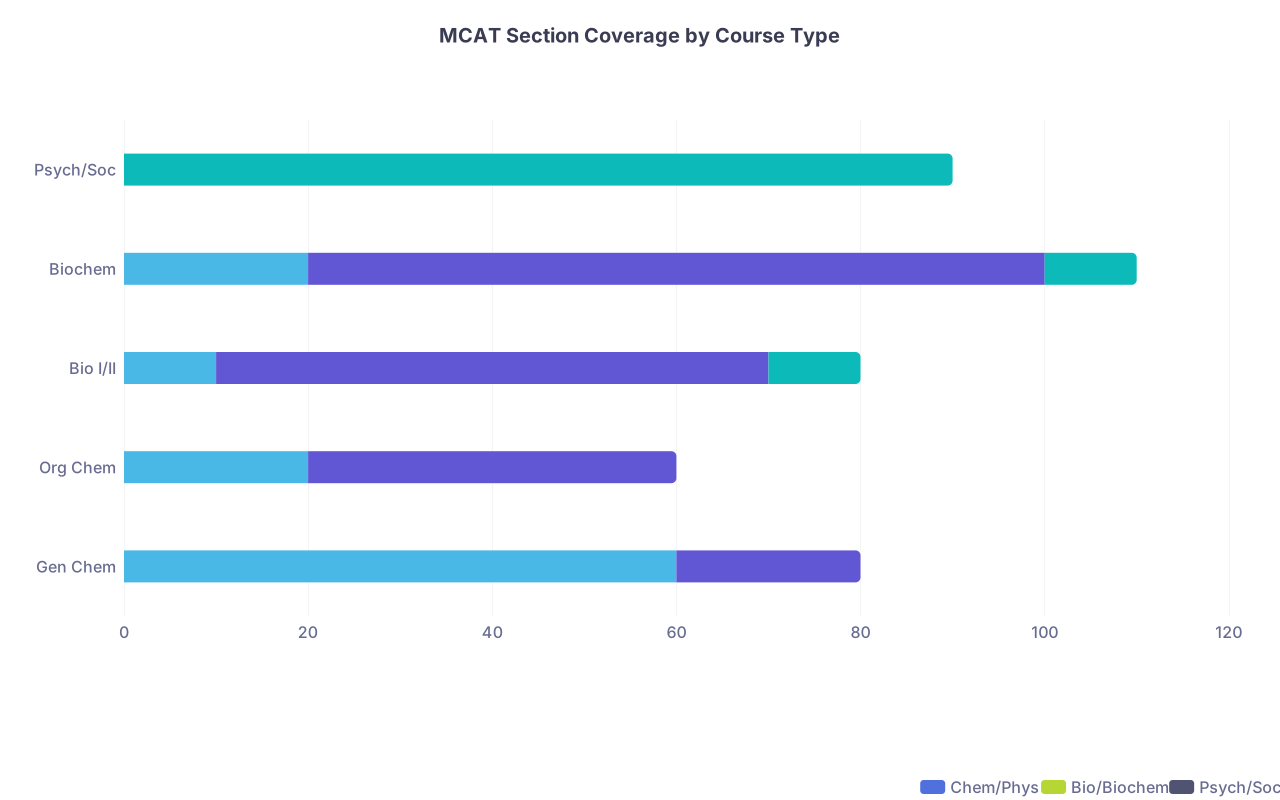
| Category | Chem/Phys | Bio/Biochem | Psych/Soc |
|---|---|---|---|
| Gen Chem | 60 | 20 | 0 |
| Org Chem | 20 | 40 | 0 |
| Bio I/II | 10 | 60 | 10 |
| Biochem | 20 | 80 | 10 |
| Psych/Soc | 0 | 0 | 90 |
This is not exact, but conceptually it is right: Biochem, Bio I/II, Psych/Soc are non‑negotiable if you want an efficient MCAT runway.
There is a tactical move I strongly recommend for late‑career folks: time biochemistry so it lands within 6–12 months of your MCAT. You want it fresh.
Example:
- If you plan MCAT in April of Year 3
- Take biochem in Fall or Spring of Year 2 or Fall of Year 3
- Start focused MCAT prep while you are in or just after biochem
Step 8: GPA Strategy – Repair, Reinvention, and Recent Trend
You cannot change your 2.6 GPA from 1999. You can build a 3.8+ last 40–50 science credits that forces adcoms to see who you are now.
For a late‑career applicant, the GPA narrative adcoms look at is:
- Cumulative UG GPA (yes, still matters)
- Science GPA (BCPM)
- Trend in recent, rigorous coursework
- Post‑bacc / graduate performance
If your old GPA is ≤ 3.0, you must treat your post‑bacc curriculum like a full academic reinvention:
- Aim for 40–60 new science credits
- Almost all A/A‑, one B is fine, two B’s are survivable, a C is a problem
- Include several upper‑division courses at a 4‑year school
If your old GPA is 3.2–3.4 with some science, you can:
- Do 24–36 credits of new science
- Focus on biochem, cell, genetics, physiology, orgo/physics repeats if necessary
- Target a clean upward trend with 3.7+ recent science GPA
Graduate degrees (MPH, MBA, MS) help only if your undergrad is borderline and your grad performance is excellent. They do not erase a bad undergrad science track. Your post‑bacc is where you prove you can handle medical‑school‑level content.
Step 9: Integrating Non‑Academic Realities Without Sabotaging Rigor
Now the uncomfortable part. You are not in a vacuum. You may have:
- Kids with events at 6 pm
- A partner who travels
- Aging parents
- A job that blows up unpredictably every quarter
Design your curriculum around worst‑case weeks, not best‑case.
A few hard‑earned rules I push on late‑career students:
- Never stack more than 2 lab sciences in a term if you are full‑time employed, unless your job is genuinely 30 flexible hours/week.
- Prioritize daytime sections if possible. You will be less fried at 3 pm than at 7–10 pm after a full day at work.
- Treat 12–15 credit “undergrad full time” as absolutely unrealistic if you are working and parenting. 6–9 credits of hard science can behave like 15+ hours when you include labs and studying.
- Plan for at least one “buffer” term every 12–18 months where you either:
- Take only 1 science course, or
- Focus just on MCAT / applications / clinical work
You are protecting longevity. Burning out in Year 2 is how people end up with half‑finished prerequisites and a stack of B‑ grades.
Step 10: Building Signal Beyond Classes (Without Overstuffing)
Your curriculum is not just titles on a transcript. It is part of a story: “I left a stable late‑career path to do this, and I am not dabbling.”
Integrate, but do not overload:
- Clinical exposure: ~3–4 hours/week longitudinally (scribing, MA work, hospice, ED volunteering). You do not need 100 different activities. You need continuity and reflection.
- Shadowing: Compressed into blocks – 40–60 hours across 1–3 physicians over a year or two. Many late‑career professionals overdo this at the expense of grades.
- Service: Choose one or two ongoing commitments aligned with your pre‑medicine narrative (community health, mentoring, underserved populations).
The correct sequence for a bandwidth‑limited adult:
Year 1: Classes first. Light shadowing or monthly clinical exposure at most.
Year 2: Add steady clinical work once you know you can maintain A‑level grades.
Year 3+: MCAT/application heavy; maintain but do not expand service/clinical roles unless they are low‑friction.
Step 11: Common Mistakes Late‑Career Returners Make With Curriculum Design
I have watched smart, motivated adults sabotage themselves the same ways repeatedly. Let me call out the big ones.
Trying to “make up for lost time” by overloading early.
First term back in school after 15 years, they sign up for Gen Chem I + Orgo I + Physics I “to accelerate.” Then they re‑discover what exams feel like and walk away with a B, C+, B‑. This starts the reinvention story in the wrong direction.Avoiding biochemistry because it looks scary.
Biochem is exactly what you want to do well in as a late‑career applicant. It screams “medically relevant.” Ducking it hurts both MCAT performance and admissions optics.Leaning too heavily on community college when other options exist.
I like CCs for access and cost, but if your whole post‑bacc is CC, you will have to answer quietly skeptical questions at mid‑tier MD programs.Letting work drive your schedule instead of your goals.
I see people who could reduce hours or negotiate flexibility but never ask, then blame work for a dragged‑out, diluted curriculum. If you are serious about this, you should at least try to restructure work.Underestimating MCAT prep.
They think, “I will just do questions on weekends for a few months.” That leads to a 502‑506 that does not match their narrative of “reinvented scientist.” You must treat the MCAT as its own phase.
Step 12: Putting It All Together – A Sample Custom Plan
Let me walk you through a realistic example.
Profile:
- Age 42, full‑time project manager, two school‑age kids.
- Undergrad 3.0 in Economics (graduated 2004).
- Took one semester of Gen Chem (C+) and one of “Intro to Biology for Non‑Majors” (B) back then.
- Has an MBA (3.8 GPA) from 2015.
- Wants MD or DO; realistic about aiming for mid‑tier, open to DO.
How I would structure a 3‑year curriculum:
Year 1
Fall:
- General Chemistry I + lab
- Intro Biology I + lab
Spring:
- General Chemistry II + lab
- Intro Biology II + lab
Summer:
- Psychology (online)
- Light start on shadowing (1 physician, 8–10 hours)
Year 2
Fall:
- Organic Chemistry I + lab
- Physics I + lab
Spring:
- Organic Chemistry II + lab
- Physics II + lab
Summer:
- Biochemistry (if offered summer; if not, push to Fall)
- Sociology (online)
- Increase clinical work to ~3 hours/week
Year 3
Fall:
- Biochemistry (if not yet taken)
- Physiology
Begin MCAT prep in August/September (content review, 8–10 hrs/week)
Spring:
- Genetics
- MCAT practice‑heavy phase (15–20 hrs/week Jan–April)
- Take MCAT in March/April
- Submit primary apps in June
She ends with:
- ~50 new science credits, almost all 3.7–4.0
- Recent, rigorous courses at a 4‑year university
- Solid MCAT timeline
- Longitudinal clinical work starting Year 2
That is how you build a credible, tailored path rather than stumbling term to term.
What You Should Do Next
You do not need a fancy “formal” post‑bacc to make this work. You need:
- A cold‑eyed assessment of where you are starting
- A clear end‑point (application year and realistic target)
- A term‑by‑term plan that respects your bandwidth but does not coddle you
Sit down with your transcript, your calendar, and your financial reality. Map out 6–8 terms, not 1–2. Decide when you will take biochem, when you will start MCAT prep, when you will intentionally under‑load to survive a brutal work cycle.
Once your curriculum skeleton exists, then you layer in clinical work, shadowing, and (eventually) application strategy.
With a tailored post‑bacc plan in place, you will not feel like you are “behind” the 22‑year‑olds. You will be running a different race entirely, on a track you designed. The next challenge is making sure your MCAT prep and application materials actually reflect the maturity and intentionality of your path. But that is a conversation for another day.