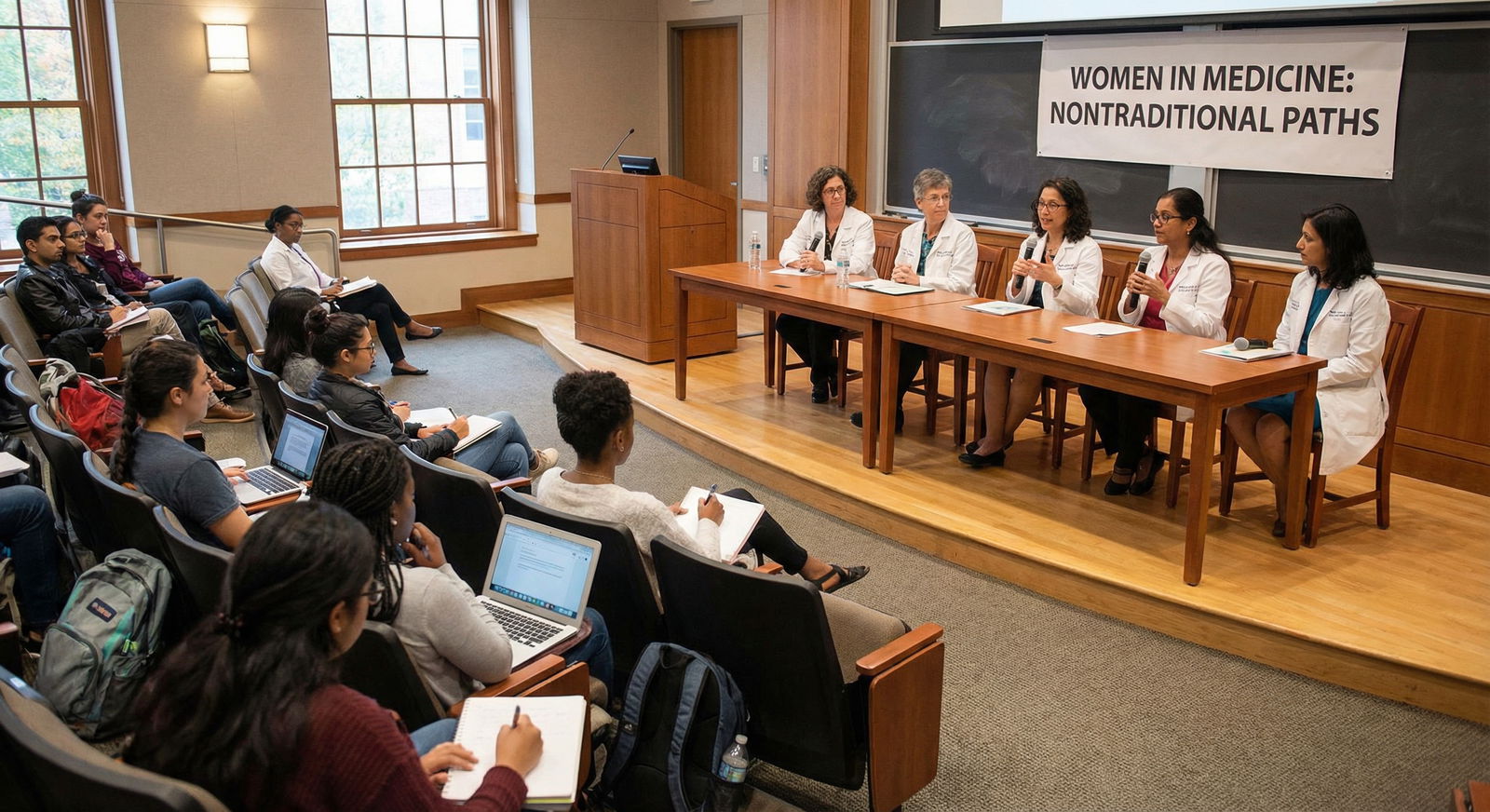
Only 17% of first‑year medical students report having a physician in the family. Yet almost every applicant acts like everyone else has an uncle who is a cardiologist.
They do not. You just feel behind because you can see their Instagram white-coat photos and you cannot see their cold emails, awkward coffee chats, and shadowing rejections.
Let me be blunt: “having zero healthcare contacts” is a temporary condition. If you treat it like a fixed identity, you will stay stuck. If you treat it like a logistical problem, you can fix it in 3–6 months.
I am going to walk you through how.
1. Stop Telling Yourself the Wrong Story
Most nontraditional and first‑gen premeds make the same mental mistake: they confuse “no contacts” with “no access.”
Those are not the same.
“No contacts” means:
- No physicians in your family.
- No close friends who are doctors.
- No alumni network that magically opens doors for you.
That is normal. That is not disqualifying.
You do have access to:
- Every physician who works at:
- Your local hospital system.
- Community clinics.
- Urgent care centers.
- County public health department.
- Every physician listed on:
- Your college or post‑bacc alumni directory.
- Specialty society “Find a doctor” pages (ACP, AAFP, ACEP, etc.).
- Every doctor with a LinkedIn profile, university email, or clinic email listed online.
The difference between the applicants who end up with 100+ hours of shadowing and 2–3 strong physician letters and those who do not is usually not background. It is process.
So you need a process.
2. Where To Actually Find Physicians (When You Know No One)
Vague advice like “network” is useless. You need concrete channels, specific keywords, and realistic expectations.
A. The three highest‑yield places almost everyone ignores
- Hospital volunteer offices
These are not there for decoration. Every mid‑size hospital has:
- A volunteer coordinator.
- Prebuilt volunteer roles.
- Existing policies for students.
You are not emailing random doctors. You are emailing the infrastructure that already exists to connect lay people with the hospital.
Your ask is specific:
“Are there any volunteer roles that bring me into regular contact with physicians or clinical teams? I am a premed / career changer and want to understand the day‑to‑day clinical environment.”
Volunteer → become a familiar face → ask about shadowing → get “yes” from someone who has already seen you show up reliably.
- Residency program coordinators
People underestimate program coordinators. Big mistake.
Residency programs care about:
- Pipeline.
- Goodwill in the community.
- Recruiting excellent medical students in the future.
They will not set up a full “shadowing program” for you. But a coordinator can:
- Forward your email to residents.
- Tell you if the hospital has a premed shadowing policy.
- Invite you to grand rounds or didactics that are open to learners.
You search “[Hospital Name] internal medicine residency coordinator” and send a concise, respectful ask.
- Physician faculty pages
Academic departments list:
- Faculty bios.
- Subspecialty.
- Sometimes direct emails.
- Sometimes “clinical interests” that basically tell you who likes teaching.
Who to target:
- Titles including:
- “Associate Program Director”
- “Clerkship Director”
- “Medical Student Education”
- “Preclinical Education”
- Family medicine, internal medicine, pediatrics, EM. They tend to be more accustomed to students.
You are not sending a generic blast. You are picking 5–10 whose bios suggest they might actually tolerate a student.
B. Specific search patterns that work
You sit down with a browser and you type:
- “[Your city] family medicine residency program faculty”
- “[Your city] hospital volunteer services”
- “[Local university] premed advising shadowing”
- “American College of [specialty] local chapter [state]”
Then you start building a spreadsheet. Names, roles, emails, notes, date contacted, response.
| Source Type | Who to Contact | Typical Yield |
|---|---|---|
| Hospital Volunteer Office | Volunteer coordinator | Clinical exposure, later shadowing |
| Residency Program | Program coordinator, APDs | Shadowing, conferences |
| Academic Departments | Clerkship / education faculty | Shadowing, mentorship |
| Community Clinics / FQHCs | Medical director | Longitudinal exposure |
| Alumni Network (college/post‑bacc) | Alumni office, alumni physicians | Warm contacts, advice |
If you are not building a list, you are just wishing. List building is where “no contacts” starts to convert into “an actual network.”
3. How To Write Emails Physicians Actually Answer
Most students write emails that scream: “I googled you five minutes ago and I want something from you.”
Physicians get dozens of those and ignore almost all.
Your email needs to be:
- Short.
- Specific.
- Respectful of their time.
- Clear about what you do not want (you are not demanding a letter).
Here is the anatomy.
Subject line: stop being vague
Bad:
- “Premed student request”
- “Shadowing opportunity???”
Better:
- “Premed student seeking brief career advice – [Your Name]”
- “Nontraditional premed hoping to learn about [specialty] – 15 min call?”
If you are contacting through a warm-ish connection (e.g., alumni):
- “Fellow [College Name] alum interested in [specialty] – 15 min?”
Body: the 7‑sentence rule
Keep it to about 7 sentences. Less is fine. More and you lose them.
Template you can actually use (modify, do not copy‑paste verbatim to 40 people):
Dr. [Last Name],
My name is [Name], and I am a [brief identity: e.g., “27‑year‑old career changer working in IT and completing premed coursework at X College”] in [City]. I am very interested in [their specialty or practice setting] and found your profile through [hospital site / department page / residency program].
I am trying to better understand what day‑to‑day clinical work actually looks like for physicians in [their field], especially as someone coming from a non‑traditional background. Would you be open to a brief 15–20 minute conversation by phone or Zoom at your convenience in the next few weeks? I would be grateful for any insight into how you think about your specialty and the path to medicine.
If it is appropriate within your institution’s policies, I would also be very interested in a limited shadowing experience after we speak, but a short conversation alone would already be extremely helpful.
Thank you for your time and for considering this.
Best regards,
[Name]
[1 line: current status – e.g., “Post‑bacc student at XYZ”]
[Phone]
[LinkedIn URL if decent]
Notice what this does:
- Makes a small ask first (conversation, not immediate shadowing).
- Acknowledges institutional policies.
- Places shadowing as an optional secondary step.
- Signals that you have thought more than 5 minutes about this.
If you are writing to an alumni physician, add one line:
I am also an alum of [School, Class Year], which is how I came across your name.
That one sentence doubles your odds.
4. How Many Emails, How Often, and When You Are Being “Annoying”
Most premeds send 3–4 emails, get no response, and declare, “No one will help me.”
That is not a network problem. That is a sample size problem.
Think more like this:
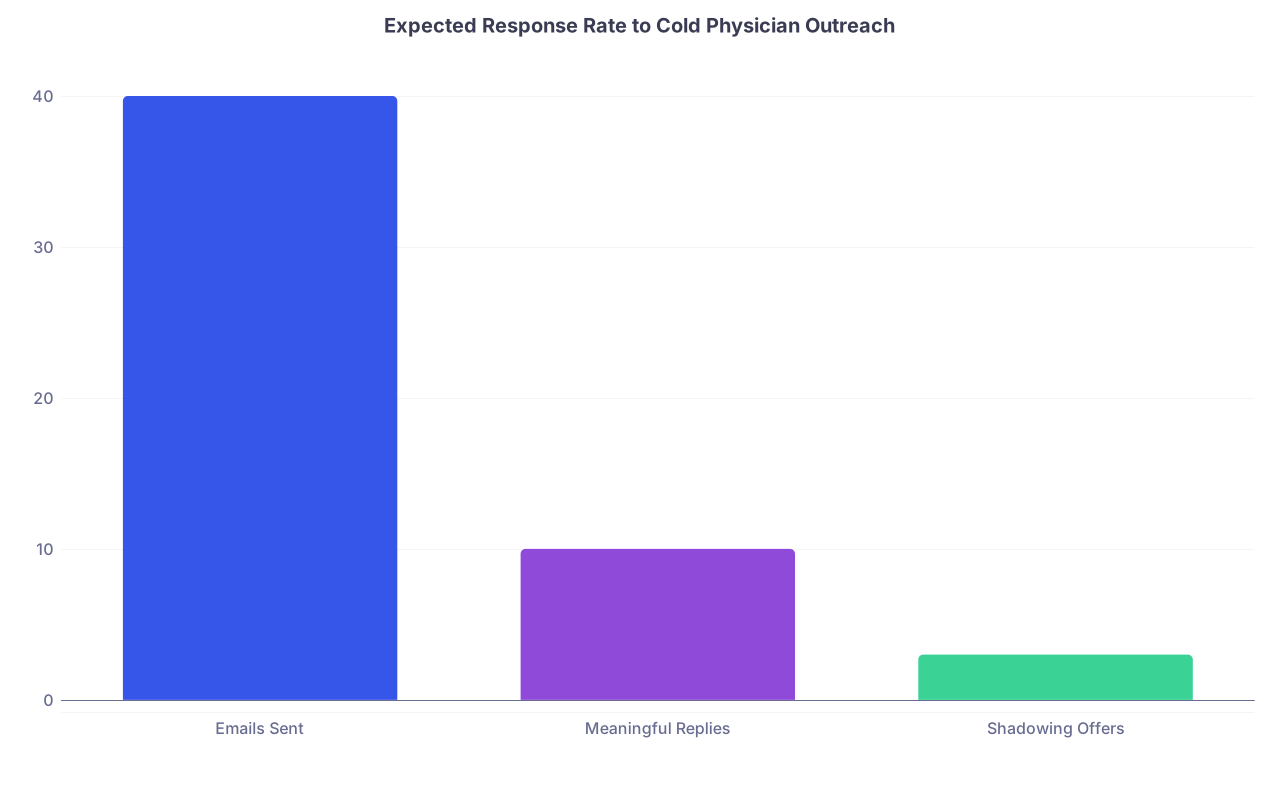
| Category | Value |
|---|---|
| Emails Sent | 40 |
| Meaningful Replies | 10 |
| Shadowing Offers | 3 |
Forty emails. Ten meaningful replies (often “happy to talk”). Maybe three actual shadowing or longitudinal mentorship relationships.
If your numbers are 4 emails → 0 responses, your “response rate” is not 0%. It is statistically nonexistent.
Follow‑up rules
You are not annoying if you:
- Send 1 polite follow‑up after 7–10 days:
- “Just bumping this to the top of your inbox in case it got buried. Totally understand if you are too busy.”
- Then let it go.
You are annoying if:
- You follow up three times.
- You show up at their clinic unannounced.
- You copy‑paste an obviously generic message to multiple physicians in the same small group practice. They talk to each other.
Plan on:
- 30–50 targeted outreach emails over 2–3 months.
- One follow‑up per non‑responder.
- Keeping a simple tracking sheet so you are not guessing.
5. Using “Nontraditional” as an Advantage, Not a Liability
Here is the part most career‑changers do not believe until they see it: a lot of physicians like nontraditional students.
Why?
- You have seen something other than school.
- You tend to flake less.
- You ask different questions.
You just need to package your story so it sounds coherent rather than chaotic.
Frame yourself clearly
One or two tight sentences that say:
- Where you are coming from.
- Where you are going.
Examples:
- “I have spent 5 years as a high school teacher and recently started a formal post‑bacc to prepare for medical school.”
- “I currently work full‑time in accounting and am completing my science prerequisites part‑time with the goal of applying to medical school in the next 2–3 years.”
No monologue about your childhood, no “I always wanted to be a doctor but…” saga. Those come later, if ever.
The identity that opens doors
Physicians are much more likely to respond when they see:
- You have already started doing something concrete (taking prereqs, volunteering).
- You are not just in the “thinking about maybe medicine” fantasy phase.
That is why you should time outreach:
- After you are enrolled in at least one science course or
- After you have at least one concrete clinical or volunteer experience to point to.
You do not need years. A simple “I volunteer 3 hours a week at [clinic]” signals that you are already moving.
6. What To Do Once You Actually Get a Meeting
This is where many students blow it. They finally get 20 minutes with a physician and treat it like a podcast interview.
You have two goals:
- Learn what you cannot Google.
- Earn enough trust that they are willing to help a bit more.
Preparation: 15 minutes, not 3 hours
You should know:
- Their specialty.
- Roughly what that specialty does.
- Where they practice.
- One or two specific things from their profile (teaching role, research interest, patient population).
You should not show up:
- With zero idea what internal medicine is.
- Asking them to explain what residency means.
Baseline knowledge is your responsibility.
Questions that work (and do not annoy)
Good:
- “What parts of your work give you the most energy?”
- “What parts of your day tend to drain you the most?”
- “If you were deciding on medicine now, with the current system, would you still do it?”
- “What do you wish premeds understood about your specialty before they commit to this path?”
- “For someone like me [briefly remind them of your background], what would you want to see in the next 1–2 years to be confident this is the right path?”
Bad:
- “Can you tell me how to get into med school?”
- “What GPA and MCAT do I need?”
- “Can you write me a letter of recommendation?” (on first or second meeting. Just no.)
Take notes. On paper. People notice when you respect their words enough to write them down.
Ending the meeting: how to keep the door open
You close with some version of:
“This has been very helpful. I do not want to take more of your time. Would it be alright if I checked back in after [milestone – e.g., finishing my first term of prereqs / getting my first clinical experience] to update you and possibly ask a couple more questions?”
Most will say yes. That is your tacit permission to follow up in 3–6 months.
If the conversation went very well and they seem enthusiastic:
“If, at some point, your schedule allows for it and your institution permits it, I would be extremely interested in shadowing you for a short period. If that is not feasible, I completely understand.”
You are offering them a chance to say yes without putting them on the spot.
7. Converting One Contact into a Small Network
If you only ever talk to one physician, you are relying on a single point of failure.
The most powerful question you can ask near the end of a good conversation:
“Is there anyone else you think I should speak with at this stage—perhaps someone in another specialty or setting whose perspective would complement yours?”
This does three things:
- Signals that you are serious.
- Leverages their own network.
- Often leads to warmer introductions (“I will CC you with my colleague Dr. X”).
In practice, here is what I have seen:
- One hospitable internist introduces a student to:
- A hospitalist.
- A primary care doc.
- A former resident now in EM.
- That student goes from zero to four physician contacts in 2–3 months.
You follow up properly, send thank‑you emails, and the web grows.
8. Shadowing Logistics and Institutional Red Tape
You will run into bureaucracy. HIPAA training, onboarding, badges, TB tests, vaccine records. Expect it.
Where students get stuck is thinking, “They probably will not allow shadowing.” Many hospitals formally “do not have a shadowing program” but informally tolerate a student following a physician who personally vouches for them.
The sequence that usually works
- Conversation (phone/Zoom/in person).
- Physician expresses openness to shadowing.
- You say:
“That would be wonderful. I know many hospitals have specific policies—would it be best for me to contact [volunteer office / medical education office], or is there someone on your end who handles student onboarding?”
- They connect you to:
- Volunteer office.
- Medical education office.
- Clinic manager.
Then you:
- Fill out forms quickly.
- Complete whatever training ASAP.
- Do not complain about the hassle.
How much shadowing is “enough”?
For credibility:
- 40–50 hours minimum.
- Spread across at least 2 different settings (e.g., primary care clinic + inpatient).
For admissions strength:
- 80–120+ hours is common among serious applicants.
- Depth with 1–2 physicians usually matters more than 10 one‑off visits.
You do not need 300 hours of standing in a corner. You need enough to talk intelligently about:
- The realities of physician life.
- How you reacted to witnessing patient care.
- What you learned that surprised or challenged you.
9. Using LinkedIn and Online Spaces Like an Adult, Not an Influencer
Most undergrads trash LinkedIn. Nontraditionals should not.
Here is how you use it without being weird:
Create a clean profile:
- Professional headshot (phone is fine, plain background).
- Headline like: “Post‑bacc Premed | Former [Profession].”
- About section: 3–4 sentences on your background and transition.
Search:
- “MD” or “DO” + your city.
- Filter by “Schools” = your college / grad school.
- Filter by “Industry” = “Hospital & Health Care.”
Send connection requests with a short note:
“Dr. [Last Name], I am a [School] alum currently transitioning from [field] to medicine and completing premed coursework. I would appreciate the chance to follow your posts and learn from your path. Best, [Your Name].”
You are not asking for a meeting yet. You are building lightweight connections.
After they accept and after you have some context (maybe you see a post, or you read their bio), you can send a slightly longer message very similar to the email template.
You still keep any ask small.
10. Time‑Boxed, Realistic 3‑Month Plan
If you want structure, do this:
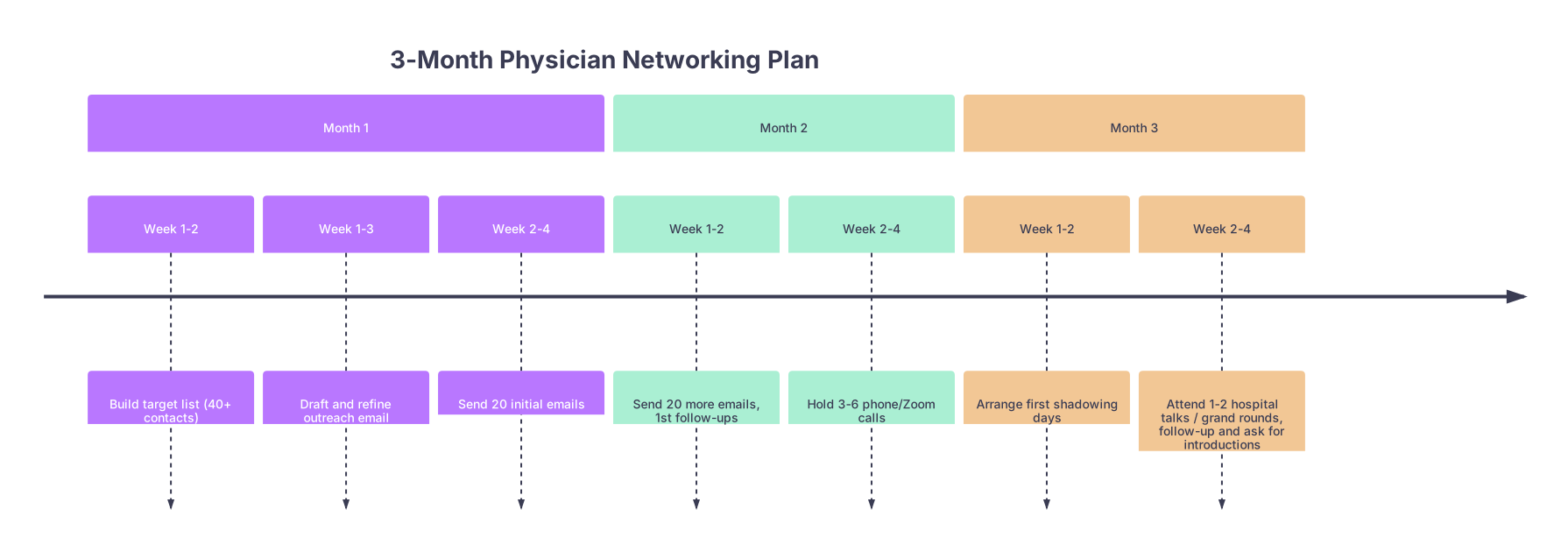
| Period | Event |
|---|---|
| Month 1 - Week 1-2 | Build target list (40+ contacts) |
| Month 1 - Week 1-3 | Draft and refine outreach email |
| Month 1 - Week 2-4 | Send 20 initial emails |
| Month 2 - Week 1-2 | Send 20 more emails, 1st follow-ups |
| Month 2 - Week 2-4 | Hold 3-6 phone/Zoom calls |
| Month 3 - Week 1-2 | Arrange first shadowing days |
| Month 3 - Week 2-4 | Attend 1-2 hospital talks / grand rounds, follow-up and ask for introductions |
If after 3 months you have:
- Sent ~40 targeted outreach messages.
- Had 4–8 real conversations.
- Shadowed at least one day or set it up.
Then you are no longer “someone with zero healthcare contacts.” You are an early‑stage applicant with the beginnings of a professional network. That is all you need at this phase.
11. How To Not Be Forgettable
You would be amazed how many otherwise promising students vanish after one shadowing day.
If you want a physician to remember you when it is letter‑writing time, you:
- Show up early.
- Dress like you respect patients (clean, conservative, appropriate).
- Bring a small notebook.
- Ask a few thoughtful questions at natural breaks. Not constantly.
- Never interrupt patient care to feed your curiosity.
Then afterwards:
- Send a same‑day thank‑you email with 2–3 sentences about what you learned.
- If you continue shadowing, give periodic updates:
- “I just finished my first semester of prereqs—biology and chem went well, A‑ and A.”
Six months later, when you ask:
“Would you feel comfortable writing a strong letter of recommendation for my medical school applications?”
You are no longer “That random student who shadowed me once.” You are “That persistent, respectful nontraditional student I have seen commit over time.”
That is a very different conversation.
FAQ (Exactly 4 Questions)
1. I am introverted and hate “networking.” Do I really have to do all this?
Yes. But do not call it networking. Call it “informational interviewing” and “professional curiosity.” You do not need to be charismatic. You need to be prepared, respectful, and able to send a clear email. Most of the “networking” is solo work: researching, writing, following up. The actual conversations are usually with adults who remember what it was like to be a student.
2. What if my local hospitals have strict “no shadowing” policies?
Many large systems have CYA policies that sound absolute but have loopholes. You pivot to:
- Ambulatory clinics (private practices, FQHCs, free clinics).
- Academic departments that allow observers through medical education channels.
- Hospital volunteer roles that, while not called “shadowing,” put you physically near clinical care.
And you lean harder into conversations and mentorship, which count just as much for personal growth and letters as pure shadowing hours.
3. How do I handle it if a physician is rude or dismissive?
Expect a few to be burned out, short, or frankly unpleasant. Do not internalize it. You thank them for their time, learn what you can (“this specialty’s culture might not be for me”), and move on. One negative interaction does not mean medicine is wrong for you. It just means that particular doctor is not your person.
4. How early should I start doing this if I plan to apply in 2–3 years?
Starting 2–3 years before you apply is ideal. Year 1–2: build contacts, get initial shadowing, start consistent clinical volunteering. Year 3: solidify mentorship, deepen relationships, and secure letters. But even if you are only 12 months out, you can still make serious progress if you treat this like a structured project rather than an afterthought.
Key points, without fluff:
You do not “lack connections”; you lack a system. A targeted, trackable outreach plan turns strangers into mentors in 3–6 months. And nontraditional status, presented clearly and backed by consistent follow‑through, is a networking advantage, not a handicap.