
The standard MCAT study advice assumes you have no kids, no job, and no real life. That advice will destroy you if you try to follow it as a working parent.
You do not need 8 hours a day and a color‑coded Notion dashboard. You need a brutally realistic, low‑friction system that fits around work, childcare, and the fact that you are exhausted most of the time.
This is that system.
Step 1: Stop Copying Traditional Premed Schedules
Let me be blunt: the classic “three-month intensive” MCAT plan is garbage for most nontraditional students.
What goes wrong:
- You plan 4–6 hours per day.
- Kids get sick. Work explodes. Sleep dies.
- You miss a week. Then another.
- You feel behind, panic, and quit or push the test back indefinitely.
The mindset shift you need:
- You are not behind. You are on a different track. Comparing your pace to a college junior living off dining hall food and parental support is pointless.
- Your constraint is not intelligence. It is time and energy. So your schedule has to be built around recovery and predictability, not just content.
- Consistency beats hero days. Two focused hours five days a week for nine months will beat random 6-hour bursts followed by burnout.
You win this by designing for your actual life, not your fantasy life.
Step 2: Define Your Reality Before You Pick a Test Date
Do not pick a test date first and then cram your life around it. That is how people burn through hundreds of dollars in rescheduling fees.
You start with constraints.
2.1 Map Your Non‑Negotiables
Take one evening and write out the hard edges of your life. No aesthetics. Just facts:
- Work schedule:
- Days and hours
- Commute time
- Predictable busy seasons (e.g., end of quarter, holidays)
- Parenting:
- Childcare coverage: daycare, school, partner, grandparents
- Bedtime and wake‑up windows for kids
- Custody schedule if co‑parenting
- Your body:
- Chronic conditions
- Times of day you are actually mentally sharp (for many parents: early morning or late evening, not both)
Now ask one question:
On a truly average week, how many hours can I reliably study without wrecking my health or relationships?
For most working parents I have seen succeed, the honest number is:
- 10–15 hours/week if you work full‑time and have young kids
- 15–20 hours/week if you work part‑time or your kids are older / more independent
Not aspirational hours. Reliable hours.
Write that number down. That number governs everything.
2.2 Turn Hours/Week Into Timeline
Next, connect your available hours to a realistic prep length.
As a rule of thumb:
- If you are aiming for 505–510 and have a solid science background:
- ~250–300 hours of focused study.
- If you are aiming for 510–515+ or your science is rusty:
- ~350–450 hours.
- If it has been 5–10+ years since your last science class or your GPA was weak:
- ~450–600 hours.
Now do the math:
- Example: Working full‑time, 2 kids under 6, rusty science.
- You can reliably do 12 hours/week.
- You target 450 hours total.
- 450 ÷ 12 ≈ 38 weeks → about 9 months.
This is why so many nontraditional students succeed with 9–12 month study plans, not 3‑month “bootcamps”.
Once you have that range, then you pick a test window that lines up with:
- Application cycles (for AMCAS, test by early June is ideal, July is acceptable)
- Work busy seasons
- Family events (births, moves, school transitions)
Do not sabotage yourself by scheduling your exam:
- Right after a new baby
- During tax season if you are an accountant
- During Q4 if you work in retail
- The same month as a major move
Step 3: Build a Schedule Around Energy, Not Just Time
Two hours at 10 p.m. after putting a teething baby down is not the same as two hours at 7 a.m. after sleep and coffee. You cannot treat all hours as equal.
3.1 Identify Your “High‑Yield Blocks”
You need 3 types of study blocks:
Deep work blocks (60–120 minutes)
Use these for:- Full‑length exams (FLs)
- Reviewing FLs
- Intensive practice on weak sections (e.g., CARS sets, passage-based practice)
Medium blocks (30–60 minutes)
Use these for:- Doing 2–3 passages with review
- Focused content review on a single topic
- Anki review of old material + 1–2 new concepts
Micro blocks (5–20 minutes)
Use these for:- Flashcards (Anki) on your phone
- Quick review of missed questions
- Short videos (if they are truly focused, not YouTube spirals)
Now match blocks to your reality:
- Early morning before kids wake up → usually deep or medium block
- Lunch break → medium block or micro block
- Sitting in the car at pickup line → micro block
- After bedtime → medium block for many people; deep if you are a night owl and not destroyed from work
3.2 Sample Weekly Structures for Working Parents
Here are three actual patterns I have seen work.
| Scenario | Hours/Week | M–F Plan | Weekend Plan |
|---|---|---|---|
| Full-time, two young kids | 12–14 | 4 days × 1.5 hr evenings | 2 × 3-hr blocks (nap + early morning) |
| Part-time, school-age kids | 16–18 | 3 days × 2 hr mornings + 2 × 1 hr evenings | 2 × 4-hr blocks (one FL, one review) |
| Shift work, shared custody | 10–12 | 2 long days off × 3–4 hr | 3–4 smaller 1–1.5 hr blocks on work days |
Key pattern: Most of your deep work happens on days off or weekends. Weekdays are for maintenance and smaller chunks.
Step 4: Use Phases, Not Chaos
You need structure. But not a 47‑page Excel monstrosity.
Think in three phases:
- Phase 1: Foundation (Content + Light Practice)
- Phase 2: Mixed (Heavy Practice + Targeted Content)
- Phase 3: Test Prep (FLs + Weak Spot Fixing)
4.1 Phase 1: Foundation (8–16 weeks for nontraditional students)
Goal: Rebuild the skeleton of your knowledge so practice questions are not pure guessing.
Approximate split:
- 60–70% content review
- 30–40% practice (discrete questions + easier passages + CARS snippets)
For working parents:
- Expect this phase to be slower. You are ramping up habits while your brain re‑learns how to study.
Weekly target (example, 12 hours/week):
- 4 evenings × 1.5 hours:
- 60 minutes content (one topic only)
- 30 minutes practice + review
- 2 weekend blocks × 3 hours:
- Block 1: Content (2 topics) + 2 passages
- Block 2: Mixed practice (5–6 passages) + review
Critical rules in Phase 1:
- Do not binge random content YouTube. Stick to:
- Kaplan, Princeton, or Khan Academy by topic
- Or a structured course if you paid for one.
- “Know it well enough to teach it to your teenager” is the standard. Not PhD‑level mastery.
- Start CARS immediately, even if only:
- 2 passages/day × 5 days/week.
4.2 Phase 2: Mixed (10–14 weeks)
Goal: Shift from “learning content” to “learning the exam.”
Approximate split:
- 30–40% content
- 60–70% practice (AAMC heavy)
Weekly target (12 hours/week sample):
- 3 weekdays × 1.5 hours:
- 1 hour passage practice (CARS or science)
- 30 minutes reviewing missed questions and updating notes/flashcards
- 1 weekday × 1.5 hours:
- Targeted content review on weak topics only
- Weekend:
- 1 × 3‑hour block: 1/2–split block test (e.g., 59 Chem/Phys questions, or 1–2 sections back to back)
- 1 × 3‑hour block: Reviewing that block test
This is where most nontraditional students start to feel the schedule crunch. You combat that by:
- Reducing new content load
- Increasing efficiency of review (more on that later)
- Ruthlessly cutting low‑yield fluff (over‑detailed biochem mechanisms, obscure psych terms that show up once in 10 exams, etc.)
4.3 Phase 3: Test Prep (4–8 weeks)
Goal: Simulate the real thing and eliminate predictable mistakes.
Approximate split:
- 70–80% FLs + review
- 20–30% targeted patching of weak spots
Ideal: 6–8 full‑length exams total (mix of 3rd party + AAMC), with at least 4 AAMC.
For a working parent at 12–15 hours/week, a realistic pattern:
- Week 1–2:
- Weekend: 1 FL
- Weekdays: 3–4 sessions of review + focused practice from weak areas
- Week 3–4:
- Same pattern, but maybe fewer new FLs if review quality is slipping
- Final 1–2 weeks:
- 1–2 AAMC FLs spaced out
- Lighter work the last 3–4 days, sleep prioritized
This phase is where a lot of people panic and try to add more hours. Be careful. Sleep and mental sharpness matter more than an extra 100 Anki cards.
Step 5: Design Daily Routines That Survive Real Life
A good schedule is not just blocks on a calendar. It is a repeatable ritual that you can execute on autopilot while tired.
5.1 Build a Pre‑Study Routine (5–10 minutes)
Same steps, every time. This conditions your brain to switch gears quickly.
Example:
- Put phone on Do Not Disturb.
- Open:
- Only two tabs: AAMC/Question bank + your notes/Anki.
- Set a timer:
- 25–30 minutes for a Pomodoro cycle.
- Quick review:
- 5 Anki cards from yesterday’s mistakes to “warm up.”
No chatting. No dishes. No “just checking email.”
5.2 Use Tight, Time‑Boxed Sessions
For most parents, open‑ended sessions are deadly. Something always interrupts.
Use planned sprints:
- 25 minutes: 1–2 passages.
- 30 minutes: 1 passage + review of each question.
- 45 minutes: 3 passages, light review, mark tricky ones for deeper look later.
- 90 minutes: CARS set (4–5 passages) + review, or targeted Chem/Phys set.
You decide at the start what the session is for. “Study MCAT” is not a task. “Do 3 Bio/Biochem passages and review” is.
5.3 Create “Emergency Backup” Plans
There will be days when the baby is up all night, or work explodes, and your 90‑minute block dies.
Your rule:
- If the original plan fails, downgrade to a 15–20 minute backup task. Do not skip entirely unless you are sick.
Backup list examples:
- 20 Anki cards
- Review 10 old missed questions from your error log
- One CARS passage
- Re‑watch a short video on a concept you consistently miss
This keeps the habit alive. Even during rough weeks.
Step 6: Pick and Use Resources Efficiently
You do not have time to wander through five different content sets and three Qbanks. You choose a small toolkit and squeeze it.
6.1 Minimum Viable Resource Set
You need:
Core content source
- Kaplan or Princeton Review books
- Or a comprehensive online course if you can afford it.
- Khan Academy videos (for targeted fill-in, especially psych/soc).
High‑quality question bank
- UWorld MCAT is excellent.
- Or Kaplan/Blueprint Qbanks.
AAMC materials (non‑negotiable)
- Question Packs
- Section Bank
- Official Practice Exams
Flashcard system
- Anki deck (Premade + your own edits)
- Or your own simple system if Anki overwhelms you.
A notebook or digital doc for your error log.
6.2 How to Avoid Drowning in Content
Rules:
One primary content source. Others are supplements for gaps, not second full reads.
For each topic (e.g., acid–base, kidney physiology), your process:
- 20–40 minutes: Read / watch focused material.
- 20–30 minutes: Do associated questions.
- 10–20 minutes: Capture:
- 2–3 key formulas
- 1–2 “classic traps” you fell into
- 1–2 Anki cards from what you missed.
That is it. No endless highlighting. No rewriting the textbook.
Step 7: Use Data, Not Vibes, to Adjust
You are not going to perfectly predict your needs in month 1. That is fine. You adjust based on feedback.
7.1 Build a Simple Weekly Review
Once a week (Sunday night is common), take 20–30 minutes and answer:
- How many hours did I actually study? (Not what I planned. What I did.)
- What percent of time was:
- Content
- Practice
- Reviewing practice
- What are my top 2 weak content areas this week?
- What test behaviors hurt me?
- Rushing
- Second‑guessing
- Not reading graphs properly
- What one thing will I change next week?
Track it. Not in a fancy app. A simple table is enough.
| Week | Hours Studied | Main Focus | Biggest Weak Area | Change for Next Week |
|---|---|---|---|---|
| 3 | 11 | Gen Chem, CARS | Acid-base, timing in CARS | Add 2 extra CARS passages on Wed/Fri |
| 4 | 13 | Bio/Biochem, Qbank | Enzyme kinetics | Make 10 Anki cards from missed questions |
| 5 | 10 | Mixed practice | Fatigue on 3rd section | Move hardest work to mornings |
7.2 Use Scores to Guide Shifts Between Phases
Rough benchmarks (not gospel, but useful):
When to move more heavily into practice:
- You can score in the 60–70% range on untimed topic questions, and you are not missing basics constantly.
When to lean heavily into AAMC practice:
- You have completed one pass of most major content.
- You are consistently:
- 70%+ on Qbank sets.
- But weak on passage interpretation and MCAT‑style reasoning.
When to take FLs seriously:
- You can sit for 3 hours and function.
- You are not missing 40–50% of easy questions due to pure content ignorance.
Step 8: Integrate Family and Work Support or You Will Burn Out
Solo‑hero mode fails eventually. You need people around you to understand what this exam means.
8.1 Have a Concrete Conversation With Your Partner / Co‑Parent
Not: “I need to study more.”
Instead:
- “From February to October, I need 12 hours/week for this exam. That is the difference between being able to apply once versus dragging this out for years.”
- “Here is what I am proposing:”
- Tuesday/Thursday: You handle bedtime while I study 7–8:30 p.m.
- Saturday: I take the kids 8–1, you get your time; Sunday 8–12 is my MCAT block.
You come to that conversation with a specific, written proposal. People respond better when they see a plan.
8.2 Use Micro‑Help
If you have any extended family or trusted friends, target specific asks:
- “Can you take the kids Friday 3–5 p.m. every other week so I can do a practice exam section?”
- “Once a month, could you do a Saturday morning with them so I can take a full-length?”
Do not assume people will say no. Many are more willing to help when they see you chasing a concrete goal.
Step 9: Manage Fatigue Without Letting Yourself Off the Hook
You will be tired. That is baked in. The trick is learning the difference between:
- “I am tired but can still do 45 minutes.”
- “I am so wrecked that anything I do tonight is junk.”
9.1 The 10‑Minute Rule
On nights when you want to bail, do this:
- Sit down, set a 10‑minute timer.
- Start your smallest task (e.g., 10 Anki cards or 1 short passage).
- At 10 minutes, ask:
- “Am I mentally functioning?”
- If yes → do another 20–30 minutes.
- If no → stop, sleep, and plan a make‑up 30 minutes during the week.
This prevents the “I skipped one night so the whole week is ruined so I might as well quit” spiral.
9.2 Non‑Negotiables During Prep
There are exactly three health domains you must protect or your performance will crater:
- Sleep: 6–7 hours minimum. Non‑negotiable.
- Caffeine control: Do not chase exhaustion with 600 mg of caffeine at 7 p.m. Then complain you cannot fall asleep.
- Movement: 2–3 short walks a week at least. Clears your head better than scrolling for 40 minutes.
You are already under heavy cognitive load. You cannot afford self‑inflicted damage.
Step 10: A Concrete 12‑Hour/Week 9‑Month Plan
Let me pull this together into something you can almost copy‑paste and modify.
Months 1–3: Foundation
Hours/week: ~12
Weekdays (4 × 1.5 hours)
- Mon: Chem/Phys content + 1–2 related passages
- Tue: Bio/Biochem content + 1–2 passages
- Wed: Psych/Soc content + 2 CARS passages
- Thu: Review + mixed questions (from all sections)
Weekend (2 × 3 hours)
- Sat:
- 90 minutes: content (rotate subjects)
- 90 minutes: 4–5 passages mixed
- Sun:
- 3 hours: Qbank questions by topic + detailed review
Goal by end of Month 3:
- Finished at least skim + practice of:
- General Chemistry
- Physics fundamentals
- Core Biology
- High‑yield Psych/Soc topics
- CARS: 6–8 passages/week.
Months 4–6: Mixed Phase
Hours/week: 12–14 (if you can bump slightly, do it here)
Weekdays
- 2 evenings: 1.5 hours heavy practice (3–4 passages) + 30 min review
- 1 evening: 1.5 hours of targeted content (only from your weakness list)
- 1 evening: 1.5 hours CARS focus (4–5 passages + review)
Weekend
- Sat: 3–3.5 hours
- 1–2 back‑to‑back sections (e.g., C/P then CARS)
- Sun: 3 hours
- Deep review of Saturday’s work + focused drilling on identified weak spots
Goal by end of Month 6:
- At least 1–2 third‑party FLs done (even if not in one sitting yet).
- AAMC Question Packs started.
- Score trend in practice sets heading into the low–mid 500s, even if not stable yet.
Months 7–9: Test Prep
Hours/week: 12–15
Every other weekend:
- Sat: Full length exam (AAMC or high‑quality third party)
- Sun: Review half of it in detail
Off weekends:
- Sat: 3 hours focused on weakest section practice
- Sun: 3 hours review + error log consolidation
Weekdays:
- 2 × 1.5 hours: Review FL sections (timing, patterns, traps)
- 2 × 1.5 hours: Targeted drills (e.g., CARS + your weakest science)
Final 2 weeks:
- 2 AAMC FLs, spaced out.
- Last 3–4 days: light practice only, early nights, minimal work stress if you can arrange it.
Here is a simple visualization of how your study hours might ramp up and stabilize across those 9 months:
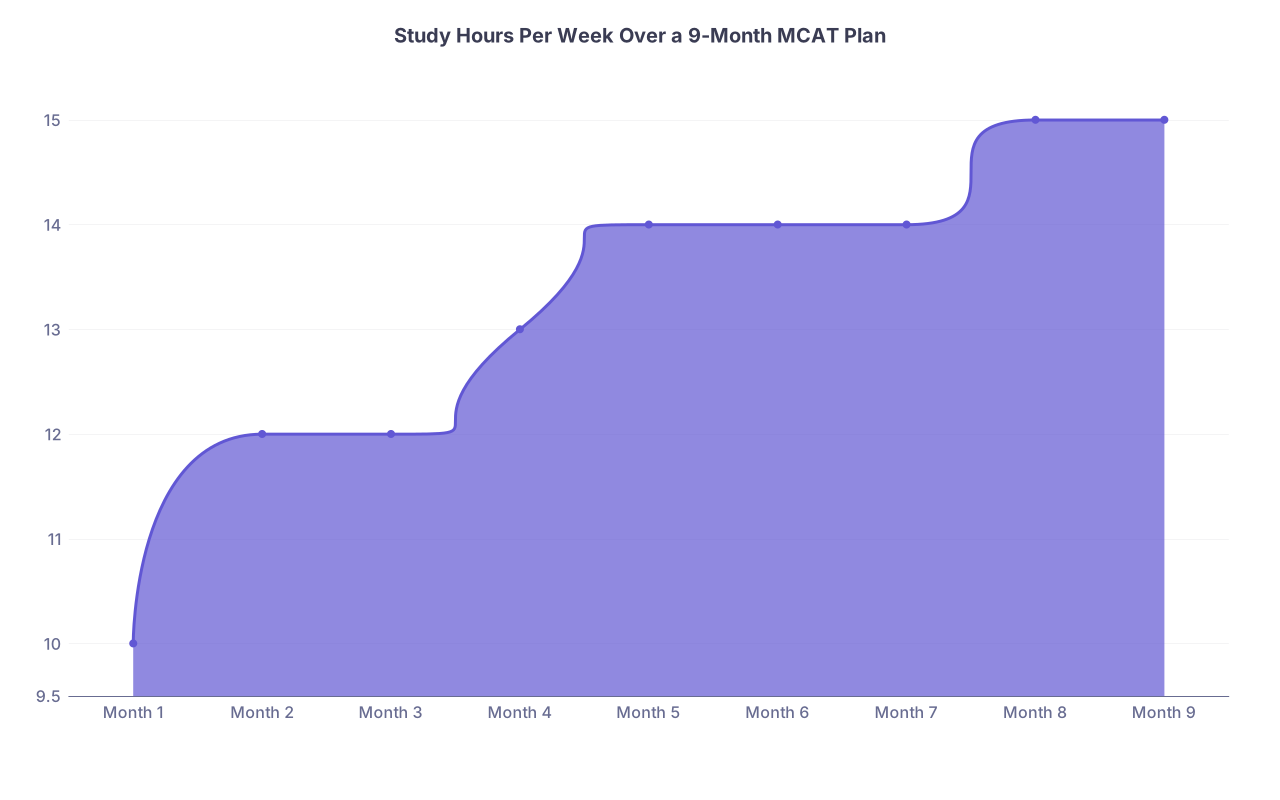
| Category | Value |
|---|---|
| Month 1 | 10 |
| Month 2 | 12 |
| Month 3 | 12 |
| Month 4 | 13 |
| Month 5 | 14 |
| Month 6 | 14 |
| Month 7 | 14 |
| Month 8 | 15 |
| Month 9 | 15 |
Step 11: A Quick Decision Map for When Life Blows Up
Because it will.

| Step | Description |
|---|---|
| Step 1 | Week Goes Off the Rails |
| Step 2 | Do 1 Extra 60-min Block Next Week |
| Step 3 | Add 2-3 hrs/week for Next 3 Weeks |
| Step 4 | Accept Lower Volume, Protect Sleep |
| Step 5 | Consider Pushing Exam 4-8 Weeks |
| Step 6 | Rebuild Plan with New Date |
| Step 7 | Missed >50% of Planned Study? |
| Step 8 | Exam >10 Weeks Away? |
| Step 9 | Scores Within Target Range? |
Use this instead of panicking. A bad week does not require a full restart. You either:
- Absorb the hit and slightly increase intensity, or
- Adjust the date before you blow up your whole life.
Final Thoughts: Your Schedule Is a Tool, Not a Report Card
Three things I want you to walk away with:
- You cannot study like a 20‑year‑old with no responsibilities. Stop trying. Build around your reality: 10–15 focused hours a week, for longer, will get you there.
- Structure beats motivation. Phases, weekly templates, and small daily rituals will carry you through the weeks when you are exhausted and doubting yourself.
- Data, not drama, should drive changes. Use weekly reviews, practice scores, and honest energy checks to adjust. Not guilt. Not comparison.
You are doing something hard. But it is doable with the right kind of discipline: not just pushing harder, but designing smarter.