
What if the thing you’re most worried about—the fact that you’re not a “perfect 21-year-old biology major who went straight through”—is actually one of the strongest assets in your application?
Let me be direct: the idea that admissions committees prefer traditional students is one of the most persistent, lazy myths in premed culture. It’s repeated by anxious undergrads, overconfident advisors, and forums full of people who have never sat in on a single admissions meeting.
Let’s pull this apart with data, not feelings.
The Myth: Committees Want 21-Year-Old Bio Majors With No Gaps
The standard script goes like this:
- You must be a science major.
- You must go straight from high school → college → medical school.
- Any gap years, career changes, community college credits, or messy timelines are red flags.
- If you are older than 24 or 25, it’s “too late” and schools won’t take you seriously.
That script is outdated. And sometimes just flat-out wrong.
Are there still schools and individual faculty with a bias toward “clean” timelines and traditional paths? Yes. Humans have biases. Medicine is not exempt.
But if you look at who is actually matriculating to medical school now—not just who people think gets in—the picture is very different.
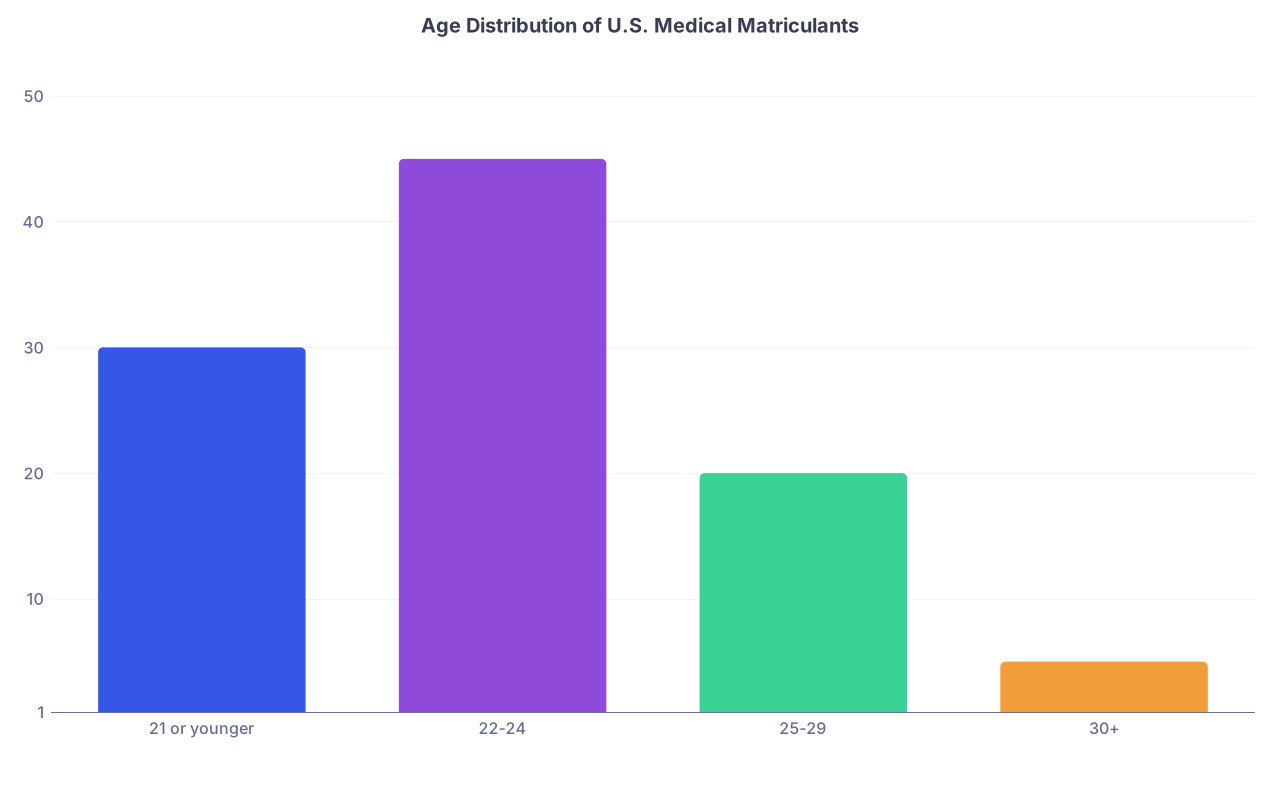
| Category | Value |
|---|---|
| 21 or younger | 30 |
| 22-24 | 45 |
| 25-29 | 20 |
| 30+ | 5 |
Those are representative ranges based on recent AAMC data patterns: the majority of matriculants are not straight-out-of-college 21-year-olds. Plenty are older. Plenty took gap years. Plenty changed careers.
So where did this “traditional only” fantasy come from? Mostly from people confusing simplicity with preference. A traditional applicant is easier to evaluate on a checklist. That doesn’t mean they’re more desirable when the committee actually starts arguing over who to accept.
What Admissions Committees Actually Have to Solve
Admissions committees don’t sit around saying, “Who is the most linear?” They’re trying to solve three main problems:
- Can this person handle medical school academically?
- Will this person show up well for patients and teams?
- Will this person graduate, pass the boards, and match into something?
Everything—GPA, MCAT, essays, interviews, nontraditional path, former career—gets filtered through those three questions.
Here’s the uncomfortable truth for traditional applicants: being “standard issue” answers almost none of those questions by itself. It just gives fewer data points to work with.
A former paramedic with a 3.6 post-bacc and a 512 MCAT? The committee knows this person has seen death, chaos, night shifts, bad outcomes. That tells them something real about resilience and motivation.
A 21-year-old with a 3.9 in biology and shadowing hours? Good start, but comparatively untested. That’s not a bad thing, but it’s not automatically more compelling.
I’ve heard actual admissions committee conversations that sound like this:
“Yes, the GPA is a hair lower, but this applicant managed that while working full-time and raising two kids. That matters.”
“This one has a 4.0 but I have no idea if they’ve ever had to deal with a real-world stressor that wasn’t an exam.”
Who do you think often wins that argument?
Data Reality Check: Who’s Actually Getting In?
Let’s look at a few realities nontraditional students keep missing because they’re too busy doomscrolling SDN.
Age and Gap Years
The AAMC has consistently reported that a massive portion of matriculants now have one or more gap years. Some schools’ classes are majority gap-year students. This alone destroys the idea that “straight through” is the expected default.
Plenty of entering M1s are 25–27. A nontrivial number are 30+. Not the majority, but not some freak rarity either.
What committees care about is not “Did you take time off?” but “What did you do with that time?”
- Worked as a scribe, nurse, EMT, tech, teacher, researcher, or in another serious field? That’s value.
- Floated with no clear growth, no pattern, no explanation? That’s a problem—whether you’re 23 or 33.
Age itself is not the issue. Trajectory is.
Majors and Backgrounds
The “must be a science major” myth is just lazy.
Non-science majors with strong prereq performance and solid MCATs are admitted every cycle. Schools brag about them in their marketing: music majors, philosophy majors, engineers, social workers.
What breaks people is not the major. It’s this:
- Weak science foundation
- Spotty or late premed realization without a coherent story
- Poor MCAT demonstrating gaps in core content
I’ve seen English majors with 520+ MCATs sail in. I’ve also seen biology majors with mediocre MCATs and no real clinical experience go nowhere. The major didn’t save them.
Where Nontraditional Applicants Actually Struggle
Here’s the part that stings: nontraditional students don’t get hurt because committees “don’t like them.” They get hurt because they often mismanage the parts of the process they can control.
Let’s be blunt.
1. Academic Repair Without a Strategy
A lot of career-changers or late bloomers have rough early transcripts. Fine. That’s fixable.
What committees want to see is:
- Clear upward trend, not random Bs scattered everywhere.
- Recent success in hard, upper-division sciences.
- Enough credits that your old GPA is contextualized, not erased.
What they actually get often looks like this:
- Two or three scattered post-bacc courses with decent grades.
- No full-time semester of rigorous science to show sustained performance.
- A mediocre MCAT that matches the old GPA rather than the new story.
Then the applicant blames being “nontraditional” instead of the weak repair.
2. Confused Narrative
Another recurring failure: the life story reads like a résumé dump with no spine.
“I worked in business, then I volunteered in a hospital, then I did some research, then I took classes, then I decided to apply…”
That isn’t a narrative. That’s a timeline.
The committee is asking: why now, why medicine specifically, and how do all your previous decisions make sense in hindsight? If they can’t answer that from your materials, being older just looks like drift, not maturity.
3. Underestimating Clinical Exposure
Some nontrads show up with amazing life stories… and almost no actual clinical work.
- Former engineer with 10 hours of shadowing.
- Veteran with no sustained patient-facing role after service.
- Corporate professional with tons of leadership, zero bedside time.
Committees are wary of people who’ve never really lived in the clinical environment and might bolt when they see what it’s actually like. Traditional or not.
If you’re nontraditional, your bar is higher here because you’re presumably more capable of arranging serious, longitudinal experience. You’re an adult. They expect you to act like one.
When “Traditional” Is Actually a Disadvantage
Now let’s flip this. Because the myth works both ways.
There are ways in which being a hyper-traditional, ultra-linear applicant is worse than being nontraditional.
Less Evidence of Real-World Functioning
If you’ve been on rails your whole life—AP classes, straight to college, no jobs beyond a summer thing at Starbucks—your whole profile might scream:
- Good test taker
- Good at school
- Totally unproven in actual work
Meanwhile, the 28-year-old nurse applying to med school has:
- Managed night shifts
- Dealt with dying patients and angry families
- Navigated hospital politics
- Maintained performance under real, not simulated, stress
If both of you have similar stats, guess who often looks like the safer, more mature bet?
Stereotyped Applications
Traditional students frequently turn in the most boring applications:
- Shadowing with no reflection
- Volunteer work that could have been done by anyone
- Research where they can’t explain what the lab actually studied
Nontraditionals often bring specificity: the exact moment they realized medicine made sense, concrete stories from real jobs, evidence of long-term persistence.
Admissions readers are human. They appreciate not being bored.
How Committees Actually Weigh “Nontraditional”
Let’s strip out the noise and be very clear: being nontraditional is neutral by default. It becomes a strength or a weakness based entirely on execution.
Here’s how it usually breaks down behind closed doors:
| Factor | Traditional Student | Nontraditional Student |
|---|---|---|
| Timeline | Simple, easy to follow | More complex, requires explanation |
| Academic Trend | Expected continuity | Upward trend can be a major asset |
| Life Experience | Often limited | Can be a major differentiator |
| Risk Perception | Predictable, but sometimes untested | Can be “safer” if proven in real-world settings |
| Story Potential | Often generic | High, if coherent and well told |
The key word here is coherent.
Nontraditional paths that look like: “I flailed for a decade and then med school seemed like a good salary” do not play well.
Nontraditional paths that look like: “Everything I’ve done keeps pushing me closer to medicine, and here’s the pattern” absolutely do.
A Realistic Playbook for Nontraditional Applicants
You want to stop worrying about whether committees “prefer” traditional applicants? Fine. Here’s what you should actually be doing.
1. Build a Brutally Clear Academic Signal
You need to give committees recent, unambiguous evidence that you can handle med school:
- A solid post-bacc or SMP with heavy science load and strong grades.
- An MCAT that matches or exceeds that new trajectory.
No half-measures. No one-off courses scattered over five years. You want them to say: “Whatever happened before, this person is academically ready now.”
2. Develop a Grown-Up Clinical Profile
Stop thinking in hours. Think in roles.
- Scribe, EMT, CNA, MA, nurse, RT, hospice volunteer, ED tech—something where you are consistently in the clinical environment.
- Longitudinal involvement so you can speak to growth, not just exposure.
You’re not checking a box. You’re accumulating proof that you understand the world you’re trying to enter.
3. Turn Your “Weird Path” Into a Cohesive Thesis
Your goal is that an admissions reader can answer, without guessing:
- Why you started where you started.
- What changed.
- Why medicine is the only path that now fits.
- How your prior life makes you an asset, not a liability, to medicine.
If they have to work to connect the dots, you’ve failed.
Reality: The Hidden Advantage of Being Nontraditional
The irony is that, when done well, a nontraditional path often gives you something most traditional applicants are desperate for: distinctiveness grounded in reality.
You’re not “another biochem major with decent grades and hospital volunteering.”
You’re:
- The special ed teacher who spent five years advocating for underserved kids.
- The Marine corpsman who has actually resuscitated a human being.
- The software engineer who built tools for healthcare systems and saw the gaps up close.
- The single parent who juggled full-time work, school, and caregiving without dropping any of them.
Those are not liabilities. They’re exactly the kind of experiences that, when paired with solid academics, make committees fight for you in the room.
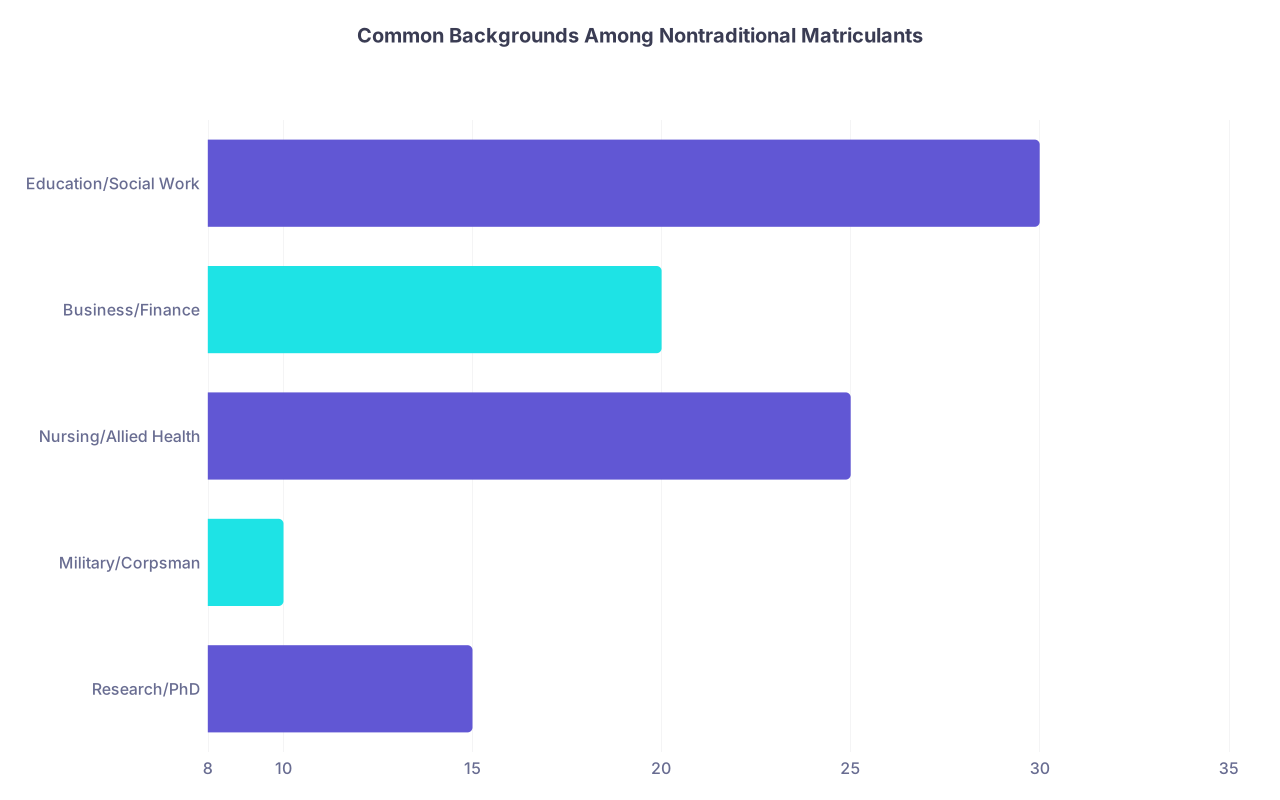
| Category | Value |
|---|---|
| Research/PhD | 15 |
| Military/Corpsman | 10 |
| Nursing/Allied Health | 25 |
| Business/Finance | 20 |
| Education/Social Work | 30 |
Do committees “prefer” these people? Not automatically. But when it comes time to fill a class with people who will bring different skills, perspectives, and resilience, they’re often at an advantage.
Timeline Reality: Nontraditional Paths Are Now Normal
Before we wrap this up, let’s put the whole process in a bigger frame.
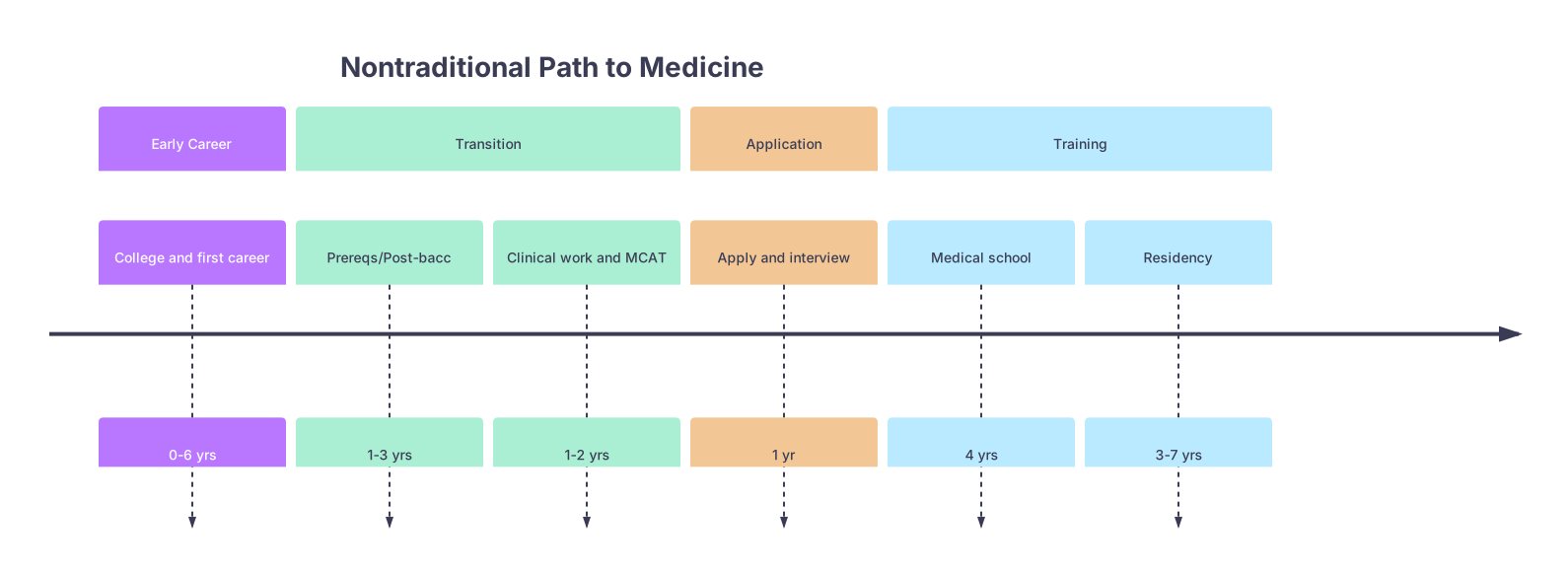
| Period | Event |
|---|---|
| Early Career - College and first career | 0-6 yrs |
| Transition - Prereqs/Post-bacc | 1-3 yrs |
| Transition - Clinical work and MCAT | 1-2 yrs |
| Application - Apply and interview | 1 yr |
| Training - Medical school | 4 yrs |
| Training - Residency | 3-7 yrs |
By the time you’re mid-residency, no one cares whether you started at 22 or 32. They care whether you’re competent, reliable, and not a disaster in front of patients.
This is why the “too old” anxiety is so misplaced. The people who actually work with residents care about capability, not the age on your ID.
FAQs
1. I’m in my early 30s with a completely different career. Is it even realistic to start now?
Yes, if you’re willing to treat this as a multi-year, full-commitment transition. You’ll need to prove current academic strength (post-bacc or similar), get real clinical exposure, and explain your shift with brutal clarity. Age alone won’t block you; half-hearted execution will.
2. I have a low undergraduate GPA but strong recent post-bacc grades. Will schools still hold my old GPA against me?
They will consider it, but what matters is the pattern. A clear upward trend with a full year or more of rigorous science and a solid MCAT can absolutely rehabilitate an old GPA. Many nontraditional matriculants have exactly that story: weak start, strong finish, believable explanation.
3. Does starting at community college hurt nontraditional applicants more?
Not if you handle it correctly. Committees see community college backgrounds all the time, especially for nontraditional and lower-SES students. The key is showing you can excel later at a 4-year institution with upper-division sciences. If your recent performance is strong, CC credits are context, not a stain.
4. Should I disclose personal struggles (burnout, layoffs, family illness) that explain my nontraditional path?
If those events directly shaped your trajectory and you can describe them without sounding like you’re asking for pity, yes. Context helps committees interpret dips, gaps, or shifts. The line you don’t cross is turning your application into a therapy session. Own the struggle, then emphasize growth, responsibility, and what you did next.
Key points:
- Admissions committees don’t inherently prefer “traditional” students; they prefer applicants who are academically ready, clinically informed, and personally coherent—traditional or not.
- Being nontraditional is neutral by default and becomes a strength when you show a clear upward academic trend, serious clinical experience, and a cohesive narrative that makes sense of your path.
- If you execute those pieces well, your “nontraditional” background is not your problem; it’s very often the reason they remember your file when it’s time to vote.