
You are not “too old” for medical school. The data simply does not support that story people keep repeating to you.
There are real tradeoffs with starting later. There are also very real advantages that almost no one talks about because the conversation gets stuck on anxiety and vibes instead of numbers and outcomes. Let’s fix that.
I’m going to walk through what the evidence actually shows about age, performance, matching into residency, burnout, and career longevity. Not the folklore from your cousin’s friend’s dermatologist.
Myth #1: “Older Students Don’t Get In”
People love to declare this like it’s a natural law: “Admissions committees want 22-year-olds. Once you’re past 30, it’s basically impossible.”
Data says otherwise.
The AAMC and many individual schools publish age distributions. The average starting age of U.S. MD matriculants is about 24, but that’s an average, not a cutoff. You see a long right tail—people in their late 20s, 30s, and yes, even 40s.
A few patterns that actually show up:
- Every entering class has nontraditional students. Commonly 5–15% depending on the school.
- DO schools and some newer MD schools often have higher proportions of older matriculants.
- Age itself is not a disqualifier. Weak academics and a confused story are.
The part people confuse: correlation vs gatekeeping. Fewer 35-year-olds apply. That does not mean 35-year-olds get rejected at higher rates because of age. They self-select out earlier, often because they’ve absorbed exactly the myth you’re asking about.
When adcoms actually talk about this (and they do, openly, at places like admission webinars, podcasts, and panels), they say things like:
- “We like applicants who have done something real before med school.”
- “Nontraditional students are often more mature and better at coping with stress.”
- “We care more about recent academic performance than how long ago undergrad was.”
They do not say: “We reject people over 30.”
If you want the blunt version: schools love a compelling nontraditional story because it diversifies their class, as long as you prove you can hack the academics and understand what medicine really is. Age isn’t the problem. Sloppy preparation is.
Myth #2: “Older Students Perform Worse in Med School”
The short answer from the research: not really, and often the opposite.
Studies looking at age and academic performance consistently find one of these three patterns:
- No meaningful difference in academic performance once you adjust for prior academic strength.
- Slight advantages for older students in clinical performance and professionalism ratings.
- In early preclinical years, younger students might sometimes perform a bit better on pure basic science tests, but that gap doesn’t predict who’ll be a good doctor.
There are a few reasons older students tend to do well:
- You’ve held real jobs. Showing up on time, taking responsibility, following through—these aren’t aspirational; they’re muscle memory.
- You’re usually more efficient. You’ve already learned how you study best, what your distractions are, and how to manage your own time.
- You’re often more motivated. You’re not there because “it seemed like the default after a bio degree.” You burned your life down to come back. That shows.
Where older students do struggle:
- Re-learning how to be a full-time student if you’ve been out of school 5–10+ years.
- Ego punches. Going from senior engineer, manager, nurse, teacher—to “MS1 who doesn’t know what a gap junction is” can sting.
- Tech hurdle sometimes: not because older people can’t use tech, but because med ed platforms are a mess and learning them feels like a tax when you’re already juggling kids, mortgages, etc.
None of that is destiny. It just means if you’re 32 and haven’t taken biochem since the Bush administration, you need to test your academic readiness before you jump.
That’s exactly what many successful nontrads do: a DIY post-bacc, a few upper-division sciences, or a formal career-changer program to prove they can still pull A’s in hard courses.
Myth #3: “Residency Programs Don’t Want Older Grads”
This one has just enough truth to be dangerous.
Programs do worry about certain things that sometimes correlate with age:
- Physical stamina for surgically demanding fields
- Long gaps that are unexplained or full of half-hearted career hopping
- Applicants who seem rigid, resistant to feedback, or “stuck in their ways”
Notice what’s missing: “We reject you for being 38.”
When program directors are surveyed (NRMP does these regularly), the heavy hitters for ranking applicants are:
- Clinical grades
- Step/COMLEX scores (or pass timing and narrative now that Step 1 is P/F)
- Letters of recommendation from people they trust
- Perceived fit and professionalism
- Evidence you actually like and understand the specialty
Age and graduation year barely register compared to those.
Yes, some highly competitive specialties skew younger and “traditional.” Dermatology. Plastics. Ortho. ENT. Those pipelines are often straight-through: undergrad → med school → residency with minimal detours. A 41-year-old career changer trying to break into derm can do it, but you’re playing on hard mode.
Other specialties quietly love nontraditionals:
- Family medicine
- Internal medicine
- Psychiatry
- Pediatrics (depending on program)
- PM&R
- Pathology
- EM (though the market is rough right now, so be cautious)
You’ll sometimes see older interns and residents in surgery, anesthesia, OB/GYN too. They’re just less loud on Reddit.
The honest constraint is less “will any program rank me” and more “how many years do I want to be a trainee with limited income while peers are hitting peak earnings.” That’s a math and values problem, not an age-discrimination inevitability.
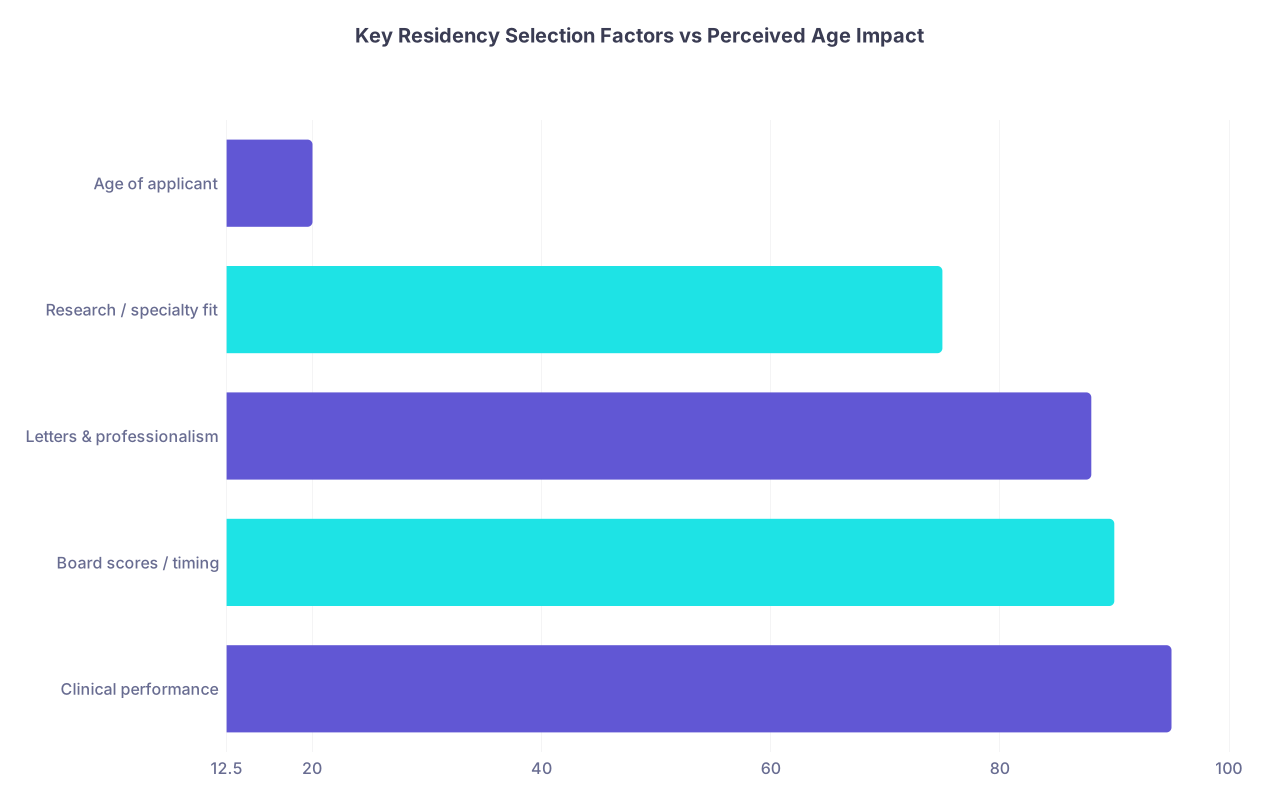
| Category | Value |
|---|---|
| Clinical performance | 95 |
| Board scores / timing | 90 |
| Letters & professionalism | 88 |
| Research / specialty fit | 75 |
| Age of applicant | 20 |
Myth #4: “You’ll Burn Out Faster Because You Started Late”
The burnout story is twisted.
You hear: “If you start at 35, you’ll be exhausted and regret it at 50.”
Reality: younger physicians are not magically protected from burnout. In some datasets, early-career physicians have higher burnout rates than more senior ones.
Background before medicine matters more than age at matriculation:
- People coming from high-burnout fields (ICU nursing, consulting with 80-hour weeks, military deployments, grinding startups) often handle the stress better because med culture doesn’t shock them.
- People with no prior serious work experience sometimes get crushed by the mismatch between their idealized view of medicine and the reality of EMR clicks, prior auth nonsense, and perpetual productivity pressure.
Older trainees do face specific burnout risks:
- Financial anxiety if you have dependents and real bills.
- Feeling chronically behind peers your age in other industries.
- Less tolerance for pointless busywork and performative tasks—and residency has a lot of that.
But they also have specific buffers:
- Stronger identity outside medicine. You’ve already been something else. Medicine isn’t your only marker of worth.
- More developed coping strategies and social networks.
- Usually a clearer “why,” which is protective when the “what” feels terrible.
Burnout is more about system dysfunction + personal expectations than your birth year.
Myth #5: “The ROI Isn’t Worth It If You Start After 30”
This is where people suddenly become amateur financial analysts, waving around phrases like “opportunity cost” and “net present value”—usually to scare you, not to help you think clearly.
Let’s do a cleaner version.
The Financial Reality (Not the Reddit Panic Version)
Assume you’re 32.
- Med school: 4 years
- Residency: 3–7 years depending on specialty
- Attending age start: roughly 39–43
Your peers in other professional fields may already be at or near peak earning by then.
But physician incomes, even in the lower-paying specialties, are not trivial.
| Specialty | Approx Annual Range (USD) |
|---|---|
| Family Medicine | $230k–$280k |
| Internal Medicine | $240k–$320k |
| Pediatrics | $220k–$260k |
| Psychiatry | $260k–$340k |
| General Surgery | $350k–$500k |
| Anesthesiology | $400k–$600k |
Even if you “only” practice 20 years, the cumulative earnings can still outpace many other careers, if you manage debt reasonably and don’t inflate your lifestyle too fast.
Where ROI gets shaky:
- Massive private med school tuition (think $70k+/year) + cost of living in expensive cities, without scholarships, plus heavy consumer debt.
- Choosing a long, low-paying training path (e.g., 7-year academic neurosurgery) if you’re already close to 40 and planning to retire early.
- Entering medicine when you already have a very high-paying established career (e.g., senior software engineer making $350k+ with good equity) and no strong non-financial reasons to switch.
The more honest question is:
Are you willing to trade:
- 7–10 years of training and lower income
- Higher debt and financial pressure
- Some physical and emotional stress
for:
- Work that may align much better with your values
- A career with clear social utility
- High long-term earning potential
- Skills that remain relevant for decades
Some people will say yes, even at 40. Others will say no at 27. That’s not about “too old”; it’s about what kind of life you’re trying to build.
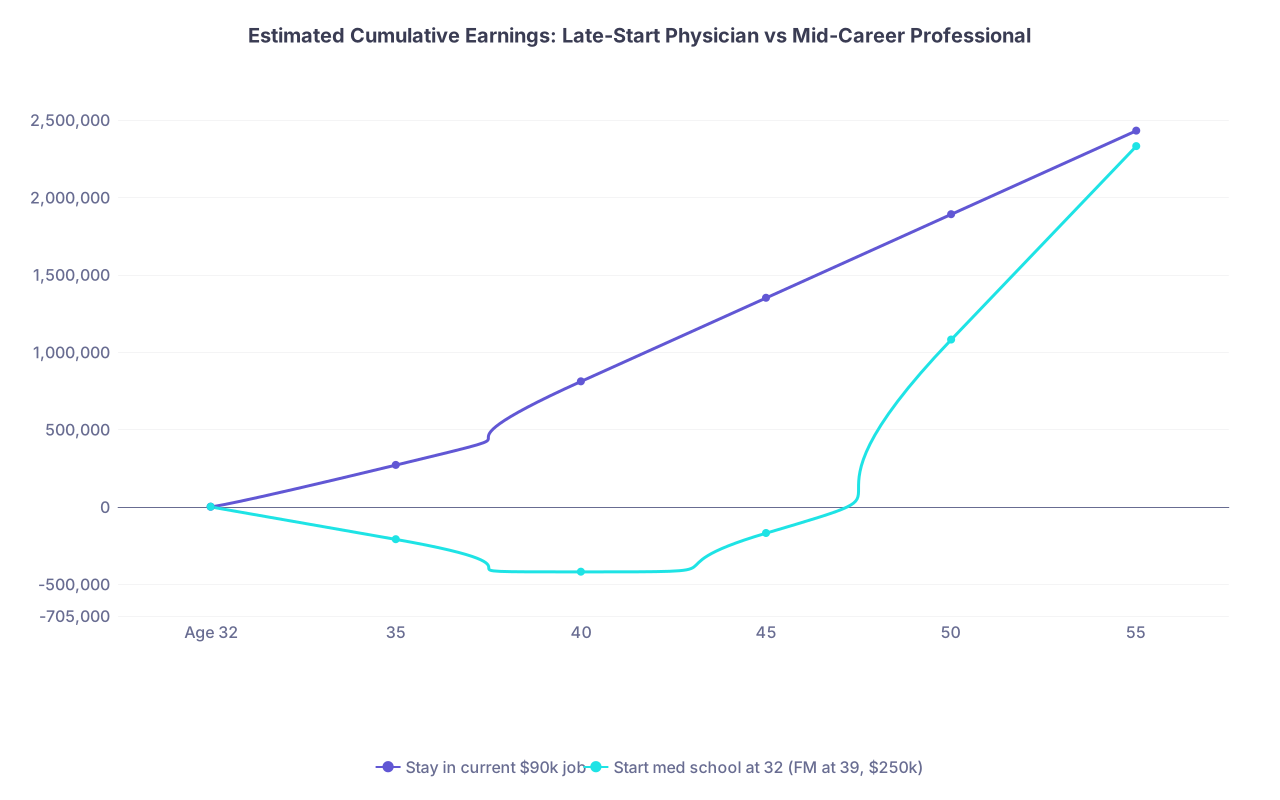
| Category | Stay in current $90k job | Start med school at 32 (FM at 39, $250k) |
|---|---|---|
| Age 32 | 0 | 0 |
| 35 | 270000 | -210000 |
| 40 | 810000 | -420000 |
| 45 | 1350000 | -170000 |
| 50 | 1890000 | 1080000 |
| 55 | 2430000 | 2330000 |
(Those are rough illustrative numbers with many assumptions—but you get the idea: the financial story is complex, not categorically “bad” after 30.)
Myth #6: “Older Students Don’t Fit In Socially”
You’ve probably pictured yourself at 36 sitting in a lecture hall surrounded by 22-year-olds talking about TikTok and bar crawls, wondering what you’re doing with your life.
Pieces of that are true:
- Many younger classmates will be fresh from college, still in student-life mindset.
- Your priorities (kids, mortgage, spouse, aging parents) will be different.
- Some social events will feel like undergrad 2.0, and you’ll skip them. Good.
But here’s the part people ignore: med school classes are not homogeneous anymore.
- You’ll see students who did Teach for America, post-baccs, MPH, military service.
- You’ll meet classmates who worked as scribes, EMTs, nurses, lab techs, engineers.
- There will be people in long-term relationships, people with kids, people your age or older in every class at most schools.
I’ve heard the same line from dozens of older students:
“I was terrified I’d feel out of place. Two weeks in, I found ‘my people’ and forgot about the age gap.”
You’re not trying to be everyone’s best friend. You’re trying to find the subset of classmates who share your values, work ethic, and sense of humor. That exists in every cohort.
What older students do need to watch:
- Coming in with a “I’m wiser than all of you” vibe. That grates on younger classmates and residents—and they will talk about it.
- Isolating completely because “no one gets my life.” You don’t have to go clubbing, but you do need peers, study partners, and allies.
- Letting impostor syndrome about age push you into overcompensation—overexplaining, overjustifying.
You’re not a guest in someone else’s party. You’re part of the class.

Myth #7: “Admissions Will See My Age as a Red Flag”
No. They’ll see holes in your story as a red flag.
Age by itself doesn’t sink an application. What hurts you is:
- Long, unexplained gaps with zero productive activity
- Skimpy or superficial clinical exposure, especially if you’re changing careers
- Weak recent coursework or MCAT scores that suggest academic rust
- An application that reads like “I just realized medicine might be fun” at 35 with no track record
What helps older applicants:
- Clear narrative: “Here’s what I did, what I learned, and why that led me to medicine.”
- Demonstrated academic readiness in the last 2–3 years (post-bacc, DIY upper-level sciences, solid MCAT).
- Depth of clinical experience: volunteering, scribing, MA work, nursing, paramedic, etc.
- Realistic specialty expectations. Saying “I’m 39 and committed to neurosurgery or nothing” will raise eyebrows.
If you’re 33, applying with a 3.2 GPA from a decade ago, no recent science, and a shaky 502 MCAT—adcoms aren’t rejecting your age. They’re rejecting weak academics and poor evidence you can survive the firehose.
You fix that by:
- Doing recent, rigorous coursework and crushing it
- Taking the MCAT seriously, not as a box check
- Building longitudinal clinical experience and reflecting on it like an adult, not like a college sophomore padding a CV

| Step | Description |
|---|---|
| Step 1 | Decide to pursue medicine |
| Step 2 | Assess old GPA & academics |
| Step 3 | Post-bacc or upper-level sciences |
| Step 4 | Plan MCAT timeline |
| Step 5 | Clinical exposure & shadowing |
| Step 6 | Refine narrative & school list |
| Step 7 | Apply strategically |
| Step 8 | Recent science success? |
The Real Constraints You Should Respect
Here’s where I stop cheerleading and get specific about where age does matter.
Age should weigh heavily in your decision if:
- You have major caregiving responsibilities and no reliable support. Med school and residency will not magically make childcare or eldercare easier.
- Your health is fragile in ways that prolonged stress, sleep deprivation, and physical demands could significantly worsen.
- You’re already financially precarious, with no realistic plan to manage another 6–10 years of training and debt.
- You are attached to retiring early or have a hard limit in your 50s, and you’re just starting at 40+.
You can still choose medicine in those situations. But you should go in with eyes open and maybe with adjusted specialty and practice-style expectations.

So, Are You “Too Old” for Med School?
You might be too old for the fantasy version you’ve been carrying around: effortless straight path, prestige specialty, early retirement, zero compromise.
But for actual medicine—the messy, human, system-burdened, deeply impactful thing we still call a profession—you’re probably not too old at all.
Here’s the distilled version of what the evidence and real-world patterns say:
- Age alone isn’t what blocks older applicants. Academic readiness, thin clinical exposure, and a weak story do.
- Older students perform at least as well, often better, especially in clinical and professional domains.
- Residency programs care overwhelmingly more about performance and fit than your birth year.
- Burnout isn’t age-specific. Your expectations and prior experiences matter more.
- Financial ROI depends on your starting point, debt, specialty, and life goals—not some magical age line in the sand.
- Socially, it’s different, not impossible. You won’t be the only one.
The real question is not “Am I too old?” The real question is:
“Given my age, responsibilities, finances, and values, am I willing to pay the actual price of this path—and do I like the kind of doctor and person this path will probably turn me into?”
Years from now, you won’t be counting how many cycles you debated your age. You’ll remember whether you told yourself the truth, did the hard math, and made a decision you can live with when the pager goes off at 3 a.m. or when you hand in your badge for the last time.