
The way most nontraditional applicants explain their pivot to medicine is confusing, defensive, or forgettable. You can do better in three steps.
You are not just “changing careers.” You are asking gatekeepers to bet on you in the most resource‑intensive training pipeline in education. If your story is muddy, vague, or overloaded with every life event since childhood, you lose them. Fast.
Here is the framework I teach career‑changers who actually get into medical school:
- Define a specific turning point.
- Connect your past to medicine with concrete transfer skills.
- Show a disciplined track record that proves this is not a fantasy.
We will build those three steps into something you can use everywhere: your personal statement, secondaries, interviews, even awkward family dinners.
Step 1: Nail the Turning Point (Not Your Whole Life Story)
Most career‑pivots fail at the first sentence. They start with:
- “I have always wanted to help people…”
- “Growing up, I was fascinated by science…”
- “As a child, I knew I wanted to be a doctor…”
You are 28–40+ with a different career on your CV. No committee believes you “always knew” you wanted medicine. And frankly, that line is overused even for traditional applicants.
You need something sharper:
“For eight years, I worked as a software engineer. The moment that pushed me toward medicine happened on a Tuesday afternoon in our oncology unit’s family meeting room.”
Specific. Time‑bound. Concrete. Now they are listening.
How to identify your real turning point
Look for a moment that meets all three criteria:
- It actually happened. No vague “over time I realized…”
- It involves real patient care, health outcomes, or systems of care.
- It changed your behavior in the weeks and months after, not just your feelings.
Examples that work:
- A clinical volunteering shift when you recognized that what energized you most was direct patient interaction, not your day job.
- Watching a loved one’s fragmented care across multiple systems and realizing you wanted to be in the room, making clinical decisions.
- A research or scribe role where you saw the physician’s scope of responsibility and knew you wanted that weight, not just adjacent involvement.
Examples that do not work:
- “COVID made me reconsider life.” (Too generic. Everyone can say that.)
- “I always respected my pediatrician.” (Too childhood‑based and distant.)
- “I like science and people.” (This is the floor, not a turning point.)
A simple exercise to find the story
Take 10 minutes and write, in bullet form:
- The 3 most emotionally intense experiences you have had involving healthcare (yours, family, work, volunteering).
- What you did in each situation.
- What changed after each event: Did you sign up for a class? Start volunteering? Shadow? Start prereqs?
Then ask:
- Which story gives the clearest before/after contrast?
- Which story naturally leads to you taking concrete steps toward medicine?
Pick one. Commit to it. That is your anchor story.
How to phrase it in your application narrative
Structure it like this:
Brief context of your prior career.
“For six years, I worked as an elementary school teacher in a Title I school, focused on literacy and classroom behavior supports.”The specific scene.
“During a parent–teacher conference, a mother asked me whether she should adjust her child’s ADHD medication because of his appetite loss. I watched her ask the same question to three different professionals that week, none of whom had the training or authority to answer.”Your internal shift.
“I realized I was always the translator, but never the person equipped to diagnose, treat, or coordinate care. I did not just want to support the system anymore. I wanted to be one of the clinicians responsible for it.”The immediate action that followed.
“Within two months, I enrolled in night classes for biology and general chemistry and arranged to shadow a developmental pediatrician at the local hospital.”
When you explain your pivot, you are not listing everything you ever did. You are showing cause and effect: X happened, so I did Y.
Step 2: Build a Bridge From Your Old Career to Medicine (Transfer Skills Only)
The second big mistake: pretending your past life is irrelevant. Or, worse, trying to milk your old job for more relevance than it has.
Admissions committees do not care that you were “successful” in another field unless you can show how that success predicts success in medicine.
You need to translate your old career into 3–5 transferable competencies that matter in medical training. Then you need to prove each with one crisp example.
Typical high‑yield competencies:
- Communication with difficult or vulnerable people
- Leadership and reliability in high‑stakes environments
- Data analysis and decision‑making under uncertainty
- Long‑term ownership of complex projects
- Teaching and mentoring
- Working across disciplines and hierarchies
- Emotional resilience and professionalism
Map your old world to medicine
Pick your field from the table below and notice the clean links. Use these as starting points, not scripts.
| Prior Field | Core Skills to Highlight | How It Relates to Medicine |
|---|---|---|
| Engineering/Tech | Systems thinking, debugging, QA | Clinical reasoning, error prevention, QI |
| Business/Finance | Risk analysis, stakeholder mgmt | Weighing options, team communication, leadership |
| Teaching/Education | Communication, scaffolding learning | Patient education, teaching team members |
| Nursing/Allied Hlth | Patient care, workflow management | Clinical insight, interprofessional collaboration |
| Military/Law Enf. | Discipline, chain of command | OR culture, emergency response, team reliability |
| Arts/Humanities | Narrative, empathy, observation | Patient stories, rapport, ethics |
Notice what is not on that table: vague personality traits. “I’m passionate.” “I’m driven.” No one on a committee believes that without evidence.
Concrete example format
Use this formula:
“In my role as [X], I was responsible for [Y]. One example of this is when [Z situation]. I did [specific actions]. The result was [outcome]. This experience trained me to [skill], which parallels [component of medical training or practice].”
Let me give you two real‑world styled examples.
Example: Software engineer → Medicine
Weak: “As an engineer, I learned to solve problems which will help me as a physician.”
Strong:
“As a senior software engineer, I owned a payment system that processed transactions for 2 million users. When a critical bug caused intermittent failures, I led a cross‑functional incident response: triaging logs, prioritizing fixes under time pressure, and communicating transparent updates to non‑technical stakeholders. That experience taught me how to make decisions with incomplete data, escalate appropriately, and stay calm while responsible for high‑stakes outcomes. Clinical care demands the same balance of analysis, communication, and accountability.”
Example: Social worker → Medicine
Weak: “Social work taught me to care about underserved populations.”
Strong:
“As a hospital social worker, I managed discharge planning for patients with complex social needs. With one patient experiencing homelessness and uncontrolled diabetes, I coordinated with endocrinology, a shelter case manager, and a free clinic to build a realistic follow‑up plan. When we saw him back three months later with improved glycemic control, it reinforced that thoughtful coordination changes outcomes. As a physician, I want to pair that systems‑level understanding with the ability to diagnose and treat.”
You are not bragging about your old status. You are showing rehearsal for what medicine demands.
Decide what to leave out
You do not need to explain:
- Every promotion you ever got.
- Every award that is not clearly linked to a skill relevant to medicine.
- Every tangential hobby that you enjoy.
If a detail does not:
- Clarify your motivation,
- Demonstrate a specific skill that predicts success in medical training, or
- Show maturity, resilience, or reliability,
cut it.
You are not writing your obituary. You are building a tight bridge between two careers.
Step 3: Prove It With a Track Record, Not Just Words
Here is the hard truth: committees have seen hundreds of “I discovered my passion for medicine at 32” essays from people who did not follow through. The only way to separate yourself from that noise is to show a disciplined, sustained pattern of action over time.
Your pivot explanation must end with:
“I realized I wanted to become a physician, so I did X, Y, Z for this long, and here is what I learned.”
That is the difference between a fantasy and a plan.
The three pillars of a credible track record
Ideally, by the time you apply, you have:
- Academic proof you can handle the science.
- Clinical and service exposure that shows you actually like the work.
- A realistic transition plan (time, finances, MCAT, prerequisites).
Let us make this concrete.
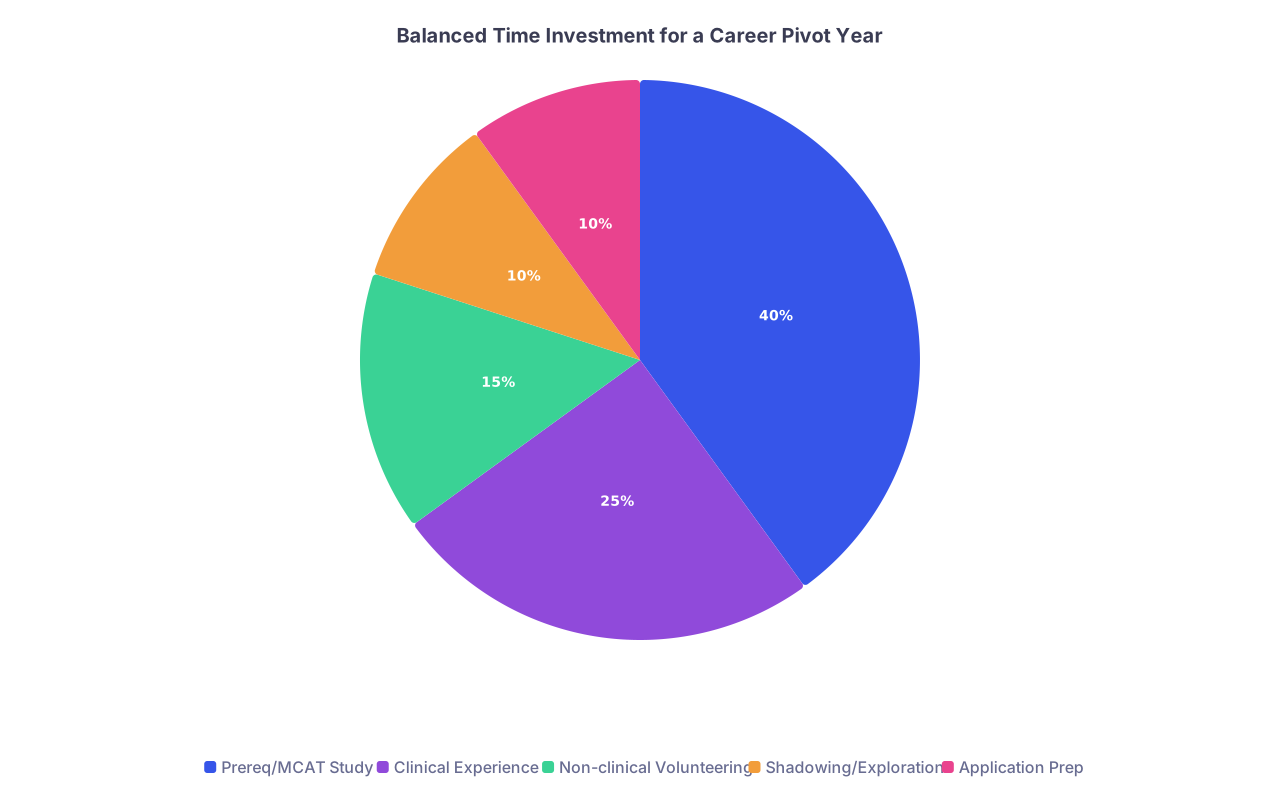
| Category | Value |
|---|---|
| Prereq/MCAT Study | 40 |
| Clinical Experience | 25 |
| Non-clinical Volunteering | 15 |
| Shadowing/Exploration | 10 |
| Application Prep | 10 |
This is an idealized breakdown for a 12–18 month pivot period while working part‑time or full‑time. Adjust the percentages, but keep the categories.
1. Academic proof
You need recent, rigorous academic evidence. Your story does not survive if the subtext is “I could not cut it in the sciences.”
Practical target:
- 1–2 years of solid performance in:
- Core prereqs (if not previously done or too old)
- Upper‑division science or post‑bacc work if your old GPA is weak
Patterns committees like:
- A rough undergrad from 8–10 years ago followed by:
- 30+ credits of recent science at ≥3.7 GPA.
- Full‑time work + part‑time night classes with strong performance → shows time management and seriousness.
How you explain it:
“My undergraduate GPA does not reflect my current capabilities. Over the past two years, while working 30 hours per week, I completed 32 credits of upper‑division biology and chemistry with a 3.8 GPA. This period was a deliberate test of whether I could handle the academic demands of medical school; it affirmed that I can.”
Own the old record briefly. Then overwhelm it with better data.
2. Clinical and service exposure
If your pivot story ends with “so I decided to become a doctor” but your activity list shows 40 hours of shadowing and no serious clinical volunteering, admissions will quietly roll their eyes.
You must show that you have seen the job up close and still want it.
Baseline targets (not magic numbers, but real ballparks):
- Clinical exposure: 150–300+ hours
Examples:- Hospital volunteer with regular patient contact
- ED tech, CNA, MA, EMT
- Hospice volunteer
- Shadowing: 40–80+ hours across 2–3 specialties
- Non‑clinical service: 100–200+ hours, ideally with vulnerable populations
Then, explicitly connect these to your pivot:
“To test whether I wanted the day‑to‑day reality of medicine, not just the idea of it, I took a part‑time role as an ED scribe and volunteered weekly at a free clinic. After 400+ hours across both roles, what stands out is not the adrenaline of trauma alerts, but the longitudinal relationships in chronic disease management. Those experiences confirmed that my interest is in long‑term, patient‑centered care, not just acute crisis.”
That sentence does more work than “I shadowed doctors and loved it.” It says you tested your hypothesis thoroughly.
3. Realistic transition plan
Especially for older, nontraditional applicants, committees are silently asking:
- “Does this person understand the financial and time commitments?”
- “Will they burn out halfway through?”
- “Are they running from something, or to something?”
You need to show adult‑level planning, especially in interviews and secondaries.
Points to make explicit:
- You have a timeline for:
- Completing prerequisites
- Taking the MCAT (with a realistic study plan)
- Applying (target year)
- You have thought about:
- Debt, income loss, family responsibilities
- Support systems (partner, savings, childcare, etc.)
- You have spoken to:
- At least a few physicians, residents, or current students about the realities of training
You do not need to detail your entire bank account. But a one‑line indicator of seriousness lands well:
“My spouse and I spent a year reorganizing our finances, downsizing our housing, and building a savings buffer to support my return to full‑time education. We did this before I started my post‑bacc because we both see this as a 10–15 year commitment, not a short‑term experiment.”
That reads very differently from “I quit my job to follow my dreams.”
Putting It All Together: The 3‑Step Framework in Action
Let us stitch this into something you can recognize, then I will show you how to flex it for different components of the application.
The core framework
Turning point:
One clear, specific moment or period that shifted you from your old path toward medicine.Bridge of skills:
3–5 concrete, adult‑level skills from your prior career that map directly to medical training.Track record:
A year or more of sustained academic work, clinical exposure, and planning that proves this is a committed pivot.
Think of this as your elevator blueprint. You can stretch or compress it depending on context.
Example: 35‑year‑old accountant pivoting to medicine
Step 1 – Turning point
“For over a decade, I worked as a forensic accountant, investigating financial misconduct in healthcare organizations. During one audit at a community hospital, I sat in on a quality‑improvement meeting about preventable readmissions. The conversation kept circling back to clinical issues—medication reconciliation, follow‑up care—that I had no training to influence. I was shaping the spreadsheets around patient outcomes, but not the outcomes themselves. That disconnect sat with me for months.”
Step 2 – Bridge of skills
“My work required meticulous attention to detail, comfort with large, messy data sets, and clear communication of complex findings to non‑experts. In one case, I led a review of 15,000 patient billing records to identify patterns consistent with upcoding. I synthesized the findings into a 10‑page report and presented it to clinicians, administrators, and legal counsel. The technical rigor, interdisciplinary collaboration, and ethical stakes of that work mirror what draws me to medicine: making consequential decisions for others based on imperfect information, and being able to explain those decisions clearly.”
Step 3 – Track record
“Three years ago, I stopped treating this as an abstraction. While continuing full‑time work for the first year, I completed general chemistry, biology, and physics at night, earning A’s in all courses. I then moved to a 60% schedule to complete organic chemistry and biochemistry and took a part‑time role as an ED scribe, accumulating over 600 hours while volunteering weekly at a free clinic. I have now completed 38 credits of science at a 3.85 GPA and scored a 517 on the MCAT after a structured 6‑month study plan. My experiences in the ED and clinic confirmed that I want the responsibility and continuity of physician‑level care, and my academic record demonstrates that I can handle the training.”
Notice what is happening:
- No childhood fluff.
- No over‑selling of irrelevant details (no need to list every audit).
- Concrete numbers. Concrete actions. Clear cause‑and‑effect.
That is the bar.
How to Use the Framework Across Your Application
You should not tell twelve different stories in twelve different places. You should tell one coherent story at multiple zoom levels.
Personal statement
Use the full framework.
- First 25%: Turning point story, old career context.
- Middle 50%: Bridge of skills with 2–3 concrete examples plus key clinical experiences.
- Final 25%: Track record + clear statement of why physician, not nurse, PA, or other roles.
Secondary essays
Most schools will ask variations of:
- “Why medicine?”
- “Why now?”
- “Describe a challenge or turning point.”
- “How will you contribute as a nontraditional student?”
Use the same skeleton, but emphasize different legs:
- For “Why now?”:
Heavier on Step 1 (turning point) and Step 3 (timing, planning). - For “How will you contribute?”:
Heavier on Step 2 (bridge of skills).
Interviews
This is where you need a tight, spoken version. Think in 60–90 seconds when they ask:
- “So you started in [X field]. What made you pivot to medicine?”
Spoken outline:
- One sentence on prior career role.
- Two–three sentences on turning point story.
- Two sentences on skills that transfer.
- Two–three sentences on what you have done since (track record).
You can sketch your flow like this:

| Step | Description |
|---|---|
| Step 1 | Prior Career One-Liner |
| Step 2 | Specific Turning Point Story |
| Step 3 | Key Transferable Skills |
| Step 4 | Concrete Actions Taken Toward Medicine |
| Step 5 | Affirmation This Is Long-Term Commitment |
Practice this out loud until it does not sound memorized but you hit the same structure every time.
Fixing Common Pivot Story Problems
You can have a strong framework and still tank the delivery by falling into a few predictable traps. Let me call them out and give you the fix.
Problem 1: Over‑justifying or apologizing
Symptoms:
- “I know I am older than most applicants, but…”
- “I realize my path has been all over the place…”
Committees do not want your apology tour. They want to know whether admitting you is a good bet.
Fix: Acknowledge briefly, then reframe as an asset.
“I am aware that entering medicine at 34 means I bring a different timeline and perspective than many applicants. It also means I have a decade of real‑world experience with deadlines, difficult conversations, and long‑term commitments. I am not testing whether I like being in school. I am committing to a profession I understand far better now than I did at 22.”
Problem 2: Throwing your old career under the bus
“I hated my job as a lawyer. It was soul‑crushing, so I decided to do something more meaningful like medicine.”
That line will quietly set off alarm bells. Medicine has tedium, hierarchy, and morally ambiguous days too. If you sound like you are fleeing boredom or lack of prestige, they will assume you will resent the less glamorous parts of medicine too.
Fix: Respect your past, explain the mismatch.
“Law gave me rigorous thinking and advocacy skills, and I am grateful for that training. Over time, I realized that what I found most meaningful were the medically complex cases where I worked closely with clinicians and families. I wanted a role where my daily work involved direct care and longitudinal relationships rather than primarily legal strategy.”
Problem 3: Making the story all about you
If your pivot story is mostly about your feelings—“I felt unfulfilled,” “I wanted more meaning,” “I realized life is short”—without clear reference to patients, systems, or outcomes, it reads self‑centered.
Fix: Tie your pivot to things outside yourself.
- Specific patient experiences
- Health disparities
- Gaps in care you have seen up close
Not performative saviorism. Just concrete realities.
A Quick Reality Check on Timing and Readiness
One last piece. Some people try to explain a pivot that is not really complete yet. They have:
- 1 science class
- 30 hours of shadowing
- Lots of “intentions”
If that is you, your primary problem is not messaging. It is substance. The story cannot compensate for missing proof.
Use the framework now as a planning tool:
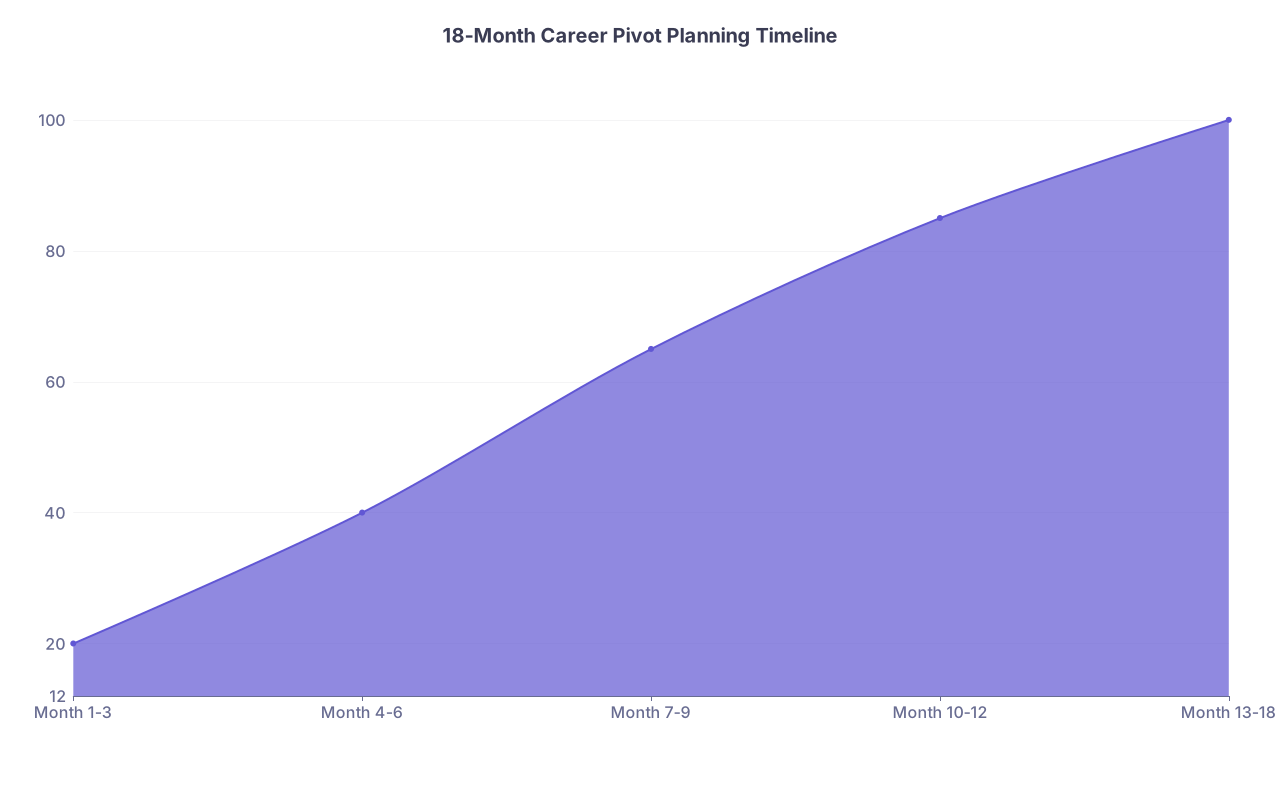
| Category | Value |
|---|---|
| Month 1-3 | 20 |
| Month 4-6 | 40 |
| Month 7-9 | 65 |
| Month 10-12 | 85 |
| Month 13-18 | 100 |
Treat that curve as your “readiness percentage.” In the first 3–6 months you are mostly exploring and starting prereqs. By 12–18 months you should have:
- Multiple science courses with strong grades
- Substantial clinical exposure
- A concrete MCAT and application plan
If you are still early, that is fine. Do not rush. Use the three steps as a checklist for what you still need to do, not just explain.

Final Tightening: Edit Yourself Like a Professional
Once you draft your pivot story using this framework, clean it up ruthlessly.
Run through this list and trim anything that fails:
- Does every paragraph connect directly to:
- Motivation,
- Transferable skill, or
- Track record?
- Are there any generic lines (“I love science and helping people”) you can replace with specific anecdotes?
- Are you repeating the same idea in multiple places?
- Is there any detail that is just there because you are proud of it, not because it advances your case?
If you are not exhausted by how many sentences you cut, you probably have not cut enough.
You can also sanity‑check your story against these three questions:
If you stripped out all adjectives, would your story still work?
If everything collapses without “passionate,” “committed,” “meaningful,” you are leaning on fluff.Could another applicant copy‑paste your essay with minor changes?
If yes, you have not been specific enough about your past career and turning point.Would a skeptical admissions dean say, “I see why this person is doing this now”?
If not, tighten the causality between events and actions.

The Three Things to Remember
Anchor on one clear turning point, not a lifetime of vague interest. Show a specific moment or period when your path shifted and what you did immediately afterward.
Translate your past career into 3–5 concrete skills that obviously matter in medicine, and prove each with a brief, specific example.
Back your story with a disciplined track record—recent strong academics, real clinical exposure, and a realistic transition plan—so your pivot reads as a mature decision, not an impulsive escape.
If you can hit those three cleanly, your nontraditional path stops looking like a liability and starts looking like exactly what it is: a tested, adult choice to step into medicine with your eyes open.