
The biggest mistake non-traditional applicants make is trying to hide who they are instead of weaponizing it.
You are not “late.” You are not “behind.” You are raw material most 21-year-olds do not have: hard-earned judgment, real responsibility, and proof you can function in the adult world. Admissions committees will take you seriously—if you stop telling a fragmented story and start telling a coherent professional one.
Here is how to rewrite “I was a manager” into “I am exactly the kind of physician you want to train.”
Step 1: Stop Apologizing For Your Past Career
Your first job is not to “explain away” your management career. It is to reframe it.
Adcoms are tired of reading vague narratives like:
- “I always wanted to do medicine, but life got in the way…”
- “I took a detour into business, but my true passion is medicine.”
That sounds flaky. Or worse, impulsive.
You need a different frame:
- “I spent X years managing people, budgets, and high-stakes situations. That experience is the backbone of how I will practice medicine.”
- “I learned specific skills in management that map directly to clinical work: decision-making under pressure, team leadership, conflict resolution, accountability.”
Here are three rules for how you think and talk about your past:
No regret narrative.
Do not say or imply that your prior decade was a mistake. You can say you outgrew it, or that patient care aligns more with your long-term goals. But never: “I wasted time.” Adcoms hear: “I might say the same about medicine in 10 years.”No identity whiplash.
You are not switching from “corporate robot” to “pure healer.” That is cartoonish. You are progressing from one form of responsibility to another. Same person, upgraded context.Anchor everything in continuity.
You had:- Responsibility for people → now you want responsibility for patients
- Stakeholders and clients → now you want patients and families
- Data-driven decisions → now you want evidence-based medicine
Your career did not “stop” and then restart. It is one continuous arc, now turning toward medicine.
Step 2: Translate Manager-Speak into Clinical Value
You cannot send your resume as-is and expect adcoms to do the translation for you. They will not. They are busy, and most will only skim.
Your job is to translate management experience into medical competencies.
Take your current/previous role. Strip the title. Ask:
- “What did I actually do, in verbs?”
- “Where was there risk? Ambiguity? Human emotion? Pressure?”
- “What required judgment, not just execution?”
Then you map that to what physicians actually do.
Core managerial skills → medical-school-relevant equivalents
| Manager Skill | How It Shows Up Clinically | Example Phrase for Application |
|---|---|---|
| Staff management | Leading care teams, mentoring juniors | "Supervised a team of 12, now mentor premed volunteers in clinic." |
| Conflict resolution | Handling difficult patients/families | "Mediated high-tension conversations among stakeholders; now de-escalate anxious patients." |
| Budgeting/P&L | Understanding healthcare systems, resource limits | "Managed $3M budget; comfortable balancing ideal care with real constraints." |
| Project management | Running QI projects, research logistics | "Coordinated multi-site rollouts; ready to manage QI initiatives." |
| Performance reviews | Giving/receiving feedback in training | "Delivered critical feedback constructively, a key part of clinical education." |
Your language needs to move from:
- “Responsible for performance management of 25 FTEs” to:
- “Oversaw a 25-person team, including hiring, training, and giving difficult feedback. I routinely had to balance empathy with accountability—exactly the tension that exists in discussing non-adherence or poor performance with trainees and patients.”
Notice the difference: less jargon, more human, directly relevant to medicine.
Make a simple two-column document for yourself:
- Column A: Actual managerial tasks you did (no buzzwords)
- Column B: What that skill looks like in clinical training or practice
Use Column B language in:
- Your personal statement
- Your activity descriptions
- Secondary essays
- Interview answers
Step 3: Build a Coherent “Why Medicine” Story (Not a Midlife Crisis)
If your “why medicine” sounds like a midlife burnout story, you will kill your application.
Adcoms do not want someone running from a bad job. They want someone running toward the right one.
Your narrative needs three components:
- Trigger events – what pushed you from interest to action
- Long-standing traits – what has always been true about you
- Deliberate testing – what you did to confirm medicine is the right fit (clinical exposure, coursework)
1. Trigger events (plural, not one dramatic story)
Avoid the cliché of a single patient/grandparent story that “changed everything.” Use 2–3 real moments that, looking back, pointed you towards medicine:
- The first time you sat in on a meeting where patient outcomes were discussed as “metrics” and you felt uncomfortable being so far from actual patients.
- The recurring pattern of employees turning to you with mental health or personal crises, and noticing you were more energized by supporting them than by hitting quarterly numbers.
- Volunteering in a free clinic as an interpreter or admin support and feeling more cognitively and emotionally engaged in 2 hours than in a week at the office.
You are not inventing destiny. You are showing pattern recognition.
2. Long-standing traits
You must argue: “This is not a personality transplant. It is a better application of traits I have had for years.”
Examples:
- “Even as a manager, I was the one people called at 11 p.m. when something went wrong. I have always been comfortable in crisis and willing to stay until the problem is solved.”
- “I gravitated to roles that were closest to people in distress—HR during layoffs, client support during failures—rather than purely strategic positions.”
3. Deliberate testing (this is the part most non-trads skip or underplay)
You cannot just say, “I shadowed a doctor a few times and loved it.” That sounds like tourism.
You need:
- Longitudinal clinical exposure (months, not hours)
- Real patient contact (within allowed boundaries)
- Clear evidence you understand the unglamorous parts
Example progression:
- Start: Volunteer in an ER or free clinic for 3–6 months
- Next: Shadow physicians across at least two specialties, including at least one primary care
- Then: Take a job as a medical assistant, scribe, EMT, or similar if time allows
Your application should then say things like:
- “After three years of feeling that my favorite part of management was one-on-one problem-solving, I started working as a medical scribe in the evenings. By month two, it was obvious that the complexity, uncertainty, and longitudinal relationships in primary care matched what I had been seeking in leadership roles.”
Step 4: Rebuild Your Application Materials Around a New Spine
Most non-trads make this mistake: they bolt “medicine” onto an old corporate resume. It looks disjointed. You need to rebuild everything around a single throughline.
That throughline might be:
- “Using systems and people skills to solve complex human problems”
- “Leading teams in stressful environments where mistakes have real consequences”
- “Standing at the intersection of data, policy, and individual lives”
Once you pick that spine, everything else orients around it.
A. Personal statement: structure for a non-trad manager
Use this structure:
- Opening scene from your management life that shows a tension you later resolve in medicine. Short, specific, not melodramatic.
- Bridge paragraph: what this scene revealed about what fulfills you / frustrates you in non-medical work.
- Evidence sections:
- What you did clinically to explore medicine (details, not fluff)
- How your management skills showed up in those clinical settings
- Forward-looking close: how you expect to use your prior career to contribute in medical school and beyond.
Do not open with college. You are not 21. Start with the version of you that actually exists now: the manager making high-stakes decisions.
Bad opening:
“I first became interested in science in my high school biology class…”
Good opening:
“On a Tuesday in March, I closed the door to tell a long-time employee that I was eliminating her position. I had prepared spreadsheets and talking points. None of it made handing her a severance packet feel any less misaligned with the kind of responsibility I wanted to have.”
Then you tie the misalignment to what you found in patient care.
B. Activities: stop wasting your best bullets
Non-trads often bury their strongest experiences under generic labels. Do not list:
- “Operations Manager – [Company] – 2014–2021” and then describe tasks.
Instead, make the description read like a preclinical attending would:
- What was the complexity?
- What was the stakes?
- What did you uniquely contribute?
Examples of better descriptions:
“Led a 20-person team through a 30% workforce reduction without losing a single critical deliverable or creating formal HR complaints. Required transparent, emotionally intelligent communication and daily presence—skills I used again when supporting anxious patients and families in clinic.”
“Coordinated cross-functional rollout of new safety protocol across 5 locations, involving 70+ staff. This experience made me comfortable leading quality-improvement style projects, which I later applied in a student-led hand-hygiene initiative at our free clinic.”
Make your three “most meaningful” entries strategic:
- One clinical (volunteering, scribing, MA, EMT, etc.)
- One from your management career that screams leadership and ethics
- One that shows service to vulnerable populations (clinic, community work, etc.)
C. Resume/CV: reformat for medicine
You cannot send a corporate resume with bullet points about “synergy” and “optimization.”
Restructure:
Section order:
- Education (with post-bacc or recent science courses prominent)
- Clinical experience
- Research (if any)
- Leadership & management (your prior career)
- Service / community work
Bullet philosophy:
- One line on scope (size of team, budget, reach)
- One line on complexity or stakes
- One line on outcome/impact
- Use plain language
Example bullet:
- “Managed a $2.5M operations budget and 18 staff across 3 sites; implemented a scheduling redesign that reduced patient wait times by ~20% and staff overtime by 15%.”
Yes: quantify impact. Physicians live in a world of outcomes.
Step 5: Fix the Academic Story Without Looking Defensive
You have another problem: non-trads often have old, mediocre grades. Or a long gap in science coursework.
You need to turn your academic story from “I messed up, but I am trying again” into “I used my adult discipline to retool my skills for a rigorous scientific field.”
Show the two key things adcoms are terrified about
They worry:
- You cannot handle heavy, dense science.
- You cannot handle volume and time pressure.
Your counterattack:
- Post-bacc or DIY science retooling with excellent grades (3.7+ preferably, 3.8+ ideal)
- Strong MCAT (for career-changers with weaker undergrad GPAs, aim realistically for 510+, and higher if gunning for more competitive schools)
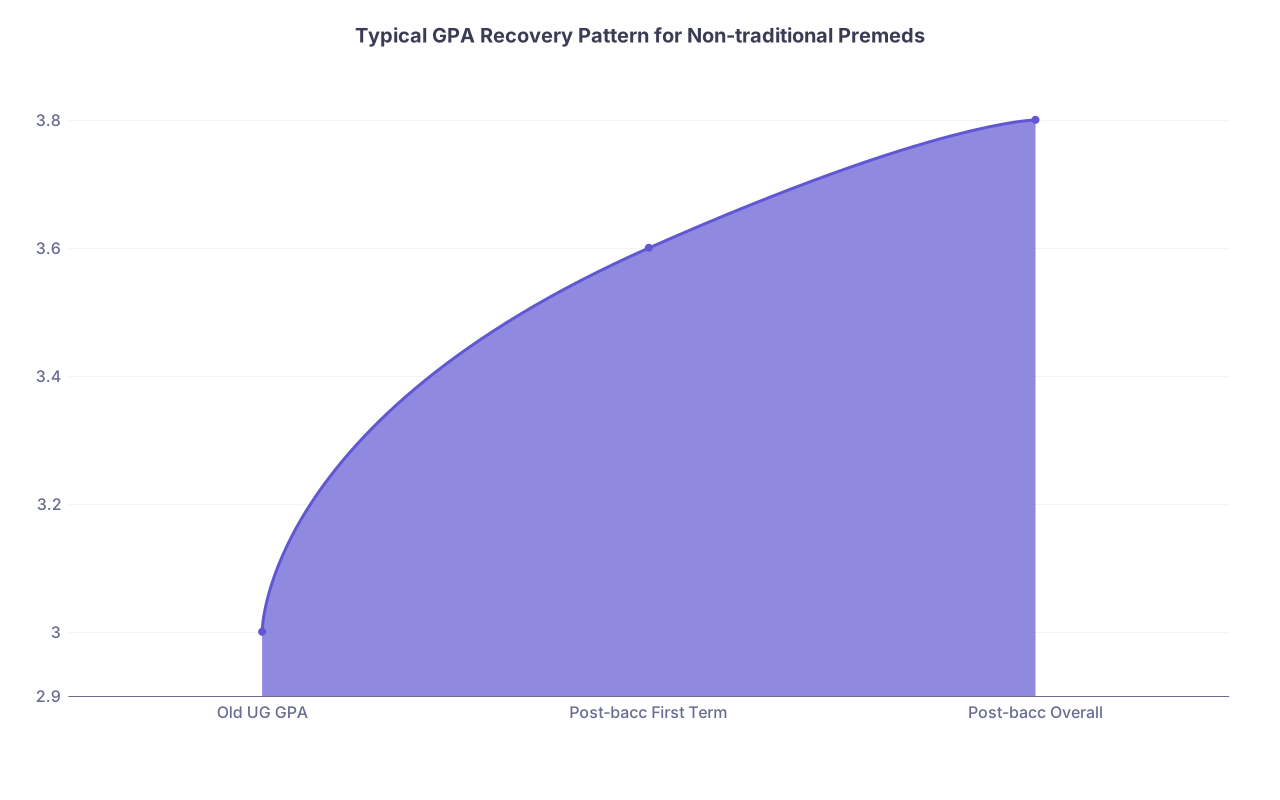
| Category | Value |
|---|---|
| Old UG GPA | 3 |
| Post-bacc First Term | 3.6 |
| Post-bacc Overall | 3.8 |
Your written narrative should:
- Briefly acknowledge poor old grades (if present)
- Emphasize current performance as the best representation of who you are now
- Frame your return to academics as an intentional, structured project—not a desperate scramble
Example:
- “My undergraduate GPA (3.1) reflects a period when I worked 30 hours a week and treated academics as one obligation among many. My last 36 credits, completed while working full time and caring for a young child, average 3.9 in upper-division biology and chemistry. This more accurately represents my current work habits and capacity.”
No long excuses. One sentence of context, then results.
Step 6: Rehearse Manager-to-Medicine Interview Answers
You will get some version of the following in almost every interview:
- “Why medicine now?”
- “Why leave a successful career?”
- “How will your past career make you a better physician?”
- “How do you know you will not change your mind again?”
If you wing these, you will ramble and sound uncommitted. Build clear, repeatable structures.
“Why medicine now?” – a simple template
Use this 3-step structure:
- Past pattern: “For years I found that the most meaningful part of my work was…”
- Catalyst + exploration: “This led me to [specific action]. Through [X months] of [clinical work], I saw that…”
- Decision: “At that point, medicine was not a sudden pivot but the logical next step in how I want to use my skills.”
Example:
- “For years as an operations manager, the best part of my job was sitting with staff one-on-one when they were in crisis—health scares, family issues, burnout. I realized I was most engaged when the problems were human, not operational. That pushed me to start volunteering weekly at a community clinic and later working as a medical scribe in family medicine. Six months in, watching longitudinal patient relationships and evidence-based decision-making in action, it was clear this was the environment where my leadership and problem-solving skills fit best. Medicine is not a rejection of my past work; it is the focused version of what I have always cared about.”
“How do you know you won’t change your mind again?”
You cannot get defensive here. You need data.
- Duration: “I have been on this path for [X] years: from first class to MCAT to consistent clinical work.”
- Sacrifice: “I gave up [title, salary, comfort] and took [lower-paid clinical job, night classes].”
- Exposure: “This is not based on inspirational media. I have seen overnight calls, bureaucracy, difficult outcomes.”
Example:
- “I have been working toward medicine for three years—two years of science coursework at night, one year as a full-time medical assistant in an internal medicine clinic. I left a director-level role and a comfortable salary to take a front-line position, and I am still more satisfied in this work despite the lower pay and long hours. I know the pace, the paperwork, and the emotional burden from the inside, and I am asking for more of it, not less.”
Step 7: Anticipate and Flip the Common Biases Against Non-Trads
Yes, there are biases. Some explicit, many not. Your job is not to whine about them; it is to preempt them.
Common concerns adcoms have with mid-career applicants:
“Will they have the energy for this schedule?”
You counter with:- Concrete examples of working full time + classes + family responsibilities.
- Specific time-management systems you use (calendar blocking, protected study hours, etc.)
- A calm, non-martyr tone: “This is hard, but sustainable.”
“Are they flexible enough to be coached?”
Senior managers can look rigid. You counter with:- Stories where you changed your approach based on feedback.
- Examples of being a learner again: “I went from managing a team to being the newest medical assistant on the floor and actively sought correction.”
“Will they fit with younger classmates?”
You counter with:- Evidence of working across generations (e.g., managing new grads and employees older than you).
- Mentoring roles where you enjoyed supporting younger staff.
You can even say directly, in an essay or interview:
- “I am not arriving in medical school expecting leadership positions. I am arriving expecting to be a learner, the same way I was on my first day in management, when my staff quietly knew more about operations than I did. That humility served me then, and it will serve me now.”
Step 8: Design Your Next 12–24 Months as a Deliberate Story-Building Project
If you are still pre-application, you have time to tune your story. Do not just collect hours. Build a portfolio.
Here is a rough blueprint for a manager-to-med-student transition timeline.
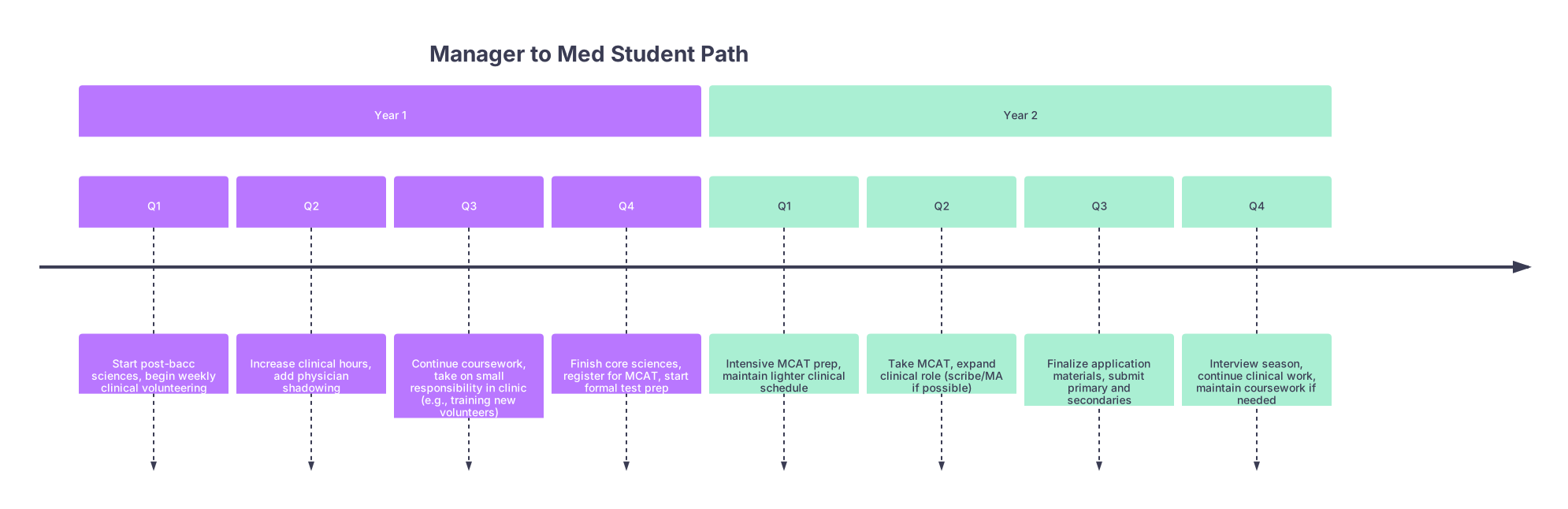
| Period | Event |
|---|---|
| Year 1 - Q1 | Start post-bacc sciences, begin weekly clinical volunteering |
| Year 1 - Q2 | Increase clinical hours, add physician shadowing |
| Year 1 - Q3 | Continue coursework, take on small responsibility in clinic (e.g., training new volunteers) |
| Year 1 - Q4 | Finish core sciences, register for MCAT, start formal test prep |
| Year 2 - Q1 | Intensive MCAT prep, maintain lighter clinical schedule |
| Year 2 - Q2 | Take MCAT, expand clinical role (scribe/MA if possible) |
| Year 2 - Q3 | Finalize application materials, submit primary and secondaries |
| Year 2 - Q4 | Interview season, continue clinical work, maintain coursework if needed |
You want your activities to show:
- Longevity – same clinic for 1–2 years > five different places for 20 hours each
- Growth – started as volunteer → became trainer → helped with a small QI project
- Alignment – choices that make sense for your stated interests
Step 9: Use Your Management Brain on the Application Process Itself
Here is where your prior career is a cheat code. Treat your path to medicine like a major project. Because it is.
Build a simple dashboard:
| Area | Metric to Track | Target |
|---|---|---|
| Academics | Post-bacc GPA | ≥ 3.7 |
| MCAT | Full-length practice average | At or above target score 4–6 weeks before exam |
| Clinical | Total direct patient contact hours | 200–500+ over 1–2 years |
| Leadership/Service | Longitudinal commitment | 1–2 roles ≥ 1 year |
| Narrative | Reviewed PS and activities by 2–3 trusted readers | Completed 2–3 months before submission |
Use the skills you already have:
- Backward-plan from application submission dates.
- Set monthly “checkpoints” for hours, test scores, coursework.
- Run small “retrospectives” on what worked or failed in your study and volunteering schedule.
Irony: The tools you used to manage budgets and teams are perfect for handling the logistics of becoming a physician. Explicitly using them reinforces your story.
Step 10: Show, Do Not Announce, That You Are a Professional
You have something most traditional applicants simply cannot fake: years of being a professional adult. Use that.
How?
- Communication: Every email to admissions, every interaction with staff, every phone call—treat it like you are talking to a C-suite client.
- Reliability: If you say you will send a document, letter, or update by a certain date, do it. No excuses.
- Boundaries: Do not overshare personal drama. Keep explanations tight and focused on impact and response, not emotional detail.
One subtle but powerful thing: in interviews, answer questions with structure and brevity. You have sat in enough meetings to know that concise, organized answers make people trust you.
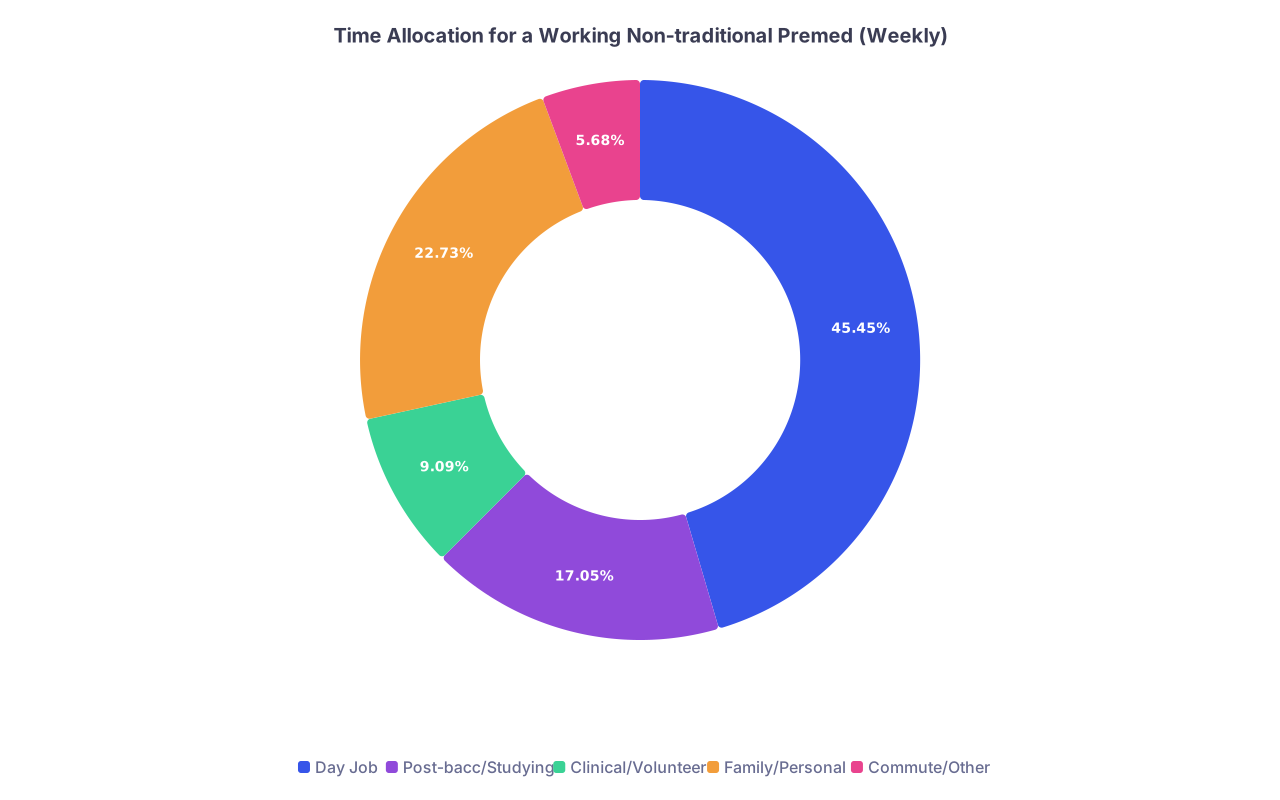
| Category | Value |
|---|---|
| Day Job | 40 |
| Post-bacc/Studying | 15 |
| Clinical/Volunteer | 8 |
| Family/Personal | 20 |
| Commute/Other | 5 |
This is what your life may look like for a while. That is fine. You are used to heavy weeks. Admissions committees will respect that—if the story you tell is cohesive, evidence-based, and professional.
Final Takeaways
- Your management career is not baggage. It is your competitive advantage—if you translate it into clinical value and build a coherent, continuous story.
- Adcoms want proof, not poetry: sustained clinical exposure, rejuvenated academics, and clear, structured explanations for “why medicine now” and “why you.”
- Treat this transition like the highest-stakes project you have ever run. Because for you, it is. Build the evidence, control the narrative, and let your professional history work for you instead of against you.