
The way most non‑traditional applicants convert their resume for medicine is wrong. They edit a few bullet points, add “shadowing” at the bottom, and hope the adcoms will “get it.” They will not.
You are not just updating a document. You are rewriting your professional story in a completely different language: the language of medicine, service, and evidence of future clinical competence.
Here is how to actually turn a non‑clinical resume into a competitive premed CV.
Step 1: Stop Thinking Like a Job Applicant
Your existing resume was built for hiring managers. Medical schools read documents differently.
Hiring manager mindset:
- “Can this person do this job tomorrow?”
- Optimized for:
- Speed‑scanning
- Hard skills
- Deliverables / revenues / efficiency
Admissions committee mindset:
- “Will this person be a safe, teachable, ethical physician in 10 years?”
- Optimized for:
- Longitudinal commitment
- Service orientation
- Maturity, resilience, self‑awareness
- Evidence of academic readiness
So before you touch a single bullet point, you have to flip the frame.
Instead of:
- “What did I do?”
You now ask:
- “What in this experience proves I have qualities that predict success in medicine?”
You are mining your past for evidence of:
- Leadership
- Teamwork under pressure
- Communication with difficult people
- Teaching / mentoring
- Ethical responsibility
- Data‑driven problem solving
- Cultural humility and working with diverse populations
- Long‑term commitment (1+ year in key roles)
Your non‑clinical background absolutely can do this. But not if you leave it written in “corporate” or “tech” or “education” language.
Step 2: Understand What a “Premed CV” Actually Needs to Show
Forget the word “CV” for a moment. For premeds, it is really a structured evidence file.
Medical schools do not care that you copied a CV template from a random website. They care that your activities clearly show the following buckets:
| Bucket | Target Evidence |
|---|---|
| Clinical Exposure | Comfort around patients, health care environment |
| Service / Community Engagement | Genuine service orientation, not box-checking |
| Leadership & Teamwork | Initiative, responsibility, impact |
| Academic & Intellectual Strength | Rigor, curiosity, follow-through |
| Research (if available) | Basic understanding of scientific inquiry |
| Professionalism & Maturity | Reliability, advancement, trust roles |
Your non‑clinical resume already hits:
- Leadership & teamwork
- Professionalism & maturity
- Often academic strength (if you have any teaching / training / certifications)
You need to:
- Translate what you already have into premed language.
- Plug the gaps (usually clinical exposure and service) efficiently and strategically.
We will do both.
Step 3: Strip Your Old Resume Down to the Frame
Open your current resume. You are going to be ruthless.
Keep:
- Job titles, organizations, dates
- Major leadership roles
- Roles where you:
- Managed people or projects
- Worked with vulnerable or upset customers/clients
- Handled high‑stakes decisions
- Taught, trained, or mentored others
- Solved process or quality problems
Delete or minimize:
- Hyper‑technical jargon that only makes sense in your old field
- Overblown business metrics that do not translate (nobody cares you increased Q4 pipeline by 37% unless you can tie it to skills relevant to medicine)
- Short‑term, low‑impact jobs unless they show grit or working through school
You should end up with a skeleton of:
- Education
- 2–5 major roles
- A few secondary roles if they fill important gaps (e.g., tutoring, coaching, volunteering)
We are going to rebuild this into a premed‑style CV.
Step 4: Translate Corporate/Non‑Clinical Experience into “Medical Relevance”
This is where most non‑trads fail. They describe their former life exactly as it was, then tack “want to be a doctor now” on top.
Bad approach:
“Led cross‑functional team to deliver SaaS product to enterprise clients.”
Better approach that pulls medical‑relevant skills forward:
“Led cross‑functional team of 8 to deliver complex projects on tight deadlines, coordinating conflicting stakeholder priorities and resolving communication breakdowns.”
Even better if broken into specific, behavior‑focused bullets:
- “Supervised 8‑person team across engineering, design, and customer support; mediated conflicts and ensured consistent performance feedback.”
- “Handled escalated client issues, including angry or distressed customers, using structured communication to de‑escalate and resolve concerns.”
What changed?
You made visible:
- Supervision
- Difficult conversations
- Conflict resolution
- High‑stakes communication
Those are medical skills.
Rewrite Template for Each Major Role
For each job, ask yourself these questions and then write bullets that answer them:
- When did I have to handle something emotionally intense or high‑pressure?
- Angry client
- Crisis project
- Safety issue
- When was I responsible for someone else’s learning or performance?
- Training new hires
- Running workshops
- Mentoring interns
- When did I make or implement decisions that affected others’ well‑being?
- Policy changes
- Safety protocols
- Quality control measures
- When did I communicate complex information in a clear, structured way?
- Presentations
- Explaining data to non‑technical people
- Writing guides / SOPs
Then convert to bullets with this structure:
Action verb + what you did + who/with whom + why it mattered / what changed
Examples for different backgrounds:
From project manager:
- Old: “Managed $1.2M software project.”
- New: “Coordinated a $1.2M implementation across 3 departments, facilitating weekly check‑ins to align priorities and troubleshoot barriers, improving on‑time delivery from 72% to 96%.”
From teacher:
- Old: “Taught 9th grade biology.”
- New: “Taught 120 ninth‑grade students foundational biology; adapted lesson plans for students with learning differences and collaborated with counselors to support at‑risk youth.”
From military:
- Old: “Platoon leader responsible for logistics.”
- New: “Led 30‑member unit in austere environments; maintained accountability for personnel and supplies while enforcing safety protocols and providing direct support during crises.”
You are not lying. You are reframing. Same work, different lens.
Step 5: Build the Sections of a Premed CV (Not Just a Resume)
Most non‑trads try to cram everything into “Work Experience.” That is a mistake. Medical schools and premed advisors are used to seeing activities in buckets.
Restructure into something like this:
- Education
- Clinical Experience
- Non‑Clinical Service / Volunteering
- Employment (Non‑Clinical)
- Leadership & Teaching
- Research (if applicable)
- Certifications & Skills
You probably will not have everything on day one. That is fine. But this is the scaffolding you are aiming for.
5.1 Education
Be clean and factual:
- Degree, major, institution, graduation year
- GPA (if competitive or required)
- Post‑bacc coursework, if any
- Relevant honors or academic awards (Dean’s List, Phi Beta Kappa, etc.)
Do not list every course you have ever taken.
5.2 Employment (Non‑Clinical) – After Translation
Here you plug in the rewritten roles from Step 4. Focus on:
- Progression (promotions, increasing responsibility)
- Stability (multi‑year roles)
- Concrete actions and outcomes
Aim for 3–6 bullets per significant role, not 15.
Step 6: Patch the Gaps: Clinical and Service Experience
Your resume likely has one giant hole: you have not been around patients.
You cannot “wordsmith” your way out of that. You must fix it with actual experiences.
Here is the minimum viable clinical/service exposure you should be aiming to build over 6–18 months, especially as a non‑trad.
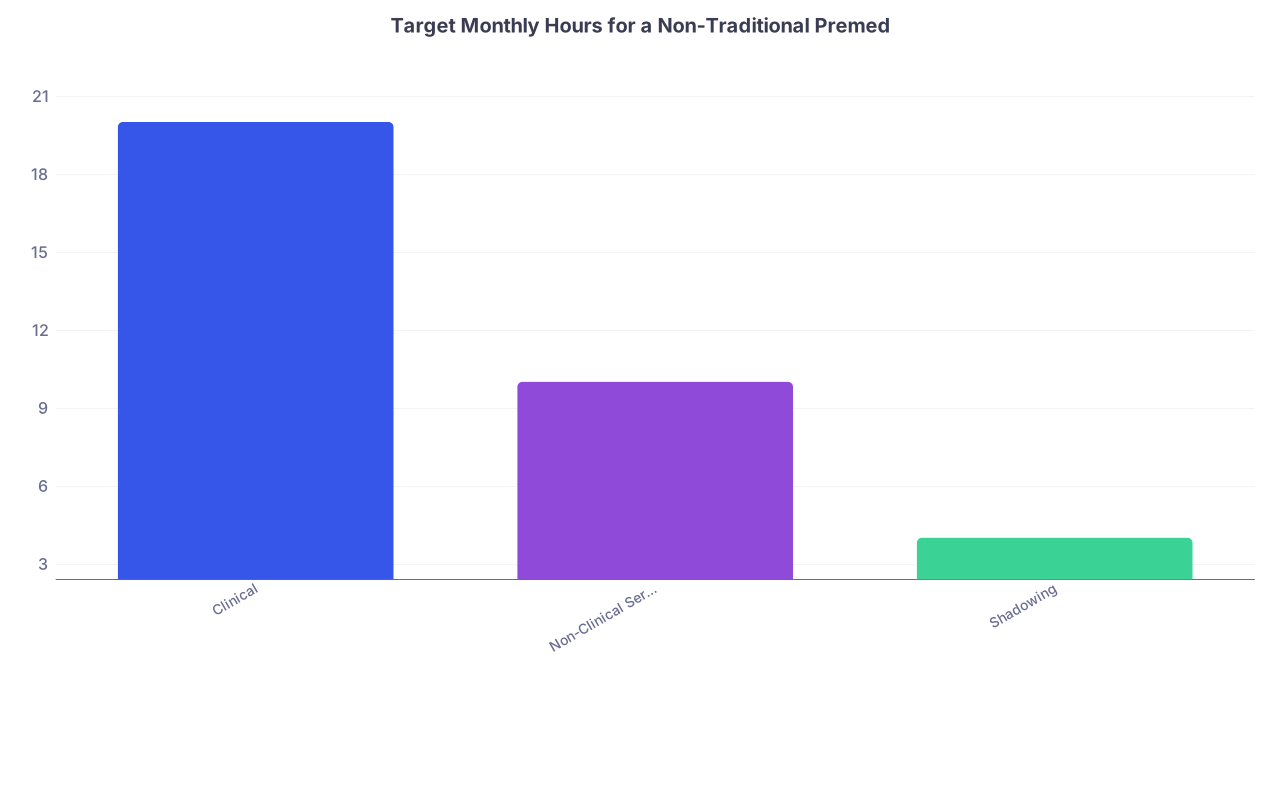
| Category | Value |
|---|---|
| Clinical | 20 |
| Non-Clinical Service | 10 |
| Shadowing | 4 |
Treat this as an average target, not an iron rule.
6.1 Fastest Ways to Add Real Clinical Experience
You want roles where you:
- Interact with patients directly
- Work alongside physicians, nurses, or allied health professionals
- See illness, vulnerability, and the messy reality of care
High‑yield options:
- Medical assistant (paid; may require short certification)
- Scribe (ED, outpatient clinic, urgent care)
- ER tech (with EMT background)
- Patient care tech / CNA
- Hospice volunteer
- Hospital volunteer with real patient contact (rounding, transport, bedside support)
If you are working full‑time, aim for:
- 4–8 hours per week of consistent clinical experience
- Sustained 6–12+ months
Then add this as its own section:
CLINICAL EXPERIENCE
Medical Scribe, XYZ Cardiology Clinic, City, State — 2024–Present
- Document physician‑patient encounters in real time, including HPI, ROS, and physical exam findings, for 12–16 patients per shift.
- Observe clinical reasoning and shared decision‑making for patients with chronic cardiovascular disease, gaining insight into long‑term management and patient adherence challenges.
6.2 Non‑Clinical Service That Actually Means Something
You already have a career. Adcoms are not expecting you to suddenly become a full‑time volunteer. But they do expect some evidence of service to people outside your own career or academic advancement.
Good non‑clinical service:
- Homeless shelter or food bank volunteer
- Crisis hotline or mental health peer support
- Refugee / immigrant support programs
- Big Brothers Big Sisters or youth mentoring
- Prison education programs
- Long‑term involvement with a community organization
Avoid:
- One‑off charity events
- “Volunteer” roles that are really networking or PR
Again, carve out a section:
SERVICE & COMMUNITY ENGAGEMENT
Volunteer, City Shelter, City, State — 2023–Present
- Serve weekly meals and provide basic resource navigation for 40–60 unhoused individuals per shift, coordinating with social workers for housing and mental health referrals.
You want this to read like real, consistent, people‑focused work. Because that is what it should be.
Step 7: Rewrite for Impact: Bullet by Bullet
At this point you have:
- Your old roles translated
- New or planned clinical/service experiences identified
- A draft structure for your CV
Now tighten the writing. Your bullets must do three things:
- Show action
- Show context (who/what you affected)
- Show something about you that matters for medicine
Use verbs that signal responsibility and interaction:
- Led, coordinated, facilitated, mentored, counseled, implemented, evaluated, designed, educated, advocated
Avoid fluff verbs:
- Helped, assisted, worked on (unless followed by powerful specifics)
Bad:
“Helped customers with questions.”
Better:
“Counseled 10–15 customers per shift on complex billing and coverage issues, using structured questioning to clarify concerns and prevent repeat calls.”
For each bullet, stress‑test it:
- “Does this sentence tell me something positive about how this person behaves under responsibility?”
If not, rewrite it.
Step 8: Align Your CV with What Will Go Into AMCAS/AACOMAS
If you are aiming at US MD or DO programs, your CV is not the final product. Your AMCAS or AACOMAS activities section is.
Do not create a CV that you cannot translate into those boxes later.
Key rules:
- Each activity in AMCAS/AACOMAS will need:
- Role/position
- Organization
- Dates
- Approximate hours
- Short description narrative (up to a fixed character limit)
- You will choose “Most Meaningful” activities and write a longer reflection
So as you build your CV:
- Already think in terms of “activities”
- Track your hours from day one (spreadsheet, notes app, whatever)
- For each role, jot down 1–2 impactful stories or turning points (you will use these in essays later)
Example conversion:
On CV:
Volunteer, Hospice Organization — 2024–Present
- Visit 2–3 patients weekly to provide companionship and caregiver respite, including reading, conversation, and basic comfort measures.
- Collaborate with interdisciplinary team (nurses, social workers, chaplains) to support family coping and grief.
In AMCAS:
- Experience Type: Community Service/Volunteer – Medical/Clinical
- Description: 700 characters describing:
- How you started
- What you do
- What you learned about death, suffering, communication
If your CV is written with this in mind, applications become much easier.
Step 9: Present It Like You Belong in Medicine
Formatting matters more than people admit. A sloppy, crowded, inconsistent document screams “I am not ready.”
Use:
- Clear section headings (caps or bold)
- Consistent date format (e.g., “Aug 2020 – May 2023”)
- 10.5–12 pt font, professional (Garamond, Calibri, Times New Roman)
- 0.5–1 inch margins
- Bullet points aligned, spacing consistent
One page is not a religion here. For non‑traditional premeds with a substantial prior career:
- 1–2 pages is acceptable for a CV used for:
- Premed advising
- Research/job applications
- Letters of recommendation packets
If someone specifically asks for a 1‑page resume, you can compress. But maintain a full CV master document for yourself.
Step 10: Build a 12–18 Month Plan Around the Gaps
You are not done when the document “looks” OK. You are done when your actual experiences match what medical schools expect from a serious candidate.
Be brutally honest:
- Do you have at least 100–150 hours of direct clinical exposure yet?
- Do you have at least 50–100 hours of meaningful non‑clinical service?
- Do you have any leadership or teaching visible in the last 3–5 years?
- Does your timeline show recent, sustained engagement with medicine, not a sudden pivot last month?
If not, build a concrete plan.
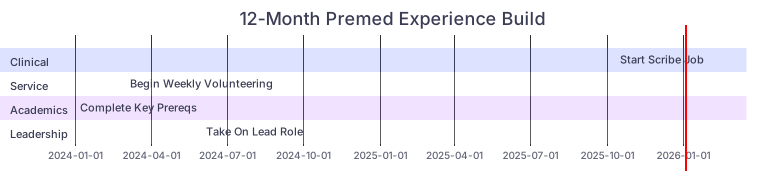
| Task | Details |
|---|---|
| Clinical: Start Scribe Job | a1, 2024-02, 10m |
| Service: Begin Weekly Volunteering | a2, 2024-03, 9m |
| Academics: Complete Key Prereqs | a3, 2024-01, 12m |
| Leadership: Take On Lead Role | a4, 2024-06, 6m |
You do not need to be perfect in 12 months. But your CV should clearly show:
- A trajectory into medicine
- Consistency
- Increasing depth of involvement
Common Specific Scenarios (And How to Fix Them)
Scenario 1: Tech Professional, Zero Clinical
Problem:
- Resume full of product and code, no people.
Fix:
- Translate work toward teamwork, communication, conflict resolution (see earlier).
- Immediately add:
- 1 part‑time clinical job (scribe, MA after quick certification, ED tech)
- 1 weekly service commitment (soup kitchen, youth tutoring, etc.)
Within 6–12 months your CV shifts from:
- “Engineer building B2B systems” to
- “Engineer with 5 years of team leadership, now with 300 clinical hours and 75 hours of community service.”
That is competitive.
Scenario 2: Teacher with Good Service, Little Clinical
Problem:
- Tons of service, leadership, and communication. Thin clinical.
Fix:
- Keep most teaching content, but:
- Cut down on less impactful bullets.
- Emphasize mentoring, conflict with parents, working with diverse communities, special education.
- Add:
- Shadowing (start 4–8 hours/month)
- Part‑time clinical volunteering (hospital, clinic) 4–6 hours/week
Your CV then shows:
- Longitudinal service, responsibility for children
- Recent, serious entry into clinical spaces
Scenario 3: Military or Law Enforcement Background
Problem:
- Strong leadership and crisis management. Potential concerns about fit or attitude if framed poorly.
Fix:
- Translate:
- Emphasize care for subordinates, safety, discipline, and ethical decisions.
- Show any training/mentoring roles, community work, humanitarian missions.
- Add:
- Clinical and service work that emphasizes compassion and care for vulnerable populations.
You want your CV to read as:
- “Someone who has carried heavy responsibility for human lives and is now turning that toward healing.”
Two Things You Must Not Do
Do not pretend non‑clinical roles are clinical.
Calling customer support “patient care” is dishonest and transparent. If you worked with “clients,” they are clients, not patients.Do not flood your CV with micro‑experiences.
Ten 5‑hour volunteer stints look like box‑checking. Two deep, consistent roles over a year look like character.
Quick Checklist Before You Call It “Competitive”
By the time you are applying, your premed CV should honestly check most of these:
- At least 1 substantial clinical role with direct patient contact
- At least 1 consistent non‑clinical service role with vulnerable populations
- Clear evidence of leadership or teaching (from old career or new roles)
- Professional progression in your prior field (promotions, increased responsibility)
- Activities spread over time, not all in one short burst
- Bullets that show behaviors, not vague job descriptions
- Formatting clean enough that someone can skim in 30 seconds and understand your path
If you cannot tick several of these yet, the answer is not “better wording.” The answer is: get the experiences, then rewrite.