
The worst myth non-traditional premeds believe is that being “bad at science” is a personality trait instead of a training problem. It is not. You are not broken. Your foundation is.
You are trying to build medical-level understanding on top of rusted high school chemistry and half-remembered freshman biology from 2005. Of course it feels impossible. The good news: foundations can be rebuilt. Systematically. In 12–24 months. While working and raising a family.
Here is how to do it without burning out or wandering in circles.
Step 1: Get brutally honest about your starting point
You cannot fix what you will not measure. “I was always a strong student” or “I used to be good at math” tells me nothing. I want data.
Do this in one week:
Run three short diagnostics
- Khan Academy:
- Take the pretests for:
- High school biology
- High school chemistry
- Algebra II
- Take the pretests for:
- Do not study first. Just take them.
- Note:
- What you recognize but cannot execute
- What looks totally foreign
- Khan Academy:
Try one MCAT-style passage per science From AAMC sample questions or UWorld/Blueprint free trials:
- 1 passage from:
- General chemistry
- Physics
- Biology/biochem You will likely bomb them. That is fine. You are scanning for:
- Vocabulary gaps (e.g., “what is partial pressure again?”)
- Math paralysis (fractions, exponents, logs)
- Reading fatigue (struggling to hold dense info)
- 1 passage from:
Write a 1-page “science autobiography” Bullet it if you like:
- Last math class and year
- Last bio/chem/physics class and year
- Any science you use in current job (even indirectly)
- How you study now (if at all) This forces you to see the gap in black and white.
If those diagnostics feel humiliating, good. You just found the weak points to rebuild. This is not about ego. It is about engineering. Old structure failed. You are redesigning it.
Step 2: Decide your timeline and intensity like an engineer, not a dreamer
“Going back to school” is vague. You need a build plan.
A realistic rebuild timeline
For someone 15+ years out, working full-time:
Phase 0 – Repair the basement (3–6 months)
- Algebra, basic functions, ratios, logs
- Unit conversions, scientific notation
- Reading dense text without your brain checking out
Phase 1 – Rebuild core sciences (9–15 months)
- General chemistry I & II
- Intro biology I & II
- College algebra → precalculus (if needed)
- Maybe physics I
Phase 2 – Pre-med specialization (6–12 months)
- Organic chemistry I & II
- Physics II
- Biochemistry
- Statistics
Can it be faster? Yes, if:
- You are part-time at work
- You had strong STEM before
- You have no major family obligations
But that is not most people 15+ years out. Design conservatively. If you finish early, great. If you overload and collapse, everything stops.
Step 3: Fix your math first or everything else leaks
This is the part most non-trads skip. Then they drown in chem and physics and blame “being bad at science.”
You are not bad at science. You are trying to do titrations while terrified of fractions.
Minimum math foundation for premed sciences
You should be comfortable with, not just vaguely remember:
- Fractions, decimals, percentages
- Ratios and proportions (e.g., conversions)
- Exponents and roots (especially 10^x)
- Scientific notation
- Logs (base 10 and natural log conceptually)
- Solving single-variable equations
- Basic functions and graphs
- Unit analysis / dimensional analysis
If those are shaky, build them deliberately.
A 2–3 month math rebuild protocol
Target: 30–45 minutes per day, 5–6 days/week.
Core resource (pick one path):
- Video-based:
- Khan Academy: Algebra I → Algebra II → basic functions
- Book-based:
- “Painless Algebra” or “No-Nonsense Algebra” for true rust
- Then a standard Algebra workbook (Schaum’s Outline)
- Video-based:
Process each day:
- 10–15 minutes: watch or skim a new concept
- 20–25 minutes: do practice problems
- 5–10 minutes: review yesterday’s errors
Non-negotiable skills by end:
- You can do unit conversions without thinking:
- mg ↔ g, mL ↔ L, mm ↔ cm ↔ m, etc.
- You can rearrange simple formulas:
- C1V1 = C2V2 → solve for any variable
- You can interpret a simple line graph or curve
- You can do unit conversions without thinking:
You do not need calculus for the MCAT. You do need to not panic when you see y = mx + b.
Step 4: Rebuild biology and chemistry from the ground up, not from MCAT decks
Jumping straight to MCAT prep when your last bio was in 2004 is like training for a marathon by starting at mile 15. You might finish. More likely, you get injured and quit.
You will rebuild faster if you respect the staircase:
- High school level
- Intro college level
- Then MCAT review
Biology: from “cells are the powerhouse” to systems and regulation
Think in layers:
Layer 1 – High school refresh (4–6 weeks)
- Resource:
- Khan Academy high school biology
- Or a used AP Biology review book (Barron’s / Princeton Review)
- Goals:
- Memorize cell structures and basic functions
- DNA → RNA → protein
- Mendelian genetics
- Major organ systems and basic functions
- Resource:
Layer 2 – College-level biology I & II (1–2 semesters equivalent) If you are enrolling in a formal post-bacc, this happens in class. If you are rebuilding before classes:
- Resource combo:
- Textbook: Campbell Biology or similar intro text
- Companion: CrashCourse Biology videos for overview
- Weekly structure (assuming self-study pre-class):
- 2–3 chapters per week:
- Day 1–2: read actively (see below)
- Day 3–4: answer end-of-chapter questions
- Day 5–6: create summary sheets/flashcards
- 2–3 chapters per week:
How to read biology when your brain is out of shape:
- Do not highlight everything. That is lazy reading.
- For each section:
- Write 3–5 bullet “What is the point?” summary
- Underline:
- Definitions
- Processes (e.g., glycolysis steps)
- Exceptions
- End of chapter: force yourself to explain one big concept in your own words on paper. No textbook open.
- Resource combo:
Layer 3 – Pre-MCAT consolidation Once you have actual college bio under your belt, then:
- Use an MCAT book (Kaplan, Examkrackers, etc.) to re-organize:
- Physiology by systems
- Molecular biology + biochem basics
- But only after the foundation exists.
- Use an MCAT book (Kaplan, Examkrackers, etc.) to re-organize:
Chemistry: the usual non-trad graveyard
This is where many mid-career students quietly drop their med school plans. Not because they cannot handle it. Because they tried to do it the undergrad way: cramming and pattern-matching.
Do it differently.
Pre-chem warm-up (2–4 weeks) If you have not seen chem since high school:
- Resource:
- “Chemistry Essentials for Dummies” or “Basic Chemistry” style book
- Khan Academy: “Chemistry library” → start at atomic structure
- Focus on:
- Periodic table layout and trends
- Types of bonds
- Mole concept at a basic level
- Resource:
General Chemistry I & II (formal or structured self-study) Strongly prefer taking this in an actual class, even if at community college. The lab experience and structured exams matter.
If you are preparing before class or reinforcing after:
- Core text: Zumdahl, Tro, or similar general chemistry book
- Supplement:
- Tyler DeWitt / Professor Dave Explains (YouTube) for visual explanations
Weekly protocol for gen chem while working full-time:
- 5–7 hours/week outside of class:
- 2 hours: preview upcoming lecture content
- Skim the chapter
- Watch 1–2 short videos on tough topics
- 2–3 hours: post-lecture consolidation
- Rework in-class examples on your own
- Annotate lecture notes with textbook connections
- 1–2 hours: problem sets
- Do not just do the assigned odd-numbered problems
- Add 5–10 additional conceptual questions from other sources
- 2 hours: preview upcoming lecture content
Non-negotiable skill in gen chem:
You must understand why procedures work, not just shapes of equations. If you find yourself memorizing “use this formula for these keywords,” stop and rebuild the concept.
Step 5: Build a working system that fits adult life, not college life
You are not a 19-year-old in a dorm with 12 unstructured hours a day. If you try to copy their study habits, you will either:
- Fail your classes
- Or torch your job/marriage/health
You need a different architecture.
Design your weekly “science block plan”
Start with constraints, not fantasies.
List your fixed commitments
- Work hours (including commute)
- Family obligations (childcare, eldercare)
- Sleep (yes, actual 7–8 hours you intend to protect)
- Non-negotiables (religious, medical, key family time)
Carve out realistic study blocks Rules that actually work for mid-career students:
- 90–120 minutes max for heavy problem-solving (chem/physics)
- 30–60 minutes for reading/flashcards
- Long blocks on weekends for:
- Catch-up
- Larger assignments
- Lab reports
Aim for:
- 10–15 hours/week during “repair the basement” phase
- 15–20 hours/week once in heavy sciences
Protect “no-science” time At least one half-day per week with no schoolwork. Your brain needs off-duty time to consolidate and to avoid resenting this entire process.
Step 6: Use active-learning techniques that actually rebuild foundations
You have less time than a traditional student. You cannot waste it on passive strategies that feel productive and do nothing.
For conceptual subjects (bio, some chem)
Use a 3-pass loop.
Pass 1 – Shock the system
- Quick skim of the chapter or video at 2x speed
- Goal: recognize the territory, not understand it
Pass 2 – Actual understanding
- Slower read, taking notes in your own words
- Draw processes (arrows, boxes) instead of writing paragraphs
- For each major heading, ask:
- “If I had to teach this to a 15-year-old, what would I say?”
Pass 3 – Encoding and testing
- Turn key facts into:
- Flashcards (Anki or paper)
- One-page summary sheets
- Next day: quiz yourself without notes
- Turn key facts into:
For problem-heavy subjects (chem, physics, math)
Follow this strict rule:
Understanding comes first. Speed comes later. Memorization comes last.
Protocol:
Study fewer representative problems deeply For each new type:
- Work one example without rushing
- After solving, write:
- “What was the core idea here?”
- “What pattern should I recognize in the future?”
- “What did I almost mess up?”
Build your own mini problem sets
- After lecture, pick:
- 3–5 “easy”
- 3–5 “medium”
- 1–2 “hard”
- Spread them over 3 days instead of doing all at once
- After lecture, pick:
Maintain a “stupid mistake log” On a separate page:
- Record each careless error type:
- Unit omitted
- Wrong exponent sign
- Forgot to convert degrees to radians (or Celsius to Kelvin)
- Before each quiz/exam, read the log and prime your brain to watch for them
- Record each careless error type:
This sounds tedious. It is. It also works absurdly well, especially if your brain is out of practice doing symbolic manipulation.
Step 7: Put structure around your courses and self-study
You are not just “catching up on science.” You are rebuilding for a specific target: being able to handle premed coursework and eventually the MCAT.
Map your rebuild to actual requirements
You need to hit these by the time you apply:
| Course Level | Typical Classes | Purpose for Non-Trad |
|---|---|---|
| Foundation Repair | Algebra, basic chem/bio review | Fix rust, restore basic numeracy and vocab |
| Core Premed 1 | Gen Chem I–II, Bio I–II, Math/Stats | Establish real college-level science skills |
| Core Premed 2 | Org Chem I–II, Physics I–II | Prove rigor, prep for MCAT depth |
| MCAT-Focused Layer | Biochem, Psych/Soc, upper-level bio | Align knowledge with actual test blueprint |
Do not treat “relearning science” as separate from your formal courses. The self-study is there to make the courses survivable and productive.
Step 8: Use process planning, not vibes, for each semester
Rather than “I hope I can handle Gen Chem and Bio alongside work,” you want a concrete plan.
Here is a simple way to blueprint a term:

| Step | Description |
|---|---|
| Step 1 | Select Courses |
| Step 2 | Map Weekly Hours |
| Step 3 | Plan Preview & Review Blocks |
| Step 4 | Set Exam Preparation Milestones |
| Step 5 | Weekly Check & Adjust |
Before the semester starts
For each course:
Get the syllabus and textbook
- List major units and exam dates.
- Estimate:
- 6–8 hours/week per hard science if working full-time.
Backwards-plan exam prep
- 10–14 days before each exam:
- Start mixed-review problems
- Block time for 1–2 “mock exam” sessions
- 10–14 days before each exam:
Pre-read the first 2–3 weeks of content Do not walk into Week 1 cold. You are older. You do not warm up as fast as a freshman.
During the semester
Every week:
- Sunday night (or whenever):
- 15-minute planning session:
- Which chapters this week?
- Which problem sets?
- Which lab tasks?
- 15-minute planning session:
- Mid-week:
- 10-minute checkpoint:
- Behind? Drop something non-essential.
- Ahead? Do 5 extra problems from a weak topic.
- 10-minute checkpoint:
This is the opposite of what most undergrads do. They float. You cannot afford that luxury.
Step 9: Track your rebuild like a project, not a vague life change
People who say “I am working on my science foundation again” usually are not. People who say “I am on Module 7 of Khan Algebra and Chapter 4 of Zumdahl this week” usually are.
Use visible metrics:
Content tracking
- Simple spreadsheet or notebook with:
- Date
- Topic (e.g., “Stoichiometry – limiting reagents”)
- Resource
- Status: Introduced / Practiced / Solid
- Simple spreadsheet or notebook with:
Performance tracking
- For each quiz/exam:
- Score
- Topics you missed
- Error type (knowledge / misread / algebra / unit)
- Pattern emerges quickly. Then you fix patterns, not random problems.
- For each quiz/exam:
Energy and time tracking
- Once a week:
- How many hours did you actually study?
- How fried did you feel (1–5)? If you are at 4–5 fried every week, you are overloading. Pull back one area before something snaps.
- Once a week:
Step 10: Integrate mental resilience and identity shift
This is not just about content. You are changing who you are in your own head: from “parent/manager/whatever who used to be a student” to “serious learner again.”
A few hard truths I have seen non-trads struggle with:
Your ego will take hits. You will sit next to 19-year-olds who crank through molarity problems you are still decoding. Do not compare. You have different life constraints and different strengths. Your job is to beat last month’s you, not the kid in the front row.
Imposter feelings are guaranteed, not optional. Plan how you will respond:
- When you bomb a quiz: what exactly will you change next week?
- When you feel slow: what is one thing you now do better than in Week 1?
You cannot grind like a single undergrad and still be functional at work/home. If your strategy is “I will just sleep less for 2 years,” you do not have a strategy. You have a fantasy. You need systems, boundaries, and real recovery.
Readiness for MCAT is not just “I finished the classes.” You need:
- Solid recall of underlying concepts
- Endurance for long, dense passages
- Problem-solving under time pressure
Your rebuild is successful when:
- You can explain acid–base in plain language
- You can follow a new experimental setup without panicking
- You can do 30–45 minutes of mixed practice without feeling completely lost
Step 11: Know when your foundation is “good enough” to move on
Many non-trads get stuck in perpetual prep mode. “I just need to review one more time before I take orgo / the MCAT / etc.”
You need objective thresholds.
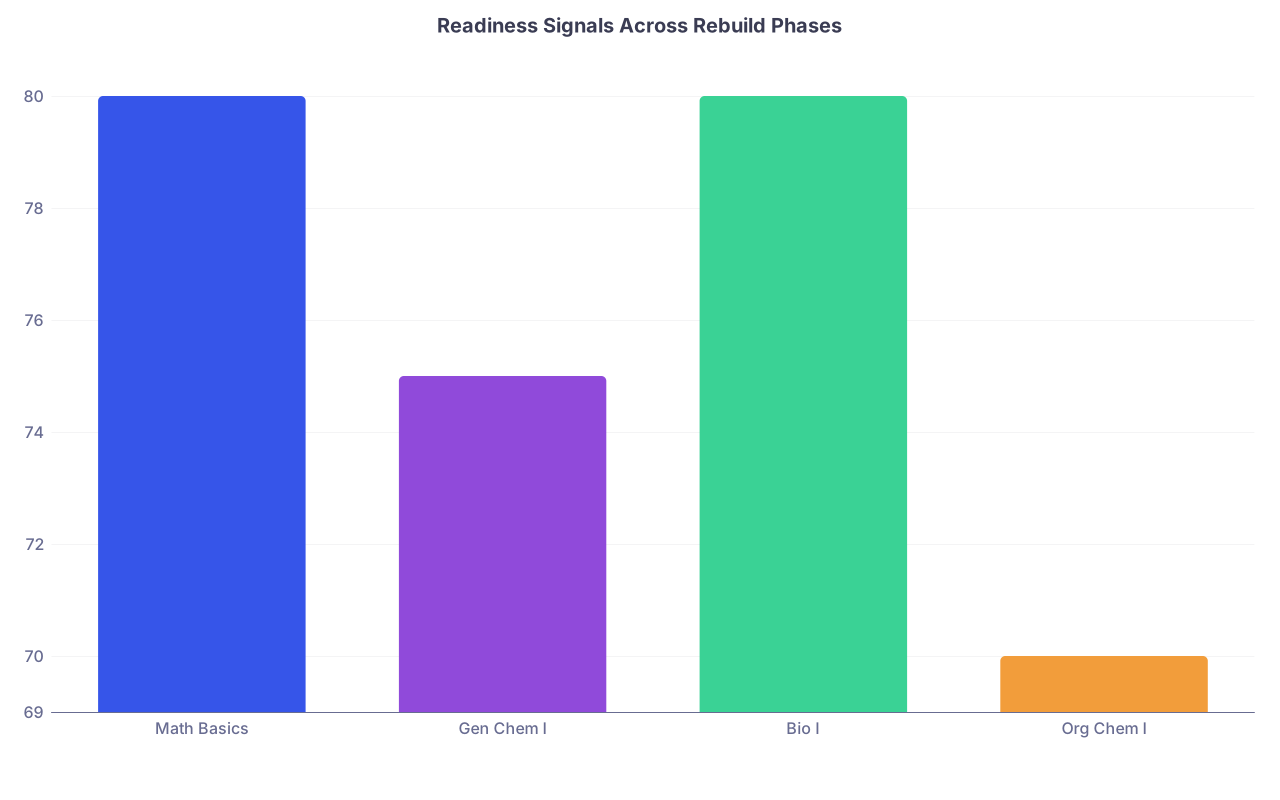
Here is a pragmatic set of signals:
| Category | Value |
|---|---|
| Math Basics | 80 |
| Gen Chem I | 75 |
| Bio I | 80 |
| Org Chem I | 70 |
Think of those bars as the target percentage you should be consistently scoring on course exams or rigorous practice sets before moving up a level:
Math basics → Gen Chem:
- 80%+ average on algebra/problem sets
- You are not losing points on unit conversions
Gen Chem I → Gen Chem II / Orgo prep:
- 75–80%+ on exams in a real class
- You can:
- Balance equations
- Handle moles and stoichiometry
- Grasp what pH means beyond “it is a number”
Intro Bio → upper-level + MCAT prep:
- 80%+ on exams
- You can explain:
- DNA replication
- Transcription/translation
- Major hormone systems
- Basic population genetics
You do not need perfection. You need consistent comprehension and the ability to recover quickly from mistakes.
Step 12: Stack everything toward medical school, not just passing classes
You are not doing all this just to survive chemistry. You are building a platform for:
- MCAT success
- Medical school admissions committees evaluating a “reinvention”
- Surviving first-year med school physiology and biochem
So as you rebuild:
Choose courses strategically
- Community college for initial repair is fine, especially if that is what you can access.
- But you should demonstrate success in upper-division sciences at a four-year institution at some point.
Treat every challenging course as part of your story
- Document:
- When you returned
- The specific obstacles (work, family, 15-year gap)
- The systems you built to succeed
- Improvement over time (e.g., C+ in first gen chem exam → A- by final)
- Document:
Build evidence of academic momentum You want a transcript narrative like:
- Early: B-/C+ range as you re-enter
- Then: steady climb to A-/A in later courses This tells adcoms your foundation is not just patched. It is rebuilt and stress-tested.
One more thing: stop asking if you are “too old” and start asking if you are willing to work this plan
Let me be blunt. Most people who ask “Is it even possible after 15–20 years?” are not really asking about neuroplasticity or admissions statistics. They are asking if someone will absolve them of trying.
Your brain can handle this. At 35. At 45. At 50. I have seen it personally.
The real questions are:
- Are you willing to rebuild slow and deep instead of fast and shallow?
- Are you willing to structure your life like a serious project, not a vague wish?
- Are you willing to tolerate feeling stupid for months while your old circuits come back online?
If yes, then your 15-year gap is not a death sentence. It is just a longer warm-up.

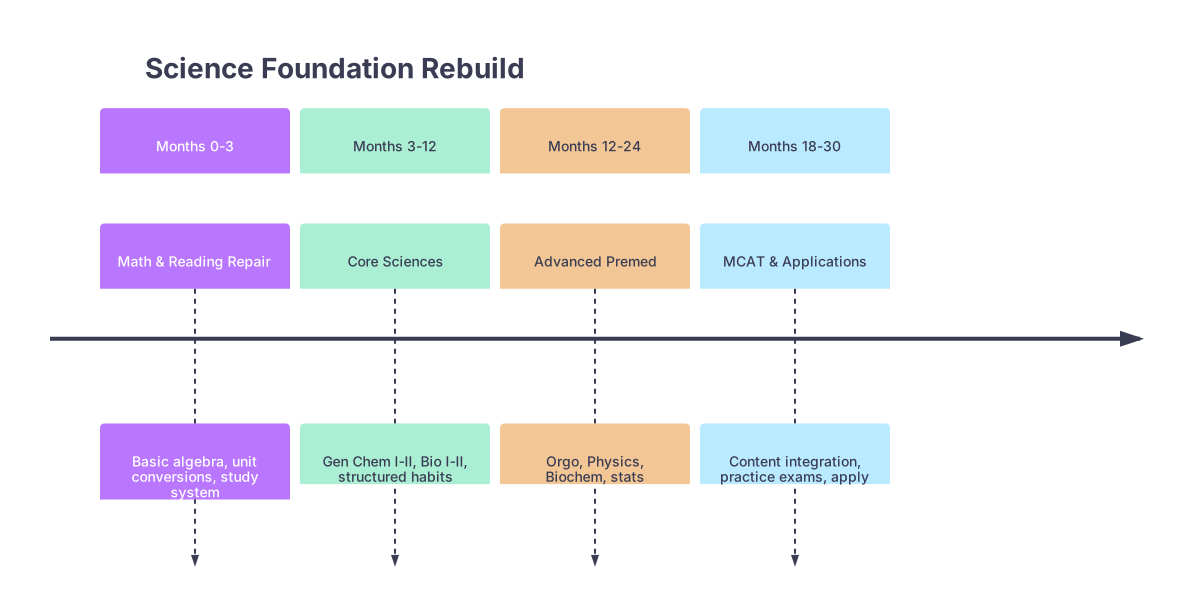
| Period | Event |
|---|---|
| Months 0-3 - Math & Reading Repair | Basic algebra, unit conversions, study system |
| Months 3-12 - Core Sciences | Gen Chem I-II, Bio I-II, structured habits |
| Months 12-24 - Advanced Premed | Orgo, Physics, Biochem, stats |
| Months 18-30 - MCAT & Applications | Content integration, practice exams, apply |

Boiled down
- Your “science problem” is a training and structure problem, not a fixed ability problem. Fix the math, then rebuild bio and chem in layers.
- Treat this like a multi-year engineering project: diagnostics, phases, tracking, and feedback loops. Not vibes and hope.
- Success is not perfection; it is consistent 75–85% performance on real exams and the ability to explain key concepts in plain language. Once you hit that, you are ready to move on to the next level.
Do this right, and 15 years away from school becomes an interesting footnote in your application, not the reason you never applied.