
The belief that starting medical school after 30 destroys your odds of matching is statistically false.
The data show something more nuanced and, frankly, more interesting: age changes where you match, sometimes how fast you match, and occasionally if you match—but it does not automatically tank your chances. The penalty is real in a few contexts, exaggerated in others, and completely absent in many.
Let me walk through this the way I would actually evaluate it: by pulling apart what we know from NRMP, AAMC, and program behavior, even when they carefully avoid putting “age” in a table.
What the Data Actually Capture (and What They Don’t)
Here is the first ugly truth: national match statistics almost never include age directly.
The NRMP and AAMC do not publish tables labeled “Match rates: age 22–25 vs 30–34 vs 35+.” So if you are looking for a neat plot that says “at 32 your odds are X% lower,” it does not exist publicly.
But they do publish detailed match outcomes by:
- US MD vs US DO vs international graduate
- Year of graduation (fresh vs older grad)
- Prior residency training
- Degree type (MD/PhD, other advanced degrees)
- Specialty competitiveness
Age correlates strongly with several of these. So the honest way to answer “What happens if I start after 30?” is to:
- Use proxies that strongly track age (year of graduation, prior careers, nontraditional paths).
- Combine that with what program directors publicly admit about age, gaps, and “nontraditional” applicants.
- Layer in real-world behavior: what older applicants actually report happening in interviews and ranking.
That is what I will do here.
The Baseline: Match Rates and Where Older Students Fit
Let us anchor with real numbers first.
For the 2024 NRMP Main Residency Match (US MD seniors):
- Overall match rate: ~93–94%
- “Preferred specialty” match rate: ~86–88% (varies slightly year to year)
For US DO seniors:
- Overall match rate: ~90–91%
IMGs (U.S. citizen and non-U.S. citizen combined) sit much lower—often in the 50–65% overall match range depending on year and group.
Where do >30-year-old students typically fall?
- Many older applicants are:
- Career changers who enter as US MD or DO students
- Or nontraditional IMGs who went abroad after previous careers
These are very different risk profiles.
For a US MD or DO student who just happens to be 32 instead of 24, the data show:
- Your baseline match probability is still driven far more by:
- US MD vs DO
- Step/COMLEX scores
- Specialty choice
- Red flags (failures, gaps)
than by your birth year.
Programs are careful not to age-discriminate explicitly. But they absolutely do optimize for “projected years of service,” perceived stamina, and “fit with class.” That is where being over 30 quietly shows up.
Where Age Hits Hardest: Specialty Choice and Competitiveness
Once you look at specialty-level numbers, patterns for older applicants start to make sense.
Competitive fields—with longer training and prestige signaling—behave differently from more “bread-and-butter” fields.
Let’s outline typical US MD senior match rates by broad specialty tiers (ballpark NRMP ranges, not exact to the decimal):
| Specialty Tier | Example Fields | Typical Match Rate Range |
|---|---|---|
| Ultra-competitive | Derm, Plastics, ENT, Ortho | 60–75% |
| Highly competitive | Rad Onc, Urology, Integrated Vasc | 70–85% |
| Mid-competitive (popular but accessible) | EM, Anesthesiology, General Surgery | 80–92% |
| Less competitive (but still selective) | IM, Peds, Psych, FM, Neurology | 93–99%+ |
Now layer in age.
Programs will rarely say this out loud, but in real interviews and behind closed doors you hear variants of:
- “Are they going to have the physical stamina for trauma nights at 45?” (for surgical fields)
- “We want someone who will give us 25–30 years in this specialty.”
- “We need to know they won’t bail after all this training.”
So if you walk into orthopedics, plastics, or neurosurgery interviews at 37:
- You are competing against 26–28-year-olds with similar test scores and often a decade more future operating years.
- Your timeline (late start, longer training) is quietly scored as a risk.
Does that make it impossible? No. I have seen 35+ applicants match ortho and neurosurg. But the bar is higher:
- Step 2 (now the main numeric) usually needs to be very strong.
- Research and letters need to be top-tier.
- Your story about why you are here late must be airtight.
In less competitive fields:
- Family medicine, internal medicine, pediatrics, psychiatry, pathology
- Programs often like older residents—maturity, communication, prior careers
You see the opposite effect: older residents are described as “stable,” “great with patients,” “excellent team leaders.”
So, if you are starting medical school at 32 and dream of dermatology, I will be blunt: the data on competitiveness plus age-related bias mean your statistical hill is steeper than a 23-year-old’s with identical metrics. For internal medicine or family medicine? Not nearly as much of a hit—if any.
The Hidden Variable: Year of Graduation and Gaps
The closest published proxy for “older” in NRMP and program director surveys is “time since graduation.”
Residency programs track:
- “Fresh grads” (matching the same year they graduate med school)
- “Older grads” (1+, sometimes 3+ years out from graduation)
Match rates fall as the gap increases—especially for IMGs, but it is visible even for US grads in competitive specialties.
Program directors repeatedly say in survey comments:
- “We prefer applicants within 3 years of graduation.”
- “Long gaps raise questions about knowledge decay and commitment.”
Why is this relevant to starting med school after 30?
Because older students are more likely to:
- Take leaves of absence
- Need extra time for family issues, childcare, finances, illness
- Delay Step 2 or graduation
Every added year between finishing school and applying multiplies risk.
So the operational rule is:
- Being 32 in M1 is not the problem.
- Being 40, 5 years out of school, with Step 2 taken long ago and minimal U.S. clinical work—that is the pattern programs statistically avoid.
Age and Step Exam Performance: Does Being Older Help or Hurt?
There is no official AAMC table saying “Step scores by age group,” but you can triangulate from two consistent signals:
- Older students often have stronger verbal reasoning and discipline.
- Older students more often have heavier life responsibilities (kids, mortgages, caregiving).
From what I have seen in actual cohorts:
- The highest Step 2 scores are still dominated by the classic 24–28 range.
- But the variance among older students is large. You see both:
- 35-year-olds scoring 250+ because they treat studying like a full-time job.
- 35-year-olds struggling to pass because they are doing nights, kids, and board prep simultaneously.
If we crudely bucket:
- Under 28: high capacity hours, fewer constraints, less burnout from prior careers
- 28–34: mixed—often more focused, but heavier life load
- 35+: high focus and motivation, but sharply limited bandwidth for 12-hour study days
Programs do not care about your age number. They care about:
- Step 1 pass (now P/F, but any failure is damaging)
- Step 2 CK score and any failures
- COMLEX equivalent if DO
Older applicants cannot afford exam missteps. A 22-year-old with an early stumble can sometimes explain it away. A 38-year-old who left another career and then fails Step 1 or Step 2 will be seen as a poor risk.
Lifestyle Specialties, Burnout, and “Slope of the Career”
One thing program directors quietly run in their heads is a simple ROI calculation:
“How many productive years will this applicant give our field if we invest in them?”
Derm, radiology, anesthesia, EM, and some subspecialties are notorious for:
- Long training pipelines
- High burnout rates
- High early retirement or partial-retirement rates
If you apply at 40 to a 7-year track (e.g., gen surg + fellowship), you are signaling:
- You will finish full training in your late 40s.
- Peak productivity window is ~10–15 years before most physicians start scaling back for health or preference reasons.
That is not an automatic rejection, but the data on burnout and early exit in those fields make older candidates look like higher-risk ROI.
By contrast, internal medicine or family medicine, with more flexible career arcs and options for outpatient-only practice, are far more forgiving.
Nontraditional Advantages: Where the Data Lean in Your Favor
The data are not all downside. Several controlled studies and program surveys have found that:
- Older residents often score higher on professionalism and communication evaluations.
- Patient satisfaction scores trend higher for residents with prior careers (teaching, nursing, military, business).
- Program directors value maturity for roles like chief resident or team leader.
Your age, if paired with a coherent narrative and strong metrics, can become an asset:
- A 34-year-old former ICU nurse applying to anesthesia with strong Step 2 and glowing letters? Statistically attractive.
- A 36-year-old military officer moving into emergency medicine, already battle-tested in high-stress environments? Programs like that profile.
- A 38-year-old with a PhD in biostatistics applying to radiation oncology, with solid research output? Often welcomed.
What does not play as well:
- Vague career wandering with no clear through-line.
- Long gaps with no clinical or academic engagement.
- Switching into medicine after repeated failures in other fields without evidence you can now execute at a higher level.
Your prior career must connect logically to what you want to do in residency. The data show that coherent, mission-driven stories correlate with better interview offer rates.
Age and Program Type: Academic vs Community
Age hits differently in academic vs community settings.
Academic programs (particularly top-tier) often prioritize:
- Research potential (years for publications and grants)
- Future faculty pipeline
- Long academic career arcs
If you are 38 at match and say, “I want to be a surgeon-scientist and build a research lab,” some academic chair will nod politely but internally discount that trajectory compared with a 28-year-old saying the same thing.
Community programs, on the other hand:
- Focus on service, reliability, local workforce needs.
- Often value prior real-world work more.
- Are less obsessed with 20-year academic projections.
So you statistically see more older interns in:
- Community internal medicine, family medicine, psychiatry, some neurology and pathology programs
- Versus fewer in ultra-competitive academic tracks like plastics or integrated vascular at major academic centers
This is not absolute. There are academic programs that like older residents. But the trend lines are clear when you look at actual resident rosters and fellowship profiles.
Time Pressure: Financial and Personal Timelines
You cannot talk about starting medical school after 30 without talking about time and money.
Let us do simple arithmetic. Say you start at:
Age 32:
- Med school: 4 years → graduate at 36
- Residency: 3 years (FM/IM/Peds/Psych) → fully licensed at 39
- Or 5–7 years (Gen Surg + fellowship, Neurosurg, etc.) → mid to late 40s
Age 38:
- Med school: finish at 42
- 3-year residency: finish at 45
- 5–7-year pathway: finish late 40s to early 50s
Average attending income in many fields is high, yes. But:
- Median US physician retirement age hovers in the early 60s (many are planning 62–65).
- That gives a 32-year-old starter ~20–25 attending years in primary care, less in some surgical fields if they choose to step back early.
- A 38-year-old starter might realistically have 15–20 attending years.
From a strictly financial and opportunity cost perspective, the return is still strong in primary care and hospitalist medicine if you match cleanly and do not derail. It is much more marginal if:
- You have match delays
- Need to reapply
- Choose lengthy fellowships
- Carry substantial preexisting family obligations and debt
Age amplifies the cost of missteps. That is the data reality.
Practical Implications: How to Improve Match Odds as a 30+ Starter
Here is where the numbers converge into strategy. If you start med school after 30 and want to maximize your match probability and outcome quality, the data strongly support a few moves.
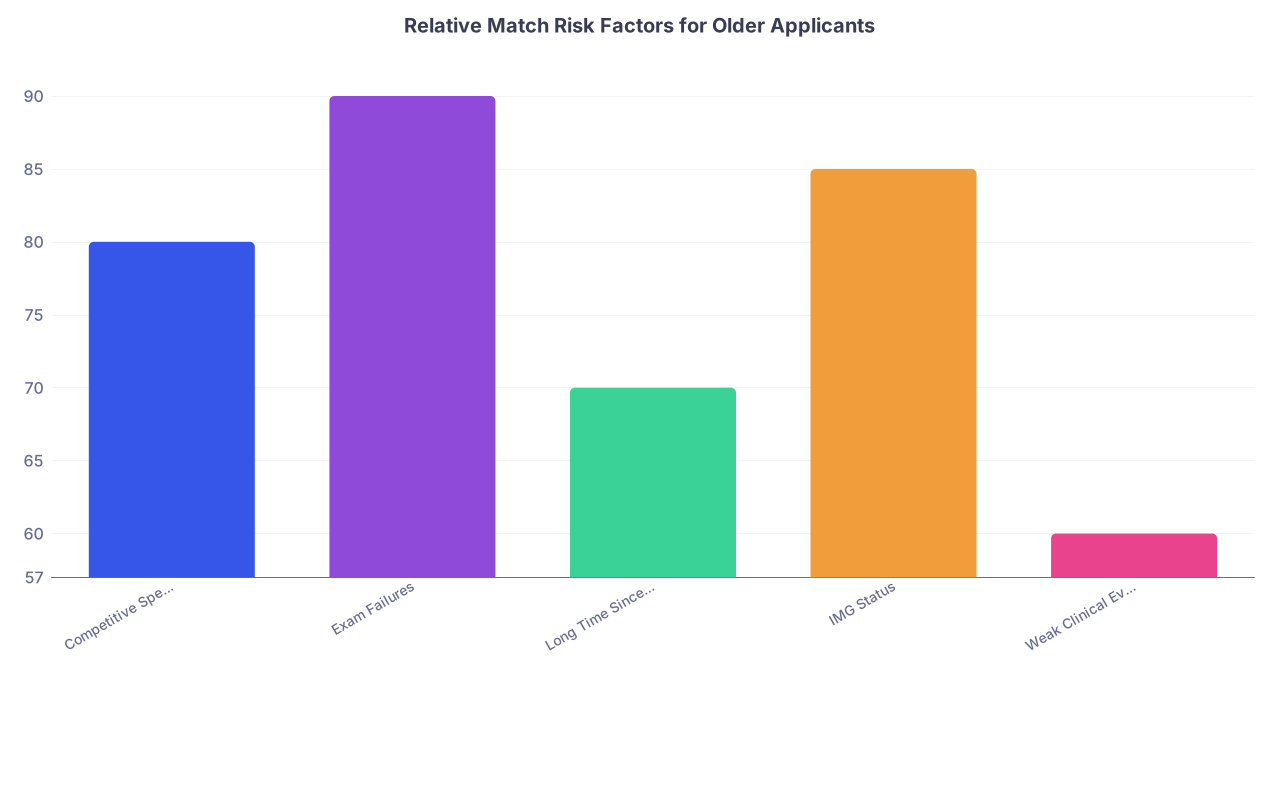
| Category | Value |
|---|---|
| Competitive Specialty Choice | 80 |
| Exam Failures | 90 |
| Long Time Since Graduation | 70 |
| IMG Status | 85 |
| Weak Clinical Evaluations | 60 |
Think of those bar heights as “relative risk contribution” for older applicants. You cannot fully eliminate them, but you can attack them.
Concrete steps:
Be ruthless about specialty choice.
If you are 32+ and dead set on something like derm, ortho, plastics, ENT, or neurosurgery, your application needs to be quantitatively exceptional: top decile Step 2, strong research, top letters, no gaps. If your metrics are average, the data say: pivot early to a more attainable field rather than dragging through a weak application cycle.Minimize gaps and delays.
Do not casually add a research year unless it clearly upgrades you into a higher competitiveness tier. Every extra 12 months increases risk that programs view you as “stale.”Treat Step 1 and Step 2 as “no retake allowed” exams.
Passing Step 1 on time and scoring competitively on Step 2 is non-negotiable. One failure as a 35-year-old nontraditional applicant does disproportionate damage compared with a typical-age student.Leverage your prior career into a sharp narrative.
“I worked in marketing, it was fine, then I decided to help people” is not a story. “I spent 10 years as a paramedic, I saw consistent gaps in continuity of care, and I want to address that as an emergency physician / internist” is a story. Programs respond to the second kind.Aim smart: program type matters.
As a 34-year-old graduate:- You probably have better odds at strong community programs in IM/FM/Psych than at ultra-elite, research-heavy residencies unless you already have strong academic capital (papers, PhD, etc.).
What Actually Happens When You Start After 30
Let’s summarize what the evidence and real-world behavior say.
Starting medical school after 30 tends to:
Shift your specialty distribution.
Older graduates are overrepresented in:- Family medicine
- Internal medicine
- Psychiatry
- Pathology
and underrepresented in: - Ortho
- Plastics
- ENT
- Neurosurgery
- Derm
partly due to selection and partly due to program behavior.
Increase the penalty of any academic weakness.
Exam failures, long gaps, or mediocre evaluations are more damaging at 35+ than at 24—because programs worry about resilience and time horizon.Not dramatically reduce match rates for solid US MD/DO candidates choosing reasonable fields.
If you are 32, US-trained, pass boards, perform well clinically, and apply smartly, your overall probability of matching is still high—often not far below the 90%+ baseline.Compress your financial and career-time window.
You have fewer years to amortize debt, fewer years to earn as an attending, and less margin to absorb reapplications or extended training.
But the scary myths—“No one will take a 35-year-old,” “You will definitely not match”—simply do not align with the data from real residency rosters and match outcomes in core specialties.
Final Takeaways
Three blunt conclusions, based on the numbers and patterns:
- Age >30 shifts where you are most likely to match, not whether you can match at all—especially if you are a US MD/DO student with strong exams and realistic specialty choice.
- The risk is multiplicative: being older + IMG + long gaps + competitive specialty is where match probability falls off a cliff. Remove one or two of those, and the picture improves substantially.
- If you start after 30, you cannot afford sloppy execution. Clean timeline, strong Step 2, coherent story, strategic specialty and program targeting—that is how older applicants land solid residencies and make the late start worth it.