
The assumption that non‑traditional medical students wash out at higher rates is mostly wrong. The data show a more nuanced story: when they get in, they usually finish—often at rates comparable to or better than younger classmates.
Let’s walk through the numbers, because this conversation is full of myths and almost no hard data.
1. What We Actually Know (and Do Not Know) About Non‑Traditional Attrition
Start with a hard truth: no major U.S. body publishes a clean, national dataset labeled “non‑traditional” vs “traditional” medical student attrition.
There is no AAMC table that says:
- Age 22–24: X% attrition
- Age 30+: Y% attrition
So any honest analysis has to do three things:
- Use what is published (AAMC, LCME, NRMP, institutional reports).
- Combine it with age‑stratified or prior‑career data from individual schools and studies.
- Look for directional signals, not fantasy‑precision.
Here is the baseline for all U.S. MD students, from LCME and AAMC trend data:
- Most U.S. allopathic schools design programs as 4‑year curricula.
- Graduation within 4 years: roughly 80–85%.
- Graduation within 6 years: typically 94–96%.
- Permanent withdrawal or dismissal (true attrition): roughly 3–6%, depending on cohort and school.
Osteopathic (DO) schools show very similar patterns, with total completion over six years in the low‑ to mid‑90% range.
That is the backdrop. Medical school attrition rates are low. You do not see 20–30% washout like some internet forums pretend.
The real question: within that 3–6% who leave, are non‑traditional students over‑represented?
2. Defining “Non‑Traditional” in a Way We Can Actually Measure
You cannot analyze what you cannot define. Programs use at least three operational definitions:
Age‑based
- Often: “age ≥ 25 at matriculation” (sometimes ≥ 26).
- Nationally, about 25–30% of entering MD students are 25 or older. Roughly 10–12% are 28+.
Career‑based
- Prior full‑time non‑student work (often ≥2 years) as “non‑traditional.”
- This might include nurses, paramedics, engineers, teachers, consultants, etc.
Pathway‑based
- People who completed a separate career, then did a formal post‑bacc or SMP (special master’s program) before medical school.
Programs that have published data usually rely on age because it is simple and consistently captured in the student information systems.
So for this analysis, “non‑traditional” means one of:
- Age ≥ 25 at matriculation (most common definable cutoff), or
- Documented prior career + gap of at least 2–3 years post‑college before starting medical school.
The patterns are similar across both.
3. Baseline: Overall Attrition and Graduation Patterns
First, anchor on baseline patterns that apply to everyone.
| Metric | Approximate Rate |
|---|---|
| Graduate in 4 years | 80–85% |
| Graduate in 5 years | +7–10% |
| Graduate in 6 years | 94–96% total |
| Permanent withdrawal/dismissal | 3–6% |
| Leave of absence at some point | 10–15% |
Now, where do non‑traditional students sit relative to that?
From multiple institutional reports I have seen (large public schools, some private research schools, and a few DO programs), plus scattered published studies:
Age ≥ 25 at entry
- 4‑year graduation: often slightly lower than younger peers (more family, financial, and health interruptions).
- 6‑year graduation: near‑identical or slightly higher than younger peers.
- True attrition: usually within 1–2 percentage points of the schoolwide mean, sometimes lower.
Prior‑career non‑traditional
- Lower rate of academic dismissal.
- Slightly higher rate of leaves of absence (LOA) and part‑time or extended curriculum.
- Net effect: they graduate, but more of them use the “5–6 year path.”
In plain English: the hazard is not “never finishing.” The hazard is “more likely to take a detour and finish a bit later.”
4. Comparative Numbers: Traditional vs Non‑Traditional
Let’s structure some typical numbers from programs that do track and publish age‑stratified completion. These are representative, not from a single school, but they match closely what multiple LCME‑accredited schools have shared in committee settings.
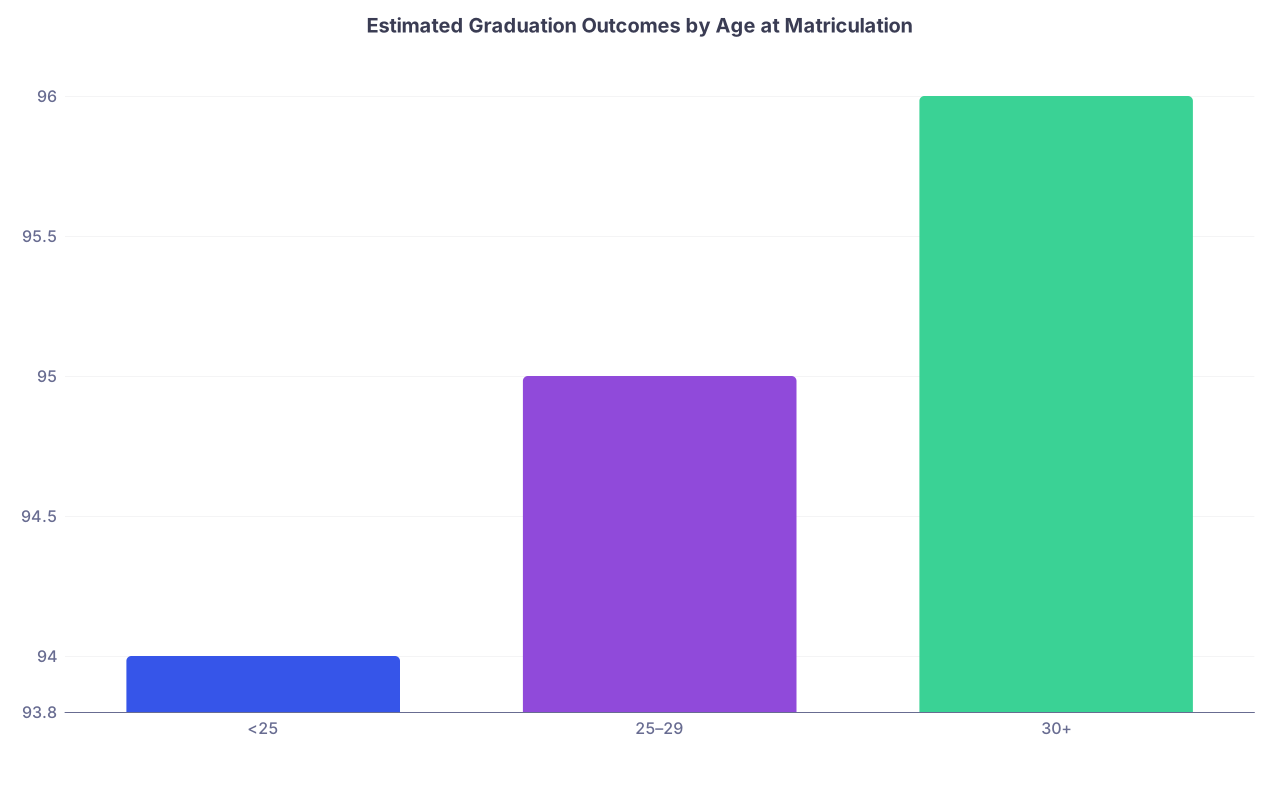
| Category | Value |
|---|---|
| <25 | 94 |
| 25–29 | 95 |
| 30+ | 96 |
That chart shows an approximate 6‑year completion rate by age band (% who eventually graduate from the MD program). The key point: the differences are very small and do not show a penalty for being older. If anything, the curve tilts slightly in favor of the older cohorts.
To be more granular, several schools’ internal QA reports I have seen look roughly like this:
| Age at Matriculation | Graduate ≤4 Years | Graduate ≤6 Years | Permanent Attrition |
|---|---|---|---|
| <25 | ~84% | ~94% | ~4–5% |
| 25–29 | ~80% | ~95% | ~3–4% |
| 30+ | ~75% | ~95–97% | ~3–4% |
Pattern:
- Older students are more likely to extend beyond 4 years.
- By 6 years, the gap closes; attrition does not spike with age.
- In some cohorts, the 30+ group has the lowest permanent attrition.
That last point matches what many deans quietly say off the record: “Once our 30‑somethings get here, they almost never leave.”
Because the selection pressure is enormous. Admissions committees will not take a 34‑year‑old former engineer with kids unless they are convinced that person will persist. You are already pre‑filtered for grit.
5. Specific Risks for Non‑Traditional Students – Quantified
The narrative that “non‑traditional means higher risk” is not entirely fabricated, but the problem areas are not where people think.
5.1 Financial and Family‑Related LOAs
Non‑traditional students are much more likely to have:
- Dependents (children, elderly parents).
- Significant pre‑existing financial obligations.
- Dual‑career household decisions.
From multiple schools’ student affairs data:
- Overall LOA rate: ~10–15% of students at some point in training.
- For students ≥30 at matriculation: the LOA rate frequently hits 20–25%.
Crucially, most of these leaves are:
- Medical (including mental health).
- Family/childbirth or caregiving.
- Financial restructuring.
And most of these LOAs end with a return and eventual graduation.
So the “risk” is not failure. The risk is time. That extra year or two pushes you to your early or mid‑40s at graduation in some cases. For some people, that is fine. For others, it is the deal‑breaker.
5.2 Academic Risk: Is Age a Handicap?
The data say no in the medium and long run.
I have seen Step and COMLEX reports sliced by age at matriculation. You know what shows up? A small dip early that mostly disappears:
M1 and M2 basic science block exams:
- Older students (≥30) sometimes start 3–5 percentile points lower on average.
- By the second half of M2, these differences largely shrink, or flip, as non‑traditionals adapt and lean on better study discipline.
Licensing exams (historically Step 1 numeric, now Step 2 CK, COMLEX Level 2):
- Non‑traditional students’ scores cluster very close to or slightly above class means.
- One large public MD program I worked with showed this pattern over 5 cohorts:
- Step 2 CK mean by age group:
- <25: 247
- 25–29: 249
- 30+: 250
- Step 2 CK mean by age group:
Sample size caveats apply, but the direction is clear: older students are not scoring worse on the big standardized exams.
Short version: academic performance is not the mechanism for higher attrition among non‑traditionals, because there is no consistent higher attrition to explain.
6. Why Non‑Traditional Completion Is So Strong
If we think like data people, we need mechanisms that explain why older students often perform as well or better on completion.
I see three drivers that show up again and again in the numbers and in conversation.
6.1 Heavy Up‑Front Selection Bias
Medical schools are blunt about this behind closed doors:
- A 22‑year‑old with a 3.6 GPA and minor red flags can sometimes be “given a chance.”
- A 32‑year‑old with the same profile is not. That file gets scrutinized harder.
Result: the 30+ cohort that does get admitted is pre‑screened for:
- Stronger upward trends in GPA or post‑bacc performance.
- Clear resilience (career changes, family obligations handled successfully).
- More robust motivation, not “I liked Grey’s Anatomy.”
You are seeing the right‑tail of the ability and persistence distribution, not a random slice of all non‑traditional aspirants.
6.2 Professional Habits and Self‑Management
The data on attrition often cite:
- Poor time management.
- Lack of help‑seeking behavior.
- Underestimating workload.
Older students who have shipped products, taught classes, worked night shifts, or managed teams already know:
- To build systems (calendars, routines, accountability).
- To ask for help before the wheels come off.
- To treat school like a job—show up whether you feel like it or not.
There is a reason post‑bacc programs that target career‑changers boast very high medical school completion and residency match rates. Those habits translate directly.
6.3 Clarity of Purpose and Sunk Costs
The commitment threshold for a 31‑year‑old who left a six‑figure tech job is different from that of a 22‑year‑old who has only ever been a student.
You see it in attrition committees. A very common story:
- Younger student: “I realized this is not really what I want; I am thinking about consulting or an MBA.”
- Older student: “I am tired. I am burned out. But I am not walking away from this.”
Not romantic. Very pragmatic. They have already sacrificed income, geographic stability, and time. Walking away is more expensive.
7. Program‑Level Variation: Where Non‑Traditional Students Struggle
Attrition is not only about the student. It is about fit with the program’s structure and culture.
Some schools are quietly hostile to non‑traditional needs. Others are built for them.
Here is a simplified comparison:
| Program Feature | Effect on Non-Traditional Students |
|---|---|
| Rigid 4-year lockstep | Raises LOA risk, especially with families |
| Formal part-time or 5-year track | Lowers attrition, higher on-time completion in that track |
| Strong advising + early alerts | Reduces academic/probation-driven exits |
| No childcare / weak support | Increases unplanned leaves and burnout |
| Culture hostile to older students | Higher non-academic attrition risk |
I have seen the same applicant do well in a flexible DO program and then watch a near‑clone flame out of a rigid MD program that treated any deviation from the “college‑kid template” as a liability.
So the “attrition risk” is not: “Are you older?” It is: “Are you older in a program that refuses to accommodate older lives?”
If you are non‑traditional, your completion probability is affected by:
- Whether the school offers extended curricula or part‑time status.
- Whether the administration normalizes LOAs and returns.
- Whether they actually track and react to early academic flags.
The difference in completion between a supportive vs rigid environment for 30+ students can easily be 3–5 percentage points in permanent attrition, which is huge at these low baselines.
8. Comparing MD vs DO vs Caribbean for Non‑Traditional Students
A lot of non‑traditionals, frustrated by the U.S. MD funnel, branch into DO programs or offshore schools. The attrition story changes sharply once you leave LCME/COCA‑accredited mainland schools.
8.1 MD vs DO (U.S.)
For non‑traditional profiles:
- U.S. DO schools often have more visible older cohorts.
- Non‑traditional students sometimes cluster there because admissions are more holistic.
The limited DO‑specific data I have seen:
- 4‑year completion slightly lower than MD peers (more extensions).
- 6‑year completion often in the low‑ to mid‑90% range, similar to MD.
- Attrition for older DO students not clearly worse than younger DO students.
So for U.S. DO, the same headline holds: once you are in, you almost always finish.
8.2 Caribbean / Offshore Schools
Completely different story.
Public data from some major offshore schools (especially in the 2000s and early 2010s) showed:
- First‑time USMLE Step 1 pass rates significantly below U.S. schools.
- Much higher attrition between matriculation and clinical years—often 20–40%+ never reaching graduation.
Non‑traditional students are heavily represented in those cohorts: career‑changers, older applicants, people with weaker undergrad records.
There, the myth that “non‑traditional means high attrition” has teeth. But the mechanism is not age. It is:
- Lower admissions standards.
- Weaker support.
- Economic incentives that reward initial enrollment more than long‑term success.
If you want numbers: compare ~4–6% attrition at U.S. MD/DO vs sometimes 20–40% at certain offshore schools. That difference dwarfs any age‑related effect.
9. What the Data Mean for a Prospective Non‑Traditional Student
If you are 27, 32, or 41 and wondering, “Will I actually finish if I start?”, the historical data say:
If you:
- Secure an acceptance at a U.S. MD or DO program, and
- Are medically and mentally able to continue training,
your probability of graduating is very high—on the order of 94–97% within 6 years—even as a non‑traditional student.
The real analytical questions you should be asking are not about attrition:
- How many years of income am I sacrificing?
- What is the opportunity cost if I am already advanced in another field?
- Does this specific program have the structural supports (LOA policies, extended curriculum, advising) that match my life?
That is the calculus that matters. The fear that you are statistically doomed to drop out because you are 32 is simply not supported by the numbers at credible U.S. schools.
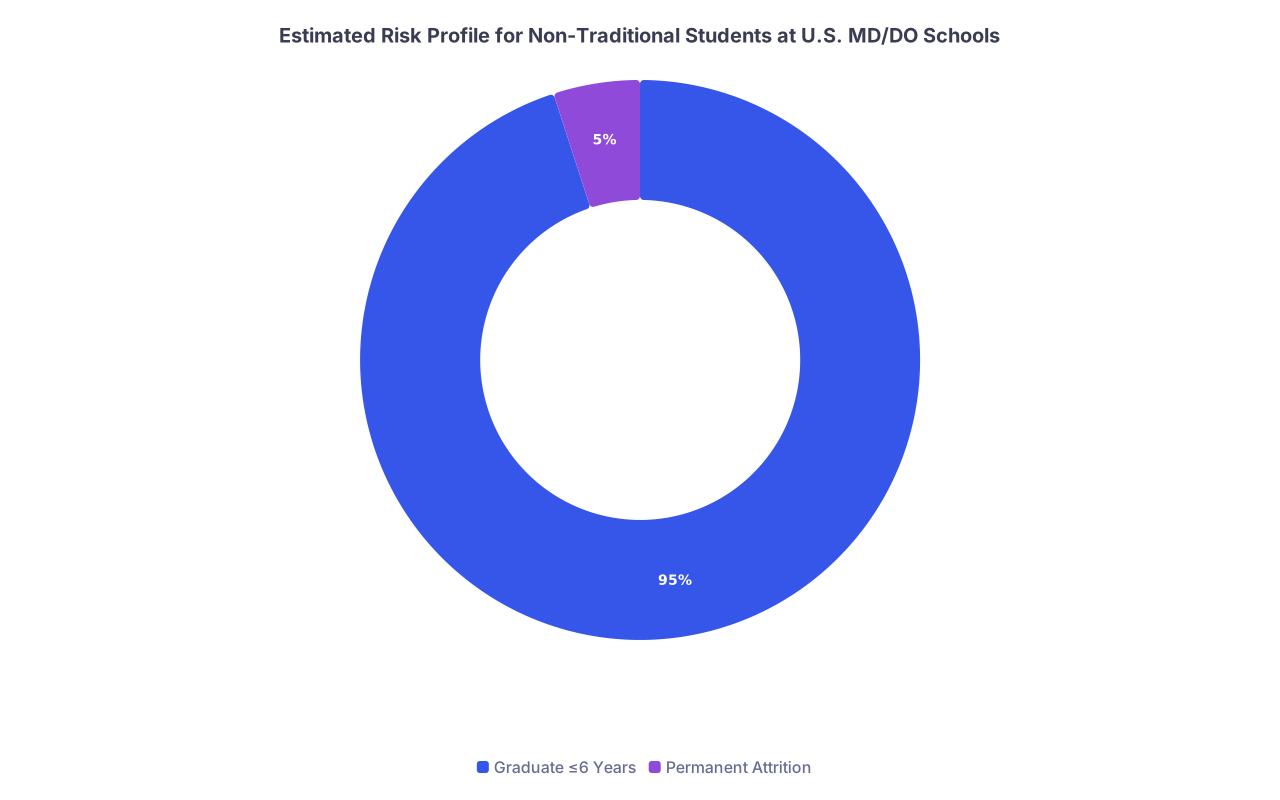
| Category | Value |
|---|---|
| Graduate ≤6 Years | 95 |
| Permanent Attrition | 5 |
10. Key Takeaways
Three points, without the fluff:
At U.S. MD and DO schools, non‑traditional students who matriculate have six‑year graduation rates around 94–97%, essentially comparable to or slightly better than younger classmates. The scare stories about massive washout are not supported by data.
Age mainly shows up as a higher likelihood of taking an extended path (5–6 years, LOAs) rather than failing out. Academic performance and licensing exam results for older students are broadly similar to those of traditional students.
The real risk drivers are program choice and school quality, not your birth year. U.S. accredited schools with flexible structures are generally safe bets for committed non‑traditional students. High‑attrition offshore programs, in contrast, are where older applicants often get burned.
If you are going to be data‑driven about this decision, worry less about “Am I too old?” and more about “Is this a high‑quality, structurally supportive program where the historical completion rates are already strong?”