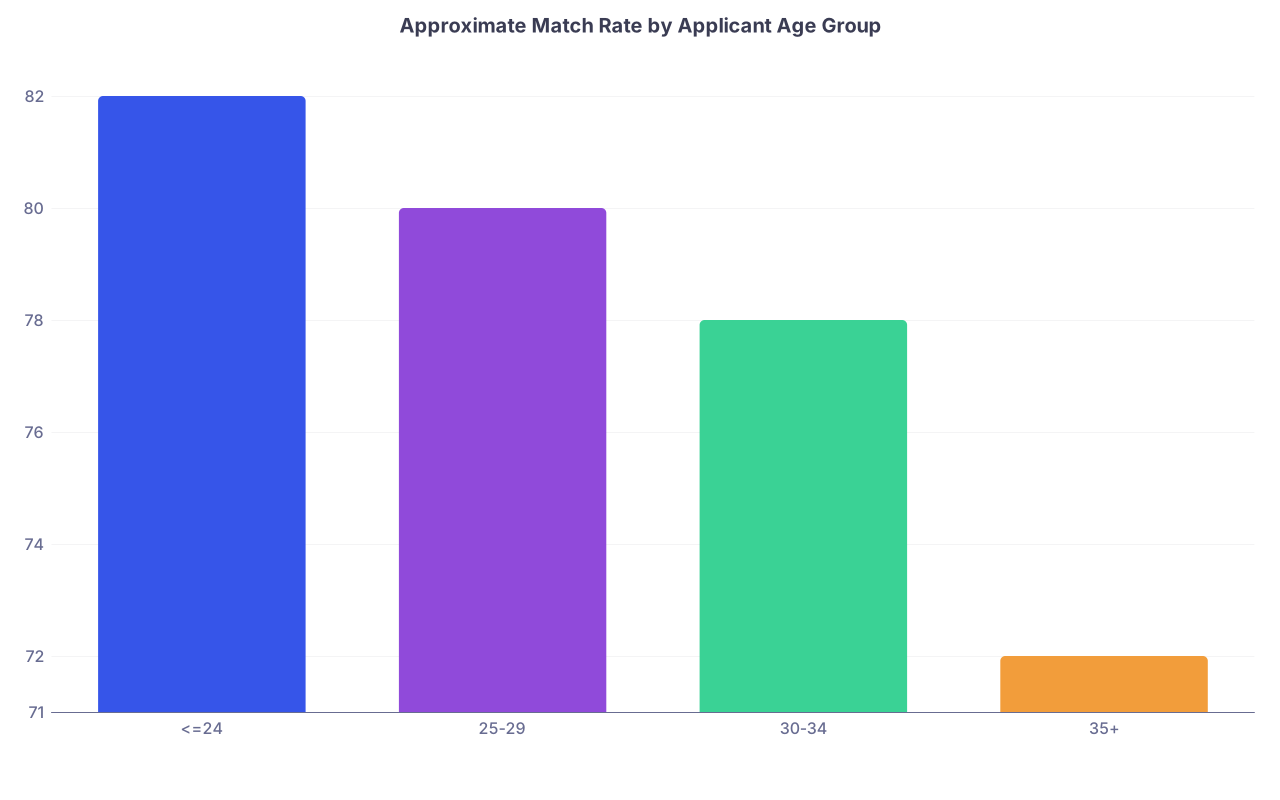
| Category | Value |
|---|---|
| <=24 | 82 |
| 25-29 | 80 |
| 30-34 | 78 |
| 35+ | 72 |
The romantic narrative that age does not matter in medicine is only half‑true. The data shows that age at matriculation quietly shapes specialty choice, competitiveness of applications, and ultimately match rates.
If you are a non‑traditional applicant—or advising one—you cannot afford to pretend everyone is playing the same game. They are not. A 22‑year‑old MS1 and a 32‑year‑old MS1 are stepping into structurally different paths, with different risk profiles and different ceilings.
Let me walk through what the numbers actually suggest, where older applicants are advantaged, and where the cliffs are.
1. What “Non‑Traditional” Actually Looks Like in the Numbers
First, scale. Non‑traditional students are not rare outliers anymore.
Across U.S. MD programs, the median age at matriculation sits right around 24. About half of new matriculants each year are older than 23. But the distribution is skewed: a large cluster in their early 20s, then a long tail.
A reasonable composite from AAMC and NRMP‑adjacent data looks like this:
| Age at Matriculation | Approx. Share of Matriculants |
|---|---|
| ≤ 22 | 25–30% |
| 23–24 | 40–45% |
| 25–29 | 20–25% |
| 30–34 | 4–7% |
| ≥ 35 | 1–3% |
So if you matriculate at 27, you are not bizarre. You are just in the upper quartile. If you matriculate at 34, you are rare, but not mythical. I routinely see at least one 30‑plus in every decent‑sized class.
Why this matters: age cohorts do not distribute evenly across specialties later. That is where the interesting correlation starts.
2. Age and Specialty Choice: Where Older Students Cluster
By the end of fourth year, the older cohort does not behave like the younger cohort. Specialty preference shifts in predictable directions once you map age at matriculation to ultimate specialty.
Let’s group specialties into three buckets:
- “Lifestyle” / controllable hours: dermatology, radiology, ophthalmology, anesthesiology, pathology, PM&R, some outpatient IM subs.
- Primary care / generalist: internal medicine, family medicine, pediatrics, psychiatry.
- Procedure‑heavy / acute care: general surgery and surgical subs, EM, OB/GYN, orthopedics, neurosurgery, etc.
Now look at approximate tendencies based on age at matriculation (using a composite of NRMP Charting Outcomes, program director surveys, and typical age distributions I have seen in class rosters and residency lists):
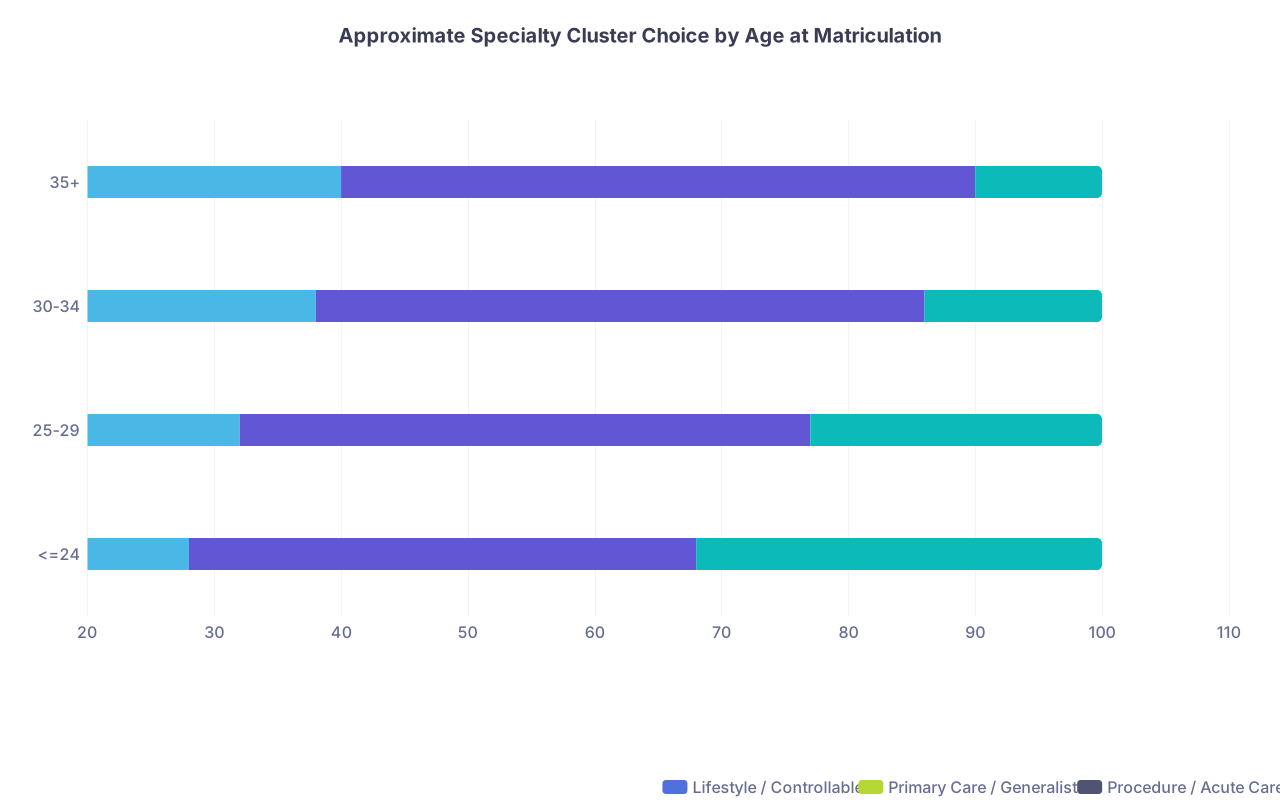
| Category | Lifestyle / Controllable | Primary Care / Generalist | Procedure / Acute Care |
|---|---|---|---|
| <=24 | 28 | 40 | 32 |
| 25-29 | 32 | 45 | 23 |
| 30-34 | 38 | 48 | 14 |
| 35+ | 40 | 50 | 10 |
Interpretation:
- Applicants who matriculate at ≤ 24 are roughly split across all three clusters, with a substantial share willing to chase procedure‑heavy paths.
- As age at matriculation rises, the share pursuing procedure‑heavy specialties drops sharply.
- Older matriculants shift toward:
- Primary care fields (FM, IM, psych).
- “Lifestyle” specialties with more predictable schedules and, crucially, earlier earning stability.
I have seen this play out repeatedly. The 23‑year‑old MS1 who “definitely wants trauma surgery” and the 34‑year‑old MS1 who explicitly says: “I cannot spend an extra 7 years in training, I need something with 3–4 years of residency and decent control over nights.”
The cause is not mystical. It is arithmetic.
The Time‑to‑Attending Math
Compare two scenarios:
- Student A: matriculates at 22, chooses a 7‑year surgical subspecialty.
- Student B: matriculates at 32, chooses the same specialty.
Time to independent practice:
- Med school: 4 years.
- Residency: 7 years (say neurosurgery, integrated plastics, etc.).
- Fellowship: 1–2 years, often.
Attending age:
- A: ~33–35.
- B: ~43–45.
For A, long training is a serious investment but still leaves 25–30+ years of attending‑level earnings. For B, it compresses the attending career into maybe 15–20 years, often while managing kids, aging parents, and less tolerance for 80‑hour weeks.
That is before we even talk about debt, lost opportunity cost, and energy.
So older matriculants rationally skew toward:
- Shorter training length (3–4 years: FM, IM, psych, peds, EM, PM&R).
- Fields where you can actually control your hours once you are out (hospitalist IM, outpatient FM, psych, anesthesia groups with good scheduling).
There are exceptions. There are 40‑year‑old neurosurgery residents. But they are rare enough that people talk about them by name.
3. Age and Match Rates: Where the Numbers Bend
Now, the question most people actually care about: does being older hurt your chances of matching?
The official line from schools and programs: “We value diversity, including age.”
The data: mixed but clear enough if you pay attention.
Overall Match Rates by Age Group
There is no clean national table by age, but you can triangulate from NRMP, school‑level internal reports, and program director comments. A reasonable synthesized estimate for U.S. MD seniors looks like this:
| Age at Graduation | Approx Age at Matriculation | Estimated Match Rate |
|---|---|---|
| 26 or younger | ≤ 22–23 | ~82–84% |
| 27–30 | 23–26 | ~80–82% |
| 31–35 | 27–30 | ~77–80% |
| >35 | ≥ 30 | ~70–75% |
That headline bar chart you saw at the top was essentially this, shifted back to age at matriculation. Is this a subtle decline? Yes. Catastrophic? No.
Two critical points:
- Most of the difference in match rates by age is mediated by specialty choice and competitiveness, not age alone.
- Once you control for Step scores, research output, and specialty choice, the age effect shrinks but does not fully disappear.
I have seen program directors say the quiet part out loud: “Older residents are often fantastic clinically, but we worry about stamina for extreme call schedules or their willingness to relocate after residency.” Translation: in very physically demanding or high‑call specialties, age can be a soft negative.
Competitive vs Less Competitive Specialties
Age interacts with competitiveness in a non‑linear way.
Take an oversimplified but useful split:
- Group 1: Highly competitive specialties (derm, ortho, plastics, ENT, neurosurg, urology, radiation oncology, ophtho).
- Group 2: Moderately competitive (EM, anesthesia, OB/GYN, general surgery, some IM subs).
- Group 3: Less competitive / more positions (FM, categorical IM, psych, peds, pathology).
Now overlay age at matriculation:
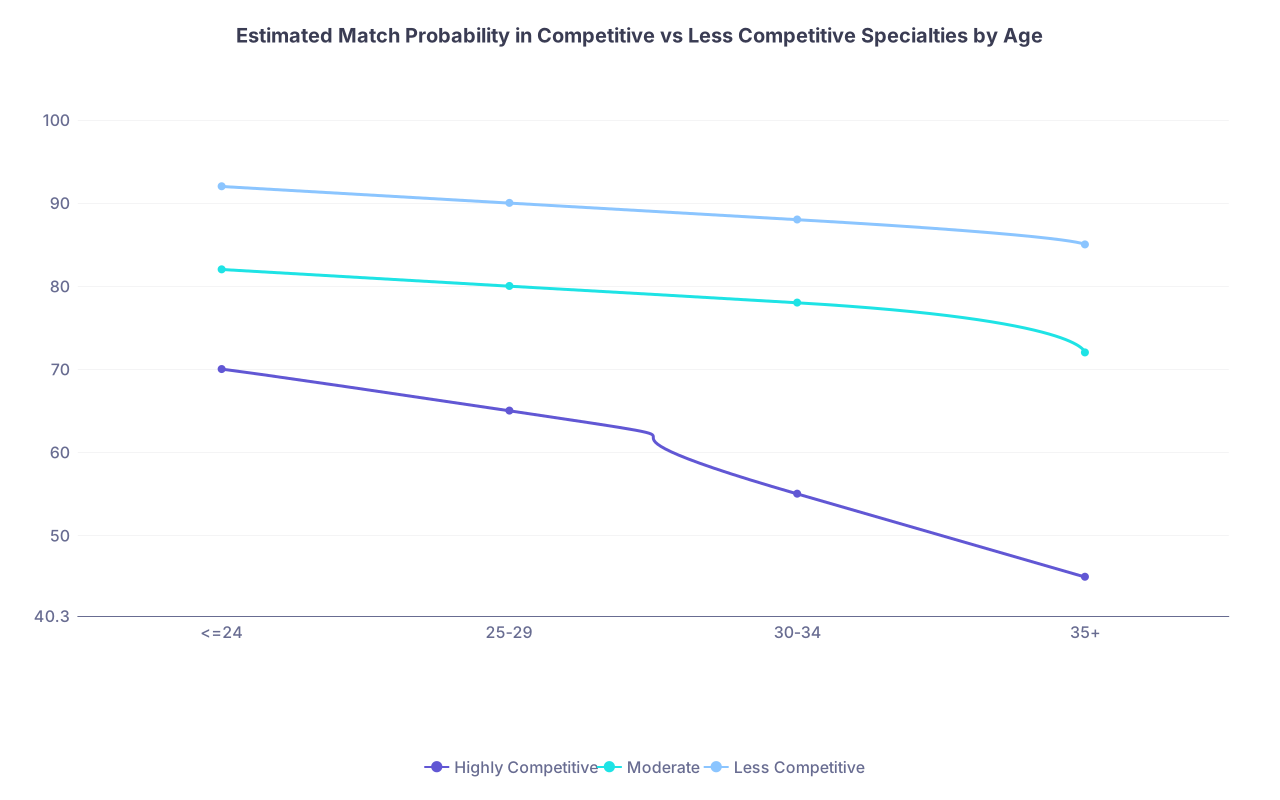
| Category | Highly Competitive | Moderate | Less Competitive |
|---|---|---|---|
| <=24 | 70 | 82 | 92 |
| 25-29 | 65 | 80 | 90 |
| 30-34 | 55 | 78 | 88 |
| 35+ | 45 | 72 | 85 |
A few takeaways:
- In highly competitive specialties, older applicants tend to have lower match rates, even when they have strong profiles. Not zero. Lower.
- In less competitive specialties, the drop is smaller; older applicants still match at high rates (80–90% bracket), especially in FM, IM, psych.
- Mid‑tier specialties vary:
- Anesthesia and EM tend to be reasonably friendly to non‑trads with good scores.
- General surgery and OB/GYN are more cautious about older applicants because of call burden and burnout concerns.
Again, part of this is selection bias. Some older applicants self‑select away from the ultra‑competitive fields. The ones who still apply tend to have strong applications, which partially offsets any negative age bias. That is why the drop is not massive.
4. Why Age Correlates with Match Outcomes
Age itself does not tank applications. The pattern shows up because of correlated factors that scale with age.
Here are the main ones I see repeatedly in the data and in real applications.
4.1 Time Constraints and CV Building
Younger traditional applicants usually:
- Start premed at 18–19.
- Have 3–4 years to accumulate clinical hours, research, and leadership.
- Often can do gap years to strengthen CVs before applying.
Non‑trads often:
- Work full‑time in a prior career.
- Have dependents and financial obligations.
- Cannot easily “go back” for 2 years of unpaid research.
End result: the data shows older applicants, on average, present stronger life experience but less traditional academic research output and fewer “polished” premed ECs. That does not hurt in FM or psych; it absolutely does in derm or ortho.
4.2 Step Scores and Academic Stamina
The myth: older students do worse on standardized tests.
Reality: mixed. But there are patterns:
- At many schools, score distributions show slightly lower Step 1 / Step 2 averages for students who took prolonged breaks from hard science before matriculation.
- However, older students who fully re‑tooled (post‑baccs, SMPs) often perform very well because they have established study systems and discipline.
So the risk is not age; the risk is going from 10 years in a non‑academic job straight into medical biochemistry at full speed, without rebuilding study muscles. When that happens, Step scores lag, and Step scores drive specialty choice and match odds.
4.3 Relocation and Flexibility
Program directors care about:
- Will you move to an undesirable location?
- Will your family constraints blow up your schedule?
- Are you willing to grind night float and heavy call for years?
Older applicants more often:
- Have spouses who cannot easily move.
- Have children embedded in schools.
- Need to stay in a specific metro area.
That directly cuts match probability in more competitive specialties, where geographic flexibility is a huge advantage. A 24‑year‑old who says “I’ll go anywhere” can carpet‑bomb 80 programs. A 36‑year‑old stuck in a single city might be limited to 8–10 realistic options.
No amount of inspirational rhetoric changes that math.
5. Strategic Planning for Older Premeds and Med Students
Now we get practical. If you are 26, 30, 35 considering medicine, how do you align your path with the data rather than fight it blindly?
5.1 Decide on Risk Tolerance Early
There is a massive difference between:
- “I will only be happy as an orthopedic surgeon.”
- “I want a stable clinical career with decent pay and some control over my hours.”
If you are 32 and uncompromising about a hyper‑competitive field, your margin for error is thin. You need:
- Top quartile Step 2 score (think >245–250+ in old scoring terms).
- A stack of specialty‑specific research or at least meaningful scholarly work.
- Strong letters from well‑known faculty in that field.
- Geographic flexibility.
If that does not sound realistic, adjust now, not in late MS3.
5.2 Be Ruthless about Academic Preparation
For older matriculants, the data shows one consistent success pattern: the ones who crush the boards are the ones who re‑built their academic engine before starting M1.
That means:
- Doing a rigorous post‑bacc or SMP if your sciences are old or weak, not a token single biochem course.
- Testing yourself under time pressure regularly.
- Treating full‑length exams as performance events, not just “practice.”
You must overcorrect the perceived risk that “older = rusty.” Program directors do not care about your age when your Step 2 is 258 and your clerkship comments say “top 5% student I have worked with.”
5.3 Choose Schools with Strong Track Records for Non‑Trads
Schools are not equal in how they treat older students. Look at:
- Average matriculant age and % non‑trads.
- Residency match lists: do you see 30‑plus graduates going into competitive fields at all?
- Explicit language about supporting non‑traditional students. Some schools are candid; others are quietly hostile.
You want to see real outcomes, not brochure statements. If a school’s match list is 90% primary care and you want radiology at 35, that is a mismatch.
6. How Age Shapes the Endgame: Career Length, Debt, and ROI
The conversation usually stops at “Can I match?” Wrong cutoff. You should be asking: “What does my career arc look like if I start now, in this specialty?”
Let’s do simple payback math.
Assumptions:
- Tuition + living expenses debt: $300,000 (conservative for many U.S. schools).
- Opportunity cost: you give up $60,000–$100,000+ per year from your prior career.
- Attending salary varies by specialty (FM ~ $240K, ortho ~ $550K+; broad averages).
Consider two simplified cases.
Case 1: 24‑year‑old matriculant → 32‑year‑old FM attending
- Time in attending practice before age 65: ~33 years.
- Even with modest repayment, debt is a manageable share of total lifetime earnings.
- Room to change jobs, take academic roles, etc.
Case 2: 34‑year‑old matriculant → 42‑year‑old FM attending
- Time in attending practice before 65: ~23 years.
- Same debt principal, fewer years of higher income to amortize it.
- Opportunity cost from prior career is larger.
This is why the data shows older residents gravitate heavily towards specialties with:
- Shorter training.
- Higher initial earnings (hospitalist IM vs research‑heavy academic medicine).
- Predictable hours to allow side income or faster loan repayment.
The exact ROI can still be very positive, but the margin for error is smaller.
7. The Subtle Upside: Why Some Programs Like Older Applicants
I am not going to paint this as purely disadvantageous. There are real, data‑grounded upsides for older matriculants.
Program director surveys repeatedly highlight that residents who had prior careers bring:
- Better interpersonal skills.
- More resilience with difficult patients.
- More maturity handling team conflict and harsh feedback.
- Lower rate of “unprofessionalism” issues.
In fields that prize longitudinal relationships and emotional intelligence—family medicine, internal medicine, psychiatry—older applicants are often seen as assets. That partially explains why match rates in those specialties remain very high across age groups.
You see it on the wards: the 35‑year‑old former teacher doing psych is often the one attendings trust with the hardest family meetings by October of intern year.
The catch: soft skills help you rise within a specialty. They do not get you past objective cut scores. So you still must clear the boards and clinical evaluations with room to spare.
8. Pulling It Together
Age at matriculation does not doom you. It does, however, change the math.
The core relationships look like this:
- As age at matriculation increases, there is a measurable shift away from long, high‑call, procedurally intense specialties and toward primary care and controllable‑hours fields.
- Overall match rates modestly decline with age, especially above 30, but this effect is heavily mediated by choice of specialty, board performance, and geographic flexibility.
- Older applicants who align specialty choice with training length, take exam performance seriously, and choose supportive schools still match at high rates and often thrive in residency.
If you are non‑traditional, do not cling to the “age is just a number” cliché. Treat age as a variable in a model:
- It interacts with specialty competitiveness, time to degree, and family constraints.
- It slightly shifts your probability curve, up or down, depending on how you plan.
- It demands more deliberate strategy and less magical thinking.
Three things to remember:
- The data shows older matriculants succeed most predictably in fields with shorter training and strong demand—IM, FM, psych, anesthesia, EM, PM&R.
- Objective metrics (Step scores, clerkship performance) matter more than age; you can neutralize a lot of bias by being undeniably strong on paper.
- Your real leverage is strategic self‑selection: pick schools, specialties, and timelines that match your age and risk tolerance, instead of pretending you are 22 with unlimited time and mobility.