
The romantic narrative that “it is never too late to become a doctor” is only half true. The data shows that past about age 35, the financial return on investment (ROI) becomes brutally sensitive to timing, specialty, and debt. You can still make it work. But the numbers stop forgiving wishful thinking.
You asked the right question: When is the financial break‑even point if you start at 35, 40, or 45? Let’s quantify it.
1. Core Assumptions: What the Numbers Say Before We Get Fancy
Before calculating time‑to‑ROI, we must lock down a baseline model. Change the assumptions and you change the answer. That is not a bug, that is exactly the point.
Here is a reasonable, conservative set of assumptions for a U.S. nontraditional premed:
- You are currently earning: $80,000–$120,000 per year (I will model at $100,000 base case).
- Medical school:
- Length: 4 years
- Total cost of attendance: $75,000/year (tuition + fees + living) → $300,000 total.
- Funded 100% by loans at 6% interest, interest capitalized at the end of medical school.
- Residency:
- Length: 3 years (think Internal Medicine, Pediatrics, FM as “base”)
- PGY‑1 salary: $65,000, 3% annual raises → roughly $205,000 total over 3 years pre‑tax.
- Attending salary:
- Primary care baseline: $250,000/year
- Higher‑paid specialty scenario: $400,000–$500,000/year
- Working life:
- You retire at 65.
- Ignore taxes for the difference calculation:
- You would pay taxes in both scenarios; for relative comparisons and timing, pre‑tax works fine as a first‑order estimate.
- No investment growth on foregone income:
- That is the harsh, fully-loaded view. If you add opportunity cost (what your old salary could have earned in investments), time‑to‑ROI gets worse. So we are already being a bit kind.
We will compare:
- Scenario A: You stay in your current job at $100,000/year, flat.
- Scenario B: You go to med school, then residency, then become an attending.
“Break‑even year” = the first year when the cumulative earnings in Scenario B finally catch up with the cumulative earnings in Scenario A.
2. Step‑by‑Step Earnings Models: 35, 40, and 45 Start Ages
To make this concrete, I will walk through the 35‑year‑old case in detail, then scale up for 40 and 45 with summary tables.
2.1 Age 35 Start: Timeline and Cumulative Gap
Age 35: You start medical school.
Baseline: If you do not go to medical school
- Age 35–65: 30 working years at $100,000/year
- Lifetime earnings (simple): $3,000,000
We can track “what you would have earned by age X” as:
- By age 39 (after 4 years): 4 × 100k = $400,000
- By age 42 (after 7 years): 7 × 100k = $700,000
- By age 65: 30 × 100k = $3,000,000
Path B: Become a doctor, starting at 35
- Age 35–39: Med school → income = $0, but you are accumulating $300,000 debt (principal) + interest.
- Age 39–42: Residency (3 years):
- Approx total: 65k + 67k + 69k ≈ $201,000 (I will round to $205,000 for simplicity.)
- Age 42–65: Attending:
- 23 years at $250,000/year → $5,750,000
Total gross lifetime earnings in the physician path (no loan repayment yet):
- 0 (med school) + 205,000 (residency) + 5,750,000 (attending) = $5,955,000
Gross numbers suggest “wow, much higher” than 3,000,000. But that is not time‑adjusted, and it ignores the when of the income and the loan hole you dig.
Time‑to‑Break-Even for a 35‑Year‑Old
We compare cumulative income year by year (ignoring loan payments for a moment, then we adjust).
At age 39 (you graduate):
- Stay‑in‑job path: 4 years × 100k = $400,000
- Med path: $0
- Earned‑income gap: –$400,000, plus you owe about $340,000–$360,000 when interest capitalizes. Call the economic gap about $750,000 if you count debt as negative wealth.
At age 42 (end of residency):
- Stay path: 7 years × 100k = $700,000
- Med path: ~$205,000 total residency pay
- Income gap: –$495,000 (700k – 205k), plus still that ~$350k of debt principal.
From age 42 onward, you are an attending at $250,000 vs staying at $100,000.
The annual income advantage from 42 on:
- Incremental income = 250k – 100k = $150,000 per year.
How many years of a 150k advantage do you need to erase a ~$495,000 cumulative earnings gap?
- 495,000 ÷ 150,000 ≈ 3.3 years
So ignoring the debt, the pure earned income break‑even hits about 3–4 years into attending life, around:
- Start med school at 35
- Graduate at 39
- Finish residency at 42
- Break even in income terms around age 45–46
Now layer in the loan.
If you borrow 300k at 6% simple, no payments during school, interest capitalizes:
Rough calc:
- Med school years: interest accrues on an increasing principal:
- Year 1: 75k at 6% → 4.5k
- Year 2: 150k at 6% → 9k
- Year 3: 225k at 6% → 13.5k
- Year 4: 300k at 6% → 18k
- Total pre‑capitalization interest ≈ 4.5 + 9 + 13.5 + 18 = 45k
You walk into residency with ~345k debt. Interest now accrues on that.
If you are in any sort of income‑driven plan, your payments in residency barely touch interest. It is very easy to walk out of residency near $370k–$390k owed if you do not pay aggressively.
So the economic deficit at age 42 is closer to:
- Lost earnings: ~495k
- Net debt: ~380k
- Combined hole: ~$875,000
At 150k extra income per year as an attending, if you devoted every incremental dollar to “making yourself as well off as if you had never gone to med school” (lost earnings + debt), you get:
- 875k ÷ 150k ≈ 5.8 years
That means:
- Financial break‑even (strict, including debt) hits around age 47–48.
- After that, every year you are strictly ahead versus staying in your old 100k job.
That is the core result for a 35‑year‑old aiming for a primary care‑type income.
3. Summary Table: Break‑Even by Start Age (Primary Care Baseline)
Let us extend the exact same structure to starting at 40 and 45, still assuming:
- 4 years med school
- 3 years residency
- 250k attending income
- 100k alternative career income
- Same loan assumptions, roughly scaled
| Start Age | Med School (Age) | Residency (Age) | Attending Start | Pure Income Break-Even Age* | Full Economic Break-Even Age** | Years as Net-Positive Attending (to 65) |
|---|---|---|---|---|---|---|
| 35 | 35–39 | 39–42 | 42 | ~45–46 | ~47–48 | ~17–18 |
| 40 | 40–44 | 44–47 | 47 | ~50–51 | ~52–53 | ~12–13 |
| 45 | 45–49 | 49–52 | 52 | ~55–56 | ~57–58 | ~7–8 |
* Pure income break‑even = ignoring loans, just when total earnings as a doctor match total earnings if you stayed in your prior job.
** Full economic break‑even = including lost earnings and accumulated student debt.
Notice the pattern:
- Every 5‑year delay in starting pushes full economic break‑even about 4–6 years later.
- The number of “ahead years” before age 65 shrinks sharply—from almost 2 decades if you start at 35 to less than a decade if you start at 45.
At 45, your time‑in‑the‑black post break‑even is short. The math still works, but the margin for bad luck (health issues, burnout, needing to cut back earlier) drops.
4. Specialty Choice: How Much Faster Can You Break Even?
The wild card is specialty. The data on physician compensation is very clear: the spread between primary care and high‑paying specialties is huge.
Let us run the same logic for a better‑paid specialty, say $400,000/year attending income, still with a 3‑year residency length for simplicity (some of the best‑paid fields have longer training, which offsets the upside).
4.1 Incremental Income Advantage
Using the same 100k alternative job:
- Primary care advantage: 250k – 100k = 150k/year
- Specialty advantage: 400k – 100k = 300k/year
That one change halves your payback time after you start attending.
4.2 Break‑Even Ages with a $400k Specialty
We will keep training length the same in this simplified model and just change attending salary.
| Start Age | Attending Start Age | Income Advantage vs Old Job | Full Economic Break-Even Age* | Years Net-Positive Attending (to 65) |
|---|---|---|---|---|
| 35 | 42 | 400k – 100k = 300k | ~44–45 | ~20–21 |
| 40 | 47 | 300k | ~49–50 | ~15–16 |
| 45 | 52 | 300k | ~54–55 | ~10–11 |
* Rough estimates using same lost earnings/debt logic but with faster payback from higher income.
You see the difference:
- 35‑year‑old, primary care → break even around 47–48.
- 35‑year‑old, 400k specialty → break even more like 44–45.
Specialty compresses the payback window by several years and gives you many more “net positive” years. But you also face:
- Often longer training (4–6 years vs 3).
- Higher competition and risk of not matching the top‑paying fields.
- Lifestyle and burnout trade‑offs that are not trivial at 50+.
Still, from a pure financial perspective, the data is blunt: higher income specialties dramatically improve the ROI curve for late starters.
5. Visualizing the Trade‑Off: Lost Years vs Higher Peak Pay
Let us visualize the net-positive attending years (years after break‑even until retirement at 65) for primary care vs specialty, by starting age.
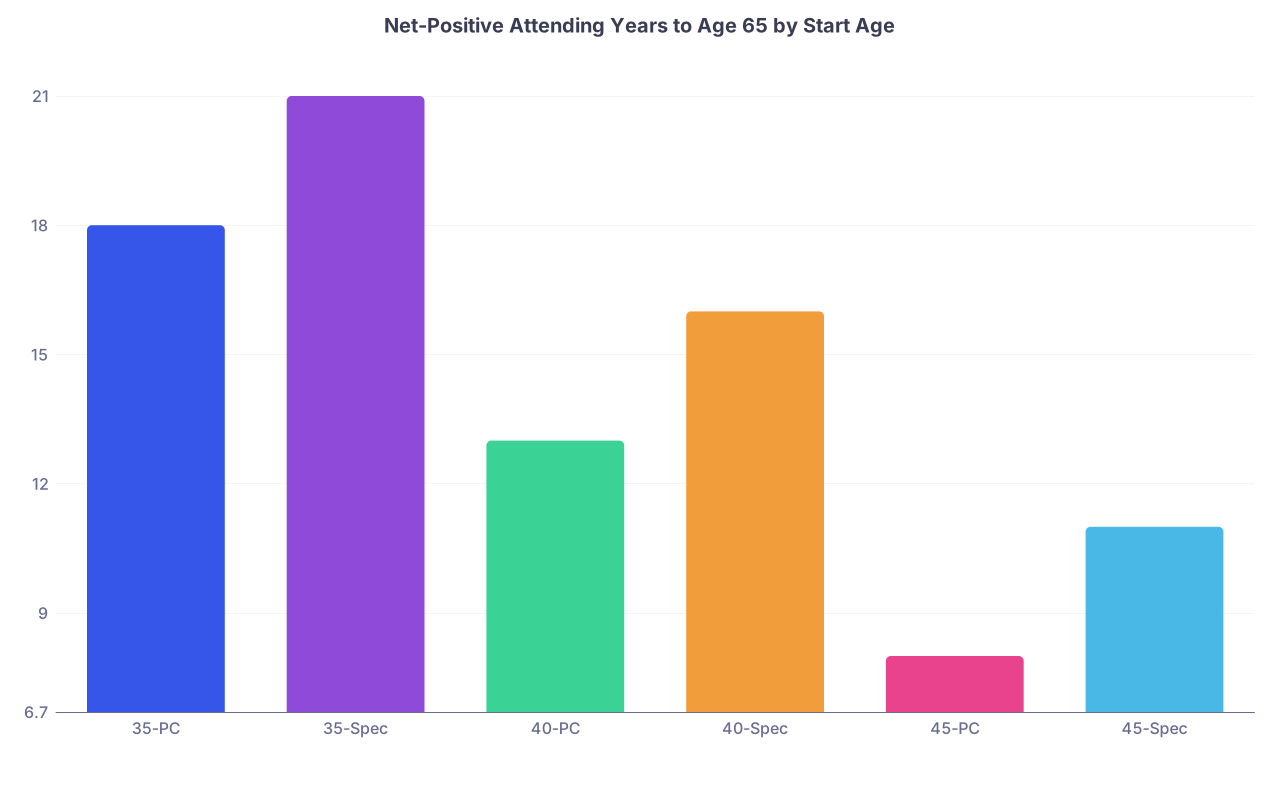
| Category | Value |
|---|---|
| 35-PC | 18 |
| 35-Spec | 21 |
| 40-PC | 13 |
| 40-Spec | 16 |
| 45-PC | 8 |
| 45-Spec | 11 |
Interpretation:
- 35‑year‑old:
- Primary care: ~18 years where you are financially ahead.
- Specialty: ~21 years.
- 40‑year‑old:
- Primary care: ~13 years.
- Specialty: ~16 years.
- 45‑year‑old:
- Primary care: ~8 years.
- Specialty: ~11 years.
So the later you start, the more the math “pushes” you toward higher‑paying specialties if your goal is purely financial ROI. Whether that is realistic is another question.
6. What If You Currently Earn More Than 100k?
Some mid‑career premeds are already pulling $150,000+ in tech, finance, or senior roles. That changes the calculus significantly.
Let’s run a quick variant:
- Alternative income: $150,000/year instead of $100,000.
- Physician income: still $250,000 (primary care).
Incremental attending income:
- 250k – 150k = 100,000/year, not 150,000.
For a 35‑year‑old:
- Lost earnings during 7 years of training:
- 7 years × 150k = 1,050,000 (vs 700k before).
- Add debt (~380k) → hole ≈ 1.4 million.
At 100k extra per year as an attending:
- 1,400,000 ÷ 100,000 = 14 years to fully break even.
Timeline:
- Start at 35, attending at 42
- Add 14 years → age ~56 for full economic break‑even.
That leaves only nine “net positive” years before 65. For a 40‑year‑old starting from 150k, the math is brutal; you may barely break even by 60.
So one harsh conclusion:
If you already make solid six‑figures outside medicine, do not assume becoming a doctor is an automatic financial upgrade. The data often shows the opposite, unless you land in the upper income specialties.
7. Loan Burden Scenarios: Less Debt vs More Debt
Debt level is the other major lever. Let’s quantify three scenarios for a 35‑year‑old:
- Low debt: $150,000 (strong savings, spouse support, military, or in‑state low‑cost school)
- Baseline: $300,000
- Heavy debt: $450,000+ (private schools, high COL area, little support)
Assume $100k alternative income, $250k attending, 3‑year residency.
| Debt Level | Estimated Debt at End of Residency* | Combined Hole at Attending Start (Lost Income + Debt) | Years of 150k Advantage to Break Even | Full Economic Break-Even Age |
|---|---|---|---|---|
| 150k | ~190k–200k | ~495k + 200k ≈ 695k | 695k ÷ 150k ≈ 4.6 | ~46–47 |
| 300k | ~370k–390k | ~495k + 380k ≈ 875k | 875k ÷ 150k ≈ 5.8 | ~47–48 |
| 450k | ~550k–580k | ~495k + 565k ≈ 1.06M | 1.06M ÷ 150k ≈ 7.1 | ~49–50 |
* Rounded estimates, assuming interest accumulation and modest payments in residency.
Takeaway:
Every extra $150,000 in med school debt adds roughly 1.5–2 years to your break‑even point in a 35‑year‑old primary care scenario.
For someone starting at 45 with 450k of debt, the breakeven point can creep well into the late 50s, leaving very little time on the “profit” side.
8. Timeline View: Training vs Time Left to Work
Here is a simple way to visualize the proportion of your remaining career spent in training vs practicing, by age of starting.
Assuming retirement at 65 and a 7‑year training path (4 med school + 3 residency):
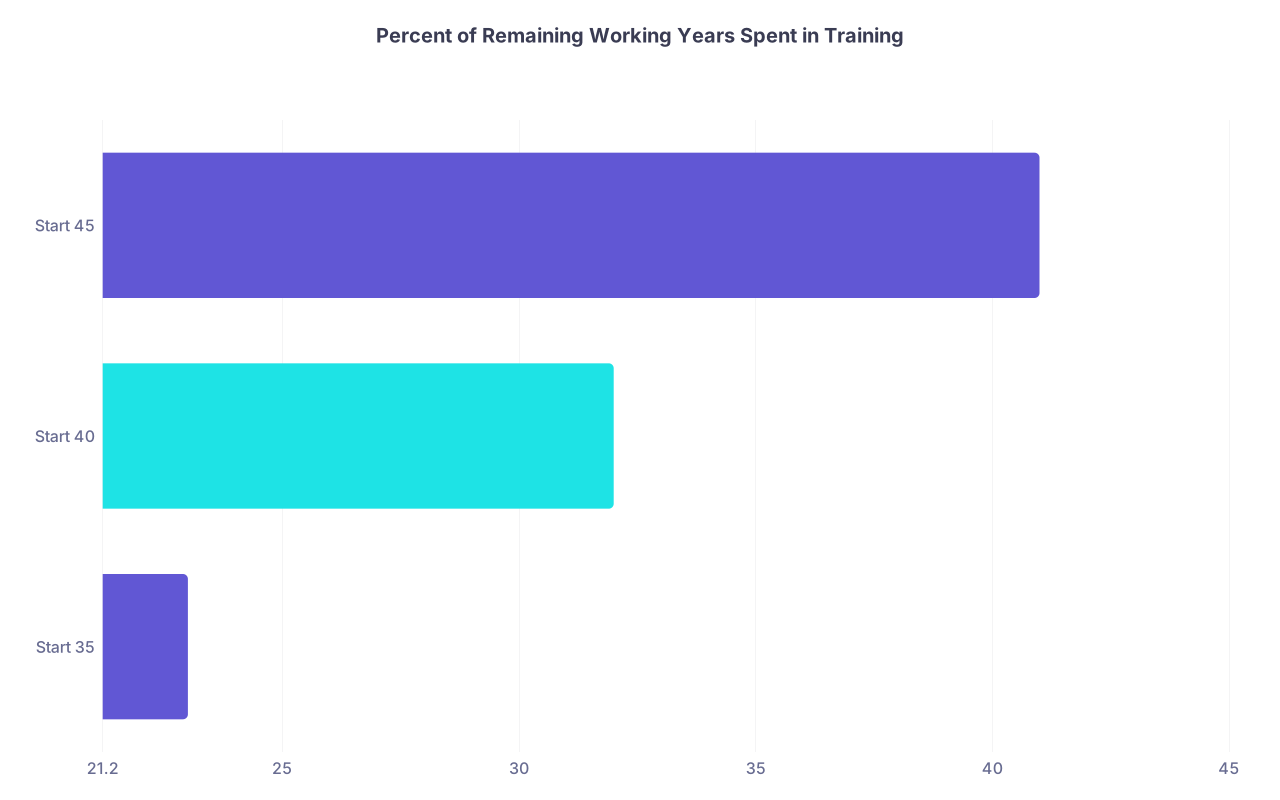
| Category | Value |
|---|---|
| Start 35 | 23 |
| Start 40 | 32 |
| Start 45 | 41 |
Rough breakdown:
- Start at 35:
- Years to 65: 30
- Training: 7 → about 23% of remaining career in training.
- Start at 40:
- Years to 65: 25
- 7 years training → 28%, but if fellowship extends training, it quickly goes past 30%.
- Start at 45:
- Years to 65: 20
- 7 years training → 35%. With fellowship or longer residency, easily 40%+ of your remaining working life is in lower‑paid training.
That is before accounting for the fact that physical and cognitive fatigue often become more prominent in your late 50s and 60s, making full‑time clinical work less likely.
9. Non‑Financial Reality Checks the Numbers Do Not Capture
The models above are clean. Real life is not.
Here are factors I have seen destroy or salvage the ROI picture, which the simple charts cannot fully encode:
Spousal / partner income.
If your partner earns well and covers living expenses, you can:- Borrow less.
- Pay during school / residency.
- Treat the doctor income as “late‑career upside” rather than survival money. This can shave years off break‑even.
Geographic / lifestyle choices.
Practicing in high‑pay, lower‑COL regions (rural, certain Midwest/Southern markets) vs high‑COL but not proportionally higher‑pay coastal cities can change effective ROI by hundreds of thousands over a decade.Ability to work part‑time longer.
If you realistically see yourself practicing part‑time until 70 or beyond, the time horizon extends and the break‑even age looks less scary. But that requires health, motivation, and a practice type that allows it.Attrition risk.
People do leave. I have seen mid‑career students burn out in M2, fail boards, or leave residencies. The older you are, the less room you have for re‑starting something else afterwards. From a risk‑adjusted perspective, that matters.Non‑financial payoff.
Some people genuinely do not care if they come out only slightly ahead or even a bit behind in total dollars, as long as they get to practice medicine. That is not irrational if your utility is not purely financial. But you cannot pretend the trade‑off does not exist.
10. Pulling It Together: What the Data Actually Says
Let me be blunt and summarize what the numbers show for nontraditional premeds at 35, 40, and 45.
At 35, medicine still has a solid financial ROI, if:
- You keep debt around or below the 300k range.
- You are not walking away from a 200k+ career.
- You accept that you do not really start to “win” financially until your late 40s.
At 40, the ROI becomes highly sensitive:
- Reasonable debt and a decent specialty are almost mandatory for clear financial upside.
- Starting from a modest income (80k–100k) is materially different from walking away from 150k+.
- Full economic break‑even often lands in your early 50s.
At 45, the financial case is fragile:
- With primary care incomes and high debt, you might barely clear break‑even before traditional retirement.
- High‑pay specialties, low debt, and an intention to work to 70 can rescue the math.
- Without those, the move is more passion‑project than rational investment.
Three key points to keep in your head:
Time is the real currency.
Every five years you wait compresses your net “ahead” years and pushes break‑even later by roughly 4–6 years.Debt and prior income dominate the equation.
A 35‑year‑old leaving an 80k job with 150k in loans is in a completely different financial universe than a 45‑year‑old leaving a 180k job with 450k in loans. Same dream, totally different math.Specialty and geography are levers, not guarantees.
Higher‑paid fields and better markets can materially improve ROI, but they are competitive, longer to train, and carry non‑trivial lifestyle costs.
If you go forward, do it with spreadsheets open and eyes wide. Not with slogans about “it is never too late.”