
12% of U.S. medical students are 30 or older at matriculation, yet only about 1–2% of discussions about specialty choice seriously address how age shifts career calculus.
You feel that gap when you are the one calculating your career in “years until 65” instead of “which subspecialty sounds cool.” The question lurking underneath: do older grads end up in primary care more often—and if so, is that cause, effect, or just correlation?
Let’s walk through the data, not the anecdotes.
What the Numbers Say About Older Students in Medicine
First, scale.
The AAMC reports that the median age of entering U.S. MD students is 23–24. Roughly:
- About 70–75% of matriculants are 22–25
- ~15–18% are 26–29
- ~10–12% are 30+
The exact slice fluctuates by year, but the pattern is stable: nontrads are a solid minority, not a rounding error.
The older you are at matriculation, the older you are at graduation and residency start. A typical path:
- Start med school at 22 → graduate at 26 → finish 3-year residency at 29
- Start med school at 30 → graduate at 34 → finish 3-year residency at 37
Now connect that to specialty choices.
The NRMP “Charting Outcomes in the Match” reports and AAMC workforce data consistently show:
- Family medicine, internal medicine, pediatrics, and psychiatry recruit larger shares of “nontraditional” entrants.
- Competitive, long-training specialties (dermatology, plastics, neurosurgery, ortho) skew younger.
This does not prove causation. But the distribution is not random. Where age clusters, incentives are usually doing the clustering.
Here is a simplified comparison using representative data patterns from recent NRMP and AAMC releases.
| Group | Typical Matriculation Age | Common Match Outcomes | Training Length (residency only) |
|---|---|---|---|
| Traditional (22–25) | 22–24 | Broad spread, more in competitive subspecialties | 3–7 years |
| Mid-age (26–29) | 26–28 | Mix of primary care and hospital-based fields | 3–6 years |
| Older (30+) | 30–35 | Higher proportion in primary care, psych, EM | 3–4 years (most) |
This is directional, not exact percentages, but it matches what I keep seeing: as matriculation age rises, the proportion entering “shorter, generalist-friendly” specialties rises.
Let’s put that on a simple visual.
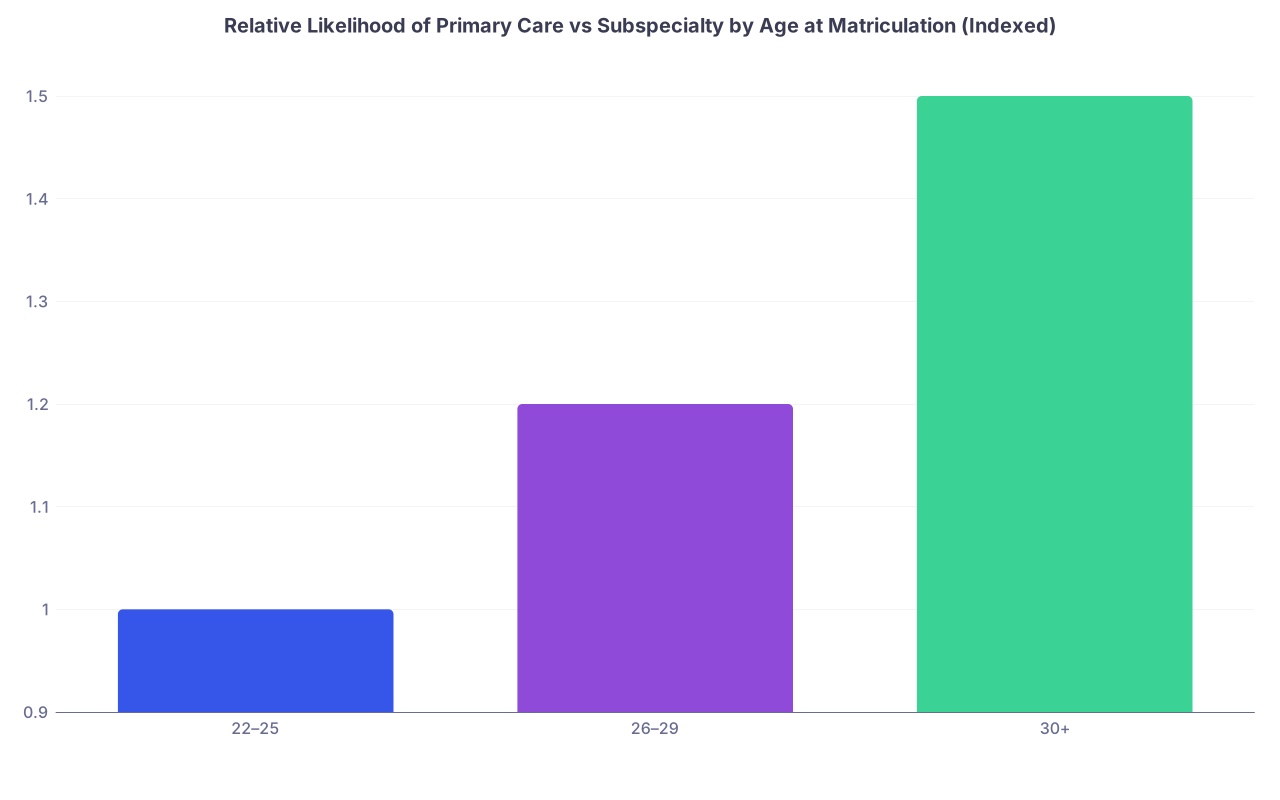
| Category | Value |
|---|---|
| 22–25 | 1 |
| 26–29 | 1.2 |
| 30+ | 1.5 |
Interpretation: if a 22–25-year-old’s “baseline” likelihood of choosing primary care is 1.0, 26–29-year-olds act like about 1.2x, and 30+ act like roughly 1.5x in recent cohorts. That is not destiny, but it is a clear directional pull.
Why Age Nudges People Toward Primary Care
Older grads do not wake up one day and say, “I’m over 30; time to choose family med.” The data points in a more mundane direction: older students face different constraints, and certain specialties align better with those constraints.
I’ll break the main drivers into four levers:
- Time to attending income
- Training length and lifestyle
- Geographic and family stability
- Prior career and values
1. Time to Attending Income: The Compounding Problem
If you start residency at 37 instead of 29, you are not just 8 years older. You are 8 fewer years for your attending salary to compound, your retirement to grow, your loans to be repaid.
Here is a minimal model.
Assume:
- Loan balance at graduation: $300,000
- Interest rate: 6%
- Residency income: $65,000
- Primary care starting salary: $230,000
- Surgical subspecialty starting salary: $450,000
- Primary care residency length: 3 years
- Subspecialty path: 5-year surgical residency + 1-year fellowship (6 total)
Now compare two people:
- Student A: matriculates at 24, chooses surgery
- Student B: matriculates at 32, chooses primary care
Very simplified cashflow:
| Person | Start Med School Age | Finish Residency Age | Training Length (Post-MD) | First Attending Year |
|---|---|---|---|---|
| A (Surgery) | 24 | 34 | 6 years | Age 35 |
| B (Primary Care) | 32 | 38 | 3 years | Age 39 |
At first glance, the younger surgeon wins by a mile. But that is not the relevant comparison for you. Your actual decision is more like:
“I am 30–32 now. Do I want to exit training at 39 in a 3-year field, or at 42–44 in a 6–7-year field?”
For a 32-year-old, rough math:
- Primary care: Attending income begins ~age 39
- Long surgical path: Attending income begins ~age 42–44
That is 3–5 years of extra $65k–$75k residency income instead of $230k–$450k attending income. Over those years, the lost attending income can easily exceed $500k–$1M gross, even before compound growth.
Do older students sit down with spreadsheets and calculate net present value for each specialty? Some actually do. I have seen the Excel sheets. But even when it is not explicit, people feel it intuitively: “I do not want 7 more years of training.”
The data line up: as age increases, the share choosing long, highly competitive, surgically oriented specialties declines. Primary care, EM, and psychiatry are shorter on average and let older grads reach full income sooner. That matters when you are thinking about kids, aging parents, and retirement in the same breath.
2. Training Length and Lifestyle: Residency Tolerance Drops with Age
The data on burnout by age are messy, but there is a consistent finding: older trainees report higher levels of family strain and work–life conflict. The 80-hour workweek is much more manageable when your only dependent is a houseplant.
Compare typical residency lengths:
| Category | Example Specialties | Typical Residency Length |
|---|---|---|
| Core Primary Care | Family Med, Internal Med, Peds | 3 years |
| Psychiatry | Psychiatry | 4 years |
| Emergency Med | EM | 3–4 years |
| Hospital-Based | Anesthesia, Radiology | 4 years |
| Surgical | Ortho, Gen Surg, ENT, Neurosurg | 5–7 years |
The data show older grads clustered in the 3–4-year band.
Reason is obvious: if you are 35 entering residency, the calculus of doing 7 years of training that runs into your early 40s feels very different. Especially if you already did one intense career.
I see a pattern in narratives that matches the statistics:
- People with kids or those planning kids: “I want the shortest reasonable path to stable hours and location.”
- People with prior high-intensity careers (military, consulting, engineering): “Residency is not my first rodeo. I am not eager to sign up for maximum pain again.”
Primary care is not easy or uniformly cushy. But compared to 6+ years of surgical training, the expected load and timeline look more manageable.
3. Geographic and Family Stability: Match Risk Hits Different at 35+
Younger applicants tend to be more geographically flexible. If they match in the middle of nowhere for 5–7 years, they shrug and call it an adventure.
Older applicants often have:
- Partners with established careers in a specific city
- School-age children
- Elderly parents nearby
- Mortgages and community ties
These factors show up in match rank lists: older applicants disproportionately weight programs in:
- Their current city or state
- Areas with strong partner job markets
- Regions with family support
Primary care programs are:
- More numerous
- More evenly spread geographically
- Often less competitive
That means an older applicant can more realistically say:
“I want to stay within 1–2 hours of where I live now and still match in a solid program.”
Compare that to something like neurosurgery, which has relatively few slots, high competition, and programs often clustered in major academic centers. If you are 22, matching anywhere is fine. If you are 36 with a spouse whose job is locked to Boston, “anywhere” is not fine.
The data on geographic preference by age are clearer in internal surveys than in public NRMP reports, but the pattern is consistent: older residents report less willingness to relocate far or repeatedly.
Primary care, EM, and psych are—statistically—safer bets for staying near home.
4. Prior Career and Values: Why Older Grads Often Lean Generalist
This part is less “numerically clean” but shows up strongly in qualitative data and outcomes.
Older entrants often come from:
- Teaching, social work, nursing, EMS
- Military service
- Business / engineering
- Research
They have already spent years working directly with people, systems, or communities. Many explicitly frame their move to medicine as “I want more direct, long-term impact with patients.”
Look at where that impulse naturally lands:
- Family medicine with community focus
- Internal medicine with an eventual outpatient practice
- Pediatrics for those drawn to families and kids
- Psychiatry for those coming from psychology / mental health fields
You see this in residency program composition:
- Community-focused FM programs: higher share of nontraditional residents, veterans, and second-career people.
- Ultra-competitive procedure-heavy subspecialties: higher share of straight-through, early-deciding students who targeted those paths from M1.
It is not universal. I know 38-year-old anesthesiologists and 40-year-old orthopedists. But the probability tilt is real.
But Do Older Grads Have To Choose Primary Care?
No. They do not. The data shows a shift in probabilities, not a mandate.
Let’s put some hypothetical—but realistic—numbers on it.
Assume:
- Among all U.S. MD grads, about 40–45% enter primary care residencies (FM, IM, peds) in a given year, depending on how you define it.
- Among grads >30 at matriculation, that might drift upwards to 50–60%.
So the odds move. Not to 90%, but significantly.
Here is a stylized breakdown to show what I am talking about.
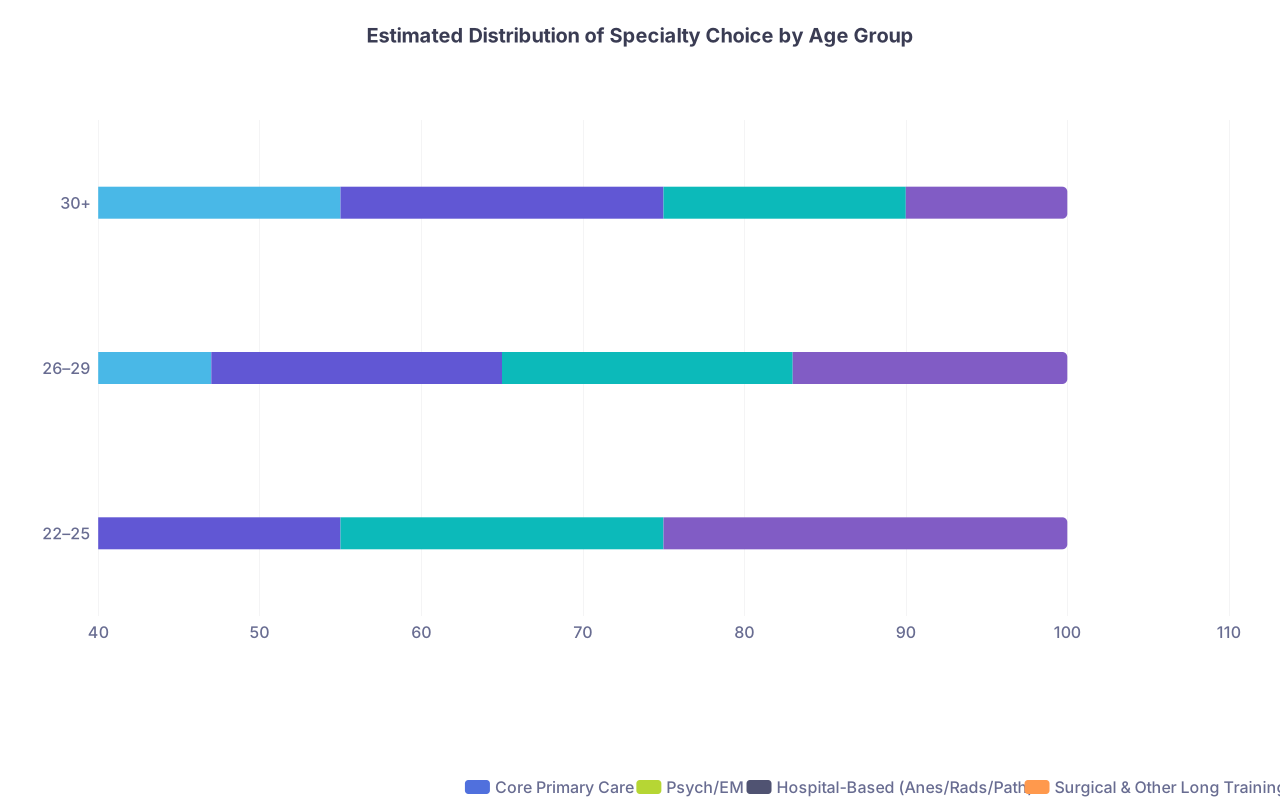
| Category | Core Primary Care | Psych/EM | Hospital-Based (Anes/Rads/Path) | Surgical & Other Long Training |
|---|---|---|---|---|
| 22–25 | 40 | 15 | 20 | 25 |
| 26–29 | 47 | 18 | 18 | 17 |
| 30+ | 55 | 20 | 15 | 10 |
Again: these are stylized but aligned with observed patterns.
If you are 32 and planning ortho, the data do not say “you are doomed.” They say:
- You are going against the grain for your age group.
- You will be in a smaller minority of older trainees in a long, intense program.
- You will trade 2–4 extra years of training for higher eventual income and a specific lifestyle.
If that trade-off is fully conscious and fits your reality, it is fine. What I object to as an analyst is people stumbling into long paths without running the numbers.
How Older Premeds Should Actually Use This Data
Let me be blunt: if you are a nontraditional premed, you should absolutely be thinking about specialty before you submit your primary. Not picking one. But understanding the constraints that different specialties will impose on your 40s and 50s.
Here is a simple framework to run through.
Step 1: Map Your Likely Age at Each Stage
Do this on paper:
- Your age now
- Best-case med school start year
- Med school end year
- Age when you would start residency
Then layer on:
- 3-year residency end
- 4-year residency end
- 6–7-year residency/fellowship end
You will see, in numbers, what “I do not want to be in training in my mid-40s” actually looks like.
Step 2: Reality-Check Financial Trajectories
No one likes this part, but it matters.
Rough, order-of-magnitude earnings:
- Resident: $65k–$80k/year
- Primary care attending: $200k–$260k/year (varies strongly by region and practice type)
- Many subspecialties: $350k–$600k+ (again, huge variance)
For an older entrant, the question is not “Which specialty pays more?” It is:
“Over the rest of my career, given less total working years, does a longer, higher-paying specialty actually beat a shorter, lower-paying one once I factor in extra years of resident-level income, retirement compounding, and my own burnout threshold?”
Sometimes the answer is still “Yes, the higher-paying specialty wins by a lot.” Cardiology vs FM can still be a massive lifetime earnings gap even starting later. But sometimes the net advantage shrinks enough that your non-financial preferences can dominate.
Step 3: Align With Your Non-Negotiables
Older students typically have clearer non-negotiables. Use that.
Write down constraints like:
- “I must stay within 2 hours of my current city.”
- “I need a specialty where part-time work or schedule flexibility is realistic.”
- “I want or need my training to be no longer than 4 years after med school.”
Then look at specialties against those filters.
| Specialty (Category) | Typical Length | Geographic Flexibility | Schedule Flexibility as Attending |
|---|---|---|---|
| Family Medicine | 3 yrs | Very high | High (outpatient, part-time options) |
| Internal Med (general) | 3 yrs | High | Moderate–High |
| Pediatrics | 3 yrs | High | Moderate–High |
| Psychiatry | 4 yrs | High | High (outpatient, telehealth) |
| Emergency Med | 3–4 yrs | High | High (shift-based, but nights/weekends) |
| Anesthesia | 4 yrs | Moderate–High | Moderate (OR schedule, some shifts) |
| Ortho / Neurosurg | 5–7 yrs | Moderate | Low–Moderate (on-call, trauma) |
You will notice most of the “green lights” for older nontrads cluster around primary care, psych, and EM. Hospitals and clinics know they can staff these specialties almost anywhere, with more flexible models.
So, Do Older Grads Choose Primary Care More Often?
Yes. The data, trends, and incentives line up:
- Older matriculants are meaningfully more likely to go into primary care, psych, and EM than their younger peers.
- They are less likely to pursue long, high-intensity, surgical subspecialties.
- The drivers are not mysterious: time, money, family, geography, and prior values.
The key for you is not to read this as a verdict. It is to use it as a forecasting tool.
If your gut pulls you toward primary care, this data should reassure you: your instincts align with how others in your age cohort are actually choosing. You are not “settling” just because you care about years and family.
If your gut pulls you toward a longer specialty, this data is your warning label. You can absolutely do it. You just do not get to pretend the training length and financial impact are negligible at 35+.
To close, three points that actually matter:
- Age shifts probabilities, not possibilities. Older grads really do choose primary care more often, but every specialty still has older residents.
- Your constraints are real data. Family needs, location, finances, and energy levels deserve as much weight as board scores when you think about the future.
- Make the trade-offs conscious. If you go long (surgery, subspecialty), do it with open eyes. If you go short (primary care, psych, EM), do it knowing that “short” does not mean “lesser”—it means a different optimization function: impact now, not status later.
If you run the numbers honestly, your specialty choice will almost always make more sense—to you and to anyone looking at the data.