
The biggest lie about switching to medicine late is that “you’re too old.” You’re not too old. You’re too unfocused on timing. Fix that, and the path gets a lot more real, very fast.
Below is a year‑by‑year, then semester‑by‑semester roadmap. This is written for the 32–50 year‑old who has a real life: mortgage, maybe kids, a career that actually pays. You do not get the luxury of wandering. You need a plan.
I’ll anchor it as a 5‑ to 7‑year arc from “maybe I want this” to “starting residency,” then zoom into what you should be doing each year, quarter, and sometimes each month.
Year 0: Exploration & Reality Check (6–12 months)
At this point you should not be doing orgo. You should be proving to yourself that medicine is the right mountain before you start climbing.
Months 0–3: Clarify the “Why” and Reality
At this point you should:
Do ruthlessly honest self‑assessment:
- How old will you be at med school start? Residency start? Attending?
- What’s your current GPA (from undergrad/grad)?
- Any science background at all?
- Debt, savings, family obligations?
Shadow for real, not a one‑off half‑day:
- Aim for 20–40 hours across at least 2 specialties: primary care and something procedural (EM, surgery, anesthesia, etc.).
- Listen for the phrases I hear all the time:
- “I haven’t had a real vacation in 3 years.”
- “I still love the work, but the system is exhausting.”
- Ask yourself if you still want it after that.
Talk with:
- 1–2 attendings (preferably in your age range or who trained non‑traditionals).
- 1 non‑traditional med student or resident. They’ll give you the unfiltered version.
By the end of Month 3 you should have a written one‑page “Why medicine, why now” that could survive cross‑examination from a grumpy admissions dean.
Months 3–6: Map Your Academic Gap
Now you shift from “should I” to “can I.”
At this point you should:
Get all old transcripts (even that random community college semester 20 years ago).
Build an academic inventory:
- Total GPA and science GPA (sGPA).
- Which prereqs are complete, which are expired (anything >7–10 years old may be functionally useless).
- Any pattern of withdrawals, Fs, or chronic mediocrity.
Meet with:
- A premed advisor (post‑bac program, local university, or private if you can afford it).
- Goal: choose path:
- Formal post‑bac
- DIY post‑bac at a local college
- Second bachelor’s (rarely necessary but sometimes cleanest for very low GPAs).
Rough budget and time horizon:
- How many years of coursework?
- When you could reasonably take the MCAT?
- When you could apply?
At the end of Year 0, you should have:
- A target MCAT year and application year.
- A preliminary course plan.
- A green light from at least one honest advisor that this is not a fantasy.
Year 1: Re‑entering School & Building Academic Credibility
This is your “I can do hard science as an adult” year. It matters more than your original undergrad did.
Big Picture: What Year 1 Should Achieve
- 24–32 credits of solid science with mostly A/A‑ grades.
- A re‑established habit of serious study while working and/or parenting.
- Initial clinical and volunteer exposure.
| Course Set | Typical Sequence | MCAT Relevance |
|---|---|---|
| General Chemistry | 2 semesters + lab | High |
| Biology | 2 semesters + lab | High |
| Organic Chemistry | 2 semesters + lab | High |
| Physics | 2 semesters + lab | Medium |
| Biochemistry | 1 semester | Very High |
| Psychology/Soc | 1–2 semesters | High |
Semester‑by‑Semester (Assume Fall Start)
Fall, Year 1 (Months 0–4)
At this point you should:
- Start with 2 science courses if you’ve been out of school for years:
- Example: Gen Chem I + Bio I, both with labs.
- Add 1 light, non‑science if you need full‑time status.
Target: 8–12 credits, straight As. You’re proving a point.
Weekly checklist:
- 15–20 hours/week studying. Non‑negotiable.
- 2–4 hours/week low‑intensity clinical exposure:
- Hospital volunteer
- Hospice
- Free clinic intake
- Scribe (if schedule allows)
Spring, Year 1 (Months 5–9)
At this point you should:
- Increase rigor if you handled Fall well:
- Gen Chem II + Bio II + maybe Psych, with labs.
- Keep the GPA pristine. Adcoms look at your most recent 30–40 credits very closely.
Also:
- Log everything:
- Hours
- Type of activity
- Supervisor contact info
- Reflective notes (for later personal statement / secondaries).
Summer, Year 1
This fork depends on your life situation.
Option A – Take Classes:
- Orgo I or Physics I (but not both if you’re working full‑time).
- Continue 4–6 hrs/week of clinical exposure.
Option B – Full‑Time Work + Volunteering:
- No classes, but:
- 4–8 hrs/week clinical
- 2–4 hrs/week non‑clinical service (food bank, tutoring, etc.)
By the end of Year 1, you should have:
- At least 16+ science credits of A/A‑ work.
- 50–100 hours of meaningful clinical exposure.
- A clear understanding of how much course load you can realistically carry.
Year 2: Heavy Sciences, MCAT Foundation, and Deeper Clinical Work
This is the grind year. This year often breaks people who underestimated how hard it is.
Big Picture Targets
- Finish (or nearly finish) core prereqs.
- Start structured MCAT prep late in this year.
- Take on more substantial, regular clinical roles.
Fall, Year 2
At this point you should:
Take the heavy hitters:
- Organic Chemistry I + Physics I, or
- Orgo I + Biochem (if Gen Chem is done and solid).
Do not stack Orgo + Physics + Biochem unless you’re working minimal hours and your Year 1 was stellar.
Clinical:
- Move from “random volunteer” to a clearly defined role:
- Scribe
- ED volunteer with real responsibilities
- MA (if you can get trained)
- Aim for 4–8 hours/week, stable and ongoing.
- Move from “random volunteer” to a clearly defined role:
Spring, Year 2
At this point you should:
Finish your sequences:
- Orgo II + Physics II
- Or Biochem + upper‑level bio (Physiology, Cell Bio, etc.)
Begin light MCAT prep (assuming you’re 12–15 months out from applying):
- 5–7 hrs/week content review, tied to your current courses.
- Start using Anki or similar for spaced repetition.
Summer, Year 2: MCAT Ramp‑Up
This summer often makes or breaks your timeline.
You have two main tracks:
Track 1: Plan to apply next summer (Year 3)
At this point you should:- Commit 15–20 hrs/week to MCAT prep.
- Take 1–2 full practice exams by end of summer.
- Identify weak sections early (often CARS and Chem/Phys for non‑science folks).
Track 2: Push applications to Year 4
At this point you should:- Continue 8–10 hrs/week clinical.
- Maybe add some research if it’s practical, but do not force it.
- Start paying attention to DO vs MD requirements, state schools, and age considerations.
Year 3: MCAT, Application Year, and Strategic Positioning
For many late‑career switchers, this is the application year. It’s intense and fragile. You don’t have many retries without serious age creep.
MCAT Timing & Study Arc
Assume you’re taking the MCAT between January and May of Year 3.
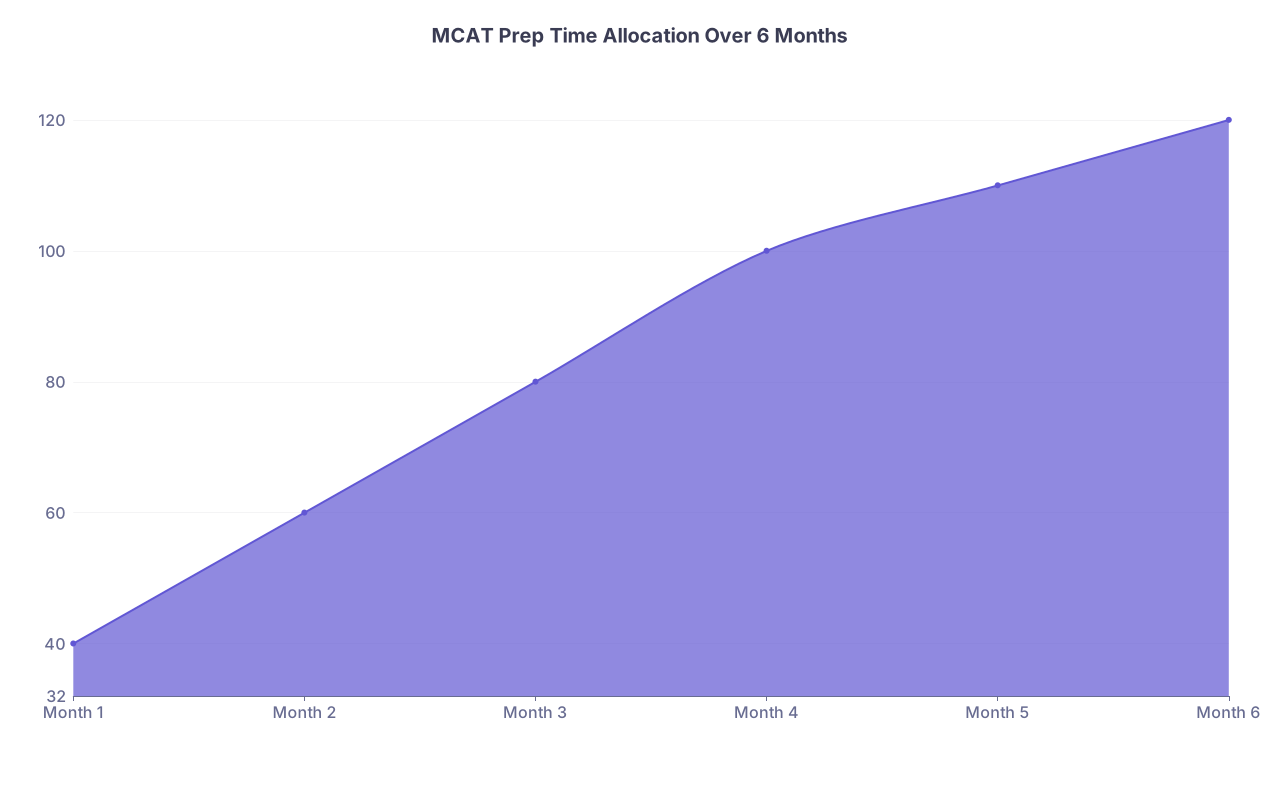
| Category | Value |
|---|---|
| Month 1 | 40 |
| Month 2 | 60 |
| Month 3 | 80 |
| Month 4 | 100 |
| Month 5 | 110 |
| Month 6 | 120 |
At this point you should:
- 6 months out:
- 10–12 hrs/week: finish content review.
- 3 months out:
- 15–20 hrs/week: heavy practice questions and full‑length exams.
- 1 month out:
- 2 full‑lengths per week.
- Intense review of mistakes and timing.
If you’re not consistently scoring near your target 4–6 weeks before test day, you delay. A weak MCAT at 38–45 years old is often fatal to the cycle.
Concurrent Activities (While Studying)
This is where time management gets brutal. You can’t pause your profile just to study.
At this point you should:
- Maintain:
- 4–6 hrs/week clinical.
- 2–4 hrs/week non‑clinical volunteering, ideally in a community you actually care about.
- Add:
- 1 leadership or initiative role, even if small:
- Coordinating volunteers at a clinic.
- Starting a health education project.
- Leading a group at your current job that tangentially relates to health.
- 1 leadership or initiative role, even if small:
Application Timeline: Month‑by‑Month
Let’s assume a standard US MD/DO cycle with application opening in May/June.
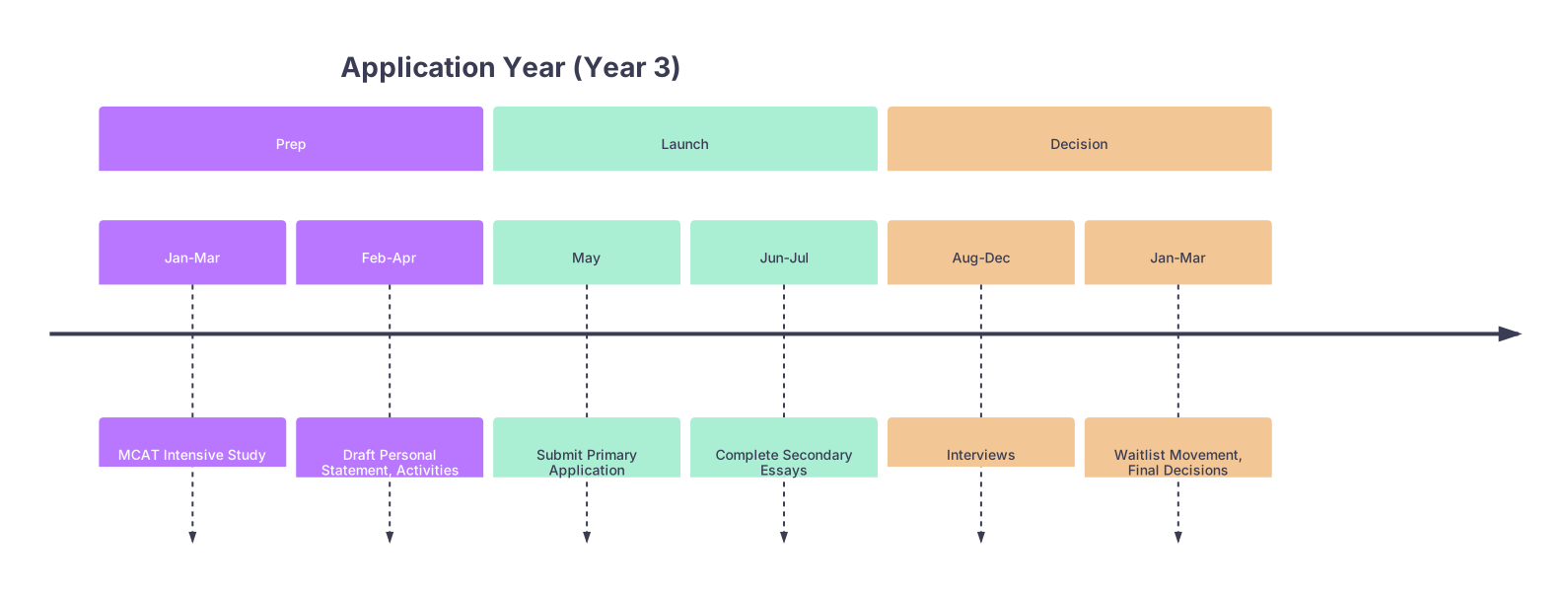
| Period | Event |
|---|---|
| Prep - Jan-Mar | MCAT Intensive Study |
| Prep - Feb-Apr | Draft Personal Statement, Activities |
| Launch - May | Submit Primary Application |
| Launch - Jun-Jul | Complete Secondary Essays |
| Decision - Aug-Dec | Interviews |
| Decision - Jan-Mar | Waitlist Movement, Final Decisions |
January–March, Year 3
At this point you should:
- Finalize your school list:
- Home state MD and DO schools.
- Age‑friendly schools (look at MSAR data for older matriculants).
- Realistic MCAT/GPA alignment.
- Draft:
- Personal statement (3–5 serious drafts).
- Activities descriptions (15 entries, 3 “most meaningful” with real reflection).
April–May
At this point you should:
Take MCAT (if ready).
Request letters of recommendation:
- 2 science faculty (from your fresh coursework).
- 1 non‑science or professional.
- 1 physician if possible (ideally someone who has seen you in a clinical role over time).
Prepare application data:
- Transcript requests ordered early.
- CV updated.
- Experiences spreadsheet clean and ready.
June–July
At this point you should:
- Submit primary as early in June as feasible. Do not wait for final MCAT score if your practice tests are solid and you can stomach the risk.
- Turn around secondaries within 7–10 days each. This timeline matters.
Year 4: Interviews, Decision Point, or “Repair Year” if You Don’t Get In
If your first cycle succeeds, Year 4 is mostly about interviews and then preparing to leave your current career. If it doesn’t, this is your critical “salvage and upgrade” year.
Scenario A: You’re Getting Interviews
At this point you should:
Prepare intensely but efficiently:
- 3–4 mock interviews (including at least 1 MMI‑style if those schools are on your list).
- Clear, practiced talking points on:
- Career change story
- Age and stamina
- Financial realism
- Family and support systems
Keep working/volunteering:
- Do not drop your clinical role. Interviewers ask what you’re doing now, not just last year.
Financial and logistical prep:
- If accepted by late fall:
- Meet with a financial planner who understands professional school debt.
- Think carefully about when to leave your job (often 1–3 months before matriculation).
- If accepted by late fall:
Scenario B: No Acceptances or Few Interviews
This is where late‑career paths usually die, or become much smarter.
At this point you should:
Do a hard debrief:
- GPA too low? MCAT too low? School list unrealistic? Poor timing/application quality?
Decide whether to:
- Retake MCAT.
- Add a structured SMP (Special Master’s Program) or post‑bac strengthening year.
- Adjust target to DO only, or include international (with caution).
Concrete “repair year” actions:
- 12–18 more credits of upper‑level sciences with A grades.
- Retake MCAT only if you can realistically improve 4+ points.
- Deepen one or two standout activities to show growth, not flailing.
Year 5–7: Medical School, Residency Match, and Late‑Career Realities
If you’re starting medical school around Year 4 or 5 from your initial decision, here’s how you should be thinking.
Pre‑Matriculation (The 6–9 Months Before M1)
At this point you should:
Clean up your life logistics:
- Move, sell or rent housing if needed.
- Line up childcare if applicable.
- Pay down short‑term debt aggressively.
Academic prep (light touch):
- Do not try to pre‑study all of med school. Pointless.
- Refresh:
- Basic biochemistry
- Anatomy basics (an atlas, not memorizing Netter)
- Main goal: arrive rested, not burned out.
Year 1–2 of Med School (Pre‑Clinicals) as a Late‑Career Student
Your advantages: discipline, time‑management, perspective. Your disadvantage: stamina and life complexity.
At this point you should:
Set a sustainable weekly pattern early:
- Hard work hours.
- Protected family time.
- Sleep that isn’t a joke.
Board prep timeline (Step 1 or equivalent):
- Light question‑bank use starting mid‑M1.
- Dedicated prep 6–8 weeks before exam date.
Year 3–4 of Med School (Clinicals, Step 2, Residency Apps)
This is where your prior career becomes a real asset.
At this point you should:
Choose specialty with hard realism:
- Age 35–50+ and aiming for ultra‑competitive fields (Derm, Ortho, Plastics) is possible but brutal.
- Many late‑career students find rewarding fits in:
- Internal Medicine
- Family Medicine
- Psychiatry
- Anesthesiology
- Pathology
- EM (though lifestyle concerns are real).
Use your previous career:
- Business background? Consider administration, QI projects.
- Tech background? Data projects, informatics.
- Education background? Teaching, curriculum work.
Residency apps will ask, explicitly or not: “Are you going to make it through this training without burning out in 18 months?” Your story, references, and consistent behavior must answer yes.
Parallel Track: Age, Timeline, and Financial Reality
You can’t ignore the numbers. You also shouldn’t be paralyzed by them.
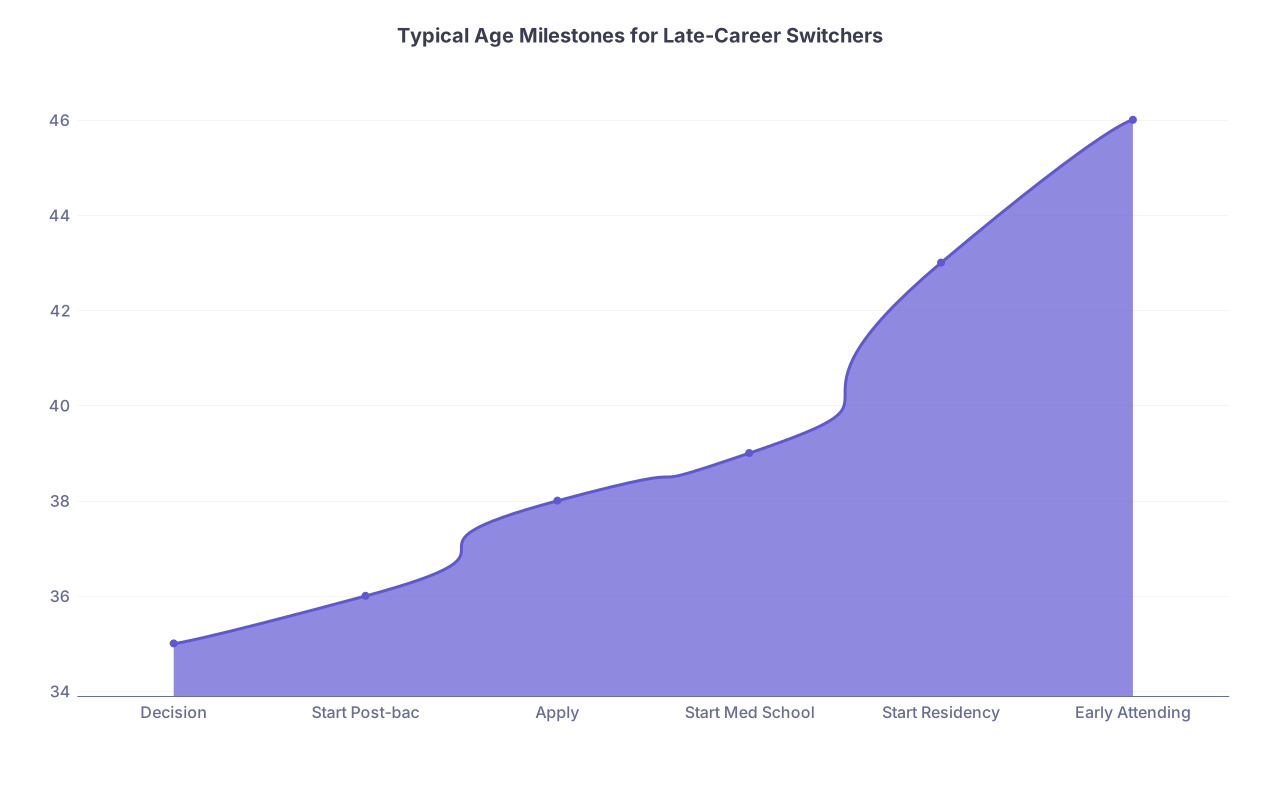
| Category | Value |
|---|---|
| Decision | 35 |
| Start Post-bac | 36 |
| Apply | 38 |
| Start Med School | 39 |
| Start Residency | 43 |
| Early Attending | 46 |
And the money:
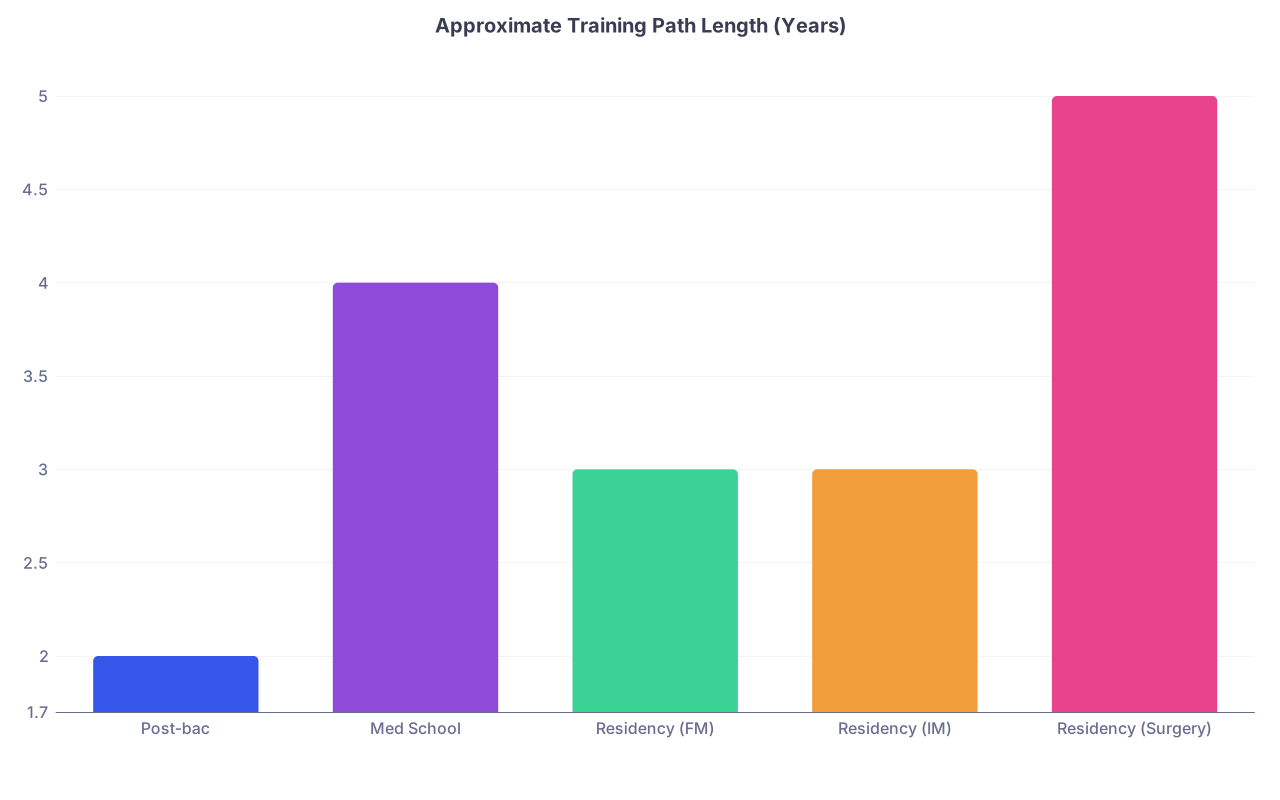
| Category | Value |
|---|---|
| Post-bac | 2 |
| Med School | 4 |
| Residency (FM) | 3 |
| Residency (IM) | 3 |
| Residency (Surgery) | 5 |
At each year, ask yourself:
- Can I sustain this financially?
- Is my family still on board?
- Do I still want this version of medicine, not the fantasy version?
If the honest answer becomes “no,” stepping off is not failure. It’s wisdom.
Quick Year‑By‑Year Snapshot
| Year | Focus | Key Outputs |
|---|---|---|
| 0 | Exploration & Planning | Shadowing, transcripts, plan |
| 1 | Re‑entry to Academics | 16–30 credits, early clinical |
| 2 | Heavy Sciences + MCAT Foundation | Finish prereqs, structured exposure |
| 3 | MCAT + Application | Strong score, complete applications |
| 4 | Interviews or Repair Year | Acceptance or targeted improvements |
| 5–7 | Med School & Early Residency | Degrees, boards, matched specialty |

Final Checks at Each Stage
At each point on this timeline, you should be asking three brutal questions:
Is my recent academic work excellent, not just adequate?
Late‑career applicants don’t get leeway for “good enough” grades in new science work.Does my daily life look like someone already living in the orbit of medicine?
Ongoing clinical work, service, and clear sacrifices—while still functioning as an adult.Am I steering the timeline, or is it dragging me?
If you’re constantly reacting—late MCAT, last‑minute applications, rushed essays—you’re increasing the odds of an expensive failure.
Focus on those three, year by year, and the late‑career path to medicine shifts from fantasy to structured project. A long, difficult project—yes. But a real one.