
The biggest lie about the MCAT is that you “need to quit your job” to have a real shot. You do not. You need structure, brutality-level honesty about your time, and a 12‑month plan you actually follow.
Here is that plan.
You are working full‑time. You are tired. You do not have endless afternoons to “catch up.” So we build this like a marathon program – not a fantasy boot camp.
Big‑Picture 12‑Month Structure
At this point, before we zoom into months and weeks, you need to see the skeleton.
- Months 12–10: Foundations + life infrastructure
- Months 9–7: Content build + light practice
- Months 6–4: Heavy content + strategy + timed sets
- Months 3–2: Full‑length exams + score gains
- Month 1: Polishing + test‑day simulation + taper
Think 10–15 focused hours per week on average. Some weeks more, some less. But consistent.
| Phase | Months Out | Main Focus | Weekly Hours |
|---|---|---|---|
| Foundation & Setup | 12–10 | Logistics, content gaps | 5–8 |
| Core Content | 9–7 | Systematic review | 8–12 |
| Intensive Study | 6–4 | Content + strategy + timed practice | 10–15 |
| Exam Phase | 3–2 | Full-lengths, review, refinement | 12–18 |
| Final Prep | 1 | Taper, mental rehearsal | 8–12 |
Months 12–10 Before Your MCAT: Set the Stage or Fail Later
If you blow this phase off, you will pay for it with panic at Month 3. This is where you stabilize your life and build your baseline.
Month 12: Decide, Commit, and Audit Your Life
At this point you should:
Pick your target test month and a 4‑week window.
Do not actually register yet, but commit mentally: “I am sitting April 2027,” for example.Time audit for 2 weeks.
Track every hour lightly:- Work, commute
- Sleep
- Screens / social media / Netflix
- Chores / family
- Exercise
You will find 8–15 hours you are currently wasting. I have never seen an honest time log that did not.
Have the “MCAT year” conversation with key people.
- Partner / spouse
- Roommates
- Boss (if you will need a week off near the test)
Sample script with partner:
“From January to next January, I’ll be studying ~10 hours/week after work and on weekends. This is going to mean fewer evenings out. I need your help protecting that time.”
Baseline academic check.
- Pull your old transcripts.
- Identify: Have you taken biochem? Statistics? Psych/soc?
If not, at this point you should sketch when you will take those prerequisites (post‑bacc, community college, etc.) or how you will self‑teach.
Weekly target: 5 hours/week, mostly planning and light diagnostics.
Month 11: Diagnostic + Resource Setup
At this point you should move from vague intention to concrete tools.
Take an honest diagnostic exam.
- Use a free full‑length from Kaplan, Blueprint, or Princeton. This is NOT your “real level” but a starting point.
- Do it timed, on a weekend morning, like a real test.
Select your primary study resources. One per category. Do not hoard.
- Content review (pick 1 main set):
- Kaplan set
- Princeton Review set
- Berkeley Review (strong for C/P and B/B, heavier)
- Practice questions:
- UWorld MCAT or Kaplan Qbank
- AAMC official materials (non‑negotiable, but you will use them later):
- Question Packs
- Section Bank
- Official full‑lengths (FL1–4)
- Content review (pick 1 main set):
Set your weekly template.
Example for a 9‑to‑5 job:- Mon–Thu: 1–1.5 hours after work (6:30–8:00 pm)
- Sat: 3–4 hours (split into two blocks)
- Sun: 2–3 hours light review
Protect at least one full evening off.
Light content warm‑up.
- Spend 2–3 weeks skimming one chapter each in general chemistry, biology, and physics to wake your brain up.
- Start building an Anki deck or decide to use a pre‑made one (e.g., Milesdown).
Weekly target: 6–8 hours/week, low‑intensity but consistent.
Month 10: Fix the Holes You Already Know About
At this point you should:
Analyze your diagnostic.
Look for:- Any section below ~123 → priority
- Content you literally did not recognize (not just “forgot”)
Patch major prereq gaps.
You do not need to fully master, but at least:- Watch a basic biochem series if you never took it (e.g., Khan Academy).
- Work through 2–3 psych/soc chapters per week if that is brand‑new.
Build a simple content roadmap.
Example (subject‑based approach):- Months 9–8: Physics + General Chem
- Month 8–7: Org Chem + Biochem
- Months 7–6: Biology
- Months 6–5: Psych/Soc + CARS intensive
Or a passage‑based rotation: each week 2 days C/P, 2 days B/B, 1 day P/S, CARS every day.
Clean your environment.
Set up:- A dedicated “study zone” at home.
- Earplugs / noise‑canceling headphones.
- A printed weekly schedule on your wall (you will need visible guilt).
Weekly target: 6–8 hours/week.
Months 9–7 Before Your MCAT: Build Core Content
This is where you start actually studying “for real.” Not cramming – methodical building.
Month 9: Start Systematic Content Review
At this point you should:
Commit to a subject order.
I like:- 4–5 weeks: Physics + General Chemistry
- 4–5 weeks: Organic + Biochem
- 4–5 weeks: Biology + P/S
Weekly rhythm example (10 hours):
- Mon: 1–1.5 hr – Review physics chapter + notes
- Tue: 1–1.5 hr – 15–20 physics practice questions
- Wed: 1–1.5 hr – Gen chem chapter
- Thu: 1–1.5 hr – Gen chem questions
- Sat: 3–4 hr – Mix of review + practice + CARS
- Sun: 1–2 hr – Anki + error review
Start daily CARS.
- 1–2 passages/day, even if it is only 15–20 minutes.
- Use Jack Westin, UWorld, or AAMC Qpacks later.
CARS gets better with habit, not with cramming.
Start an “error log.”
Simple spreadsheet or notebook:- Question stem
- Why you missed it (content gap vs misread vs rushed)
- Correct reasoning
Review weekly.
Weekly target: 8–10 hours/week.
Month 8: Maintain Content, Add More Practice
At this point, your brain should be adjusting to the workload. Now you gently increase the intensity.
Finish physics/gen chem, move into orgo/biochem.
- 2 chapters/week total is a reasonable pace while working full‑time.
- Do questions the same day you read. No pure reading nights.
Increase practice questions.
- Aim for 80–120 questions/week across all sections.
- Use timed blocks of 30–45 minutes after work, not single questions scattered all day.
Add spaced repetition seriously.
- Daily 20–30 minutes of Anki, preferably:
- Early morning before work, or
- During lunch break.
This is where most nontrad students fall apart – they let cards pile up. Do not.
- Daily 20–30 minutes of Anki, preferably:
Check your fatigue level.
- If you are constantly exhausted, scale to 8 hours/week, not 12.
- Study quality beats bragging rights.
Weekly target: 10–12 hours/week.
Month 7: First Mini‑Assessments
At this point you should test whether your studying is actually doing anything.
Take a half‑length or shortened exam.
- Use a third‑party full‑length but only do 2 sections one weekend, 2 the next.
- Strictly timed, no notes.
Review results deeply.
- Content categories causing repeated misses?
- Are you running out of time or making sloppy reads?
- Make 2–3 concrete adjustments (e.g., more focus on fluids, change CARS strategy).
Finish orgo/biochem, start biology.
- Prioritize high‑yield systems: endocrine, nervous, immune, genetics, molecular biology.
Audit your schedule.
- Which days are repeatedly getting skipped?
- Move study blocks away from those danger zones. If Thursdays always die, front‑load Mon–Wed.
Weekly target: 10–12 hours/week.
Months 6–4 Before Your MCAT: Intensive Content + Strategy
This is the grind window. You are past “warming up.” You are not yet in full‑length frenzy. Perfect time to sharpen.
Month 6: Close Content Gaps in Biology + P/S
At this point you should:
Finish first pass of all major content by the end of this month.
- That means you have at least seen everything. Not mastered, but not brand‑new anymore.
Push P/S more aggressively.
- 3–4 chapters/week until you cover major theories, names, and foundations.
- Heavy Anki for definitions and terms.
Timed passage sets, regularly.
- 3–4 days/week, add one 30–45 minute timed passage block:
- 3–4 passages of C/P or B/B
- 3–4 passages of P/S
- Always review every question you got wrong or guessed.
- 3–4 days/week, add one 30–45 minute timed passage block:
CARS: Increase passage numbers.
- 3–4 passages, 3 days/week if you can manage:
- One full 90‑minute CARS session every 2–3 weeks.
Weekly target: 12–14 hours/week.
Month 5: Transition from “Learning” to “Performing”
At this point, you should start behaving like someone who will actually sit for the exam in a few months.
Take your first official AAMC full‑length (FL1).
- Treat it like test day: 8:00 am start, 10‑minute breaks, quiet space.
- Do this on a weekend with the day after mostly free for review.
Set a preliminary score goal based on FL1.
- Example: Diagnostic 495 → FL1 503 → realistic target might be 508–512.
Review FL1 in excruciating detail.
- Break down by:
- Topic area (e.g., kinematics, endocrine)
- Error type (content vs reasoning vs rushing)
- Add missed concepts to Anki.
- Identify your top 3 weakest subtopics and schedule them the next 2–3 weeks.
- Break down by:
Refine test‑taking strategy.
- Experiment with:
- Mark‑and‑move (e.g., 90 seconds max then mark it and move on).
- Passage annotation style (very light – underlining key variables, not rewriting).
- CARS approach: main idea first, then details.
- Experiment with:
Weekly target: 12–15 hours/week.
Month 4: Content Mostly Done, Practice Becomes King
At this point you should be largely finished with “new” content and pivot heavily into practice and refinement.
Stop heavy reading. Start heavy practice.
- 60–70% of study time = practice passages + full‑length review.
- 30–40% = targeted content review from your error log.
Use AAMC Section Bank selectively.
- Start with B/B and C/P. They are brutal. That is fine.
- Do small chunks (2–3 passages) and review deeply.
Take a second full‑length (AAMC FL2 or high‑quality third‑party).
- Again, full test‑day simulation.
- Compare to FL1:
- Sections that are improving = good strategies.
- Sections flat or worse = retool.
Lock in test date now (if you have not yet).
- You have enough data to know if you are roughly on track.
- Reserve a seat on the day that best fits your work schedule (ideally a Monday or Friday so you can take off).
Weekly target: 12–15 hours/week.
Months 3–2 Before Your MCAT: Full‑Length Focus
Here is where most working students either break through or burn out. The difference is planning your full‑lengths intelligently around your job.
Month 3: Regular Full‑Lengths + Ruthless Review
At this point you should:
Take 1 full‑length every 2 weeks.
- Weekend morning (usually Saturday).
- Sunday = review day.
Use a structured review method.
For each FL:- Re‑do missed questions untimed, write out reasoning.
- Categorize mistakes (content vs reasoning vs stamina).
- Summarize big patterns in a 1–2 page “lessons learned” document.
Solidify your daily schedule.
Sample week (while working):- Mon: 1.5 hr timed C/P passages + review
- Tue: 1 hr P/S + Anki
- Wed: 1.5 hr B/B passages + review
- Thu: 1 hr CARS
- Sat: FL exam (7–8 hours)
- Sun: 3–4 hr review, 1 hr Anki
Watch for burnout markers.
- If your scores plateau and your brain feels fried, cut 10–20% of study volume for 7–10 days, but keep the routine.
Weekly target: 14–18 hours/week (heaviest period).
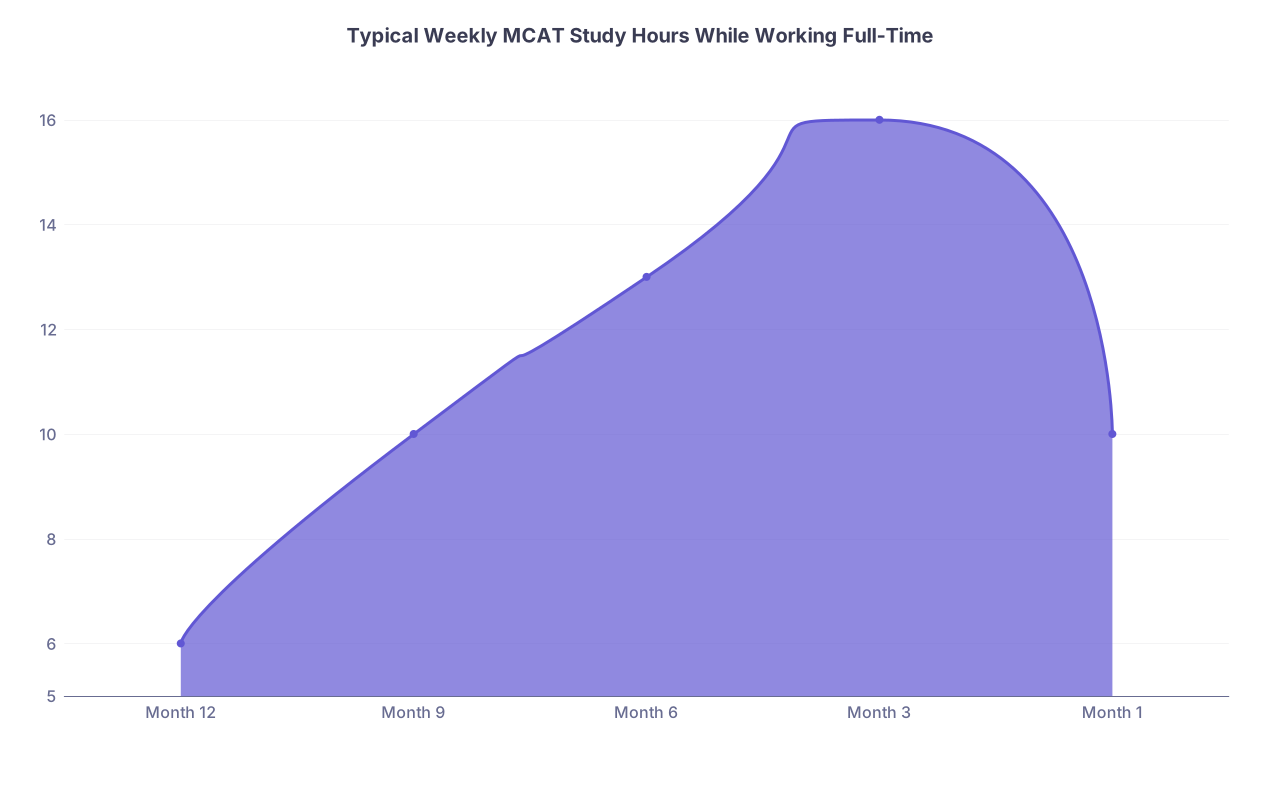
| Category | Value |
|---|---|
| Month 12 | 6 |
| Month 9 | 10 |
| Month 6 | 13 |
| Month 3 | 16 |
| Month 1 | 10 |
Month 2: Final Score Climb and Targeted Fixes
At this point, you should be close to your desired range or clearly understand what is holding you back.
Increase full‑length frequency if you can handle it.
- Many nontrads do:
- Week 1: FL
- Week 2: No FL, heavy practice + review
- Week 3: FL
- Week 4: No FL or lighter one-section practice
- Many nontrads do:
Prioritize AAMC full‑lengths now if you have not done most of them yet.
- Aim to complete at least 3–4 official AAMC FLs before test day.
Fine‑tune timing.
- Practice hitting:
- ~9 minutes per passage set C/P & B/B.
- ~10 minutes per CARS passage set.
- Train yourself to accept educated guesses rather than obsessive re‑checking.
- Practice hitting:
Adjust work schedule if possible.
- Ask for:
- 1–2 lighter weeks around your heaviest FL period, or
- A personal day after a full‑length if you find review impossible after work.
- Ask for:
Weekly target: 14–18 hours/week, but start tapering slightly toward the end of this month.
Final Month: Taper, Rehearse, and Protect Your Brain
This is where people panic and try to “make up” a year of half‑hearted studying in 4 weeks. You will not do that. You will consolidate.
4 Weeks Out
At this point you should:
Take your last or second‑to‑last full‑length (AAMC).
- This is your most predictive score.
- Use it to:
- Identify last‑minute weak topics
- Solidify confidence in your strengths
Plan your final 3 weeks almost day‑by‑day.
Example week (3 weeks out):- Mon: C/P targeted review + 2 passages
- Tue: CARS 4 passages + review
- Wed: B/B passages + key pathways review
- Thu: P/S flashcards + 3 passages
- Sat: Half‑length test or mixed‑section practice
- Sun: Light review + rest
Sleep discipline.
- Fixed bedtime and wake time that match test day hours.
- No “revenge bedtime procrastination” scrolling until 1 am.
2 Weeks Out
At this point you should:
Take your final full‑length (if you plan one this close).
- Many do it 10–12 days before test day.
- If your score drops slightly due to fatigue, do not freak out. Look at the trend, not one data point.
Shift to light‑to‑moderate intensity.
- 2–3 hours/day of:
- Passage practice
- Error log review
- Anki for formulas and facts
- 2–3 hours/day of:
Lock in logistics.
- Confirm test center location and drive time.
- Plan:
- What you will eat for breakfast
- Snacks for breaks
- What you will wear (layers, quiet clothes)

| Step | Description |
|---|---|
| Step 1 | 14 Days Out |
| Step 2 | Last Full-Length Exam |
| Step 3 | 2-3 Days Deep Review |
| Step 4 | Targeted Practice & Light Content |
| Step 5 | 7 Days Out: Stop New Material |
| Step 6 | Day Before: 1-2 hr Light Review |
| Step 7 | Test Day Routine |
Final Week and Test Day
At this point you should stop trying to change who you are as a test taker. You are just sharpening and calming.
7–4 days out:
- 1.5–3 hours/day max.
- Activities:
- Light passage sets, especially CARS and P/S.
- Review formula sheets and high‑yield concepts.
- Skim your “lessons learned” from earlier FLs.
3–2 days out:
- No more full sections.
- Maybe:
- 1–2 CARS passages.
- 30–45 minutes of flashcards.
- Focus on:
- Sleep
- Hydration
- Normal meals
Day before:
- 1–2 hours, light only. Or nothing. Both are fine.
- Do a test‑center dry run if you have not.
- Pack:
- ID, confirmation
- Snacks, water
- Layered clothing
Test day:
- Wake at practiced time.
- Eat your rehearsed breakfast.
- No last‑minute cramming beyond a quick glance at formulas if it calms you.
- During the test:
- One question at a time.
- Use breaks to reset, not to obsess about previous sections.
Final Takeaways
- You do not need to quit your job; you do need a 12‑month structure and brutally protected study blocks.
- The shift from content to timed practice around Months 4–3 is where most nontrads either take off or stall. Plan that transition now.
- The final month is about consolidation and execution, not heroics. If you respect that, your working‑full‑time MCAT year can still produce a highly competitive score.