
The idea that you have to quit your job to be a “real” premed is nonsense. And the data backs that up, not the loud voices on Reddit.
Let me be blunt: medical schools do not give bonus points for burning through your savings so you can post full‑time study pics on Instagram. They do, however, care if you can handle sustained workload, manage competing demands, and not crumble when life is not perfectly optimized around your Anki spacing intervals. Working while premed, done right, is often a green flag, not a liability.
Let’s dismantle this myth properly.
Where This Myth Actually Comes From
This “you must quit your job” narrative doesn’t come from admissions committees. It comes from:
– Full‑time traditional students who’ve never had to pay their own rent.
– MCAT tutoring companies that love to sell 6‑month full‑time “immersion” packages.
– Forum echo chambers where the loudest opinions often belong to people who have not actually gotten in anywhere yet.
What do med schools actually say?
Look at the AAMC’s own data on “nontraditional” students. Roughly a third of entering medical students are 24 or older. Many had full‑time jobs between undergrad and matriculation. I’ve sat in on admissions meetings where people explicitly said things like:
“This applicant worked 35–40 hours a week while taking science prerequisites and still pulled solid grades. That’s a big plus.”
Not a minus. A plus.
The myth persists because people confuse optimal conditions for an idealized 520 MCAT fantasy with sufficient conditions to be competitive. Those are not the same thing.
Could quitting your job help if your GPA is borderline and you need a perfect year? Maybe. Is it the default requirement for being “serious”? Absolutely not.
What the Data Actually Shows About Work and Admissions
Let’s pull in something stronger than vibes.
The AAMC regularly publishes data on accepted applicants, including age, time since undergrad, and work experience. A large fraction of matriculants have significant employment history. Not just “summer barista.” Real jobs.
Nontraditional applicants frequently have:
– Years of full‑time work
– Family responsibilities
– Part‑time or evening classes
– Commuting and financial constraints
And yet they still get in. Every cycle.
What admissions committees tend to notice about applicants who worked:
– Evidence of time management under real constraints
– Maturity and professional behavior (especially in health‑adjacent jobs)
– Clear understanding of sacrifice and delayed gratification
– Financial responsibility instead of magical thinking about loans and “figuring it out later”
If you want a simple summary: working while premed doesn’t tank your chances; doing it badly can.
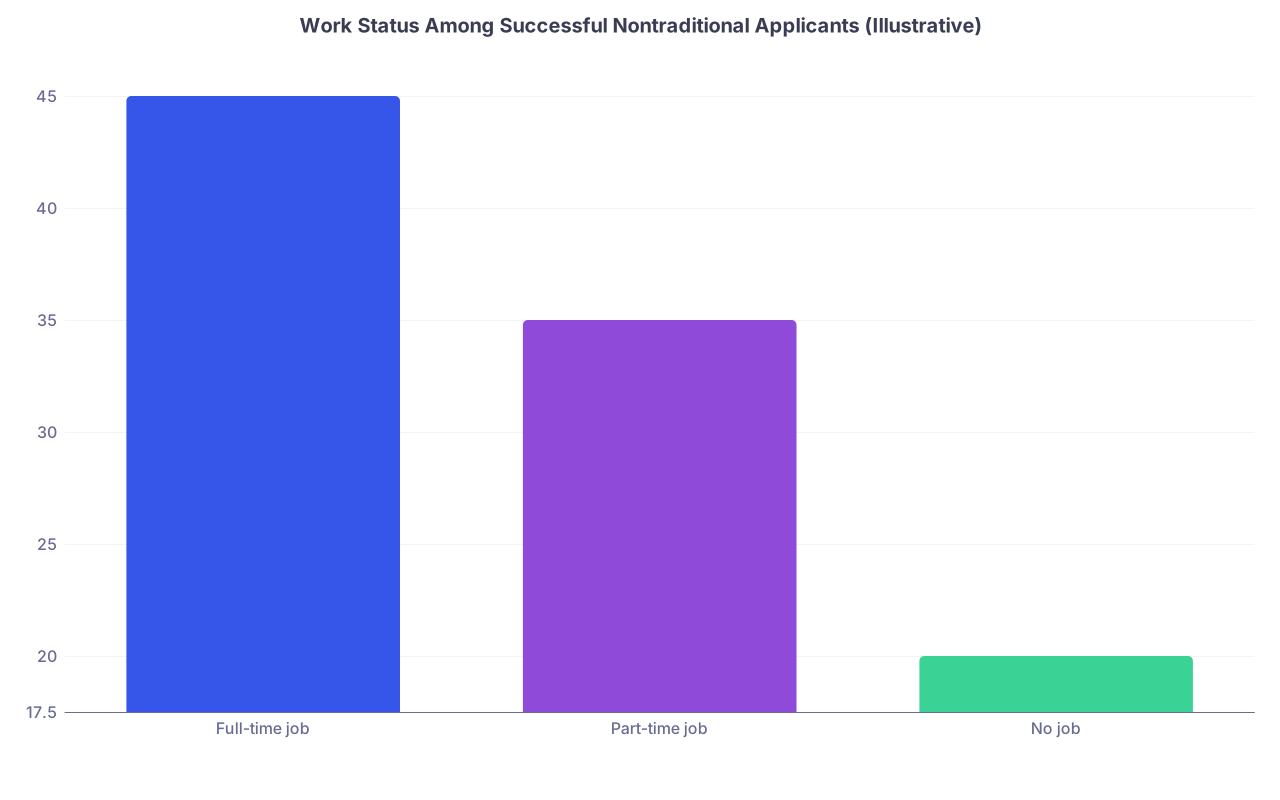
| Category | Value |
|---|---|
| Full-time job | 45 |
| Part-time job | 35 |
| No job | 20 |
Those numbers are illustrative, but they match what many advisors and admissions folks quietly know: a lot of successful nontrads did not clear their lives to zero before applying.
The problem is that people see a few anecdotes of “I quit my job and then I finally did well on the MCAT” and generalize that to everyone. That’s survivor bias. You’re not hearing from the people who quit, torched their finances, still scored in the low 500s, and now don’t post about it.
The Real Trade‑Off: Money, Time, and Cognitive Bandwidth
Let’s be honest about what working while premed really does: it taxes your time and your mental energy. That can absolutely hurt your performance if you pretend you can do everything at 100%.
The job question is not “work vs. serious.” It’s “how much cognitive bandwidth can you preserve for GPA, MCAT, and experiences without wrecking your life?”
You have three main buckets:
- Academics (post‑bacc or undergrad repair, prerequisites, GPA trend)
- MCAT (content, practice, review)
- Experiences (clinical, shadowing, volunteering, research)
Add work and life (family, kids, health) on top.
The smart nontrad doesn’t try to max all five. They triage.
If your GPA is weak, that’s priority #1. If your GPA is fine but you’ve never seen a patient outside of your own appointment, clinical exposure is priority #1. If your transcript is solid but you bombed a practice MCAT, you know the answer.
The job is a variable, not a moral statement.
I’ve seen people work 50 hours a week and salvage a GPA by taking only 1–2 prerequisite courses at a time over a longer period. The trend looked excellent and admissions noticed. I’ve also seen people cut their job down to 10 hours a week, over‑enroll in coursework to “get it over with,” and face‑plant.
The problem was not the job. It was bad planning.
When You Shouldn’t Quit Your Job
Here’s the uncomfortable truth: for most nontrad premeds, quitting a job outright is actually a terrible idea.
You probably shouldn’t quit if:
– You don’t have at least 6–12 months of living expenses saved.
– You’re supporting kids, a partner, or family members.
– Your job is in healthcare and gives you meaningful exposure (MA, EMT, scribe, nurse, RT, social worker).
– Your mental health is tightly linked to financial stability and structure.
Walking away from a decent income without a realistic runway is not “commitment.” It’s self‑sabotage dressed up as hustle.
There’s also the admissions optics angle. Being employed in a health‑adjacent role while taking courses and prepping for the MCAT looks like this:
“They’ve been in the trenches. They know what patient care feels like at 3 a.m. They still want this.”
Quitting that same job to focus 100% on MCAT and classes can look like:
“They study well in perfect conditions. Can they function when life is not arranged entirely around their exam schedule?”
No, schools won’t reject you just because you quit. But don’t pretend leaving a substantive job is automatically an upgrade in their eyes. Often, it is not.
When Cutting Back or Quitting Does Make Sense
Sometimes, yes, your job needs to shrink. Or go.
This is not about proving you’re “serious.” It’s about applying with numbers and experiences that are actually competitive.
Here are the real justifications I’ve seen make sense:
– You’re consistently scoring below what your target schools require on full‑length MCATs, and you can clearly link it to exhaustion and lack of study time despite already having optimized your schedule.
– Your science GPA is fragile (3.2–3.4 range) and a couple more mediocre terms will effectively close doors to MD and maybe even some DO options.
– Your job is high‑stress, low‑relevance, and eats evenings and weekends (think: rotating retail management) while you have zero clinical experience.
In those cases, cutting work hours, switching to a less demanding role, or taking a defined 3–4 month period off before the MCAT can be strategic. Notice the keyword: defined. Not “I quit and now I’m floating, hoping for the best.”
I’ve seen smart versions of this:
– ICU nurse who goes per diem for 4 months leading up to the MCAT, then ramps back up.
– Software engineer who stockpiled 6 months of savings, took a planned 3‑month leave, had a daily study schedule, then returned to work.
– Retail manager who moved to a lower‑responsibility, fixed‑schedule clerical job to preserve evenings for classes and studying.
Those people weren’t signaling their “seriousness.” They were managing risk and bandwidth.

| Step | Description |
|---|---|
| Step 1 | Current Job |
| Step 2 | Keep Job, Optimize Schedule |
| Step 3 | Cut to PT or Per Diem |
| Step 4 | Find Lower-Demand Job |
| Step 5 | Planned Short-Term Break |
| Step 6 | Killing GPA or MCAT? |
| Step 7 | Can Reduce Hours? |
| Step 8 | Have 6-12 mo Savings? |
How Admissions Actually Judge Working Applicants
Here’s what faculty and admissions staff actually scan for when they see work on your app:
Pattern, not perfection. Did your grades go up, stabilize, or crater when you started working? If your trend is upward while working decent hours, that screams “resilient and prepared.”
Story coherence. Does your narrative make sense? Example they like: “I was working full time as an EMT, taking two classes at a time, realized I needed more bandwidth for MCAT, dropped to part time for 6 months, then returned to full‑time until matriculation.” That shows planning and self‑awareness.
Time justification. You don’t need a confession in your personal statement that you “couldn’t” quit; you simply explain your constraints and choices. Many nontrad essays do this well: “As the primary earner in my household, I balanced full‑time employment with evening coursework. This forced me to be deliberate about...” That’s not an excuse. It’s context.
Evidence you know medicine is not a fantasy. Applicants coming from real‑world health jobs often have better, grittier stories about suffering, uncertainty, and team dysfunction. They also tend to have more realistic motivations. That comes across.
What they are not doing is cross‑referencing who quit their job versus who didn’t and ranking “dedication.”
They care whether you can handle hard, prolonged effort without falling apart. Working responsibly while you build your application is literally a demonstration of that.
Practical Reality: Building a Competitive App While Working
Let’s get tactical for a minute. Suppose you’re working 35–40 hours a week and want to be a strong premed. The move is not to quit by default. It’s to architect a sane, multi‑year plan.
Take a 2–3 year lens, not a 6‑month panic sprint.
Something like this (adapt as needed):
| Timeframe | Academics | Work | MCAT | Clinical/Other |
|---|---|---|---|---|
| Year 1 | 1–2 prereq classes/term | Full-time | Light content review | Start consistent clinical/volunteering |
| Year 2 H1 | Finish core prereqs | Full/Part-time | Dedicated study ramp | Continue clinical; add some shadowing |
| Year 2 H2 | Lighter or no classes | Reduced hours or planned leave | 3–4 months focused MCAT push | Maintain minimal ongoing clinical |
The key moves:
– You do not stack all prerequisites at once while working full-time. You spread them out and protect your GPA trend.
– You don’t ignore clinical exposure until the final semester, then scramble. You build it in early and keep it consistent.
– You adjust work intensity in targeted windows (e.g., MCAT study, heavy science terms), not by torching your income forever.
Could you accelerate by quitting earlier? Yes. But you’d be trading stability and often maturity for speed. Most nontrads do not need more speed. They need a realistic runway.
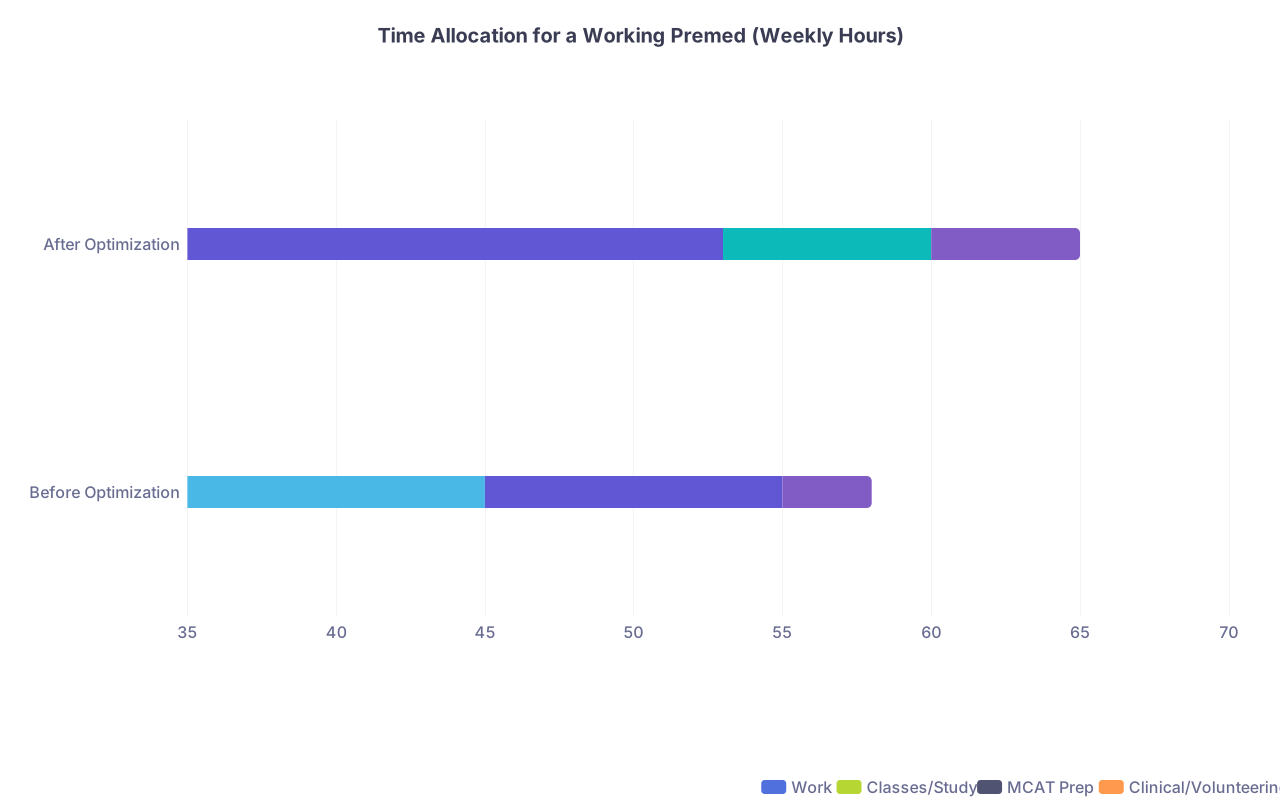
| Category | Work | Classes/Study | MCAT Prep | Clinical/Volunteering |
|---|---|---|---|---|
| Before Optimization | 45 | 10 | 0 | 3 |
| After Optimization | 35 | 18 | 7 | 5 |
See the pattern? You’re not choosing “job or premed.” You’re rebalancing.
The Psychological Trap: Equating Sacrifice with Worthiness
One more thing people don’t talk about out loud.
There’s a martyrdom culture in premed land. If you’re not suffering visibly—no social life, no job, no sleep—you’re accused (subtly or directly) of not “wanting it enough.” That’s emotional nonsense masquerading as advice.
You are not more deserving of a medical career because you voluntarily made yourself poor when you didn’t have to. You are more deserving if you demonstrate judgment, resilience, self‑knowledge, and the ability to do hard things over time without blowing up your life.
Quitting your job might be the right call in your case. Or it might be you trying to buy confidence with suffering, instead of doing the slower, more boring work of building competence.
Admissions committees don’t reward self‑destruction. They reward evidence you can survive the reality of medicine: chronic stress under constraints, with no perfect conditions.
Working while premed is not a mark against that. Often, it’s your best proof you’re already living it.
Bottom line:
- You do not need to quit your job to be a “serious” premed; many successful nontrads work full‑time and are valued for it.
- The smart move isn’t binary quitting—it’s deliberate adjustment of hours and timelines to protect GPA, MCAT, and meaningful clinical exposure.
- Med schools care far more about consistent performance under real‑world constraints than about performative sacrifice or martyrdom.