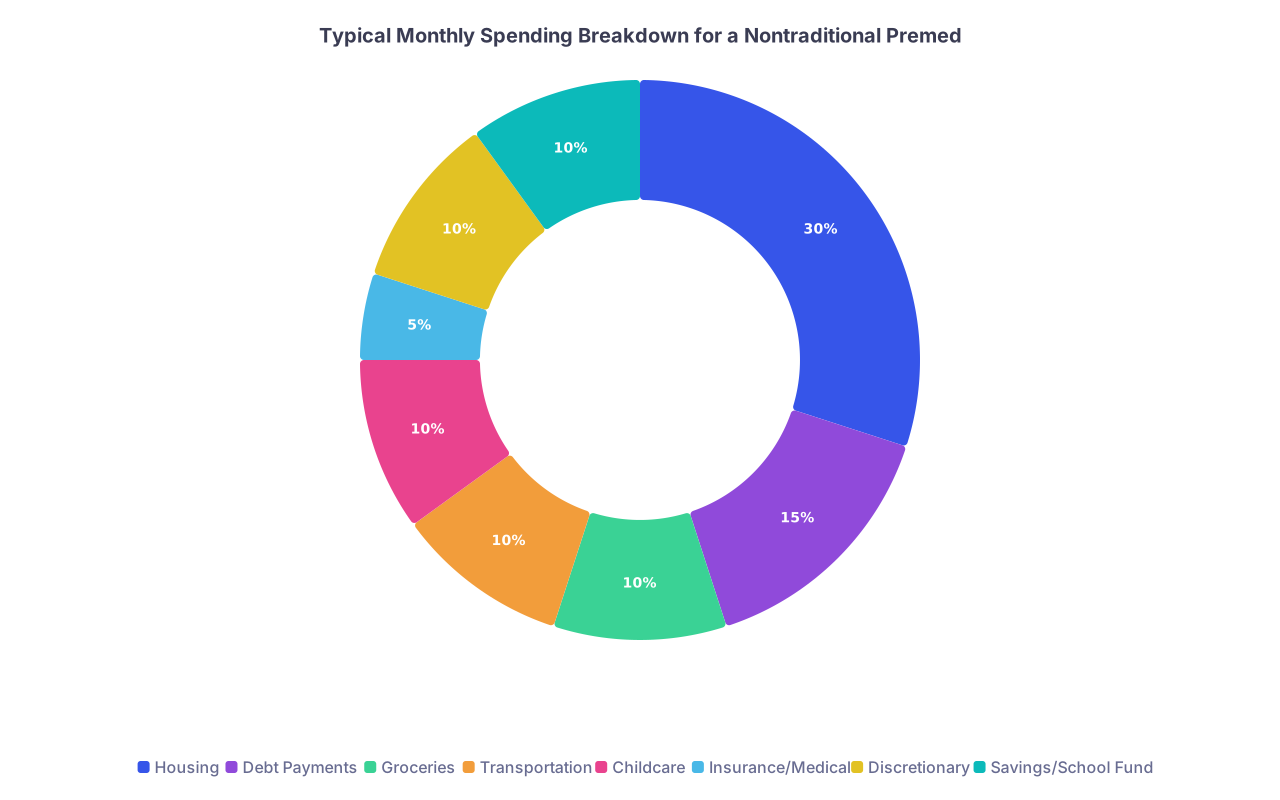
| Category | Value |
|---|---|
| Housing | 30 |
| Debt Payments | 15 |
| Groceries | 10 |
| Transportation | 10 |
| Childcare | 10 |
| Insurance/Medical | 5 |
| Discretionary | 10 |
| Savings/School Fund | 10 |
The biggest lie about going to medical school in your late 30s or 40s is that it is “financially impossible.” It is not. But it is absolutely impossible if you keep budgeting like everyone else your age.
You are not “everyone else.” You are about to light a fuse on 8–12 years of training with delayed income. Your budget has to reflect that reality.
This is a practical blueprint for how to do it without wrecking your finances or your life.
1. Your Situation Is Different – So Your Budget Must Be Different
If you are 35–45 and premed, you are juggling at least some of this:
- Rent or a mortgage in a city that is not cheap
- Credit cards, car loan, maybe old student loans
- Kids. Or aging parents. Sometimes both.
- A job you cannot just abandon tomorrow
- Zero interest in “eating ramen for ten years”
You cannot use a 22‑year‑old’s “cut Netflix, make coffee at home” budgeting advice. You need:
- A multi‑year financial plan, not a monthly “spend less” challenge
- A way to fund prereqs, the MCAT, and applications without high‑interest chaos
- A realistic picture of what med school and residency will do to your cash flow
So we build a budget backwards from your goal: starting med school without financial disaster.
2. Step Zero: Hard Reality Check (Numbers, Not Vibes)
You cannot plan what you refuse to measure. Take one weekend and do this. No excuses.
A. Map Your Current Monthly Numbers
Pull the last 3 months of bank and card statements. Average them.
Write down your real numbers, not what you “think” they are.
- Take‑home pay (after tax and benefits)
- Partner’s take‑home pay (if applicable)
- Side income (reliable only)
Then list monthly expenses:
- Housing (rent/mortgage, HOA, property tax if escrowed)
- Utilities (power, gas, water, internet, phone)
- Groceries + dining out
- Transportation (gas, transit, maintenance, parking, car payment)
- Insurance (health, auto, renters/home, life, disability)
- Childcare/school costs
- Debt payments (credit cards, student loans, personal loans, medical bills)
- Subscriptions and “drip fees”
- Discretionary (clothes, entertainment, hobbies, travel, etc.)
Now you have your baseline. Most people are shocked. Good. You need that.
B. Identify Your True Financial Constraints
Ask yourself:
How many years until I realistically could start medical school?
- 1–2 years: You are already in prereqs and MCAT.
- 3–5 years: You are still fixing GPA, building ECs, etc.
Who financially depends on me?
- No dependents: you can be more aggressive.
- Kids, spouse, parents: you must protect a safety margin.
What big anchors do I currently carry?
- High car payment?
- Private school tuition?
- Massive credit card balances?
Write these down. Those anchors will drive your early budget moves.
3. Core Framework: The “Premed Reallocation Budget”
A normal mid‑career budget aims at:
- Retirement savings
- Maybe upgrading housing
- Maybe college savings for kids
- Lifestyle comfort
Your budget for the next 3–7 years has a different priority stack:
- Survival and stability (roof, food, basic health, safety)
- Debt risk reduction (especially high‑interest)
- Funding the premed pipeline (courses, MCAT, applications)
- Emergency buffer
- Targeted retirement maintenance (do not stop entirely)
- Lifestyle upgrades (last priority, not first)
Think of it as a reallocation, not deprivation. You are diverting money away from random lifestyle burn and toward this career pivot.
4. Build the Monthly Blueprint: Category by Category
I am going to give you a target structure for your budget. Adjust the percentages to your income, but keep the hierarchy.
| Category | Suggested Range of Net Income |
|---|---|
| Housing & Utilities | 25–35% |
| Food (Groceries + Dining) | 8–15% |
| Transportation | 8–12% |
| Insurance & Medical | 5–10% |
| Childcare/Dependents | 5–20% (highly variable) |
| Debt Payments | 10–20% |
| Premed/School Fund | 5–15% |
| Retirement Savings | 5–10% |
| Discretionary/Other | 0–10% |
A. Housing: The Big Lever Most People Ignore
If you are serious about this path, your housing decision is one of the top 3 financial levers you have.
If your rent or mortgage + utilities is over 35–40% of your take‑home pay, you are boxing yourself in.
Options to consider (that people resist emotionally, but which work):
- Move to a cheaper place for 3–5 years
- Rent out a room (yes, even with kids — I have seen families do this with a graduate‑student tenant in a basement)
- If you own, sell and rent smaller during the premed/med school ramp period
- Move closer to work/school to slash commute and car costs
If your answer to all of these is “I could never,” fine. But understand: refusing to move often means you will finance more of this journey with high‑interest debt later.
B. Transportation: Your Second Hidden Tuition Payment
Look at your car situation.
- Huge payment on an SUV or truck?
- High insurance because the vehicle is “nice”?
Solution pattern I see work again and again:
- Sell the expensive car.
- Buy a reliable, boring used car in cash or with a very small loan.
- Pocket the difference and redirect the freed-up payment into:
- Debt payoff
- Premed costs fund
This alone can free $300–800/month.
If you live where you can realistically do:
- One car instead of two
- Or car + transit
Do it. You are not trying to “win” the next 18 months of social comparison.
5. Create a Dedicated “Premed / Med School Fund”
You need one separate account—call it:
- “Premed Pipeline Fund” or
- “Med School Launch Fund”
Why separate? Because blended money disappears into the monthly fog. You want to see that number grow.
What This Fund Will Pay For
Over the next 1–4 years, you will have to cover:
- Prereq tuition (if not covered by aid/benefits): $2,000–$10,000+
- Textbooks/online resources: $200–$1,000/year
- MCAT prep:
- Registration: ~$330 (can change slightly)
- Prep materials: $200–$2,000 (books vs course)
- Application season:
- Primary apps (AMCAS/AACOMAS/TMDSAS): $1,000–$2,000
- Secondaries: $1,000–$3,000 depending on number of schools
- Travel (if in‑person interviews): $0–$3,000
- Lost income windows:
- Time off for MCAT
- Time off for interviews
Realistically, you should aim to accumulate at least $8,000–$15,000 in this fund before you start your application year. More if you have dependents and cannot just “float” random costs.
How Much To Put In Monthly
Take your timeframe:
Planning to apply in 3 years:
- Target fund: $12,000
- That is $333/month
Planning to apply in 5 years:
- Target fund: $12,000
- That is $200/month
Plug that into your budget as a non‑negotiable line item.
This is your “tuition down payment” for changing careers.
6. Dealing with Debt Without Sabotaging the Plan
This is where many older premeds blow themselves up. They either:
- Ignore debt completely, hoping “future doctor salary” will solve it
- Or go nuclear on debt payoff and have nothing left to fund courses and applications
You need a middle path.
A. High‑Interest Debt (Credit Cards, Personal Loans)
Anything over ~8–9% interest is corrosive.
Your playbook:
- Stop new charges.
- If possible, roll to a 0% balance transfer card and calculate the monthly payment to clear it before promo ends.
- Otherwise, use a debt avalanche:
- Pay minimums on all
- Attack the highest rate with every spare dollar until gone
- Repeat
But here is the line: Do not redirect all of your future‑career money to current debt.
If it takes you 7 years to become “debt free” before even starting the premed pipeline… you just lost most of your 30s or early 40s.
Better: aggressively pay down the worst debt while still:
- Putting something into your Premed Fund
- Keeping at least minimal retirement contributions (especially if you get a match)
B. Student Loans
Federal loans with income‑driven repayment? Different story.
If your payments are crushing, explore:
- Income‑driven repayment plans
- Consolidation (if it simplifies, not just for the illusion of progress)
- Pausing aggressive payoff during retraining
I have seen applicants unnecessarily throw $1,500/month at low‑interest student loans while trying to save for MCAT. That is backwards. You are upgrading your earning power; this is investment season.
7. Budgeting Time as Seriously as Money
Your financial budget collapses if you do not budget time. Because then you buy your way out of time shortages.
- Expensive takeout because there is “no time to cook”
- Paying for convenience everything (late fees, Ubers, last‑minute flights)
- Wasted prep cycles because you studied inefficiently and have to retake exams
You are juggling:
- A job
- Possibly kids/family
- Classes
- Studying for the MCAT
- Clinical/volunteer hours
You must build a time structure that keeps money from bleeding out.
Simple Weekly Time Protocol
Block your non‑negotiables:
- Work hours
- Commute
- Childcare school runs
- Classes and labs
Then block:
- MCAT study / prereq study blocks (minimum 5–10 focused hours/week to start; more later)
Then add:
- 1 weekly block for batch cooking / meal prep
- 1 weekly block for “money admin”: paying bills, reviewing budget, moving money to Premed Fund
This is boring. It is also how people save a four‑figure sum each year in food, random fees, and chaos purchases.

| Step | Description |
|---|---|
| Step 1 | Define Work & Family Obligations |
| Step 2 | Schedule Classes & Labs |
| Step 3 | Block Study Time |
| Step 4 | Add Meal Prep & Chores Block |
| Step 5 | Add Weekly Money Review |
| Step 6 | Protect Sleep & Recovery Time |
8. Protecting Family and Relationships Financially
If you have a partner or kids, this is not just your budget. It is a family restructuring.
You must make them part of the process, not casualties of it.
With a Partner
You need one brutal, honest conversation that covers:
- Timeline: “I expect 2 years of prereqs, 1 year to apply, then 4 years of med school, 3–7 of residency.”
- Income hit: “In med school, my income drops to near zero; in residency, modest; attending income later.”
- Role shifts: “During X years, I will have less bandwidth for overtime / side work / household tasks; we need to adjust expectations.”
Then you show them the budget.
- What changes?
- What gets cut or delayed?
- How do you protect some shared joy (cheap but meaningful)?
The couples that make it through training are the ones who treated it as a joint project, not one person dragging the other through a black box.
With Kids
Age appropriate honesty:
- Younger kids: “Dad/Mom is going back to school to become a doctor. That means we may do fewer trips but more parks/library days.”
- Teens: Show them the numbers. Teach them what debt means, what delayed gratification looks like. Many actually step up if you treat them like stakeholders, not accessories.
Budget line items that protect sanity:
- Some cheap but reliable childcare during crunch times
- Occasional low‑cost treats (pizza night, library movie nights, etc.) baked into the budget rather than impulse‑bought
9. Employer and System Hacks You Should Not Ignore
You are older. Use that to your advantage.
A. Employer Education Benefits
Go to HR. Today. Ask:
- Do you offer tuition reimbursement?
- Does it cover community college or university extension courses?
- Are there lifetime caps? Annual caps?
I have seen people leave $5,000/year on the table because they “assumed” it only applied to degrees related to their job.
Even a modest benefit can cover:
- One or two prereq courses per term
- Or MCAT prep if coded as “continuing education”
B. Flexible Work Arrangements
Look for:
- 0.8 FTE positions with benefits
- Four 10‑hour days giving you one weekday for classes
- Remote work options for part of the week (saves commute time and money)
Yes, some managers will say no. Some will say yes if you come with a concrete plan that keeps your output high.
C. Tax‑Advantaged Accounts
You are not 22. You need to keep one eye on retirement and risk.
- If your employer matches 401(k)/403(b), at least contribute to get the full match unless cash flow is truly dire. That is instant 100% return.
- Use an HSA (if you have a high‑deductible plan) as both a medical buffer and long‑term tax‑advantaged bucket.
- If you are self‑employed, look at SEP‑IRA or Solo 401(k), but do not overfund to the point you cannot cash‑flow your premed expenses.
10. What Changes Once You Start Medical School
Premed budget is one thing. Med school budget is a different beast.
Once you start school, the main levers shift:
- Income → mostly gone or minimal
- Loans → primary funding source for living expenses
- Location → often dictated by your school
Your goal in the premed years is to:
- Reduce high‑interest obligations before you lose full income.
- Practice living on a leaner, disciplined budget now, not in a panic later.
- Build a cushion so you do not borrow every possible loan dollar just to survive.
Typical med student mistake: “The loan money is there, so I will use it.” That mentality compounds into tens of thousands in interest over time.
The older you are, the less time you have post‑training to amortize a huge loan pile. Your premed budget discipline is not optional.
11. Putting It All Together: A Sample Blueprint
Let us take a concrete example.
- Age: 38
- Income: $90,000 take‑home ~$5,400/month
- Married, one child
- Current monthly:
- Housing + utilities: $2,200
- Car + transport: $800
- Food: $1,000
- Childcare: $600
- Debt payments: $700 (credit cards + car)
- Misc/discretionary: $600
- Savings: basically $0
This person feels “stuck.” Here is how I would restructure:
- Housing: stay put (already ~40% but city is expensive; moving saves little).
- Car: sell current car, buy used reliable for cash or small loan; cut payment + insurance by $300 → transport now $500.
- Food: Commit to meal planning, cut to $750.
- Discretionary: Cut to $250 with some planned cheap family activities.
- Debt: Keep $700 but move highest‑interest balances to 0% card if possible.
- New lines:
- Premed Fund: $350/month
- Retirement: $250/month (enough to still get partial match)
- Small emergency fund build: $100/month until it hits ~$3,000
New monthly:
- Housing + utilities: $2,200
- Transport: $500
- Food: $750
- Childcare: $600
- Debt: $700
- Premed Fund: $350
- Retirement: $250
- Emergency fund: $100
- Discretionary: $250
Total: $5,700 → This is $300 more than take‑home. So we still need $300.
Options:
- Partner picks up 1–2 short shifts per month bringing extra $300–400
- Or applicant does one evening/weekend shift — but not at the cost of MCAT/grades
- Or look again at housing (roommate, smaller place) for another $200–300 savings
You work the problem from the top down until the math closes.
12. Weekly Money Maintenance: The 30‑Minute Habit
You do not need a hyper‑complex system. You need consistency.
Once a week:
- Log into all accounts.
- Check for:
- Upcoming bills
- Weird charges
- Progress toward your Premed Fund target
- Move:
- Automatic transfers on payday to:
- Premed Fund
- Debt extra payment (if any)
- Retirement (if not via payroll)
- Automatic transfers on payday to:
This 30‑minute habit does more for your long‑term success than any clever spreadsheet.
13. When the Numbers Truly Do Not Work
Sometimes, even after aggressive changes, the math still fails in a way that is not denial but reality.
That can mean:
- You need more time — 5–7 years, not 2–3, to stabilize finances first
- You need to aim for linked programs (e.g., PA → bridge later, or a solid allied health role) that change your trajectory without the full med school cost
- You need geographical arbitrage (move to lower cost‑of‑living now or for med school)
There is no shame in revising the path. The mistake is pretending the numbers will magically fix themselves later.
FAQ (Exactly 3 Questions)
1. Should I stop all retirement contributions while I prepare for medical school?
Usually no. If you get an employer match, cutting contributions to zero is throwing away free money. A reasonable compromise for many is to reduce contributions to the minimum needed to capture the full match or maintain 5–10% total, if that allows you to still fund your Premed Fund and pay essential bills. If your cash flow is absolutely drowning, you may temporarily reduce retirement further, but the goal is to re‑establish contributions as soon as you stabilize, not abandon retirement indefinitely.
2. Is it financially smarter to choose a cheaper DO or state school over a more prestigious MD program?
For a 35‑ to 45‑year‑old applicant, total cost and location often matter more than the name on the diploma, as long as you attend an accredited school with solid match outcomes. A lower‑tuition state school near family support can reduce living expenses dramatically and shorten your training‑to‑attending runway. Chasing prestige with an extra $80,000–$150,000 in loans and higher living costs usually does not pay off, unless that specific school meaningfully increases access to a specialty you are very committed to and competitive for.
3. How much emergency fund should I have before starting medical school?
Ideal: 3–6 months of bare‑bones expenses. Realistic for many nontraditional students: 1–3 months, plus access to low‑interest backup options (HELOC, supportive partner income, etc.). You do not delay medical school for a decade trying to hit a perfect emergency fund number, but you also do not walk in with nothing and multiple dependents. The bare minimum is at least enough to cover one major unexpected event (car repair, medical bill, sudden childcare gap) without resorting immediately to high‑interest credit. Aim for that first, then build more if time and income allow.
Key points to walk away with:
- Your age and responsibilities mean your budget must be engineered, not guessed.
- A dedicated Premed Fund and aggressive but strategic debt handling are non‑negotiable.
- Housing, car, and time structure are your main levers; move them now, not later.