
The myth that only fresh-out-of-college science robots survive med school is flat-out wrong.
I know it doesn’t feel wrong when you’re staring at an old organic chemistry textbook, realizing you’ve forgotten what a mole is and wondering how on earth you’re supposed to keep up with 21-year-olds who just took biochem last semester. But I’ve watched too many nontraditional students go from “I’m too old and too rusty” to “I’m tutoring my classmates” to pretend this is some rare miracle.
Your fear is real. Your worst-case scenarios feel very possible:
- You sit in the first lecture and understand nothing.
- You’re the slowest test taker in the room.
- Everyone else remembers every pathway and formula, and you’re googling “what is mitosis” in shame.
Let’s walk straight into that fear and pull it apart.
The Nightmare Loop in Your Head (You’re Not the Only One Thinking This)
Let me guess what’s running on repeat in your brain:
- “It’s been 5, 8, 10+ years since I did any serious science.”
- “I was decent in college, but that was with ‘normal’ course loads, not med school firehose mode.”
- “What if my brain just… slowed down?”
- “What if I get in and then wash out? That would be worse than not getting in at all.”
And the ugliest one:
“I’m going to look stupid. Professors, classmates, everyone will see I don’t belong.”
You’re not imagining this alone in a vacuum. I’ve heard versions of these exact sentences from:
- A 33-year-old former teacher who hadn’t taken science since undergrad.
- A 29-year-old accountant who spent 7 years in corporate before going back for prereqs.
- A 40-year-old military vet who didn’t remember basic algebra.
Every single one of them was convinced they’d be the slowest, the weakest, the one who “couldn’t keep up.”
Every single one of them passed. Most did fine. A couple absolutely crushed it academically.
The difference wasn’t that they were secretly geniuses. It was this: They stopped hoping it would “just come back” and built a system like they were training for a marathon, not wandering onto a treadmill.
What’s Actually Hard vs. What Your Anxiety Is Exaggerating
Let’s be brutally honest for a second.
You will be rusty. You will feel slower than people fresh from undergrad. There will be moments where you stare at a slide and think, “I should know this. I absolutely do not know this.”
But that’s not what breaks nontraditional students.
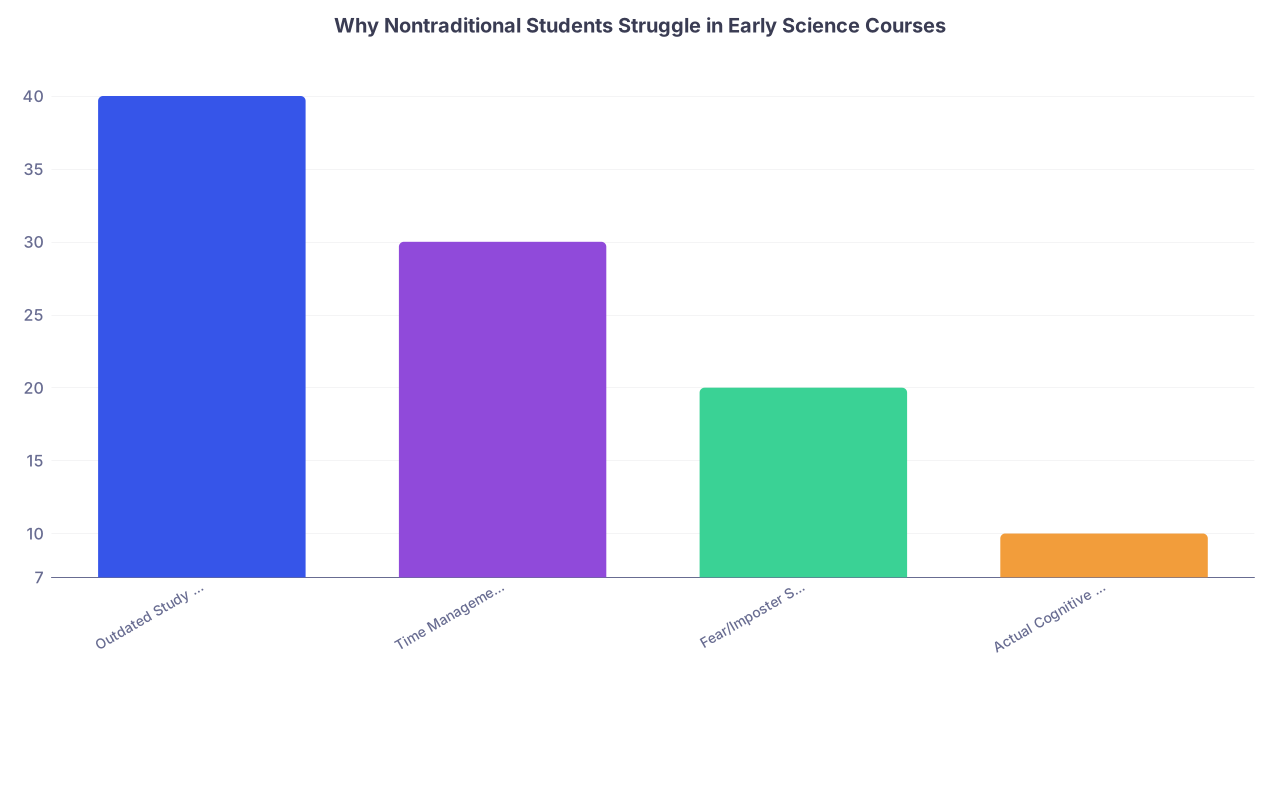
| Category | Value |
|---|---|
| Outdated Study Habits | 40 |
| Time Management & Life Stuff | 30 |
| Fear/Imposter Syndrome | 20 |
| Actual Cognitive Limits | 10 |
Here’s how it usually shakes out:
Outdated or nonexistent study system is the biggest killer.
Trying to memorize everything. Re-reading notes. Watching lectures twice. No spaced repetition. No active recall. That will drown anyone, not just you.Life chaos hits harder when you’re older.
Kids, jobs, partners, sick parents, mortgages. The 20-year-old who lives in a dorm and has one part-time job just has more hours to brute-force things. You don’t. So you actually need a better system, not more willpower.Fear and shame quietly sabotage you.
You don’t go to office hours because you’re embarrassed. You don’t ask “dumb” questions. You hide in the back and fall more behind.
The “my brain is too old” thing? Tiny piece of the pie. Your brain is wildly plastic. You’re not 95. You can absolutely rebuild speed and depth.
The Competitiveness Myth That’s Making This Worse
There’s this unspoken belief:
“If I’m not naturally fast at this, I’ll never survive med school. I should just accept I’m not cut out for it.”
That’s… convenient. It lets you quit before you risk failing. It turns anxiety into a personality trait: “I’m just not that kind of person.”
Here’s what I’ve actually seen:
- 3.9 GPA biology major, straight from undergrad, used to cramming the night before. Crashes hard in M1 because that strategy stops working instantly.
- 3.3 GPA English major, 6 years out, absolutely terrified, spends months rebuilding study skills before starting, tests in the top half of the class.
The second one wins. Not because of talent. Because of humility and preparation.
If you’re reading this and already worrying about being behind? You’re more likely to succeed than the overconfident person who thinks med school is “just like undergrad but more.”
You’re scared. Good. That fear can be fuel if you use it now instead of waiting until orientation week.
Concrete Academic Skills You Actually Need (And How to Rebuild Them)
Let’s strip this down. You don’t need to become a perfect scientist before med school. You need to build a core toolkit:
- You must be able to learn dense information quickly.
- You must be able to remember it long enough to use it.
- You must be able to apply it to questions under time pressure.
The details—glycolysis steps, physics formulas—matter less than how you train these three muscles.
Here’s what that training can look like if you’re years out of science.
1. Stop Romanticizing “Review” – Build Active Recall Now
No more “I’ll just re-read my old textbook” fantasy. That’s wishful thinking with highlighters.
Do this instead:
- Pick one core subject: probably biology or general chemistry.
- Get a structured resource: e.g., Khan Academy, a current intro bio text, or a reputable MCAT book.
- After every short section, close the book and write down everything you remember. No looking. No cheating.
- Then compare and fill in gaps.
You’re training your brain to retrieve, not just recognize.
You can level up this with Anki (yes, I know, everyone screams about Anki for a reason):
- Make simple, small cards. One fact, one concept.
- Do them every day, even on busy days. 10–15 minutes minimum, 30–45 if you can.
- Let the algorithm handle spacing. You just have to show up.
This will feel slow at first. That’s normal. You’re rebuilding neural pathways that haven’t been used in years. Give it a few weeks, not a few days.
2. Rebuild “Math Brain” Without Shame
If you haven’t touched algebra or physics in a decade, of course it feels impossible. That’s not a character flaw. That’s disuse.
Start stupidly small. No one’s grading you here.
- Work through a basic algebra refresher book or course. Aim for 30 minutes a day.
- Focus on: manipulating equations, exponents, logs, fractions, unit conversions.
- Then layer in very basic physics concepts: kinematics, forces, energy.
And yes, you will get questions wrong that a high school junior might get right. You’re not in competition with them. You’re rebuilding foundations grown adults are allowed to forget.
How to Test If You Can “Actually Keep Up” Before It’s High Stakes
You don’t have to wait until med school to find out if your brain can handle this.
Run a real experiment on yourself.

| Step | Description |
|---|---|
| Step 1 | Pick 1 Science Course |
| Step 2 | Study Seriously for 4-6 Weeks |
| Step 3 | Do Timed Practice Tests |
| Step 4 | Keep Scaling Up |
| Step 5 | Adjust Strategy & Get Help |
| Step 6 | Improving? |
Here’s a rough template:
Week 1–2:
- Choose a structured course: community college bio/chem, an online course, or a self-study plan using a standard textbook.
- Set up your schedule like you’re already in school: certain hours every week, non-negotiable.
- Use active recall and Anki from day one.
Week 3–4:
- Add timed practice questions. Not just “do I eventually get it” but “can I answer this in 60–90 seconds?”
- Notice how your brain feels. Overwhelmed is fine. Utterly nonfunctional, day after day, not fine.
Week 5–6:
- Take a cumulative, timed practice exam for that material.
- You’re not looking for perfection. You’re looking for:
- Can I get through without shutting down?
- Are my scores trending up, even slowly?
- Do I understand my mistakes when I review?
If you see any upward trend, you’re trainable. That’s all med school really requires.
The Nontraditional Advantage You Keep Forgetting You Have
You’re so focused on what you’ve lost (recent coursework, automatic recall, speed) that you’re ignoring what you’ve gained.
Older students tend to be better at:
- Tolerating discomfort. You’ve already done hard, unglamorous things: full-time jobs, graveyard shifts, parenting, deployments. You can sit with frustration longer.
- Managing time when they actually commit. Once you decide this matters, you know how to protect chunks of your day better than a 19-year-old who lives on group chats.
- Asking for help like an adult. Or at least, you can learn to. Office hours, tutoring, mentors—you’ve worked in teams before, you know you don’t have to be a lone wolf.
I’ve watched 30-somethings in med school who:
- Weren’t the fastest memorizers,
- But were the first to find study groups,
- The first to ask professors for clarification,
- The first to throw out a broken strategy and try something new.
They ended up solidly middle or upper-middle of the class. Not because they were magical, but because they treated this like a job, not an extension of college.
What If You Truly Can’t Keep Up? The “Failure” Scenario You’re Afraid to Look At
Let’s stare down the worst one:
“What if I try all this, get in, and then I really can’t keep up academically? What if I fail out?”
Here’s the messy, unsanitized truth:
Most people don’t “suddenly” fail out of med school. There are warning signs:
- Constantly failing quizzes and exams with no upward movement.
- Faculty and advisors expressing concern.
- You feeling like you’re drowning from month 1 and never getting any foothold.
And along that path, there are interventions: academic support, tutoring, sometimes remediations, leaves of absence. People get second chances.
You know who’s most at risk?
The ones who ignore the signs because they’re too ashamed to ask for help.
The anxious person who:
- Tracks their performance,
- Adjusts their study system early,
- Is willing to talk to professors, advisors, classmates—
That person almost always stabilizes. Even if it’s bumpy.
And say—worst worst case—you really couldn’t sustain it despite every effort. That’s brutal. But it doesn’t retroactively make you a failure as a human. It would mean your brain, life, and nervous system were better suited to a different path in healthcare or service. Not nothing. Not worthless. Just different.
Your anxiety is telling you: “If I can’t guarantee success, I shouldn’t try.”
Reality says: You can gather enough evidence before med school to make a high-confidence decision about your capacity.
Tiny, Boring Habits That Quiet the Academic Panic
You don’t fix this fear with one giant burst of “motivation.” You fix it with annoying, repeated, boring proof to your own brain that you can learn again.
Some small, concrete things that actually move the needle:
- 30 minutes of Anki every day for 3 months. No zero days. You will be stunned by what sticks.
- One full timed practice set (20–30 questions) every week in any science subject. Review mistakes in detail.
- Weekly “systems check”: what worked, what didn’t, what to change. Treat yourself like a student-athlete adjusting training.
- Practice explaining key concepts out loud to someone (or to your wall) once a week. If you can explain it, you own it.

This stuff sounds too small to matter. It’s not. It’s building the exact same muscles you’ll lean on in med school.
How to Emotionally Survive Sitting Next to 21-Year-Old Science Machines
This part no one really prepares you for.
There will be a kid who:
- Took biochem last spring.
- Did 3 years of lab research.
- Says things like “Oh yeah, we did this in AP Bio” while you’re internally googling “what is an amino acid.”
Your brain will twist that into:
“I’m already behind. I’ll always be behind. I shouldn’t be here.”
You’ll need a strategy for that moment.
Try this script with yourself:
- “Their starting line is different, not their finish line.”
- “I’m not competing to be the fastest learner. I’m competing to be a safe, competent physician.”
- “I’ve done hard things in other domains. This feels the same: awful at first, then tolerable, then normal.”
And yes—find other nontrads. Even just one. Someone who also has gray hair in the room. Someone who says, “I had to ask how to take a screenshot last week.” That solidarity can blunt a lot of the shame.

Where to Start If You’re Frozen Right Now
Let’s cut through all of this and give you something painfully specific.
This week—not “someday,” not “after work calms down”—do this:
- Pick one subject you feel most scared of: bio, chem, or math.
- Get one resource (don’t hoard them): a textbook, an online course, or MCAT book.
- Study that one subject 4 days this week for 45 minutes.
- After each session, write down 5–10 things you remember without looking.
- If you can stick with that for 3 weeks, then layer in timed practice questions.
You’re proving to your own terrified brain: “I can still learn. I can still improve. I’m not broken.”
FAQs
1. How do I know if I’m actually too far behind academically to pursue medicine?
Look at behavior and trajectory, not feelings. If you:
- Study consistently (not perfectly) for 4–6 weeks,
- Use active recall and timed questions,
- See zero improvement in understanding or speed,
then that’s a flag to pause and get outside feedback—from a tutor, professor, or learning specialist. Most people see some upward trend once they stop re-reading and start actually testing themselves. No improvement at all with a proper system is rare and worth investigating, but don’t assume you’re that rare case without actually running the experiment.
2. Do I need to retake all my old science courses if they’re 7–10 years old?
Depends on your goals. For admissions, some schools have time limits on prereqs; you need to check. For you, retaking everything is usually overkill. Focus first on:
- The subjects you were weakest in, and
- The ones heavily tested on the MCAT (bio, chem, biochem, physics).
Sometimes a targeted refresher course (like one semester of orgo or biochem) plus dedicated self-study is enough. The real test: can you handle MCAT-level questions on that material? If yes, you probably don’t need a full do-over.
3. What if I work full-time and can’t study like a traditional student?
Then you treat this like training for a competition while working a day job. That means:
- Smaller, consistent study blocks (45–60 minutes) most days instead of marathon Sundays.
- Ruthless prioritization: you can’t watch 3-hour lectures passively. You need tight, focused resources and active practice.
- Longer timeline: maybe you need 18–24 months for prereqs and MCAT instead of 12. That’s not failure. That’s realism.
Plenty of nontrads get in while working. They just don’t pretend they can do in one year what a college student with 40 free hours a week does.
4. How do I handle the fear of getting in and then failing out?
You lower the odds of that happening now instead of just worrying about it.
- Stress-test yourself with real courses and MCAT-level practice while stakes are low.
- Build study systems, not just hope and caffeine.
- Practice asking for help early—from tutors, classmates, professors—so that behavior is natural later.
You’ll never get a 100% guarantee. But you can get yourself to the point where you can say, honestly: “I’ve tested this. I’ve improved. I have tools I didn’t used to have.” That’s as close to insurance as anyone gets.
Open your calendar right now and block off four 45-minute study sessions for this week—then pick one rusty science topic and commit to showing up for all four.