
The fantasy of “having it all” in medicine is a lie — but the nightmare that your kids will hate you for trying doesn’t have to come true.
That’s the tension, right? On one hand, this pull toward medicine won’t shut up. On the other, you picture your kid at 17 screaming, “You were never there. You chose med school over me.” And you end up frozen, scrolling forums at 1am, looking for someone to tell you you’re not a selfish monster.
I’m going to be honest with you, because the sugar‑coated advice online is useless: there are real trade‑offs. Your kids will notice. There will be hard, ugly moments.
But resentment isn’t automatic. It’s not a math equation where:
“Late‑career med switch + kids = trauma.”
It’s more like: “How you do this” >> “That you do this at all.”
Let’s pull this mess apart.
The Fear You’re Not Saying Out Loud
Under all the practical questions about schedules and finances, there’s usually a darker one sitting in the back of your throat:
“What if I become the parent they talk about in therapy?”
Not “what if they miss me sometimes.” You can live with that. The real fear is:
- What if I miss the big stuff and can’t get it back?
- What if I turn into a burned‑out, snappy zombie and they remember that instead of me?
- What if, when they’re older, they say, “I get why you wanted to be a doctor, but I wish you hadn’t done it while we were kids”?
And the worst one:
“What if this is just selfishness with a pretty label.”
I’ve heard versions of this from people with toddlers, middle‑schoolers, even college‑age kids. The clock feels loud. Like there’s an expiration date on being “allowed” to go to med school.
Let me be really clear: your kids don’t resent your dream. They resent how your dream affects their experience of you:
- If your new path means you’re always absent, distracted, brittle, and guilty? That’s resentment fuel.
- If your new path means life is sometimes chaotic, but they still feel chosen, seen, and safe? That’s a very different story.
The scary part: both of those are possible with the same schedule. The difference is in the design and the communication, not magic free time you don’t have.
What Actually Makes Kids Resent Parents (It’s Not What You Think)
Resentment doesn’t come from “my parent worked a lot.”
Kids of physicians, nurses, residents, entrepreneurs, and shift workers will all tell you similar things if you listen carefully. They don’t complain that their parent had a job. They complain about feeling:
- Like second place to everything else
- Like they had to compete with a laptop or a pager and always lost
- Like they weren’t allowed to be a burden or have needs
- Like decisions were made about them, not with them
- Like they had to manage the parent’s stress to keep the house from exploding
Notice what’s missing? “They weren’t home for every school event.” That’s not the core wound.
Resentment thrives in these patterns:
Chronic broken promises.
“I’ll be there” followed by no‑shows, again and again. Kids track patterns. They may not say it, but they learn, “I can’t rely on you.”Guilt‑based emotional dumping.
“Do you have any idea how tired I am?” “I’m doing this all for you.” That one stings. It teaches them your dream is their fault and your burnout is their problem to manage.Performative presence with no actual connection.
You’re in the room, scrolling Anki or staring at UWorld, nodding while they talk. You’re technically there, but they can feel when your attention is locked in Step 1 purgatory instead.Inconsistency that isn’t acknowledged.
Not the inconsistency itself — that’s medicine. But the silence around it. “Plans changed. Deal with it.” That’s what leaves a mark.
You can’t make med school or residency into a 9‑to‑5. You can avoid these mistakes. That’s where your power actually is.
The Ugly Truth About Time (And What You Can Salvage)
Here’s where the anxiety spikes: the numbers.
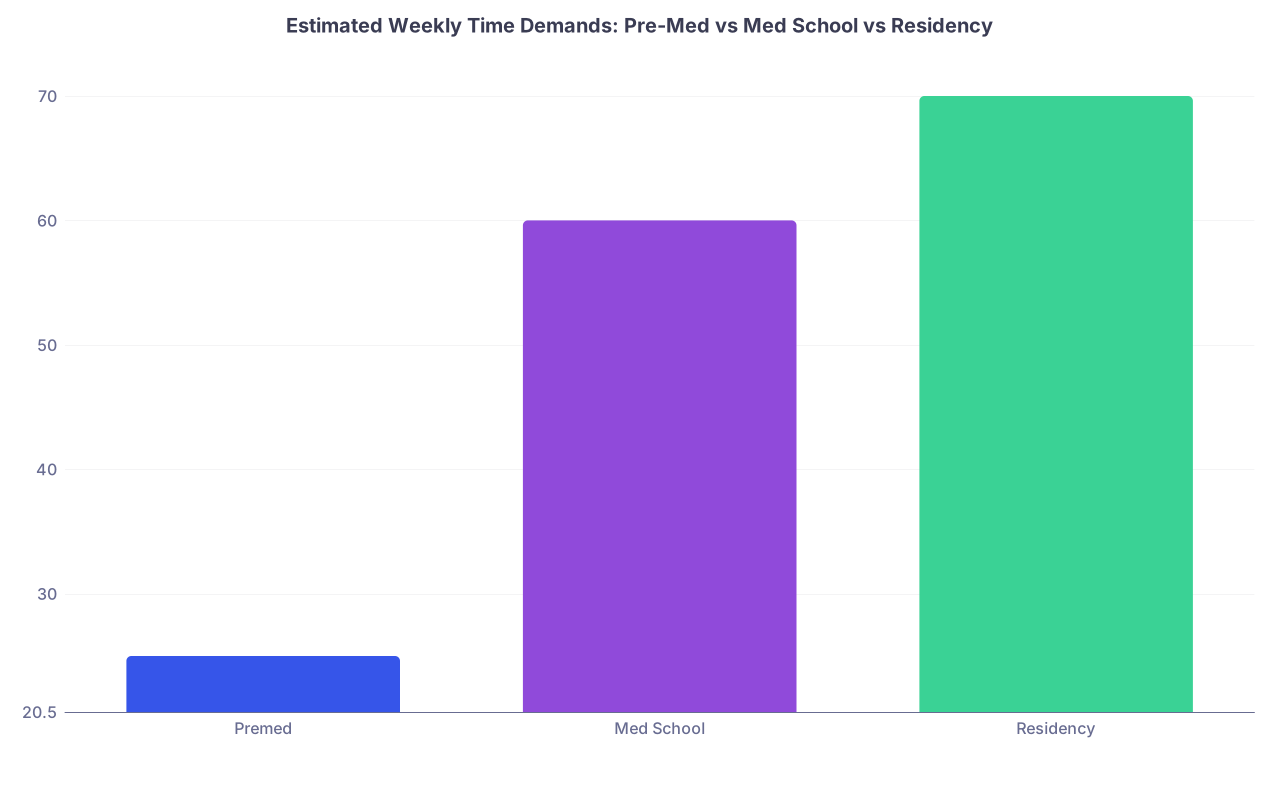
| Category | Value |
|---|---|
| Premed | 25 |
| Med School | 60 |
| Residency | 70 |
That’s a rough, realistic picture of how bad the time squeeze can get. Not counting commute. Not counting kids waking up sick at 3am. Not counting “I forgot it was picture day.”
So yeah, your brain goes straight to, “So… they just won’t see me for like 7–10 years?”
No. But it will feel that way if you let your schedule be purely reactive. You can’t shrink the total time demands that much. You can change where the time pain lands.
Here’s the mindset shift I’ve seen work:
Stop asking, “How do I maximize time with my kids?”
Start asking, “What are the non‑negotiable anchors my kids can count on, even in chaos?”
You probably can’t:
- Be there for every bedtime
- Make every game or performance
- Have leisurely, phone‑free weekends every week
You can absolutely:
- Protect one ritual like your life depends on it (Saturday breakfast, nightly 10‑minute 1:1 chat, Sunday park walk — whatever your family actually likes)
- Tell your kids specific, predictable windows when they get you undistracted
- Cancel other crap before you cancel them
And yes, sometimes that means your scores or CV are slightly less “perfect” and you feel like you’re self‑sabotaging your competitiveness. Welcome to parenthood in medicine. You will constantly feel like you’re screwing someone over. The trick is to choose who less often, on purpose, instead of by default.
The Conversation You’re Probably Avoiding With Your Kids
Most people try to “protect” their kids from the stress by not talking about it. They just quietly disappear into their laptop and hope the kids “understand” someday.
They won’t. Not if you leave them to fill in the gaps themselves.
Even young kids can handle more honesty than you think, if you keep it simple and age‑appropriate. What they can’t handle is confusion plus distance plus your unexplained irritability.
You need a version of this conversation, repeated many times over the years:
Name the dream clearly.
“I’ve always wanted to be a doctor. I didn’t go this route earlier, but the feeling never went away. I’m scared, but I really want to do this.”Name the impact on them without pretending it’ll be nothing.
“This means I’ll be studying a lot. There will be days I miss things. You’re allowed to be mad or sad about that.”Give them explicit permission for their feelings.
“You don’t have to pretend it’s okay just to make me feel better. If you hate it some days, you can tell me.”Make specific promises you can actually keep.
Not “I’ll come to every game.” More like, “I will always tell you ahead of time when I can’t make something,” or “If I mess up and miss something big, I will talk to you about it instead of acting like it’s no big deal.”Make it a two‑way street.
“If this starts feeling too hard for you, I want to know. We’ll figure out adjustments together.”
Kids resent parents who rewrite the family script unilaterally and then gaslight everyone into pretending it’s normal. They do a lot better when they feel like minor stakeholders in the decision, even if they’re not actually deciding.
The “Selfish Parent” Question You Keep Beating Yourself Up With
Let me say the quiet thing out loud:
You are doing something that benefits you. You do want this for you, not just “to help people” or “to provide for the family.”
That doesn’t automatically make it selfish in the bad way.
You know what is selfish? Slowly rotting in a job you hate, resenting everyone who depends on your paycheck, snapping at your kids because your life turned into something you never chose. That’s the hidden, quiet form of selfishness that looks like sacrifice on the surface.
Kids are not stupid. They can tell when a parent gave up their whole identity “for them” and then spends the next 20 years half‑alive and low‑key bitter.
I’ve watched kids grow up with parents who:
- Stayed in safe jobs they despised “for the family”
- Never pursued anything they loved
- Constantly telegraphed, “I could have been X, but I had you”
Guess what? Those kids also end up in therapy.
Your kids don’t need a martyr. They need a parent who’s a human being with a pulse. A parent who models:
- Taking smart risks
- Owning your desires
- Setting boundaries around your energy
- Admitting when you screw up and trying again
There’s a middle ground between “I’m the center of the universe, everyone deal with it” and “I have no needs, only children.” That middle ground is where this choice can actually be healthy — for them, not just for you.
What You Can Actually Control (And What You Can’t)
Let me be blunt: you cannot engineer a childhood your kids will never complain about.
They will have grievances. If it’s not “you were gone too much,” it’ll be “you hovered too much” or “you were anxious about everything” or “you never let me fail.” Humans have issues. That’s baked in.
What you can control:
How intentional you are before you commit.
Do you have a support plan, or are you just hoping it somehow works?How you respond when reality is worse than you expected.
Do you double down and isolate, or do you recalibrate, ask for help, maybe extend the timeline?How willing you are to let some achievements go to protect your kid’s experience of you.
Rank list choices. Research demands. Extra shadowing. You’ll have to drop something. Better you choose consciously than let burnout choose for you.Whether you talk to your kids like people or treat them like obstacles.
That one might matter more than your Step score in the long run.
And what you can’t control:
- Their future narratives about you
- How their friends’ families look by comparison
- Future versions of “I wish it had been different”
You can do everything “right” and still have a 19‑year‑old tell you they were lonely and angry. That doesn’t automatically mean you ruined them. It means they’re doing the work of individuating and making sense of their story. Your job is to give them a story that, even with pain in it, includes: “My parent tried. They cared. They showed up as best they could.”
A Brutally Honest Look at Family Life in Training
Let’s stop speaking in abstractions for a second. Picture this.

| Step | Description |
|---|---|
| Step 1 | Wake up 4:30am |
| Step 2 | Review notes / quick studying |
| Step 3 | Kids wake 6:30am |
| Step 4 | Breakfast & brief family time |
| Step 5 | Drop-off or handoff to partner |
| Step 6 | Hospital / Classes 7:30am-5:30pm |
| Step 7 | Commute home 30-45 min |
| Step 8 | Family time 6:30-8pm |
| Step 9 | Kids bedtime |
| Step 10 | Study 8:30-11pm |
| Step 11 | Sleep 11pm-4:30am |
This is not a theoretical schedule. It’s basically what a lot of med‑parent days look like.
Where do kids fit in here?
- That breakfast window
- That 90 minutes at night
- Weekends, sometimes, if you’re not on call or buried
Does that feel thin? Yeah. It is. But thin doesn’t have to mean empty.
Everything will be competing for those same small windows: your relationship, your sanity, your sleep, your studying, your kids. There will be no “perfect balance.” Only triage.
Your kids do not need four hours of high‑quality playtime every day to feel loved. They need to reliably feel:
- When you’re with them, you’re with them
- They can count on some part of you that isn’t constantly “too tired” or “too busy”
- Their needs aren’t always last on the list
That’s doable, even in this hell‑schedule. Hard, but doable.
Concrete Safeguards So Your Kids Don’t Become Background Noise
If I were sitting across from you at a coffee shop and you told me, “I’m about to commit 7–10 years to this, and I have kids,” here’s what I’d push you to put in place before you start.
| Area | Minimum Safeguard |
|---|---|
| Support System | At least 1 other reliable adult for childcare |
| Money | [3–6 months living expenses cushion if possible](https://residencyadvisor.com/resources/nontraditional-path-medicine/practical-budget-blueprint-for-a-35-to-45yearold-premed-applicant) |
| Time Anchor | [1 protected weekly family ritual](https://residencyadvisor.com/resources/nontraditional-path-medicine/advanced-timeblocking-techniques-for-working-professional-premeds) |
| Communication | Clear, repeated explanation to kids & partner |
None of this makes it easy. It just makes it survivable without turning your kids into collateral damage.
And if you’re already deep in — post‑bacc, M1, wherever — it’s not too late to retrofit some of this. You can still:
- Add a weekly family anchor
- Stop over‑promising, start under‑promising and over‑delivering
- Apologize, out loud, when training eats something important
- Share small wins with your kids so they feel like they’re part of the journey, not victims of it
FAQ: The Stuff Still Keeping You Up at 2am
1. What if my kids actually do resent me later — is that proof I made the wrong choice?
No. Resentment is a feeling, not a verdict on your entire life. Your kids will resent something you did or didn’t do. That’s human. The measure isn’t “Did they ever resent me?” It’s “Was I willing to listen, repair, and own my choices when they told me how it felt?” You can be a good parent and still have a teenager bitter about your schedule. Those ideas aren’t mutually exclusive.
2. Is it better to wait until my kids are older before starting this path?
“Older” sounds safer, but not always. If you wait until they’re teens, they’ll remember every detail of the hardest years. If you start when they’re younger, they’ll grow up with this as baseline reality. Both have pros and cons. The real question is: when do you have the most support, financial stability, and emotional capacity to handle being pulled in two directions? There is no magical “right” age that guarantees they won’t struggle with it.
3. Can I do this part‑time or “slower” so my kids don’t suffer as much?
You can sometimes slow the front half (post‑bacc, SMP, MCAT timeline) and spread that over more years. Once you hit med school and residency, the structure is much less flexible. You might be able to take a leave, repeat a year, or choose a less time‑intense specialty, but “part‑time med school” is not a real thing in most places. That means any flexibility you can build in before you matriculate is worth considering if your family situation is fragile.
4. What if my partner says they’re on board now, then burns out and resents me too?
That’s a legitimate risk, not paranoia. This path is brutal on relationships. You need more than “I support you” in theory. You need an explicit, maybe uncomfortable, conversation about: childcare coverage, money, chores, emotional load, sex, time together, and what happens if one of you starts to feel trapped or used. Put it all on the table now, when everyone’s still idealistic. Resentment grows in the gap between unspoken expectations and reality. Shrink that gap as much as you can.
Here’s where I’m going to land this, because you don’t need another 10 paragraphs of platitudes.
You’re not a villain for wanting medicine later in life.
Your kids are not doomed to hate you for it.
The outcome depends less on the hours you’re gone, and more on how honestly, consistently, and humbly you show up in the hours you do have.
If the pull toward this path is real and won’t go away, your choice isn’t between “pursue medicine” and “keep your kids safe.” It’s between:
- Building a life where your dream and your kids coexist — messily, imperfectly, but intentionally
- Or slowly erasing yourself to be “safe,” and letting that erasure leak out on them anyway
Neither path is painless. But only one lets your kids grow up watching a parent who is fully alive.