
The panic you feel about failing the MCAT after years away from standardized tests is not irrational. It’s exactly what happens when a high‑stakes exam collides with real adult life.
You’re not crazy for thinking, “What if I’ve permanently lost my test-taking brain?” or, “What if my age shows up in my score report?” I’ve watched people spiral over this exact thing—teachers, engineers, parents, former humanities majors—staring at a Kaplan book like it’s written in another alphabet.
Let’s pull this apart before the anxiety convinces you to quit before you even start.
The MCAT will feel worse after a long break. That doesn’t mean you can’t beat it.
There’s this lie people tell nontrads: “Oh, you’re older and more mature, you’ll be fine.” That’s incomplete at best and kind of insulting at worst.
Here’s the more honest version:
You’re at a disadvantage in speed and rust, and at a huge advantage in discipline, perspective, and emotional endurance. The MCAT punishes rust, but it rewards grind.
Most nontrads I’ve seen fall into one of these mental loops:
- “I haven’t taken a real exam in 5–10 years. My brain is too slow now.”
- “I was never a great standardized test taker even in college. It’ll be worse now.”
- “If I bomb this after rearranging my life around medicine, what does that say about me?”
The last one is the killer. Because now the MCAT isn’t just an exam; it’s a referendum on your entire life pivot.
Let me be blunt: the MCAT is not an IQ test and it’s not a moral judgment. It’s a brutal, weird, learnable skill test. Being away from standardized tests means you just haven’t practiced that skill in a while. That’s it.
Rusty is not the same as incapable.
What actually makes the MCAT terrifying after a long break
It’s not just the content. The fear is more layered.
You’re older. You probably have:
- A job you can’t just drop.
- Bills. Rent. Maybe kids.
- Less stamina for 8‑hour hyper-focus days.
- Zero recent experience bubbling in Scantron-style answers for 7.5 hours.
So this ugly “what if” shows up: What if I invest 6–12 months, thousands of dollars, burn vacation days, disappear from my social life… and I still fail?
That’s the voice that whispers every time your practice score drops or you miss a question you “should have known.”
Here’s the part people don’t say out loud:
Most nontrads aren’t just scared of a low score. They’re scared that a low score confirms the fear that they “don’t belong” in medicine. That maybe they missed the window. That maybe the undergrad version of them was as smart as they were ever going to be.
I don’t buy that. At all.
I’ve seen:
- A 34-year-old nurse who hadn’t touched physics in 12 years go from a 496 diagnostic to a 511 over 6 months.
- A former English major who took prereqs at a community college at 29, thought she was “bad at science,” end up with a 515 on her second attempt.
- A dad in his 30s working full-time IT, failing his first MCAT (499), recalibrating, then hitting 510 on a structured retake.
Were they special geniuses? No. They just treated the MCAT like a training program, not a personality test.
What a long break from standardized tests actually does to you
Let’s separate fear from reality.
You’re probably right that:
- You read slower than you did at 19.
- Mental stamina is lower at first.
- You’ve forgotten formulas and biological pathways.
- Timed passages feel like a car crash in slow motion.
But here’s what your anxiety usually gets wrong:
- That speed can’t be rebuilt. It can. Through timed drills and lots of them.
- That forgetting content means you’re bad at science. It doesn’t. It means you’re human.
- That being older means you can’t adapt. Actually, you’re probably better at systematic practice now than you were in undergrad.
Think of your brain like a runner who hasn’t trained in years. The first mile is disgusting. Your lungs burn, your legs feel heavy, you’re convinced you’re “just not a runner.”
Give that same person a structured 12‑week plan and they’re finishing 5Ks without dying.
The MCAT is the same. The first FL (full-length) will be brutal. Maybe humiliating. But it’s not your ceiling. It’s your baseline.
How nontrads actually get from panic to passing MCAT scores
Not with vibes. Not with grinding random Anki cards at 11pm until they fall asleep on their laptop. With a plan that respects the fact you’re rusty and not 20.
Here’s the framework I’ve seen work repeatedly for people who’ve been away from standardized tests for years.
1. Accept that your first diagnostic might look ugly
You’re scared to take a diagnostic because you don’t want to “confirm” your fear. But right now your fear is writing its own imaginary score report anyway.
Rip the band-aid off. Take a full-length under real conditions. Don’t game it. No pausing. No snacks every section. Treat it like test day.
Then, when you see the score—maybe it’s a 495, maybe a 500—your brain will say: “See? I told you.”
But here’s the reframe: now you have an actual starting point. You’re not guessing anymore.
2. Build in reps, not just “studying”
Most people who’ve been away from exams make one core mistake: they over-index on content review and under-index on practice.
You can memorize every amino acid and still miss half the passage questions because the MCAT is about how you think, not just what you know.
Your week should not be “I’m going to cover these 4 chapters.” It should be something like:
| Day | Timed Practice (Passages/Qs) | Content Review | Review & Error Analysis |
|---|---|---|---|
| Mon | 60 questions | 2–3 hours | 1–2 hours |
| Wed | 60 questions | 2–3 hours | 1–2 hours |
| Fri | 60 questions | 2–3 hours | 1–2 hours |
| Sat | 1/2 Full-Length (or 2 sections) | Light review | 2–3 hours |
You’re training standardized test muscles: timing, endurance, pattern recognition. That only comes from doing MCAT-style questions again and again.
Stamina is your hidden boss battle (not the content)
Everyone panics about orgo and physics. The secret assassin is stamina.
A 7.5-hour exam after years away from any formal testing is like doing a marathon after you’ve only walked from your couch to your car for five years. Of course your brain taps out.
You don’t fix that by “hoping” you’ll have enough energy on test day. You fix it by progressively overloading your brain.
Think of it like:
- Month 1: Timed sets of 30–40 questions. You’ll feel fried after.
- Month 2: Regular 60–90 minute blocks. Start stacking 2 in a day.
- Month 3–4: Full-lengths every 1–2 weeks, then weekly closer to test day.
Yes, it’s exhausting. You’ll doubt yourself after almost every full-length at first. You’ll finish with a headache and a vague sense of failure.
But you need those miserable practice days. So test day is just “another one of these,” not some mythical dragon.
“What if I do everything right and still fail?”
Here’s the ugliest fear: that you’ll genuinely try, sacrifice, show up consistently… and still walk out with a 4-something score that might as well be a neon sign saying “Not doctor material.”
So let’s define “fail” honestly.
“Failing the MCAT” isn’t always about literally not sitting through the exam. It’s:
- Scoring significantly below your target (say you needed a 510+ and get a 501).
- Performing way below your practice average on test day.
- Getting a score that closes off the kinds of schools or paths you wanted.
Here’s where your anxiety distorts reality: it treats one MCAT attempt as the only shot.
It’s not.
Does retaking suck? Yes. Is it common? Extremely. Do med schools automatically blacklist you? No. They look for: upward trend, clear improvement, context.
Nontrads retake all the time and still get in. I’ve seen people go:
- 498 → 507
- 502 → 513
- 499 → 510
You don’t want that outcome. But your brain is acting like “one and done or my dream dies.” That’s just not how this process works.
How your age and nontrad status secretly help you
You know what traditional 20-year-olds often don’t have?
Pain tolerance.
They’ve never worked 40+ hours with no one checking on them. They’ve never balanced kids and aging parents and bills and sleep. They’ve never had to study after a 10-hour shift.
You have.
You know how to show up when you don’t feel like it, not because you’re “motivated,” but because life has forced you to.
That is gold for MCAT prep.
Where a younger student might implode after one bad FL and ghost their books for a week, you are more likely to:
- Get mad.
- Adjust the plan.
- Keep going, because quitting has real-life stakes.
That ability to continue through discouragement is literally what gets nontrads from “I don’t remember what a mitochondrion does” to “I just scored a 510.”
How to keep your brain from eating itself alive while you prep
The fear of failing doesn’t just show up on test day. It shows up every single study session as this background hum of, “What if this doesn’t work?”
You won’t magically stop being anxious. But you can stop letting the anxiety be in charge.
A few things that actually help (not the fluffy “self-care” nonsense, the stuff I’ve seen nontrads use to stay functional):
Bounded catastrophizing
Give yourself a literal 5–10 minutes to imagine the worst-case scenario in grotesque detail. You fail. You bomb. You cry in your car. Then force yourself to answer: “Okay. Then what?”
Usually, the then-what is: regroup, adjust timeline, retake, maybe expand school list. Your life doesn’t end. Your identity doesn’t explode.Data over vibes
Stop measuring your worth by how you feel about your studying that day. Track numbers:- FL scores over time
- Section scores
- Question blocks accuracy
Feelings will tell you, “You’re doomed.” The data might quietly say, “You’ve gone from 497 to 504 in 6 weeks.”
Micro-wins
When you’ve been away from tests for years, your brain’s default is “I suck at this.” You need evidence that’s not totally true.- “I got 70% on this CARS set; last month it was 50%.”
- “I sat for a full-length with less mental collapse than the last one.”
- “I can now do a whole physics passage without rage-quitting.”
Non-heroic consistency
You don’t need 8 perfect hours a day. You need 2–4 hours most days for months. Imperfect, tired, distracted, but done. That’s the part nobody glamorizes.
The truth about “failing” the MCAT as a nontrad
Here’s the part your anxiety keeps twisting: failing the MCAT is not a binary pass/fail moral verdict.
What it actually is:
- A signal about your current prep quality and test-taking skill.
- A data point you can respond to with changes.
- Sometimes, a delay. Rarely, a dead end.
If you walk into this exam after a long break with no practice, no full-lengths, and just vibes and lectures… yeah, your odds of “failing” are high.
If you walk in after months of:
- Timed practice
- Realistic full-lengths
- Honest review
- Adjusted study plan when scores plateau
…then even if you don’t hit your dream score on the first try, you’ll be miles beyond that terrified, rusty version of you from day one.
And that version absolutely can get to a competitive score, even if it takes more time than you wish.
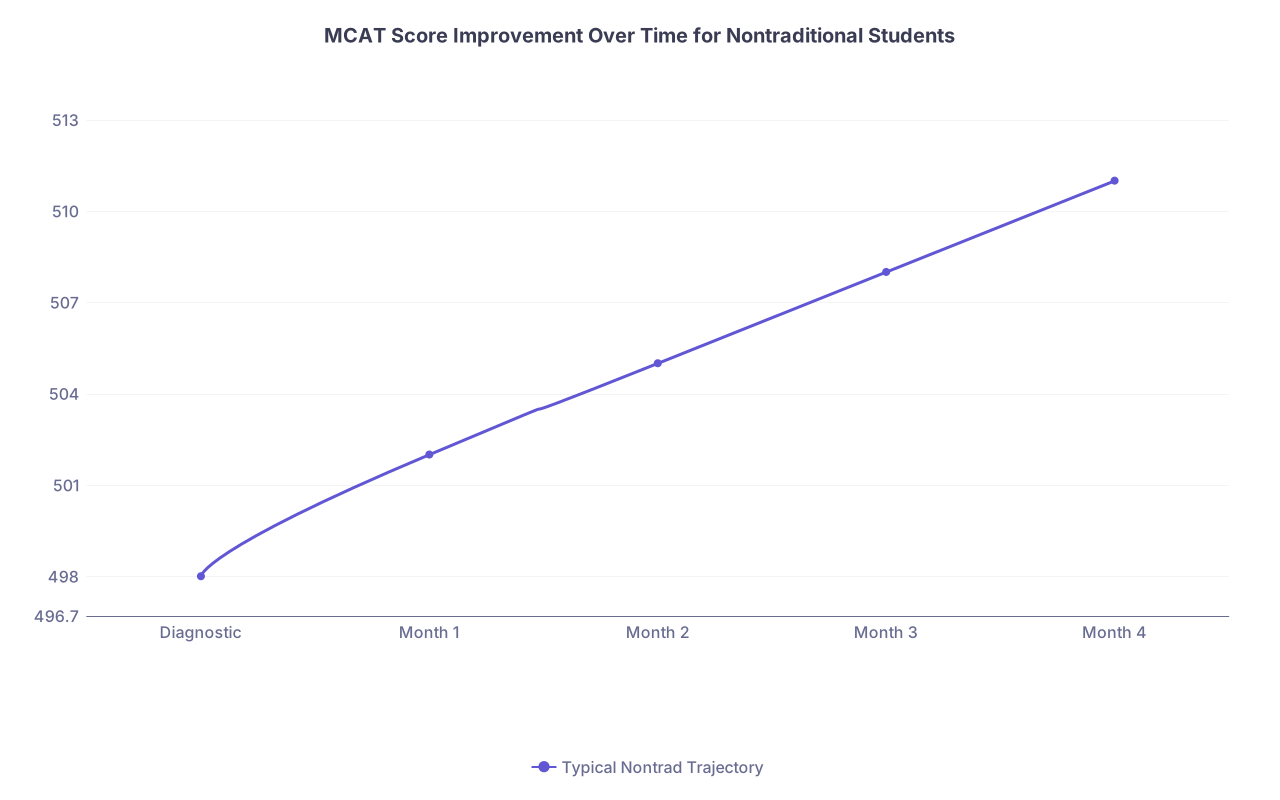
| Category | Typical Nontrad Trajectory |
|---|---|
| Diagnostic | 498 |
| Month 1 | 502 |
| Month 2 | 505 |
| Month 3 | 508 |
| Month 4 | 511 |

| Step | Description |
|---|---|
| Step 1 | Long break from exams |
| Step 2 | Diagnostic test |
| Step 3 | Strengthen content + light timed sets |
| Step 4 | Balanced content + heavy timed practice |
| Step 5 | First full-length |
| Step 6 | Review errors & adjust plan |
| Step 7 | Continue plan + build stamina |
| Step 8 | Change resources or timeline |
| Step 9 | Test day |
| Step 10 | Score vs Target |
| Step 11 | Improving? |
FAQ (You’re not the only one panicking about this)
1. What if my diagnostic score is so low I feel stupid for even trying?
Then you’re in the most common nontrad starting position. Seriously. I’ve seen diagnostics in the high 480s and low 490s from smart, competent adults who went on to score 505–510+. A diagnostic just tells you how rusty you are, not how smart you are. Take the hit, feel awful for a day, then use that score as the baseline you’re going to stand on while you climb.
2. How long should I plan to study if I’ve been away from school for years?
For most nontrads working full-time or close to it, 4–6 months of structured prep is realistic. That doesn’t mean 6 months of random YouTube bingeing. It means months of consistent timed practice, regular full-lengths, and real review. Faster is possible if you have recent prereqs and more free time, but if you’ve truly been out of the game, giving yourself too little time is a much bigger risk than giving yourself an extra month or two.
3. How do I know if I’m ready to actually sit for the real MCAT?
Ignore the fantasy that you’ll feel “100% confident.” That’s not happening. Use data: your last 3–4 full-lengths (ideally from AAMC + one reputable company) should be in the rough neighborhood of your target score, or at least within a couple points of what would be acceptable for your school list. If your practice scores are still all over the place or dropping, you’re probably not ready and should consider pushing the date if you can.
4. What if I take it and really do badly—should I give up on medicine?
One bad score is not a verdict. It’s feedback. If you walk out with a score way below your target, it sucks. You get to be upset. Then you ask: was it content, timing, stamina, anxiety, or life chaos that tanked it? Fixing why you scored low matters more than the number itself. Many nontrads have a rough first MCAT, take a breath, re-strategize, and come back noticeably stronger. You only truly “fail” this exam if you let one result stop you from adjusting and trying again.
Key points, stripped of sugar-coating:
- Being away from standardized tests makes the MCAT harder, but “rusty” is fixable; “incapable” is a lie your fear tells you.
- You beat this thing with structured practice, brutal honesty about your weaknesses, and non-heroic consistency—not magical test-taking talent.
- One bad score is a data point, not a life sentence. Your decision to keep going (or not) matters more than what appears on that first score report.