
You get home at 7:15 p.m. after a full workday. There’s a half‑eaten protein bar in your bag, 27 unread emails, and you promised yourself you’d “study organic” tonight. You open your laptop, scroll for “just a minute,” then look up and it’s 9:40 p.m. You’ve watched two YouTube videos about other people studying and done almost none yourself.
You are not lazy. You are running two lives in parallel: full‑time professional and premed. The usual “just block off two hours in the evening” productivity advice collapses the second your boss drops a late meeting on your calendar or your kid spikes a fever.
Time‑blocking can still work for you. But not the cutesy Instagram version with pastel blocks and “self‑care” written at 3 p.m. on a Tuesday. You need a more aggressive, more flexible, and frankly more honest system.
Let me break this down specifically.
1. The Core Reality: You Have Less Time Than You Think
Stop pretending you have 24 usable hours. You do not. You have a constrained, noisy, interruption‑prone subset of the day. The first step is to quantify that precisely.
The Brutal Inventory
For one typical week, track everything in 30‑minute increments. Work, commute, Netflix, scrolling, cooking, spiraling about your future. Do not “estimate.” Write it down.
At the end of that week, you should be able to construct something like this:
| Category | Hours/Week |
|---|---|
| Full-time job | 45 |
| Commute | 7 |
| Sleep | 49 |
| Basic life admin (food, chores, bills) | 14 |
| Family/relationships | 10 |
| Exercise/health | 4 |
| Unstructured screen time | 12 |
Right away, you see the problem. If this is your life, you are already at 141 hours used out of 168. That leaves 27 hours “free.” But those 27 are scattered, low‑energy, or emotionally loaded.
This is where basic time‑blocking dies. It assumes all “free” hours are equivalent. They are not.
You will build your system around usable hours, not theoretical ones.
2. Energy‑Matched Time‑Blocking: Stop Forcing MCAT After 11 p.m.
Working professionals get this wrong constantly: they block their cognitively heaviest work (MCAT, hard prereqs, dense reading) into their cognitively worst hours (late evenings after work).
You already know this pattern:
- 8–10 p.m. MCAT CARS “plan”
- 8–9 p.m. scrolling, 9–10 p.m. guilt
Instead, your time‑blocking has to be energy‑matched: tasks go into slots based on what your brain can actually do there, not what looks nice on a schedule.
Map Your Energy Curve
Over 5–7 days, notice when you:
- Feel mentally sharp and focused
- Feel okay but not great
- Feel useless for anything complex
Most full‑time professionals land in one of three patterns:
- Morning‑sharp: 6–10 a.m. best
- Mid‑day‑sharp: 10 a.m.–2 p.m. best (harder to use if you are at work)
- Night‑sharp: rare, but exists
Now here is the rule that matters:
Deep work blocks (MCAT, prereq studying, writing personal statement) must live in your highest‑energy 60–120 minutes of the day. Non‑negotiable.
Everything else—emails, forms, light review—gets the leftover time.
3. Advanced Time‑Block Types: Not All Blocks Are Equal
Most people use one type of time‑block: “Study.” That is useless. You need more granularity if you want this to stick when life hits you.
I use five kinds of blocks with working‑professional premeds:
Deep Work Blocks (DW)
High‑focus, no‑distraction time for:- MCAT passages and review
- Problem sets in orgo, physics, biochem
- Personal statement and meaningful writing
Duration: 60–120 minutes
Requirements: quiet, devices controlled, clear micro‑goal.
Admin Blocks (A)
Low‑cognitive, but necessary:- Scheduling shadowing/volunteering
- Emailing professors or advisors
- Filling out forms, tracking hours, logging experiences Duration: 20–45 minutes.
Review/Light Study Blocks (R)
Medium‑light effort:- Flashcards (Anki, Quizlet)
- Re‑watching key lectures on 1.5x while commuting
- Re‑reading notes Duration: 20–40 minutes.
Squeeze Blocks (S)
Ultra‑short blocks during dead time:- 10–15 minutes between meetings
- Waiting in line, on trains, during lunch Used for: flashcards, 5 CARS questions, quick content recall drills.
Recovery/Non‑Negotiable Life Blocks (L)
Sleep, meals, key family time, exercise.
These are not “optional” or “reward.” They are structural.
Your weekly calendar should visibly distinguish these. Color coding is not cute here; it is functional. If your week is all one color, you are lying to yourself.
4. Designing a Realistic Weekly Template (With Contingencies)
Let us build something concrete. Assume this scenario:
- Full‑time job: 9–5:30, in‑person
- Commute: 45 minutes each way by train
- Goal: MCAT in 6 months, plus 4–6 hours clinical/volunteering per week
You are morning‑sharp. Here is a realistic baseline week.
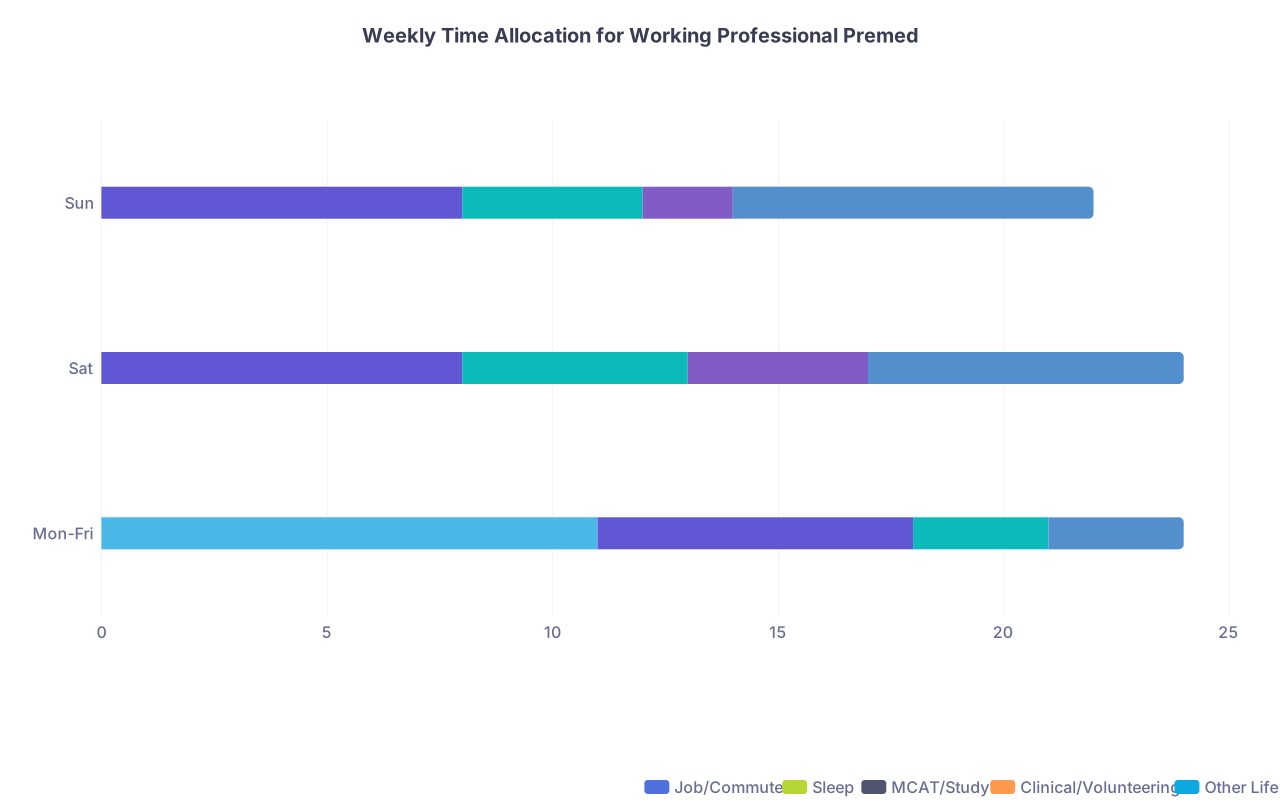
| Category | Job/Commute | Sleep | MCAT/Study | Clinical/Volunteering | Other Life |
|---|---|---|---|---|---|
| Mon-Fri | 11 | 7 | 3 | 0 | 3 |
| Sat | 0 | 8 | 5 | 4 | 7 |
| Sun | 0 | 8 | 4 | 2 | 8 |
Example Weekly Template (High‑Yield Version)
Monday–Thursday
5:45–7:15 a.m. – Deep Work Block (DW)
MCAT science passages + review, or hardest prereq material.Commute (7:45–8:30 a.m. & 5:45–6:30 p.m.) – Squeeze + Review (S/R)
- Morning: 20–30 min Anki or formula recall
- Evening: light review or nothing if drained
8:00–9:00 p.m. – Admin/Review (A/R) only 2 nights per week
- Monday: scheduling, emails, log hours
- Wednesday: light question review or content refresh
Friday
Minimal structured study. Treat Friday as:
- Optional R (light cards)
- Social / decompression time
You are not a robot. If you try to run DW blocks Friday night after a full week, you will quit in 3 weeks.
Saturday
- 8:00–10:00 a.m. – Deep Work (DW)
- 10:30 a.m.–2:30 p.m. – Clinical/Volunteering (L/Professional)
- 4:00–5:00 p.m. – Review (R) of morning work
Evening off or flexible.
Sunday
- 8:00–10:00 a.m. – Deep Work (DW)
- 11:00 a.m.–12:00 p.m. – Admin + Planning (A)
- 3:00–4:00 p.m. – Light Review (R) or MCAT section drills
- Evening fully off
That schedule yields:
- Deep Work: 10–12 hours/week
- Review/Light: 4–6 hours/week
- Admin: 1–2 hours/week
- Clinical: 4–6 hours/week
This is the zone where non‑traditional applicants actually progress without burning out.
5. Advanced Technique: “Shadow Blocks” and Fallback Plans
Time‑blocking for a working professional fails when you treat your calendar like stone tablets. You need it to be closer to wet clay.
Enter “shadow blocks.”
A shadow block is a pre‑planned backup time for your most important task, sitting elsewhere in the week. For every critical Deep Work block, you have one shadow block. If Monday morning implodes (kid sick, emergency release at work), you do not “figure it out later.” You move Monday’s block into its shadow.
Example:
- Primary DW block: Monday 6–7:30 a.m. (MCAT chem/phys)
- Shadow DW block: Tuesday 8–9:30 p.m.
If Monday goes fine, Tuesday night becomes rest/light review. If Monday is chaos, you already know where that work lands. No decision fatigue, no spiral.
You should maintain:
- 3–5 Deep Work blocks / week
- 3–5 Shadow DW blocks / week
They are not bonus time. They are contingency slots. Use them intentionally.
6. Micro‑Scopes: Defining What Happens Inside Each Block
“Study MCAT” is not a task. It is a category. Your brain will resist it every time because it is vague and open‑ended.
Before the week starts, write a micro‑scope (tiny scope of work) for each Deep Work block. Example:
DW1 (Mon 6–7:30 a.m.)
- 3 discrete chemistry passages (Kaplan Qbank)
- Immediate review of wrongs and 2 flagged questions from last week
- Summarize 3 key takeaways in notebook
DW2 (Wed 6–7:30 a.m.)
- Watch 1 orgo lecture (1.5x) + active notes
- Do 10 linked practice questions
- Update Anki deck with 8–12 new cards from errors
If your block starts and you do not know the first concrete action, you will burn 15 minutes “getting organized.” That kills the value of short windows.
I usually have students write their micro‑scopes during a Sunday Admin block and keep them in the calendar description for each block.
7. Turning Commute and Fragmented Time into Squeeze Blocks
Your commute is either a drain or an asset. Middle ground does not exist.
For train/bus commuters:
- Morning: active recall or content review
- MCAT discrete questions
- Flashcards
- Mental walkthrough of yesterday’s material
- Evening: lighter, less structured
- Re‑watching explanation videos
- Listening to audio summaries
- Planning the next day
For drivers:
- Do not be stupid. No flashcards while driving.
Use:- High‑yield audio content
- Verbal recall: explain a concept out loud, pretend you are tutoring
- List 5 equations or definitions from memory at red lights, then check later (from memory only while fully stopped)
Squeeze blocks add up. If you capture five 10–15 minute windows per weekday, you can easily add 4–5 focused hours per week without touching “prime” time.
8. Structuring Time‑Blocks Around Application & Coursework Cycles
Your time‑blocking will shift by phase. Working through prereqs at a community college is different from the final 8 weeks before MCAT, which is different from primary application season.
Typical Non‑Traditional Timeline Snapshot
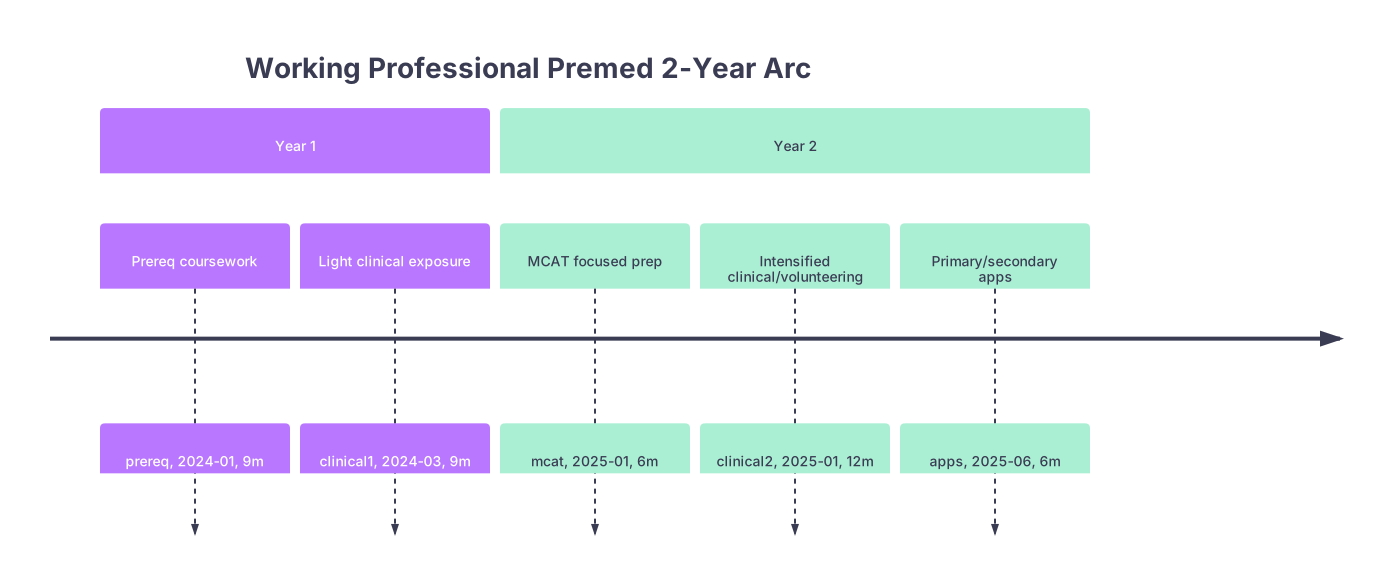
| Period | Event |
|---|---|
| Year 1 - Prereq coursework | prereq, 2024-01, 9m |
| Year 1 - Light clinical exposure | clinical1, 2024-03, 9m |
| Year 2 - MCAT focused prep | mcat, 2025-01, 6m |
| Year 2 - Intensified clinical/volunteering | clinical2, 2025-01, 12m |
| Year 2 - Primary/secondary apps | apps, 2025-06, 6m |
Your weekly template should not be fixed for two years. It should adapt.
During Heavy Prereq Semesters
Priority stack:
- Survive and excel in classes (grades matter more than MCAT this early)
- Maintain minimal viable MCAT exposure if test is >9–12 months away
- Light but continuous clinical/volunteer activity
Blocks:
- 3–4 DW blocks / week: problem sets, exam prep
- 1–2 R blocks / week: MCAT style discrete questions / content
- 1 A block / week: scheduling, office hours emails, logging hours
3–4 Months Pre‑MCAT
Priority stack:
- Full MCAT focus
- Maintain coursework at “safe” level if still in classes
- Clinical can taper slightly but not vanish
Blocks:
- 4–5 DW blocks / week: full-length sections, passage sets, review
- 3–4 R blocks / week: flashcards, error analysis
- Weekly A block: schedule exams, school logistics, application planning
If you are working full‑time and prepping for MCAT without significant PTO, you need 12–15 high‑quality hours per week dedicated to MCAT for 4–6 months. That is what your blocks are aiming to protect.
Application Season (Primaries + Secondaries)
Secondaries do not care about your neat color‑coding. They arrive in unpredictable waves and want essays yesterday.
Here is how you keep this sane:
- Pre‑assign 3–4 DW “writing” blocks per week for 6–8 weeks starting 1–2 weeks after primary submission.
- Maintain 1–2 R blocks / week for light MCAT or content review if an exam is upcoming.
- Convert 1 DW block to “wildcard essay” block during heavy secondary weeks.
You do not stop time‑blocking during applications. You just temporarily re‑label your Deep Work.
9. Guardrails: Protecting Your Blocks from Work and Life
If you are a working professional, the enemy of your time‑blocks is not TikTok. It is:
- “Can you stay late for this urgent thing?”
- “We moved that 3 p.m. meeting to 6 p.m.”
- “We need this deck by tomorrow morning.”
You need explicit guardrails.
Hard vs Soft Blocks
- Hard blocks: immovable unless emergency. Think: MCAT full‑length test, organic exam prep day, primary app completion.
- Soft blocks: nice‑to‑have but movable. Think: generic review, extra questions, routine emails.
For each week:
- Declare 2–3 Hard DW blocks.
Example: Saturday 8–11 a.m., Sunday 8–10 a.m., one weekday morning. - Everything else is Soft by design.
Communicate as needed:
- To partner/family: “Saturday 8–11 I am unavailable unless someone is bleeding or the house is on fire.”
- To yourself: no “I’ll just sleep in and do it later.” Hard block means you show up even if you feel like garbage, and do at least 75% of the planned work.
Pre‑Deciding Trade‑offs
You will have to sacrifice things. If you do not pre‑decide, you will always sacrifice the hard stuff and keep the easy dopamine.
Decide now:
- What gets cut first in a bad week? (Hint: not sleep.)
- Social? Extra screen time? Non‑essential overtime at work?
You cannot be a hero in all domains simultaneously. The people who actually make it to med school as non‑trads are the ones who intentionally choose where they will be mediocre for a season.
10. Tools and Implementation Details that Actually Matter
You do not need a $40 planner. You do need consistency between your tools.
Digital vs Paper
Pick one as primary:
- Digital calendar (Google, Outlook): best if your work life runs in Outlook and you want everything integrated.
- Paper planner: best if you are tactile and less disciplined with screens.
Hybrid that works well:
- Digital for global weekly template and events.
- Paper for daily execution: list of today’s blocks, micro‑scopes, and quick debrief.
Daily Execution Ritual: 5 Minutes, Twice a Day
Morning (or start of your first block):
- Look at today’s blocks.
- Confirm or adjust based on reality.
- Pick the first concrete action for each DW block.
Evening:
- Quick debrief:
- What blocks did I actually complete?
- What got bumped? Move to shadow blocks.
- 1–2 sentence reflection: “Why did X fail?” (No shaming. Just data.)
This feedback loop is where your calendar stops being fantasy and starts being an engineering document.
11. Data‑Driven Adjustment: Tracking Reality vs Plan
You are a premed. You understand data. Use it.
For 3–4 weeks, track:
- Planned vs actual Deep Work hours
- Planned vs actual Review hours
- Subjective fatigue (1–5) at the start of each block
Then look at the patterns. You might see something like this:
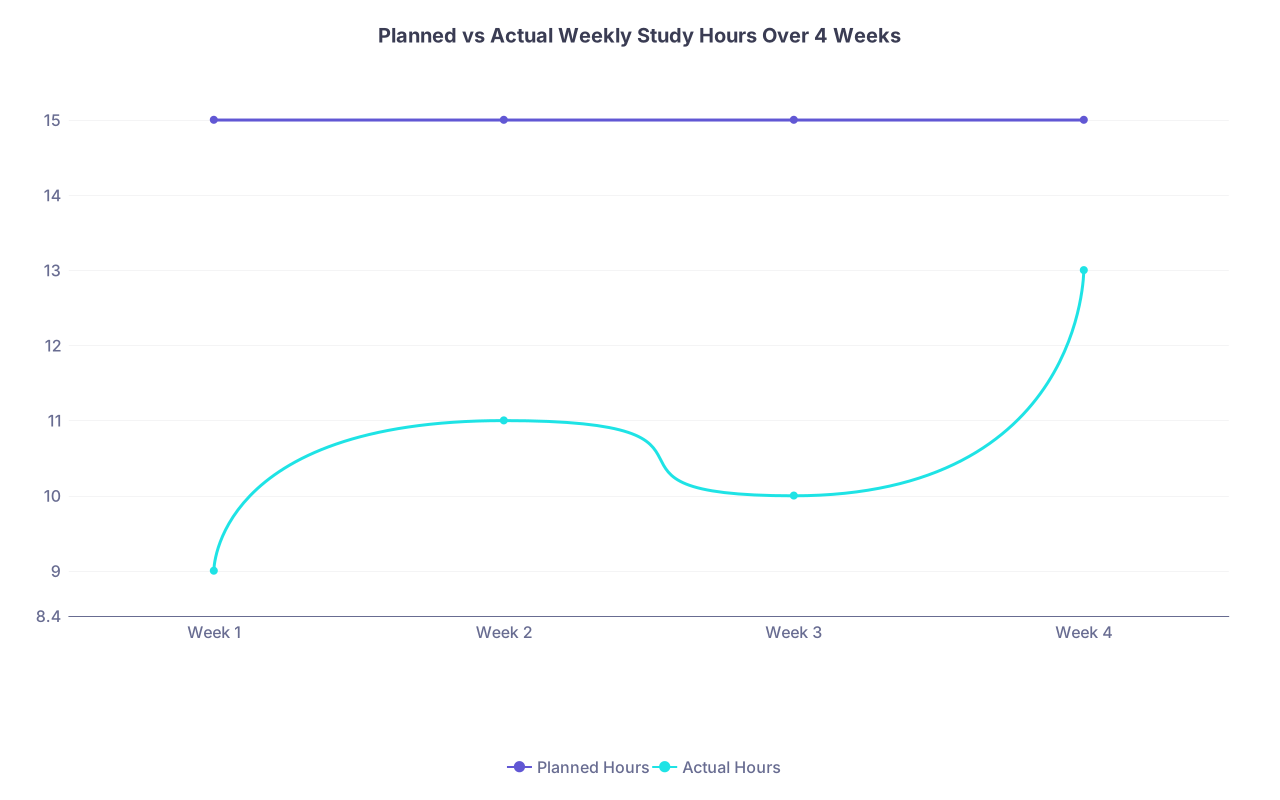
| Category | Planned Hours | Actual Hours |
|---|---|---|
| Week 1 | 15 | 9 |
| Week 2 | 15 | 11 |
| Week 3 | 15 | 10 |
| Week 4 | 15 | 13 |
If you are consistently at 60–70% of your plan, your plan is fantasy. Scale down the planned hours and make them real before scaling back up.
Target:
- 80–90% completion of scheduled DW blocks.
- If you are above 95%, you may be under‑challenging yourself.
- If you are below 70%, you are pretending you are a full‑time student when you are not.
12. Preventing Burnout While Still Being Aggressive
Here is the trap: non‑trads often overcorrect. They spend 6 months in “monk mode” and then collapse for 2 months. That is a net loss.
Sustainable time‑blocking requires:
- 1 completely unscheduled evening per week (usually Friday)
- 1 “low‑structure” day per month where you let the schedule loosen but do not annihilate your habits
- Honest sleep protection: 6 is not “close enough” to 7–8 if you are also working + studying hard
Think of this as periodization. Athletes cycle intensity; you should too.
During lower‑stakes windows (e.g., summer before prereqs, post‑MCAT, pre‑apps), intentionally:
- Drop 1–2 DW blocks per week.
- Increase social/family time.
- Keep a small “maintenance” R block for momentum.
Burnout does not usually come from working hard. It comes from working hard indefinitely with no defined off‑ramp.
13. Case Study: 32‑Year‑Old Engineer Pivoting to Medicine
Let me make this less abstract.
Profile:
- 32 years old, software engineer
- 45–50 hour workweeks, on‑call one week out of four
- Evening classes in gen chem and bio at community college
- MCAT planned in 9 months
- Married, no kids yet
Phase: heavy prereqs + early MCAT exposure.
Baseline week we built:
- M/W: class 6–9 p.m. → no DW those evenings
- T/Th: morning DW 6–7:30 a.m. (prereq homework, MCAT discretely integrated)
- Sat: 8–11 a.m. DW (MCAT focus), 1–3 p.m. R block
- Sun: 9–11 a.m. DW (mix prereq + MCAT), 11–12 A block
Shadow blocks:
- T/Th 8–9:30 p.m. labeled as DW shadow, used only if morning collapses.
- Sunday 4–5 p.m. as emergency catch‑up.
Outcome (over 8 weeks):
- Consistent 9–11 hours DW, 3–4 R per week
- A’s in both classes
- MCAT baseline moved from 498 → 506 on early diagnostics, without formal dedicated time yet
The key was not genius. It was:
- Aggressive morning DW blocks matched to his energy
- Honest admission that Fridays were dead
- Shadow blocks to absorb work disruptions and on‑call chaos
This is what advanced time‑blocking is for. Not perfection. Predictable progress despite mess.
14. When to Break Your Own System
There are weeks when your schedule should lose.
Examples:
- Death or serious illness in the family
- Severe acute mental health crisis
- Extreme work events (layoffs, mergers) that directly threaten your livelihood
During those:
- Drop all but 1–2 minimal “anchor” habits: maybe 10 minutes of Anki daily and 1 short R block on the weekend.
- Explicitly call it a “maintenance week.”
- Do not try to “catch up” the following week. Resume the template; let the lost week be lost.
Long‑term, professional schools do not care if you had 1–2 rough weeks during your multi‑year journey. They care if your story is: “I burned out and stopped for 9 months.”
15. Final Calibration: Matching Ambition to Reality
Here is where I am going to be blunt.
If you are working 60+ hours a week, have young kids, and are trying to prep for MCAT + do two night classes + start applications, time‑blocking will not save you. That is not a calendar problem. That is a scope problem.
Sometimes the advanced technique you need is pulling back:
- Extend your timeline by 6–12 months
- Take fewer classes per term
- Plan MCAT for a lighter work season or after negotiating PTO / reduced hours
A tight, realistic 12‑hour/week study plan executed for 9 months will beat the 25‑hour/week fantasy plan you maintain for 3 weeks before collapsing.
Time‑blocking is not about cramming more in. It is about making your actual constraints explicit and then building something that works inside them.

Key Takeaways
- Treat your time like a scarce clinical resource: map your real week, then build energy‑matched Deep Work, Review, Admin, Squeeze, and Life blocks, not generic “study time.”
- Use advanced structures—shadow blocks, micro‑scopes, hard vs soft blocks, and data‑driven adjustment—to keep the system alive when work and life get messy.
- Be ruthless with scope. A smaller, honest, consistently executed time‑blocking plan will take you to medical school; an overstuffed fantasy calendar will not.