
The usual premed shadowing advice is built for 20‑year‑olds with no real-life experience. If you are a non‑traditional applicant, that advice will actually waste your biggest asset: your prior expertise.
You are not trying to prove you have seen a hospital. You are trying to prove you know how your background will make you a better physician. That is a completely different design problem.
Let me break this down specifically.
Step 1: Stop Thinking “Hours.” Start Thinking “Story.”
Most premeds chase a number: 50 hours, 100 hours, “enough” hours. Non‑trads need to chase something else: a coherent narrative.
Your shadowing should answer three questions, explicitly:
- What did you already bring into these clinical spaces that most students did not?
- How did you use that background to understand or improve something?
- How does that translate into specific value as a future physician?
Your prior expertise might be:
- Teaching (K‑12, higher ed, tutoring)
- Engineering or IT
- Business, consulting, management
- Military service or law enforcement
- Nursing, PT, OT, EMS, RT, etc.
- Social work, psychology, mental health
- Public health, policy, law
- Arts, design, communication
The mistake I see constantly: people with genuine depth in some other field do generic “follow a doctor around and smile politely” shadowing, then write generic “I learned about the importance of empathy and communication” essays. You just erased all differentiation you had.
Instead, you design shadowing that forces your prior expertise to show up.
Step 2: Map Your Expertise to Clinical Functions
You need to translate your old world into the clinical world. Admissions committees will not do that translation for you. You must make it obvious.
Ask: “What does my background actually make me good at in a clinical environment?”
Let’s take a few concrete examples.
Example 1: Former Teacher
Real strengths:
- Explaining complex ideas simply
- Managing group dynamics
- Reading nonverbal cues
- Scaffolding learning over time
Where this shows up clinically:
- Patient education (new diabetes diagnosis, inhaler technique)
- Chronic disease management visits
- Pediatrics, adolescent medicine, family medicine
- Group visits (diabetes education classes, prenatal education)
So your shadowing should not just be “any doctor.” It should be heavily skewed toward settings where you can watch and eventually assist in education.
Example 2: Software Engineer / Data Analyst
Real strengths:
- Systems thinking
- Workflow optimization
- Comfort with EHRs, dashboards, data
- Debugging processes
Where this shows up clinically:
- Quality improvement meetings
- EHR‑heavy outpatient practices
- Telemedicine clinics
- Population health teams
Your shadowing should include time not only in exam rooms, but also in operations meetings, huddles, or with a medical director or CMIO type.
Example 3: Business / Management / Operations
Real strengths:
- Process improvement
- Resource allocation
- Team leadership
- Handling conflict
Where this shows up clinically:
- Multi‑disciplinary team meetings
- Clinic flow / throughput
- Discharge planning
- Administrative roles of physicians
Your shadowing should let you see the practice of medicine, not just the “patient encounter” slice.
Step 3: Choose Clinical Settings That Amplify Your Background
The setting matters more than most premed advisors admit. A former ICU nurse and a former marketing director should not have the same primary shadowing environment.
Use your background as the starting point, then match to clinical context that makes sense.
| Prior Background | High-Yield Shadowing Settings |
|---|---|
| K-12 / College Teaching | Pediatrics, family med, patient education clinics |
| Engineering / IT | Outpatient clinics with heavy EHR use, telemedicine |
| Business / Consulting | High-volume clinics, private practices, hospital admin |
| Nursing / EMS | Different specialties from prior role, outpatient care |
| Social Work / MH | Integrated care clinics, psychiatry, addiction medicine |
| Military / Law Enf. | VA hospitals, trauma centers, community EDs |
Key principles:
Do not recreate your old job
If you were an ICU nurse, primary shadowing in ICU often reads as “I stayed where I was comfortable.” Better: shadow in outpatient internal medicine, cardiology clinic, or palliative care—somewhere your clinical literacy is a strength, but the role is clearly different.Maximize contrast + continuity
You want continuity (your skills clearly transfer) but also contrast (you are obviously not just doing your old job with a new name). Admissions committees like to see both.Think team, not just physician
Some of your best “highlight your expertise” moments will come from watching or interacting with nurses, MAs, social workers, pharmacists. Pick clinics where that team is visible and active.
Step 4: Design the Shadowing “Package,” Not One‑Off Days
Random, disconnected shadowing days make for weak stories. You want a deliberate package.
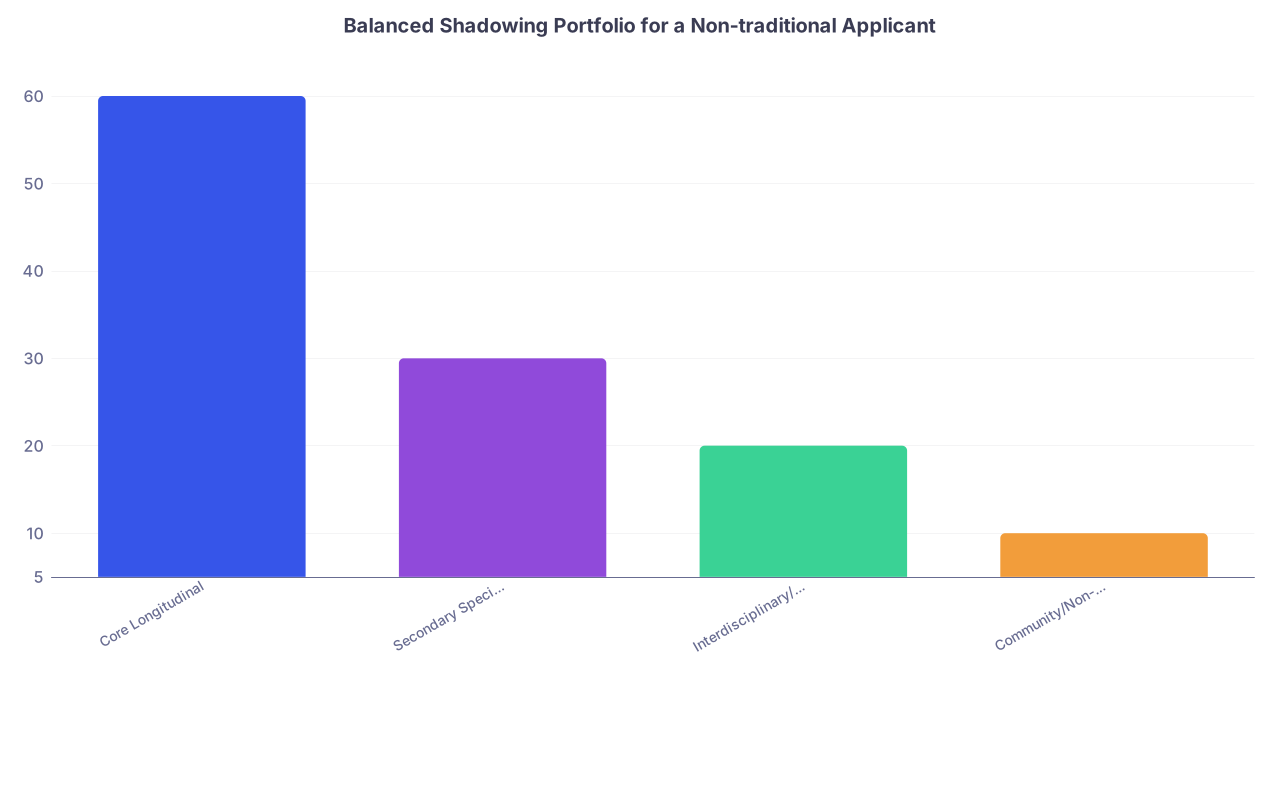
I often have non‑trad students build something like this:
| Category | Value |
|---|---|
| Core Longitudinal | 60 |
| Secondary Specialty | 30 |
| Interdisciplinary/Meetings | 20 |
| Community/Non-clinical | 10 |
Target structure:
One core, longitudinal experience (40–80+ hours)
Same physician or clinic over months. Lets you show growth, deeper reflection, and how your background integrated over time.One contrasting specialty (20–40 hours)
Different patient population or setting that still links to your story. Shows you are not narrow.One “systems/meetings” component (10–30 hours equivalent)
Could be sitting in quality improvement meetings, morning huddle, tumor board, M&M, interdisciplinary care conferences.Optional: community or non‑clinical health context (10–20 hours)
Health department, mobile clinic planning sessions, outreach programs—especially powerful for public health or policy backgrounds.
The key is intentionality. Each component should exist for a reason that you can articulate in one sentence:
- “I shadowed in pediatrics because of my background as a high school teacher; I wanted to see how physicians educate families across developmental stages, not just adolescents.”
- “My engineering background made me curious about how telemedicine workflows actually function, so I arranged to observe in a clinic that ran both in‑person and virtual visits.”
You are building a portfolio, not punching a time clock.
Step 5: Have the “Here Is My Background” Conversation Up Front
Most premeds lurk silently behind the physician and hope not to be a nuisance. Non‑trads should not do that. You need to treat physicians almost like mentors or collaborators.
On day one, you explicitly frame your prior expertise. Something like:
“Before pursuing medicine, I spent five years as a middle school science teacher. I am not here to pretend I know clinical medicine, but I am very interested in how you educate patients and families. If there are times when it is appropriate for me to observe or even help you think about explanations, I would be eager to learn from that.”
Notice what you did:
- Stated your background clearly
- Marked your boundaries (“not here to pretend I know medicine”)
- Flagged the domain (education) where your expertise might be relevant
- Invited the physician to intentionally use that asset
Do this even more strongly if you are from a clinical background:
“I was an ICU nurse for eight years. I know this is a different role, and I am not going to interfere with your workflow. What I am really trying to understand is how physician responsibilities differ from what I am used to—particularly in decision making and conversations with families.”
You would be surprised how often a good attending will later say:
“Actually, you might have good insight on this from your prior life—what do you think?”
Those moments become gold in your essays and interviews.
Step 6: Engineer Opportunities That Let Your Skills Appear
You obviously cannot examine patients or give medical advice. But there are plenty of legitimate, ethical ways to let your prior expertise show.
Here is what that can look like, case by case.
If You Have a Teaching Background
Ask the physician:
- “Are there patient education materials you wish were better?”
- “Are there explanations you give a lot that could maybe use a visual or analogy?”
Then, within ethical boundaries:
- After clinic, draft a one‑page patient handout (plain language, visuals) and ask for feedback.
- Suggest a simple metaphor you used as a teacher that the physician might adapt for explaining a concept (like insulin as “keys” or beta‑blockers as “taking your heart off speakerphone”).
Even if nothing is formally used, you can now honestly write:
“Drawing on my teaching background, I started to notice where patient education broke down—jargon‑heavy brochures, rushed explanations. After clinic, I drafted a simple, visual handout for new asthma diagnoses and discussed it with Dr. X, which sharpened my sense of how physicians can leverage education more effectively.”
If You Have Engineering / IT / Data Experience
Ask to observe:
- How the physician uses the EHR during a visit
- How lab dashboards or registries are used for population management
- Team meetings about clinic efficiency or quality metrics
Then, again after hours or in conversation:
- Map out a simple flow of the current process
- Ask thoughtful questions like, “Where do you feel the most friction in this workflow?” instead of “Why is this so inefficient?”
- If invited, sketch a potential small tweak, like rearranging template elements or flagging labs differently—but stay humble and clearly non‑authoritative.
This lets you later say:
“My software engineering background changed what I saw when I shadowed. While other students noticed primarily the content of visits, I was drawn to the structure—the clicks, the handoffs, the bottlenecks. Shadowing in Dr. Y’s clinic, I began informally mapping the appointment flow and asking how EHR templates supported or obstructed patient‑centered care.”
If You Have Business / Management Experience
Zero in on:
- Throughput (why is this clinic always behind schedule?)
- Staff morale, role clarity, conflict points
- How decisions are made about scheduling, double‑booking, no‑shows
You can:
- Ask to sit in a staff meeting
- De‑brief with the physician: “How do you decide how many patients to book per hour?”
- Reflect on how leadership style affects care delivery
Then your application does not just say “teamwork is important.” It says:
“Having managed a 15‑person operations team, I could not help seeing the clinic as a living system. Watching a morning huddle where the physician quickly validated the MAs’ concerns about a new triage protocol, then adjusted the plan in real time, gave me a model of clinical leadership far more compelling than any business textbook.”
Step 7: Targeted Note-Taking: Capture Evidence, Not Sentiment
Reflective notes are where you convert shadowing into material you can actually use. But non‑trads should not keep the same notes as everyone else.
You are looking for evidence of your prior expertise intersecting with medicine.
During or right after each shadowing session, jot down:
One specific moment your background changed what you noticed
Example: “Because of my years handling software outages, I instantly saw that the EHR downtime protocol was missing a backup communication channel between front desk and nurses.”One interaction that illustrated a clinical use of your old skills
Example: “Observed physician adjust educational approach when explaining ADHD meds to a parent who was clearly skeptical—mirrored strategies I used with resistant parents at IEP meetings.”One question that now exists in your mind at the intersection of fields
Example: “How much autonomy do physicians have to change clinic workflows that affect safety vs. just tolerating system problems?”
You are building a bank of very specific stories. Not vague “I saw doctor–patient relationships.” Concrete:
- The diabetic patient who clearly did not understand “A1c”
- The 20 minutes lost because of an EHR bug
- The nurse–physician conflict over a new protocol
That is where your expertise can actually be seen.
Step 8: Convert Shadowing into Application Language
Here is where most people fail. They have a rich background and thoughtful experiences, then flatten them into clichés.
You need to be deliberate about how you translate these shadowing experiences into personal statement, activity descriptions, and interview talking points.
Think in terms of 3 layers of language:
Observation language – what you saw
“I watched Dr. Singh manage a group diabetes visit that included patients with literacy levels ranging from 3rd grade to graduate school.”Interpretive language – what that meant given your background
“My years teaching adult ESL classes made the tension immediately obvious; a single verbal script could not serve everyone in that room.”Translational language – how that shapes you as a future doctor
“This pushed me to start thinking like an educator within medicine—how to tier explanations, use visual aids, and check for understanding without condescension.”
Avoid the generic:
- “This showed me the importance of empathy.”
- “I learned the value of communication.”
- “I realized that medicine is both an art and a science.”
Those phrases are functionally invisible in 2026.
Instead:
- Anchor every claim to a prior skill and a concrete clinical vignette.
- Use vocabulary from both your old field and medicine in the same sentence when appropriate (carefully).
- Make it absurdly easy for the reader to say, “This person will bring X to their medical school class.”
Step 9: Handle the “Overqualified” or “Role Confusion” Problem
Non‑trads, especially those with clinical backgrounds, often worry about two things:
- “Will they think I am just trying to be a doctor because I am bored with nursing/PA/PT/etc.?”
- “Will they see me as not understanding the boundary between my old role and the physician role?”
Your shadowing design can directly counter both.
You want experiences that show:
- Respect for all roles – you observe and appreciate how nurses, MAs, PTs, RTs, social workers contribute, not just the physician. You never talk like the physician is “above” everyone, just in a different lane.
- Curiosity about physician‑specific responsibilities – diagnosis uncertainty, risk communication, ultimate accountability. You ask questions that show you know what is different about being the one signing the note.
Example you might voice in an interview:
“Shadowing in primary care after years as a respiratory therapist was humbling. I expected to focus on the pulmonary aspects of visits. Instead, I was struck by how much energy went into negotiating uncertainty—explaining when we did not need to order a CT scan, or how to monitor a new symptom at home. That type of decision‑making and framing is not part of my current role; seeing it up close is what solidified my desire to move into the physician responsibility set.”
That is what mature, role‑aware thinking looks like. It is far more compelling than vague “I want more responsibility.”
Step 10: Concrete Shadowing Designs by Background
Let me give you a few fully fleshed‑out “packages” so you can see what intentional design looks like.
Former High School Science Teacher
Goal: Highlight education, communication across developmental stages, comfort with adolescents and parents.
Shadowing package:
50–60 hours with a family medicine physician who sees kids, teens, and adults
Focus: patient education, anticipatory guidance, chronic disease management.20–30 hours in adolescent medicine or school‑based clinic
Focus: confidential care, explaining sensitive topics, negotiating autonomy with parents.Sit in on at least 2–3 group education sessions (diabetes class, prenatal class, asthma class)
Focus: group dynamics, explaining complex physiology at different literacy levels.
Key narrative move: “I already know how to teach. Here is how I watched physicians teach. Here is what I will bring to that element of care.”
Former Software Engineer / Data Scientist
Goal: Highlight systems thinking, comfort with technology, interest in quality and efficiency.
Shadowing package:
40–50 hours in a high‑volume outpatient internal medicine clinic that uses an advanced EHR
Focus: how the physician uses templates, order sets, decision support.20–30 hours with a medical director, informatics physician, or quality improvement lead
Focus: meetings, metrics, policy decisions, workflow redesign.10–20 hours observing telemedicine sessions
Focus: how technology changes communication and care.
Key narrative move: “I already think in systems and databases. Here is how I saw those systems intersect with human care. Here is how that shapes the kind of physician I want to be.”
Former Business / Operations Manager
Goal: Highlight leadership, team function, process awareness.
Shadowing package:
40–50 hours in a busy community ED or urgent care
Focus: triage, resource allocation, interprofessional communication under pressure.20–30 hours in an outpatient practice where the physician is also the owner/partner
Focus: scheduling, financial constraints, staffing decisions.10–20 hours sitting in operations or quality meetings if possible
Focus: how physicians influence systems beyond the exam room.
Key narrative move: “I know how fragile complex operations are. Here is how I watched physicians lead—or fail to lead—in that context. Here is the kind of leader I am planning to be.”
Step 11: Build a Simple Shadowing Plan and Timeline
You do not need a complex Gantt chart, but you do need a plan. If you are working full‑time, especially, you cannot hope this will magically come together.
A simple process:

| Step | Description |
|---|---|
| Step 1 | Identify Prior Expertise |
| Step 2 | Map to Clinical Functions |
| Step 3 | Select Target Settings |
| Step 4 | Cold Email / Network for Physicians |
| Step 5 | Secure Longitudinal Core Site |
| Step 6 | Add Complementary Shorter Experiences |
| Step 7 | Track Notes & Reflections |
| Step 8 | Translate to Application Stories |
If you have 6–9 months before you apply, this is very doable even with a full‑time job, if you:
- Commit to a half day per week for 3–4 months for your core site
- Use vacation days strategically for concentrated blocks
- Stack shorter experiences during lighter work periods
Step 12: Common Mistakes Non‑Trads Make With Shadowing
Let me be blunt about what I see repeatedly that undermines otherwise strong candidates:
Doing only one type of shadowing that matches your old job exactly
Former ER nurse who only shadows in the ED. Former EMT who only shadows emergency physicians. This reads as narrow and comfortable, not intentional.Pretending your prior expertise does not exist
Nurses who write personal statements that sound like generic 21‑year‑old biology majors. Engineers who never mention systems, data, or problem‑solving except in one throwaway sentence.Overstepping during shadowing
Using your prior clinical expertise to correct staff, touch patients, give advice, or “help” uninvited. That is how you lose opportunities and get bad word of mouth.Focusing on pathophysiology, not roles
Non‑trads with science or clinical backgrounds often get absorbed by the medicine itself (“this was a fascinating case of x”). Admissions want to know if you understand what physicians do, not just diseases.Collecting hours instead of building a narrative
20 different doctors for 5 hours each is almost useless compared to 1–2 physicians who actually knew you, saw your growth, and wrote about your unique background.
One More Layer: Using Data to Track Your Own Growth
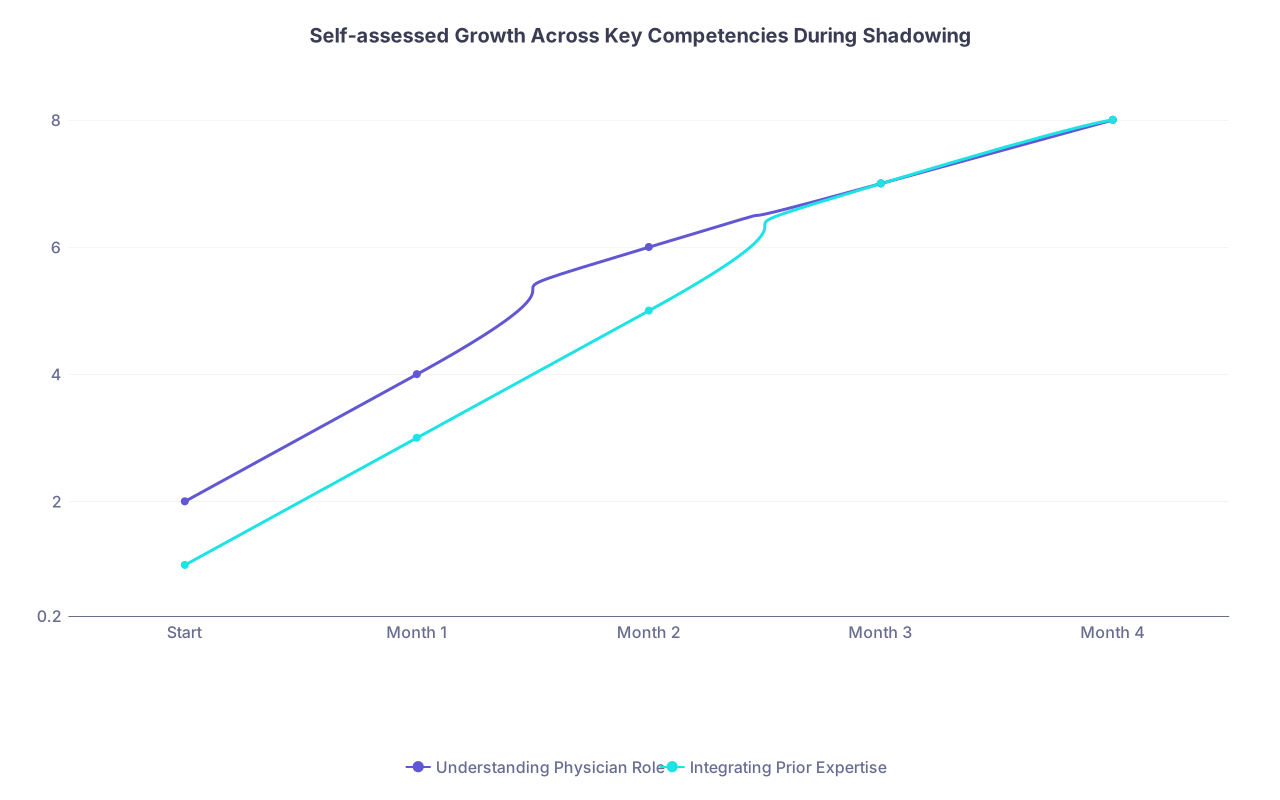
You can even borrow a bit of your professional life and quantify your shadowing experience.
| Category | Understanding Physician Role | Integrating Prior Expertise |
|---|---|---|
| Start | 2 | 1 |
| Month 1 | 4 | 3 |
| Month 2 | 6 | 5 |
| Month 3 | 7 | 7 |
| Month 4 | 8 | 8 |
Keep a simple 1–10 self‑rating every few weeks on:
- Understanding of physician responsibilities distinct from your prior role
- Comfort seeing how your prior expertise fits into medicine
- Clarity about which specialty or practice style resonates
This is not for the committee. It is for you. It sharpens your reflections and lets you say, very concretely, how you changed.
FAQ (Exactly 5 Questions)
1. Do I “need” shadowing if I already worked clinically (nurse, PA, RT, EMT)?
Yes. Paid clinical work proves you know patients and health care. Shadowing proves you actually understand the physician role and still want it. For non‑trads with prior clinical roles, shadowing does not have to be hundreds of hours, but it must be intentional and clearly show how the physician role differs from what you did.
2. How many shadowing hours are enough for a non‑traditional applicant?
Stop at the point where you can:
a) articulate physician responsibilities in detail,
b) give 3–4 strong, concrete stories showing your prior expertise intersecting with clinical care, and
c) answer “why physician, not X?” convincingly. For many strong non‑trads, that is 40–80 well‑designed hours, not 300 scattered ones.
3. Is it bad if my shadowing is mostly in one specialty that matches my background?
It is limiting, not fatal. You should still build in at least one contrasting experience—even 15–20 hours—to show you tested your interest beyond the most obvious environment. Engineering background in orthopedics? Add some internal medicine or primary care. Former teacher in pediatrics? Add family medicine or adult internal medicine.
4. Can I ever mention suggestions or ideas from my prior field to the physician I’m shadowing?
Yes, but cautiously and never during active patient care. Ask first if they are interested, frame it as curiosity, and stay humble: “Would you be open to hearing how we handled similar workflow issues in software projects? It may or may not translate, but it helped us.” If they seem hesitant, drop it. Your priority is observing and learning.
5. How do I talk about this “designed shadowing” in secondaries and interviews without sounding calculated?
You name your intent honestly. You say, “Given my previous career in X, I deliberately sought out shadowing environments where I could see how those skills translated—or did not—into clinical care.” Then you back that up with specific examples. That does not read as manipulative; it reads as mature and self‑aware.
Key points, distilled:
Design shadowing around your story, not a target number of hours. Choose settings and mentors that actually surface your prior expertise in visible ways. Then convert those experiences into concrete, role‑aware narratives that make your background an obvious asset, not an oddity.