
You are a 29‑year‑old former project coordinator sitting in a campus library surrounded by 22‑year‑olds. They are highlighting Robbins in neon colors. You are staring at Anki, Boards and Beyond, and a syllabus that looks like a six‑month Gantt chart with none of the structure.
You know how to run a $500k implementation across three departments with competing stakeholders.
But no one has told you how to apply that to:
- 8 weeks of renal,
- 40+ lectures,
- 3 different resources,
- and a final that will not care how “hard you tried.”
Let me be blunt: most medical students run their studying like a chaotic side project. You, coming from a non‑traditional path with project management skills, can run it like a well‑scoped, deadline‑driven engagement.
That is your edge.
I will walk you through how to treat med school studying as a project portfolio: scoped, scheduled, tracked, and iterated. Not “work harder.” Work like a project manager who happens to be mastering pathophysiology.
1. Translate PM Fundamentals Directly Into Med School Reality
Forget corporate jargon for a second. Strip project management to four things:
- What exactly needs to be done? (Scope)
- By when? (Timeline)
- With what time and tools? (Resources)
- How do you monitor and adjust? (Tracking & iteration)
You already know these. The trick is mapping them to concrete med school artifacts.
1.1 Define Scope Like a Real Project, Not a Vague “Study Cardio”
“Study cardio” is not a task. It is a multi‑week workstream.
Your actual scope should be defined in units that you can check off and measure. For a single block (say GI) you want scope broken down like this:
- Every required lecture (with associated slides and objectives)
- Every assigned chapter or section from the textbook
- Every video resource you choose (Boards & Beyond, Pathoma, etc.)
- Every Anki deck or custom card subset you plan to use
- Every required assignment, quiz, OSCE, or lab
You build a work breakdown structure (WBS) for the block. In plain English: list every discrete piece of content or task you must complete.
What this looks like practically:
- One row per lecture (e.g., “GI‑07: Hepatobiliary Physiology”)
- Linked to: slides, video resource, relevant Anki tags, textbook pages
- Add quizzes or practice question sets as separate, trackable items
You are not “doing GI.” You are executing 60–120 discrete tasks.
1.2 Time is Your Hard Deadline: Work Backward From Exam Dates
In project terms, the exam is a fixed milestone. It is not moving for you.
You treat every exam date like a go‑live. Then you work backward:
Hard constraints:
- Lecture schedule
- Mandatory labs / small groups
- Existing travel / family obligations
Performance goal:
- Pass vs “gun for honors” is not vague. It drives depth and buffer.
Safety margin:
- You do not schedule work up to the minute before exam. You build in a 1–2 day cushion before each exam as a “sharpen and consolidate” period.
You then convert that into a realistic weekly capacity. Example:
- 60 hours / week “available” is fantasy.
- Factor in: sleep, food, commutes, random admin, email, call shifts if you work.
If you get 35–40 net study hours per week, that is your actual project capacity. Treat it that way.
2. Build a Study Kanban That Actually Matches How Med School Flows
Most non‑trads gravitate to Kanban or task boards naturally. Good. Now use it correctly.
Your brain is not special; it will benefit from visualizing work states.
2.1 Design a Board that Mirrors Learning Stages, Not Just “To Do / Done”
A generic Trello board with “To Do, Doing, Done” is underpowered for med school.
You care about stages of learning, not just task status. For example:
- Backlog (not yet scheduled)
- Scheduled This Week
- Learning – First Exposure (watch/read)
- Active Recall – Questions/Anki
- Consolidation – Notes / Maps / Cheat Sheets
- Ready for Exam (all spaced repetitions done)
| Column | Meaning |
|---|---|
| Backlog | All block content, unscheduled |
| Scheduled This Week | What you commit to handling this week |
| Learning – First Exposure | Initial pass: lecture, text, or video |
| Active Recall | Anki + practice questions for that content |
| Consolidation | Summaries, diagrams, concept connections |
| Ready for Exam | Fully processed, only light review remaining |
Each card represents one atomic unit of work: usually one lecture or one topic (e.g., “Nephrotic vs Nephritic,” “Cardiac Cycle Physiology”).
You move the card across the board as you go through learning stages.
2.2 Attach the Right Metadata to Each Card
This is where your PM brain pays off.
Every card should carry:
- Tag(s): System (GI, Cardio), Discipline (Phys, Path, Pharm)
- Links: slides, videos, pages, specific Anki tag
- Effort estimate: 1, 2, or 3 “points” (light, medium, heavy)
- Deadline: soft “must be fully processed by X date” (usually 3–7 days before exam)
Now your board is not a pretty wall of colors. It is a small database.
You can sort:
- All high‑effort cardio path lectures not yet in “Active Recall”
- All pharm topics that have not reached “Consolidation” and are within 5 days of exam
That is how you avoid the classic “oh right, I never really studied anti‑arrhythmics” moment at 3 a.m.
3. Turn Your Weeks Into Sprints (But Do It Like an Adult, Not a Tech Bro)
You know the Scrum theater you hated in industry. Stand‑ups with no substance. Sprint retros no one read.
Use the structure, not the nonsense.
3.1 Weekly Sprints: Plan, Execute, Review
Think of each academic week as a 7‑day sprint.
Sprint planning (30–45 minutes, usually Sunday):
- Pull from Backlog into “Scheduled This Week”
- Estimate your capacity (events, call shifts, exams)
- Choose how many “points” (effort) you can realistically move to “Ready for Exam”
- Lock it. No midweek “oh I’ll just add 20 more lectures.”
Daily execution:
- Start the day by checking your board, not your email
- Move items from “Scheduled This Week” to “Learning – First Exposure” etc.
- Never work from a vague to‑do list; always pull from the board
Sprint review (15–20 minutes at week’s end):
- Count how many points you planned vs completed
- Look at what got stuck and where (e.g., many items left in “Active Recall” but not consolidated)
That is your data for improving the next week.
3.2 Use Burndown Logic Without Needing Complex Tools
You do not need Jira. A simple burndown gives you sanity.
At the start of the block:
- Total points (effort) for all content = e.g., 200 points
- Block duration = 4 weeks → ~50 points/week required
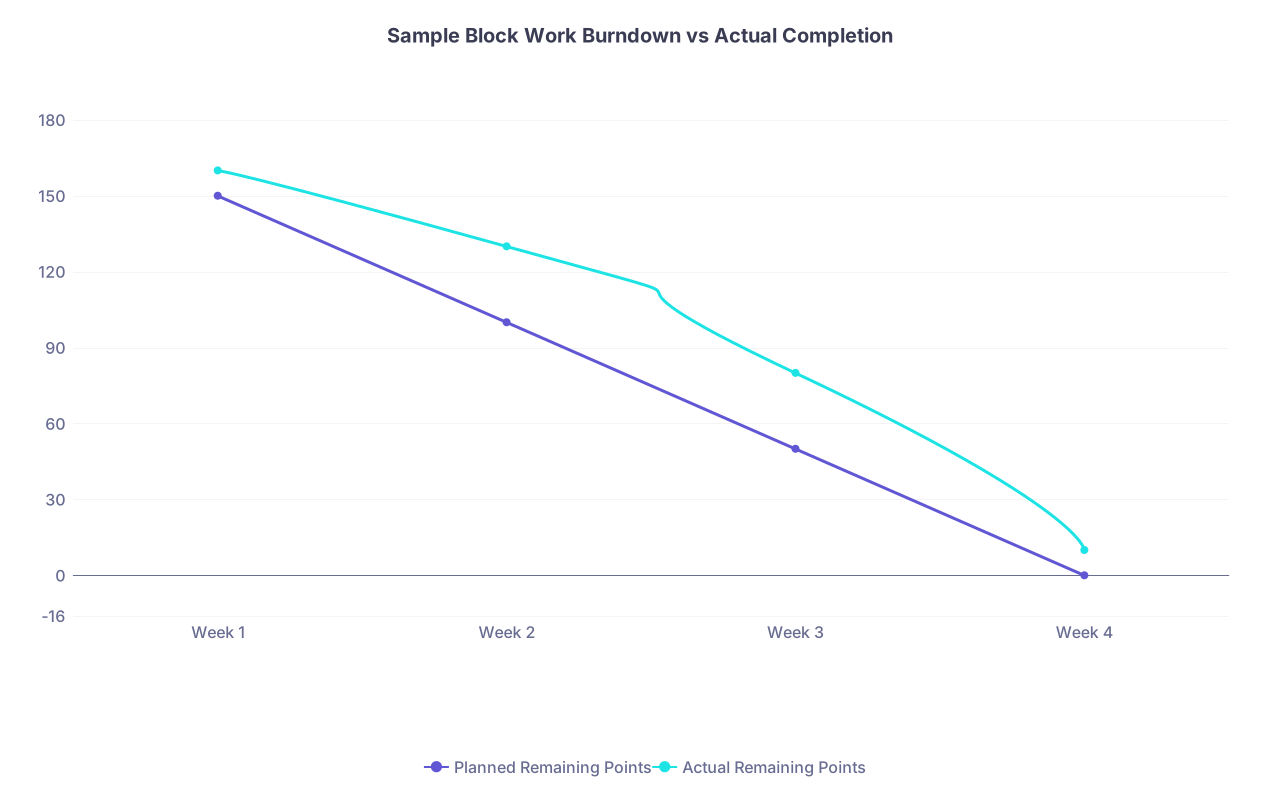
| Category | Planned Remaining Points | Actual Remaining Points |
|---|---|---|
| Week 1 | 150 | 160 |
| Week 2 | 100 | 130 |
| Week 3 | 50 | 80 |
| Week 4 | 0 | 10 |
If your “actual remaining” is consistently above the ideal line by mid‑block, you have a hard fact:
- Your resource mix or depth is too heavy
- Your time estimates are off
- Or you are procrastinating
PM mindset: you do not “feel behind.” You see you are behind, quantitatively.
Then you decide how to react: cut scope (secondary resources), increase capacity (weekend push), or adjust quality threshold (maybe 90th percentile is not realistic this block).
4. Build a Personal Study SOP: Don’t Re‑Design Your System Every Week
One reason non‑trads burn out fast is that they keep reinventing their study method.
You would never let a project team redesign the workflow every sprint. Same here.
Create a standard operating procedure (SOP) for a single lecture/topic, then run it as a template.
4.1 Example SOP: From First Exposure To Ready For Exam
For a typical med school lecture:
Pre‑Lecture (optional, 15–20 minutes)
- Skim objectives and high‑yield headings
- Write 3–5 questions you expect the lecture to answer
Lecture / First Exposure (time = lecture length + 0–15 minutes)
- Watch once at 1.25–1.5x
- Minimal notes; mark “?” where unclear
- Immediately move card to “Learning – First Exposure (Done)”
Same‑Day Active Recall (20–40 minutes)
- Anki: unsuspend relevant tagged cards or create 10–20 cards max
- Do a 10–15 question set if available (UWorld, AMBOSS, or in‑house)
- Spend last 5 minutes answering: “What would I get wrong if tested now?”
24–48 Hour Check (15–25 minutes)
- Rapid review via Anki
- Fill conceptual gaps (short video clip, 2–3 pages from text)
- Draw a quick diagram or 1‑page map for tricky mechanisms
Week‑of‑Exam Consolidation (variable, 10–20 minutes)
- Quick check: can you teach this topic in 2–3 minutes out loud?
- If yes, move card to “Ready for Exam.” If no, schedule a focused micro‑review.
You can write that once, refine it twice, and stop tinkering. That is your workflow.
Any time you are tired, you run the SOP instead of debating “what is the best method now?”
4.2 Standardize Resource Use: No Ad‑Hoc Tool Grabbing
You have seen this at work: teams that keep changing software every 3 months are always behind.
Same problem in med school: students bouncing between Lecturio, Sketchy, YouTube, 3 Qbanks, and custom notes.
Pick primary resources per domain and treat everything else as optional:
- Physiology: Boards & Beyond + Costanzo
- Pathology: Pathoma + path sections of First Aid
- Pharm: Anki deck (e.g., AnKing) + Sketchy for tricky classes
Then in your SOP, resource choice is fixed. You do not bleed hours on “YouTube shopping.”
5. Risk Management: Med School Has Failure Modes, Treat Them As Risks
Corporate projects have risks: vendor delays, scope creep, regulatory surprises.
Your med school risks are just as predictable. You are not special enough to avoid them. So you plan around them.
5.1 Identify Your Top 5 Personal Risks Up Front
Typical examples for non‑traditional students:
- Family obligations / childcare interruptions
- Financial stress → part‑time work, extra shifts
- Health issues or chronic fatigue
- Imposter syndrome and low confidence → paralysis when behind
- Perfectionism leading to over‑studying low‑yield details
Write them down. Not for journaling. For planning.
For each risk:
- Probability (Low/Med/High)
- Impact (Low/Med/High)
- Mitigation plan
- Contingency if it actually hits
Example:
- Risk: Kids get sick during exam week
- Prob: Medium, Impact: High
- Mitigation: Pre‑build 1–2 day content buffer each week; exam‑week childcare backup plan
- Contingency: Pre‑decided which resources to cut (extra videos) while preserving Anki + Qbank
You remove the drama from crises by pre‑deciding.
5.2 Manage Scope Creep Like You Would With A Pushy Stakeholder
In med school, your “scope creep” is usually:
- Classmates insisting you “must” watch X resource
- Faculty dumping “supplemental reading”
- Your own anxiety: “Maybe I should add this entire 600‑page review book mid‑block”
Your rule:
No new resource becomes mandatory mid‑block unless:
- It replaces another resource (not in addition), and
- You explicitly replan your remaining work (like re‑baselining a timeline)
Otherwise, it is optional / “nice to have” and only done if you are ahead.
This is where non‑trads often save themselves. You have seen doomed projects bloated by extra “nice‑to‑haves.” Treat your attention and time the same way.
6. Use Data Like A Project Dashboard, Not Like A Guilt Generator
You already know how leadership misuses dashboards to shame teams. Do not replicate that with yourself.
Use data for calibration, not self‑flagellation.
6.1 Build a Simple Personal Learning Dashboard
Sources of data:
- Anki stats: review counts, ease factor, retention rate
- Qbank stats: % correct per system and discipline
- Exam results: breakdowns when provided
- Kanban metrics: cards / points completed per week
You want to answer specific questions:
- Which systems are consistently underperforming?
- Is my retention dropping because my daily Anki load is too high?
- Am I front‑loading or back‑loading too much work near exams?
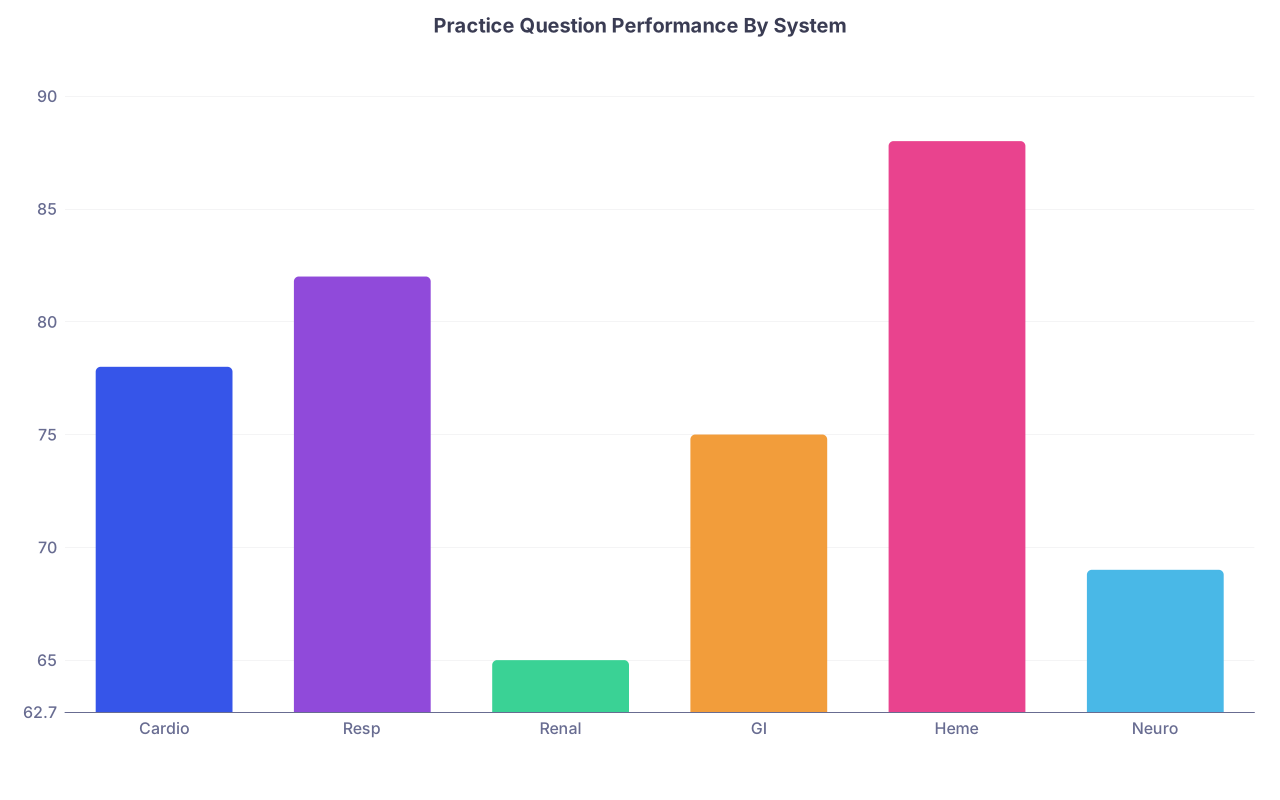
| Category | Value |
|---|---|
| Cardio | 78 |
| Resp | 82 |
| Renal | 65 |
| GI | 75 |
| Heme | 88 |
| Neuro | 69 |
Looking at this, PM brain kicks in:
- Renal and Neuro are obvious risk areas → adjust future block planning with more time and earlier emphasis.
- Heme is high → maybe you can use less time there next cycle.
6.2 Run Retrospectives Like You Would With a Real Team
End of every block, do a 30–45 minute retrospective with yourself. Not vague reflecting. Structured.
Questions:
- What actually worked? (Specific tactics. Not “Anki” but “doing new cards immediately after lecture.”)
- What consistently failed or created stress?
- Where did my estimates go wrong?
- Which resources were not worth the time?
- What one or two changes will I commit to next block?
Write it down. Three months later, reading those notes will save you from repeating dumb mistakes. I have watched many non‑trads climb fast simply because they treat each block as a version update, not a fresh start.
7. Communicate and Coordinate Like a PM, Not a Passive Student
Your project management experience includes stakeholder management and expectation setting. Use that.
Med school is full of passive complaining and zero actual communication up the chain.
7.1 Manage Up: Talk to Faculty Like Colleagues, Not Just “Professors”
If a block is overloaded, or exam feedback is vague, most students just grumble on Reddit.
You can:
- Ask for clarification on learning objectives (scope clarification)
- Request example questions that reflect exam style (quality criteria)
- Confirm relative weight of lectures vs outside reading (priority)
You are not demanding special treatment. You are doing what any reasonable project lead does with a vague client request: forcing clarity.
Phrase it like this:
“Given the volume of materials, I am trying to prioritize appropriately. Could you clarify whether the primary emphasis on the exam is from lecture objectives or assigned chapter readings?”
Not needy. Professional.
7.2 Coordinate With Peers Like Cross‑Functional Teams
Group study is notorious for wasting time. But if you treat it like a structured working session, it can be lethal (in a good way).
You can:
- Run a weekly 60‑minute “rapid‑fire concept check” with 3–4 classmates
- Each person comes with 5–10 questions they wrote on high‑yield topics
- Time‑box everything; no 20‑minute tangents
Think of it as a sprint review for concepts. You quickly see where your understanding breaks.
8. Special Considerations For Non‑Traditional Students
You have extra variables most 21‑year‑olds do not. That is not a complaint. It is a constraint set.
8.1 Energy Management Is Part Of Your Resource Plan
There is a difference between 19‑year‑old brains and 32‑year‑old brains. Both can crush med school; they just respond differently to abuse.
You plan study intensity like phased resource allocation:
- High‑focus blocks: 2–3 × 60–90‑minute deep focus periods per day
- Low‑focus tasks: admin, organizing cards, light review for evenings
Your system should explicitly schedule deep work when your brain is best (often morning) and not rely on “I will power through late at night.” That is childish planning.
8.2 You Must Integrate Life Commitments Into The Plan, Not Around It
If you have kids, a spouse, or a job, those are not random disruptions. They are known recurring tasks.
Treat them as project work items:
- Fixed time windows (e.g., 5–8 p.m. daily is family time)
- Non‑negotiable constraints around which you schedule high‑yield work
Many non‑trads run into guilt on both sides because they try to multitask life and studying. Better approach:
- Block protected, fully present life time
- Block protected, fully present study time
- Do not blur the boundary except in genuine emergencies
It looks rigid. It feels much less stressful.
9. Step‑By‑Step: Setting Up Your System From Scratch (Weekend Build)
Let me give you a concrete implementation plan. Two days, no perfectionism.
Day 1 – Architecture
Choose your tools:
- Kanban: Trello, Notion, or ClickUp. Pick one, do not obsess.
- Calendar: Google Calendar or Outlook.
- Spaced repetition: Anki.
Define columns on your Kanban board:
- Backlog → Scheduled This Week → Learning – First Exposure → Active Recall → Consolidation → Ready for Exam
Build your first block’s backlog:
- Go through the syllabus and lecture schedule
- Create one card per lecture/topic
- Tag system + discipline, add links to slides / videos
Estimate effort:
- Light (1), Medium (2), Heavy (3) for each card
- Sum total to get block effort points
Day 2 – Scheduling And SOP
Create a weekly template in your calendar:
- Morning blocks: deep work (lecture + Anki + Qbank)
- Afternoon: review and lighter tasks
- Evening: either off, or low‑effort (depending on your life situation)
Decide your SOP for a single lecture:
- Write it as a 5–7 step checklist (like the example earlier)
- Paste it as a template in the description field of each card
Sprint plan:
- Look at Week 1 of your block
- Pull realistic cards into “Scheduled This Week” based on your capacity
First retrospective placeholder:
- Schedule a 30‑minute end‑of‑week block for review
- Create a simple note with headings: Worked / Did Not Work / Change Next Week
Once this is in place, your day stops being “what am I supposed to study?” and becomes “pull next card and run the SOP.”
That reduction in decision fatigue alone is worth the setup time.
FAQ (Exactly 6 Questions)
1. I am already behind this block. Is it too late to implement a project‑style system?
No. You do not need a full redesign mid‑block. Do a “triage build”:
- Create a quick backlog for the remaining weeks only.
- Estimate effort and see what is actually possible.
- Ruthlessly cut optional resources.
- Implement just three pieces: Kanban columns, a basic SOP for lectures, and a once‑weekly retrospective.
You stabilize now, then do the full architecture between blocks.
2. How detailed should my work breakdown be? One card per lecture or smaller units?
Start with one card per lecture or major topic. If you find certain lectures are monstrous (e.g., “Cardio Path 1” with 80 slides and multiple diseases), split only those into 2–3 smaller topic cards. The rule: if you cannot reasonably move a card from first exposure to “Active Recall” in one focused session (60–90 minutes), it is probably too big. Do not over‑granularize or you will drown in cards.
3. How many resources are “too many” in a block?
For most students: one primary explanation source + one spaced‑repetition tool + one question bank is enough per major domain. If you are stacking 3 video series, a textbook, and two Qbanks, that is bloat. Your performance ceiling comes from depth and retrieval practice, not number of brands consumed. Pick, commit, and adjust only between blocks.
4. What if my classmates are studying in totally different ways? Am I missing something?
Probably not. Most med students operate on vibes, peer pressure, and panic. You coming in with structure will look “weird” until they start asking how you seem less frantic before exams. Measure your outcomes: if your scores and sanity are stable, keep your system and ignore the noise. If outcomes lag, you tweak inputs—just like in any project—rather than copying someone else’s mess.
5. How do I integrate board prep (Step/COMLEX) into this during pre‑clinicals?
Treat board prep as a parallel project with lower initial priority that gradually ramps. Example: in MS1, board work is 10–20 percent of your weekly capacity via Anki and a modest number of board‑style questions aligned to your current system. Later in MS2, that shifts to 50–70 percent. On your Kanban, tag certain cards as “Board‑aligned” and prioritize those; do not create a totally separate chaotic system.
6. What if I am not naturally organized? Can I still apply project management concepts?
Yes, because the point is to externalize organization into tools and routines so your brain does not have to constantly improvise. Start with a very minimal setup: a three‑column board (Backlog, Doing, Done), a simple lecture SOP, and a once‑weekly planning session. You do not need to be “type A.” You need a repeatable structure that catches you when you are tired, stressed, or distracted. That is what good project management systems do.
Key points to walk away with:
- Treat each block like a scoped, scheduled project: clear backlog, effort estimates, weekly sprints, and retrospectives.
- Run a fixed, refined SOP for how you process each lecture/topic so you stop wasting energy deciding how to study every day.
- Use your project management habits—risk planning, scope control, data‑driven adjustment—not just for work, but as your unfair advantage in mastering med school content.