
Yesterday I watched a 30‑year‑old scribe stare at a group of fresh‑faced gap‑year premeds in the ED. They were laughing about biochem finals; he was quietly calculating how old he’d be on Match Day if he applied this cycle. When the attendings walked in, he stepped back, almost physically shrinking, like he didn’t deserve to stand in the “future doctor” circle anymore.
I know that feeling way too well—the sense that you’re already behind, that the race is half over and you’re just tying your shoes.
Let me just say the ugly part out loud: it feels like medicine is set up for 22‑year‑olds with perfect GPAs, no kids, no mortgage, no back pain, and unlimited time to study. If you’re late 20s, 30s, 40s, or beyond and thinking about medicine, it’s very easy to convince yourself you’re delusional.
You’re not. But the anxiety is rational. So let’s actually talk about how older students really do—and where the worst fears are true, and where they’re honestly just mental torture you’re putting yourself through.
The Age Thing No One Says Directly (But You Feel It)
You walk into an info session and everyone’s wearing college sweatshirts that are newer than your car. Someone asks what year you’re in and you say, “I graduated a while ago,” and you watch their eyebrows do that tiny jump.
You wonder:
- Are adcoms going to think I’m “too old”?
- Will I be the slowest one in the class?
- Are residencies going to toss my app when they see my age?
- Am I insane for even trying this?
Here’s the blunt truth: programs care way more about your timeline and trajectory than your raw age.
They’re not sitting in admissions meetings saying, “Oh, 32? Absolutely not.” They’re saying things like:
- “Does this application show recent academic strength?”
- “Is their story coherent or all over the place?”
- “Can this person handle the pace and volume of med school now?”
I’ve watched nontrads get into very good schools in their 30s and even early 40s. I’ve also watched applications from older students get shredded because the grades were old, the MCAT was weak, and the personal statement sounded like, “Medicine has always been my dream,” with no receipts.
Age itself isn’t the problem. Age without proof you still belong in a high‑intensity academic environment? That’s where you get killed.
How Older Students Actually Perform Once They’re In
Here’s where the fear really ramps up: “What if I somehow get in and then I can’t keep up with the 22‑year‑olds who can memorize 100 pages in a night and still go out drinking?”
That nightmare loop—get in, fail, humiliate yourself in front of everyone you impressed—that one’s brutal.
But this is what actually happens, pattern‑wise, once older students are in med school:
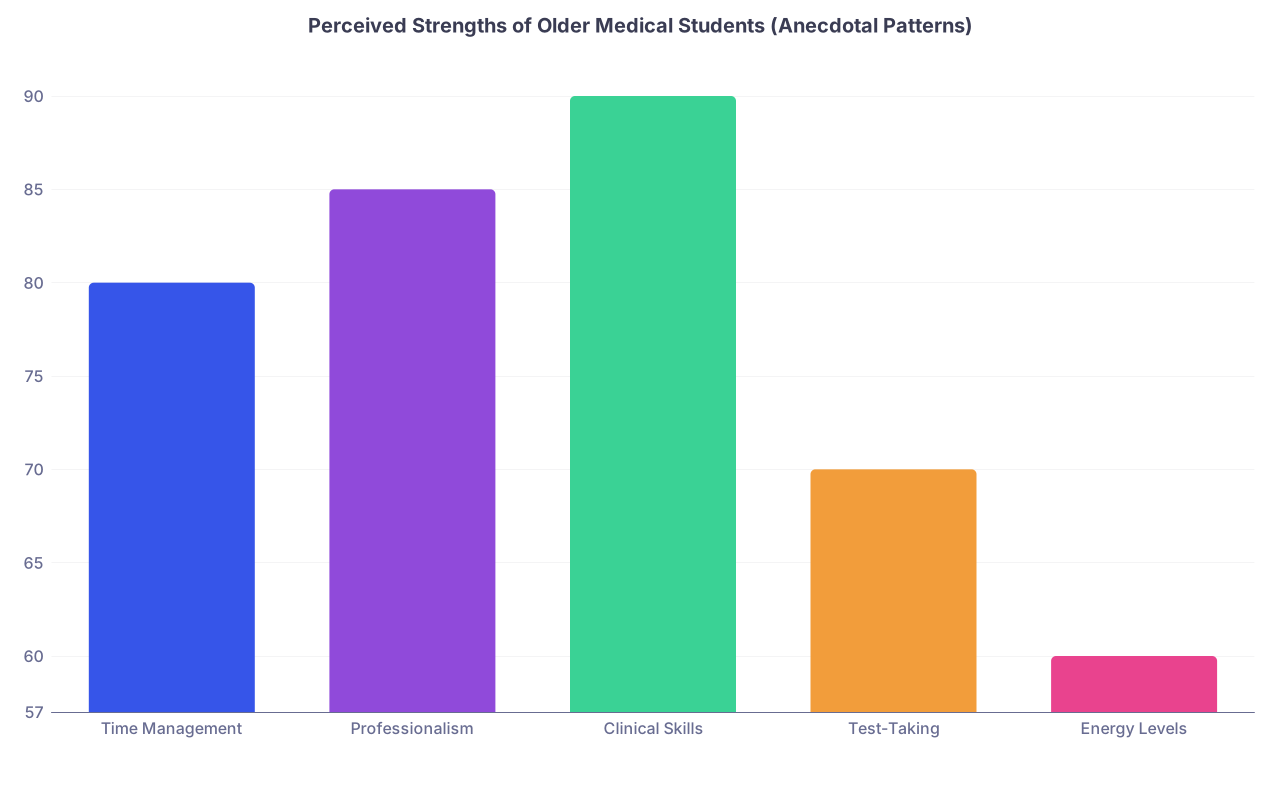
| Category | Value |
|---|---|
| Time Management | 80 |
| Professionalism | 85 |
| Clinical Skills | 90 |
| Test-Taking | 70 |
| Energy Levels | 60 |
This isn’t a real data set; it’s a decent summary of what I keep seeing:
Older students usually excel at:
- Professionalism. They show up on time. They email like adults. Attendings notice.
- Clinical communication. If you’ve ever had a real job, you’re already miles ahead on basic human interaction.
- Time prioritization. When you’ve juggled rent, kids, partner, and bills, “I have three exams” doesn’t feel like the end of the world. It’s Tuesday.
They sometimes struggle with:
- Raw memorization speed. You can still memorize a ton, but yeah, it might take you longer than a 21‑year‑old brain that just left Orgo.
- Endurance. The all‑nighter energy? Usually gone. And that’s actually fine—you need to study smarter, not brick yourself.
Older students aren’t the bottom of the class by default. I’ve seen plenty of 30+ folks land AOA, honor heavy clinical rotations, and crush Step 2. I’ve also seen them get steamrolled when they try to “out‑grind” the 22‑year‑olds instead of leaning into the way they work best now.
If you treat med school like undergrad 2.0, you will suffer. If you treat it like a demanding job, you’ll do a lot better than you think.
How Admissions Really View Older Applicants
You’re probably imagining some admissions committee member looking at your date of birth and thinking, “This is a waste of a seat, they’ll only practice for 20 years.”
I’m not going to say no one thinks about career longevity. That’d be a lie. But I’m telling you what I’ve actually heard in admissions discussions:
What they care about with older applicants:
Have you shown recent academic ability?
Old 2.8 from 2013 with no new coursework + okay MCAT? That’s a problem.
Old 2.8 + strong post‑bacc or SMP + solid MCAT? Totally different story.Do you understand what medicine actually is—not just the TV version?
This is where your age helps. Scribing, MA work, RT, nursing, paramedic, military medic—this stuff lands hard.Is your story clean?
Not perfect. Coherent. Gap years have explanations. Career shifts make sense. You’re not switching paths every 18 months.
| Concern From Adcoms | What They Look For as Proof |
|---|---|
| Can you handle academics now? | Recent A-level science courses, strong MCAT |
| Do you know what you're signing up for? | Significant clinical exposure, shadowing, service |
| Are you reliable and mature? | Work history, leadership, consistent responsibilities |
| Are you running *from* something? | Clear, honest explanation of career change |
Your age is not the red flag. Your application either answers these questions or it doesn’t.
Nontrads get in every cycle. And not just to DO or lower‑rank MDs. I’ve seen 30‑somethings at Mayo, UCSF, Columbia. They got in because their present‑day record screamed: “I can do this now.”
The Time Bomb in Your Head: “I’ll Be 40+ as an Attending”
This one hits late at night when everything is quiet: “If I start post‑bacc at 30, apply at 33, graduate med school at 37, finish residency at 40 or 41… will I regret this? Am I wasting the years I have left grinding instead of living?”
I’m not going to give you the fake Instagram answer: “It’s never too late!” Because sometimes it is too late for what you personally want—kids, certain lifestyle specialties, financial goals.
But I’ll tell you how older physicians usually talk about this when they’re honest:
- “I wish I’d started earlier—but I’d still do it again.”
- “My friends have more savings, but they also hate their jobs.”
- “I don’t regret becoming a doctor. I regret some of the anxiety I marinated in getting here.”
If you’re older, you have to do real math, not magical thinking. Years, loans, specialties, lifestyle. And yes, your margin for error is smaller.
But also—what’s the alternative timeline you’re picturing? Staying in a job where you already feel stuck, counting years anyway, wondering if you chickened out?
Decide which regret you can live with:
- Regret of trying and going through hell for a decade.
- Regret of never trying and asking yourself about it for the rest of your life.
Neither is painless. You just have to pick your pain.
Competing with 22‑Year‑Olds in the Classroom (And Not Losing Your Mind)
The mental game is brutal. You sit in a review session and some kid casually quotes a random biochem pathway from memory. You’re still trying to remember which enzyme was in which step.
Your brain instantly goes: “I’m not cut out for this. I’m already behind. They’re built for this. I’m not.”
Here’s the part you don’t see: a lot of those 22‑year‑olds are a mess internally. They’re cramming, burning out, crying after anatomy practicals, questioning everything. They’re just louder about what they know and quieter about what they don’t.
You’re older. Use it. Don’t try to be them.
Some patterns I’ve seen work well for older students:
- Treat it like a job: fixed hours, protected sleep, boundaries around nonsense.
- Ruthless efficiency: Anki, question banks, boards‑style thinking early, no “aesthetic” note‑taking.
- Accept that you won’t know everything first. But you can know the important things solidly.

| Step | Description |
|---|---|
| Step 1 | Plan Week |
| Step 2 | Work/Family Schedule |
| Step 3 | Block Study Hours |
| Step 4 | High-Yield Tasks Only |
| Step 5 | MCAT/Prereqs/Apps |
| Step 6 | Daily Review |
| Step 7 | Adjust Next Week |
You don’t have the luxury of wasting time. That’s actually an advantage if you’re disciplined. You’re not going to spend three hours color‑coding your notebook; you’ll do 60 UWorld questions and move on.
The One Real Disadvantage You Can’t “Mindset” Away
I’m not going to sugarcoat everything. There’s one piece that really is harder for older students, and no mindset hack fixes it: life load.
You’re more likely to have:
- Kids or a partner who actually needs you present.
- Sick parents.
- A mortgage or real bills.
- A body that does not appreciate 28‑hour calls.
Meanwhile, someone else’s biggest headache is “my roommate is loud.”
This isn’t a character flaw. It’s reality.
Where I’ve seen older students drown is when they try to pretend their life load is the same as everyone else’s and don’t adjust. Or ask for help. Or set boundaries.
The older students who do well:
- Ruthlessly delegate where possible—childcare, cleaning, errands.
- Involve partners early in realistic planning. Not “it’ll all work out somehow.”
- Are willing to say no—no to extra clubs, extra projects, “fun” obligations that cost them their last two functioning brain cells.
You cannot compete with a 22‑year‑old on available hours per week. Don’t. Compete on focus per hour instead.
How Older Students Do in Residency and Beyond
Another dark thought: “Even if I get in and survive, will residencies rank me lower because I’m older? Will attendings roll their eyes at the 38‑year‑old intern?”
I’ve watched older residents on medicine, surgery, EM, peds, psych. Here’s the unvarnished version.
How attendings often see older interns:
- More composed with patients.
- Less dramatic, less gossip.
- Better at handling stress like… an adult.
- Occasionally physically slower on brutal services, but often more emotionally stable.
Some PDs quietly like older residents because they’re low‑drama and used to work. Some worry about stamina in very intense surgical fields. That’s reality.
But no one cares that you were 28 instead of 22 when you started med school. What matters is: Are you good? Can you function on the team? Do you know your stuff? Do patients trust you?
Long‑term, older docs don’t walk around with a sign on their heads that says, “Late start.” No patient ever asked their cardiologist, “Wait, how old were you when you started med school?”
If You’re Still On the Fence: A Brutally Honest Self‑Check
Let me be a little harsh here, because it’s better you face this before you drop tens of thousands into a post‑bacc.
Ask yourself, honestly:
- Am I willing to do 3–4 years of hard sciences again (if needed) without constant validation?
- Can I carve out 15–20 focused hours per week to study right now without my life collapsing?
- Am I prepared for 10+ years of training where my friends advance in their careers, buy houses, take vacations, and I… don’t, for a while?
- Do I have at least one strong reason for medicine that isn’t “I think I’ll feel important” or “I hate my current job”?
If those answers tilt mostly yes—even if you’re scared—you’re probably not insane to try.
If they tilt no, or “maybe if everything lines up perfectly,” then medicine might still be possible, but you’d need serious structural changes first (money, childcare, support system, etc.). Hoping it magically works out is how people break.
FAQ (Exactly 6 Questions)
1. Am I “too old” for medical school if I’m 28, 32, 38?
No. People start in their late 20s and 30s every year. I’ve seen early 40s too. The question isn’t “too old?” It’s “Can you show recent academic strength, a coherent path, and realistic understanding of the job?” Age matters less than whether your file looks like you can actually handle med school now.
2. Will admissions or residency programs secretly hold my age against me?
Some individual humans might have biases. They’re human. But structurally? Programs don’t have a cutoff where they toss apps by age. What gets older applicants rejected is usually weak recent academics, vague motivation, or poorly explained career changes—things you can fix. Strong, recent performance and a solid story beat your birth year.
3. What if I can’t keep up with the younger students academically?
You might not memorize as fast, but older students usually compensate with better strategy. If you lean into evidence‑based study methods (spaced repetition, questions, high‑yield focus) instead of brute force, you absolutely can keep up. I’ve seen 30‑something students land in the top quartile. The ones who drown are usually trying to study like it’s sophomore year again.
4. Are certain specialties basically off the table if I’m older?
Hyper‑competitive surgical subs (like neurosurgery, plastics) can be tougher because they’re long, brutal, and PDs might quietly worry about longevity and stamina. But older grads still match into a wide range of fields: IM, EM, FM, Psych, Peds, even some surgical fields. Your board scores, clinical evals, research, and letters matter more than your age alone.
5. Will starting this late ruin my finances and personal life?
It will hit both. No way around that. You’ll likely have more debt later in life, delayed savings, and less time for some personal milestones in the short term. But “ruin” depends on your expectations. Plenty of older grads pay loans, build a decent life, and are happier in medicine than they were in their old careers. It’s a tradeoff, not automatic ruin—you just need to go in with open eyes and a real plan.
6. How do I even start if I’ve been out of school for years?
You start small and recent. Take a science class at a local university or formal post‑bacc. See how your brain handles it now. If you can earn As while working reasonable hours, that’s a strong sign. Add clinical exposure (scribing, MA, CNA, volunteering), shadowing, and then the MCAT. You rebuild your academic record step by step—and every A you earn now is a direct rebuttal to the fear that you “can’t do school anymore.”
If you remember nothing else, remember this: older students don’t fail because they’re old; they fail because they try to do this like they’re 20 again or they never fix the weak spots in their record. Your age is not your disqualifier. It’s just the context. The actual question is whether you’re willing—and able—to build a current version of yourself that belongs in medicine.