
The romantic story of “follow your passion into medicine at any age” hides a blunt financial reality: for late‑career switchers, the loan math can either work…or quietly wreck your retirement.
This is not about whether medicine is meaningful. It is. The data shows something simpler and harsher: timing, debt structure, and repayment strategy will drive your financial outcome far more than your specialty dreams or your motivational quotes.
Let us treat this like what it is: a capital investment decision under uncertainty.
1. The Core Variables: What Actually Moves the Needle
Ignore the noise. Four variables dominate the financial picture for late‑career entrants:
- Age at matriculation
- Total debt (including existing non‑medical debt)
- Post‑training income trajectory
- Repayment framework: standard vs. income‑driven vs. PSLF
The rest—tiny scholarship differences, $5 coffee, side‑hustles—are rounding errors by comparison.
Typical Ranges for Late‑Career Switchers
Across applicants I have seen in their early‑ to mid‑30s and beyond, the realistic ranges look like this:
- Age at matriculation: 30–45
- Existing retirement savings: $0–$400k (huge spread)
- Existing non‑edu debt (mortgage, consumer, etc.): $0–$400k
- New med‑school related debt (tuition + living): $250k–$550k+
(Private schools and high cost of living push the upper bound fast.)
Let us anchor with a realistic cost set:
- Tuition + fees: $60k/year (private) or $40k/year (public OOS)
- Living expenses (modest): $30k/year
- Total annual cost: $70k–$90k
- 4‑year total principal: $280k–$360k
With interest accrual and capitalization, that often lands in the $350k–$450k range by residency.
Now overlay age and income patterns.
2. Income Timeline: How Much Earning Time You Actually Have
The big structural disadvantage for late‑career switchers is not just debt. It is the shortened earning runway at attending‑level income.
Assume a 34‑year‑old entering a 4‑year medical school, then 3‑year residency in internal medicine:
- Med school: 4 years (age 34–38)
- Residency: 3 years (age 38–41)
- Attending start: ~41
- Reasonable full‑time practice horizon: 41–65 (24 years), maybe less if burnout or transition to part‑time around 60
Compare that to a “traditional” 24‑year‑old matriculant entering the same specialty:
- Attending by 31, with ~34 years of full‑time potential
You are trading away roughly a decade of high‑income years to invest in this training.
Simple Income Model
Use average, solid but not extreme numbers:
- Residency salary: $65k starting, 3% annual raises
- General IM outpatient attending salary: ~$260k base, 2–3% raises
- Effective tax + payroll + benefits load: ~30–33% for most attendings in the $200k–$350k band
- Net take‑home (before loans, after tax): ~67–70% of gross
That means:
- Resident net: roughly $45k–$50k/year
- Attending net: roughly $175k–$190k/year
Now place that next to your pre‑med income. Many career‑switchers are already earning $80k–$200k. Some higher. That lost income during 7 years of training is an invisible “shadow cost” you cannot ignore.
3. The Loan Repayment Frameworks: The Levers You Actually Control
You do not control tuition inflation or Medicare reimbursement. You do control how you structure your loans.
At a high level, you face three archetypes:
- Aggressive payoff (standard 10‑year or faster)
- Income‑driven with full payoff (no PSLF)
- Income‑driven with forgiveness (PSLF or 20–25‑year IDR)
Let us quantify these on a baseline scenario.
Baseline Debt Scenario
- Total med school debt at residency start: $400,000
- Average interest rate: 6.5%
- No prior student debt (we will add that complexity later)
By the end of residency, if you pay very little (just required IDR), this principal will likely balloon.
Rough ballpark:
- Interest accrual on $400k at 6.5%: ~$26k/year
- Over 3 years of residency: ~$78k added
- Loan balance at attending start: often $450k–$500k unless you pay more than the IDR minimums
Round to $475,000 at attending start for modeling.
4. Scenario 1 – Standard / Aggressive Payoff as an Attending
This is the “rip the band‑aid off” strategy. You accept tight attending years to be debt‑free quickly and preserve later flexibility.
Numbers: 10‑Year Standard Repayment
Assume:
- Starting balance as attending: $475k
- Interest: 6.5%
- Standard 10‑year repayment
Monthly payment (approximate amortization):
- Payment ≈ $5,400–$5,600/month
- Annual payment ≈ $65k–$67k
- Total paid over 10 years: ~$650k–$670k
- Total interest paid: ~$175k–$195k
Put that against an attending making $260k gross:
- Net after tax (30%): ≈ $182k
- Net after loans: ≈ $115k–$120k
That is ~63%–66% of take‑home swallowed by everything besides loans. Manageable, but there is not massive slack if you have kids, mortgage, or are behind on retirement.
Accelerated 7‑Year Payoff
Say you hate debt and push $8,000/month:
- $8,000/month = $96,000/year
- With starting balance $475k @ 6.5%, payoff time ~6.5–7 years
- Total paid: roughly $620k–$650k
- Interest: roughly $145k–$175k
So you trade higher monthly pain to cut 3+ years off. That returns to you:
- 3 extra years of attending income with no loans.
- At $260k gross, that is ~$550k net across those 3 years not constrained by loan payments.
From a pure NPV perspective, aggressive payoff often wins over slow‑roll payoff in private practice without forgiveness, especially for those in their 30s/early 40s who still have 15–20 years post‑debt‑free.
5. Scenario 2 – Income‑Driven Repayment without PSLF
This is the quiet trap for a lot of late‑career switchers: they choose IDR to keep payments low early on, but never line their career up for PSLF. The math often tilts against them.
Assumptions:
- Plan: SAVE (current U.S. IDR gold standard)
- Discretionary income calculation: AGI – 225% FPL
- Married vs. single filing status, spouse income, and kids matter. I will model single, no kids first.
During Residency
Resident AGI: ~$65k
- 225% FPL (single): roughly ~$32k–$33k
- Discretionary income: ~ $32k
- SAVE payment: 10% of discretionary ≈ $3,200/year ≈ $270/month
Loan interest on $400k: ~$26k/year
You are paying ~$3k; interest is ~$26k. But SAVE currently waives 100% of unpaid interest. So:
- Required payment: ~$3k/year
- Effective balance growth: ≈ $0 (no negative amortization while in SAVE under current rules)
At attending start, your principal is still around $400k–$420k instead of $475k. Better than the prior scenario that did not use an IDR interest subsidy.
As an Attending on SAVE, No PSLF
Attending AGI: $260k
- 225% FPL: ~$32k
- Discretionary: ~$228k
- Annual SAVE payment: ~10% of $228k = $22.8k
(About $1,900/month)
Interest on $400k principal @ 6.5%: ~$26k/year. Here is the key:
- Payment: ~$22.8k
- Interest: ~$26k
- Unpaid interest: ~$3.2k/year
- SAVE still waives unpaid interest.
So your balance stays roughly flat while you pay ~$23k/year. You are barely touching principal.
You could be doing this for 20–25 years until taxable forgiveness (if PSLF is not part of the plan). Now inject the tax bomb risk:
- If $400k principal is forgiven after 20+ years, and you land in a ~35% marginal tax bracket late career, the tax hit alone could be ~$140k.
- Total paid in IDR over 20 years: ~$22.8k × 20 ≈ $456k
- Plus tax bomb: ~$140k
- Effective total outflow: ~ $600k on a $400k loan, over 20+ years, with debt hanging over your retirement.
This is why for a late‑career physician without PSLF, IDR as a long‑term hotel is usually a bad deal. It lowers monthly pressure at the cost of prolonged uncertainty and a bad psychological anchor.
IDR for this group is usually best used as:
- A short‑term cash‑flow relief valve during residency and the first 1–2 attending years, then
- A bridge into an aggressive repayment strategy once income stabilizes.
If you plan to work full‑time well into your 60s and do not care about long‑tail debt, maybe you tolerate the 20–25‑year IDR route. But many late‑career switchers absolutely do care, because that timeline crosses directly into their intended retirement window.
6. Scenario 3 – PSLF as a Late‑Career Switcher
Public Service Loan Forgiveness is where the numbers swing dramatically in your favor—if and only if you commit to the qualifying path early and stay disciplined.
You need:
- Direct federal loans
- 120 qualifying monthly payments under a qualifying IDR plan
- Full‑time employment at qualifying 501(c)(3) or government employers for those 120 months
Residency usually counts. Many academic and safety‑net attendings qualify.
Baseline PSLF Scenario
Assume:
- 34‑year‑old matriculant
- 4 years med school, 3 years residency, 7 years attending in nonprofit/academic practice
- Total loans at graduation: $400k
- On SAVE during residency and all qualifying years
- AGI as above: $65k → $260k increasing ~2–3% annually
You essentially get:
- 3 years of low payments as a resident
- 7 years of moderate payments as an attending
- Full forgiveness of remaining balance after 10 total qualifying years (residency + attending)
Let us approximate total paid.
Resident Years (3)
- Payments: ~$270/month × 12 × 3 ≈ $9,700
- Principal: stays near flat because of interest subsidy
Attending Years (7) – Nonprofit Job, $260k starting
Rough approximation ignoring raises:
- Annual payment: ~$22.8k
- 7 years: ~$159.6k
Total paid across 10‑year PSLF window ≈ $9.7k + $160k ≈ $170k
If your principal at start of residency is $400k and stays around that level through the SAVE interest subsidy period, after 10 years of qualifying payments, you might still have ~$300k+ forgiven tax‑free.
This is the only scenario where “stay on IDR for a decade” makes hard financial sense. You pay maybe ~40–45% of your original borrowed amount out‑of‑pocket, and the rest disappears.
Here is the comparison in structured form.
| Scenario | Time to Debt Freedom | Total Paid (Principal + Interest + Tax) | Qualitative Outcome |
|---|---|---|---|
| 10-Year Standard, No PSLF | 10 years post-residency | ~$650k–$670k | High monthly payments, debt-free by early/mid-50s |
| 7-Year Aggressive, No PSLF | ~7 years post-residency | ~$620k–$650k | Very high payments, more financial freedom later |
| 20+ Year IDR, No PSLF | 20–25 years | ~$600k+ (incl. tax bomb) | Lower monthly payments, debt hangs into 60s |
| 10-Year PSLF (3 res + 7 attending) | 10 total qualifying years | ~$160k–$190k | Requires nonprofit career, massive subsidy |
The data here is unambiguous: if you are late‑career and carrying $350k–$500k in med school debt, PSLF at a qualifying employer can be a financial home run. Absent PSLF, aggressive payoff is usually the next‑best rational strategy.
7. Adding Real‑World Complexities: Age, Prior Debt, and Retirement
Everything above was “clean.” Your actual life is not.
Existing Retirement Savings
If you are 35 with $250k already in retirement accounts, you are in a fundamentally different position than a 35‑year‑old with $0.
Rough projection:
- $250k at 35, left to grow at 6% real for 30 years (to age 65) without new contributions
Future value ≈ $250k × (1.06^30) ≈ $250k × 5.74 ≈ $1.44 million in today’s dollars.
That cushion changes the risk profile. You can afford a more moderate loan payoff path without annihilating retirement security.
If you are starting medicine with virtually no retirement assets in your late 30s or 40s, you are playing catch‑up in two dimensions at once: debt freedom and retirement saving. You cannot “IDR and chill” for 25 years and then suddenly save $80k/year in your 60s to catch up. The math will not cooperate.
Existing Mortgage / Consumer Debt
Suppose you enter med school with:
- $300k mortgage at 4%
- $30k auto at 6%
- No other major debt
Those are not necessarily deal‑breakers if someone else (spouse) is supporting the household. If you are solo and plan to cover everything with loans, the stack becomes:
- Med debt: $400k–$500k
- Mortgage: $300k
- Other: $30k+
You can easily emerge from training with $700k–$900k total liabilities. Even at physician income, that requires deliberate sequencing:
- IDR and emergency fund during early attending years.
- Attack highest‑interest non‑mortgage debt.
- Then aggressively pay student loans and resume large retirement contributions.
What you cannot do is default to minimum payments on everything and hope rising income solves it. That is spreadsheet fantasy.
8. Comparing Career‑Switch Scenarios: Age 30 vs. 40 Start
Let us run a simple side‑by‑side.
Assumptions (same specialty, no PSLF, aggressive 10‑year payoff)
- Debt at attending start: $475k
- Attending salary: $260k
- 10‑year standard payoff
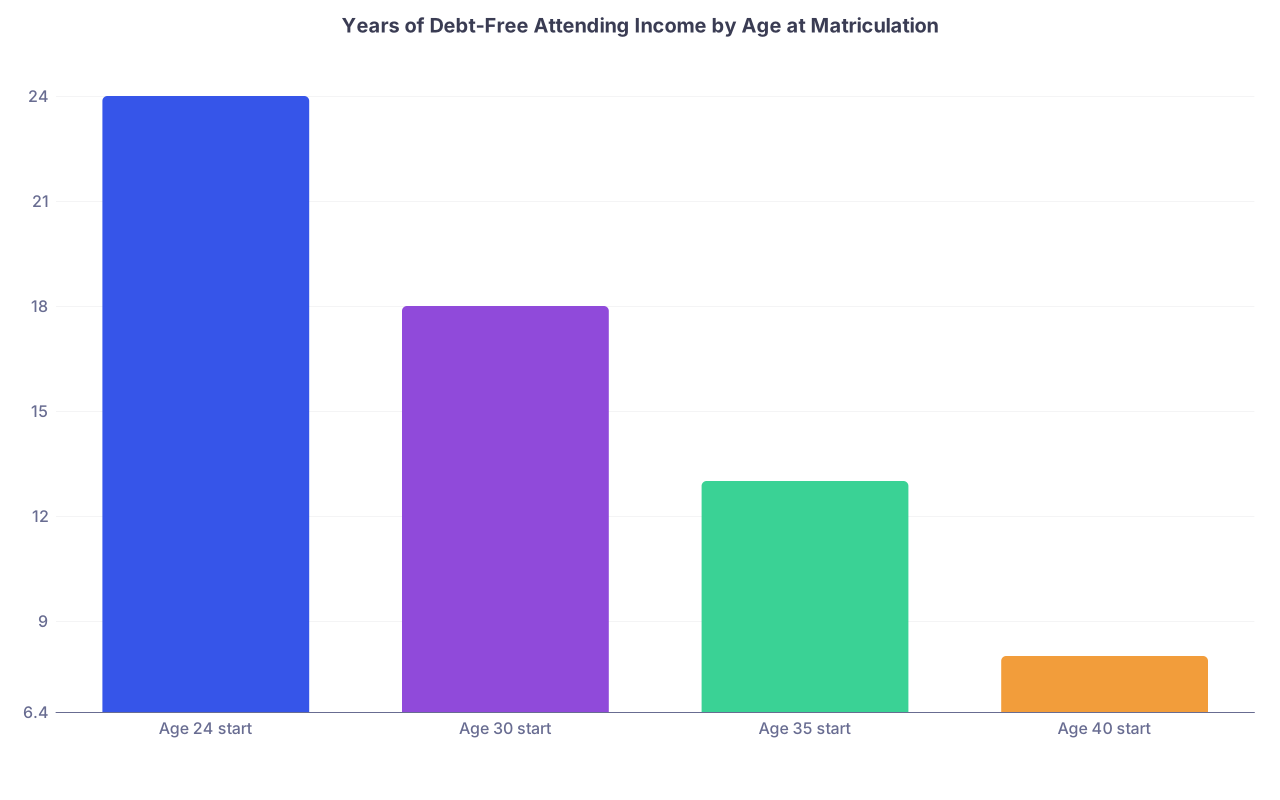
| Category | Value |
|---|---|
| Age 24 start | 24 |
| Age 30 start | 18 |
| Age 35 start | 13 |
| Age 40 start | 8 |
Interpretation:
- Age 24 start: Attending by ~31, loans done by ~41. You get ~24 debt‑free attending years (41–65).
- Age 30 start: Attending by ~37, loans done by ~47. ~18 debt‑free years.
- Age 35 start: Attending by ~42, loans done by ~52. ~13 debt‑free years.
- Age 40 start: Attending by ~47, loans done by ~57. ~8 debt‑free years.
If your plan is to shift to part‑time or retire by early 60s, starting after 40 compresses your debt‑free runway into less than a decade in this standard payoff model. That is not “impossible.” It just demands much tighter budgeting and almost no room for big financial detours (failed practice, long unemployment, late divorce).
For late‑40s entrants, the math gets especially harsh. You can still do it, but from a pure financial perspective, there are usually better ways to pivot into meaningful work in healthcare than full MD/DO at that age.
9. Specialty Choice: Yes, It Matters
The cliché that “you should pick a specialty only based on passion” ignores the most obvious dataset available: pay differences of $150k–$300k per year for decades.
Quick snapshot (rough U.S. averages, heavily rounded):
| Specialty | Median Salary (Approx.) |
|---|---|
| Family Medicine | $230k |
| Pediatrics | $230k |
| Internal Medicine | $260k |
| Psychiatry | $280k |
| Emergency Medicine | $370k |
| Anesthesiology | $420k |
| General Surgery | $420k |
| Orthopedic Surgery | $650k+ |
Now combine that with age.
A 42‑year‑old new attending:
- At $230k peds salary, net maybe ~$160k, then subtract $60k–$80k in loans for a decade.
- At $400k+ surgical/anesthesia salary, net maybe ~$275k, subtract the same $60k–$80k and still have $200k left.
I am not arguing that every late‑career switcher should chase ortho. Many are not competitive or interested. But pretending the numbers do not matter is self‑deception.
For someone entering medicine at 38 with two children, $0 retirement, and $400k in upcoming loan principal, choosing a consistently lower‑paid outpatient specialty purely on idealism is a financial bet with very narrow margins. Sometimes it is still the right one. But make it as a conscious choice, with eyes open to the data.
10. Concrete Example: Two Late‑Career Paths
Let me lay out two composite cases I have actually seen versions of.
Case A – Age 33, PSLF‑Aligned, Reasonable Savings
- Age: 33 at matriculation
- Existing retirement: $150k
- No other student debt; modest mortgage supported by spouse’s income
- Med school debt: $360k at graduation → ~$400k start of residency
- Career: Internal medicine → academic hospitalist ($250k–$270k), PSLF‑eligible
Plan:
- SAVE throughout residency and 7 attending years
- 10 total PSLF qualifying years → forgiveness in early 40s
- Continue to max retirement accounts (~$40k+/year combined) once attending
Outcome (rough):
- Total loan payments: ~$170k–$190k before PSLF wipe
- Retirement accounts by 65: original $150k growing + 20+ years of consistent contributions → $2M–$3M+ realistic
- Life: financially stable, not extravagant, but not wrecked. Medicine is expensive, but PSLF makes it workable.
Case B – Age 42, No PSLF, Modest Income Specialty
- Age: 42 at matriculation
- Existing retirement: $50k
- Med school: expensive private, high COL → $420k at graduation → ~$475k attending start
- Career: Outpatient family medicine in private practice ($230k–$250k), no PSLF
- Chooses SAVE for comfort, never consolidates into PSLF path
Plan (or lack thereof):
- IDR payments around $20k–$25k/year as attending
- No serious extra payments
- Expects forgiveness at 20–25 years with tax bomb
Outcome rough math:
- Age at forgiveness: mid‑ to late 60s
- Total IDR payments over 20 years: ~$400k–$500k (depending on raises)
- Tax bomb: ~$100k–$150k
- Total outlay: ~$500k–$650k on $475k loan, stretching across the entire remaining career
- Retirement: Needs to save aggressively in 50s and 60s just to get to a modest number
Financially, this is barely viable. It might still be subjectively “worth it” to that person. But the window for major errors is gone. Divorce, disability, job loss, parent care obligations—they all hit harder when your loan tail reaches into retirement.
11. How to Actually Plan Your Scenario
Here is how I would structure the decision if you are a late‑career premed seriously considering this path:
- Build a realistic 15–25‑year cash‑flow model. Use actual tuition quotes, local living costs, realistic resident/attending salaries for your top 2–3 target specialties.
- Include your spouse’s income, kids, and tax status. These dramatically change IDR payment amounts.
- Decide upfront: Are you willing to pursue PSLF via academic/nonprofit work for at least 10 years? If “yes,” model PSLF as the primary repayment plan. If “no,” plan for aggressive payoff as attending.
- Stress‑test the model. What if your attending salary is 20% lower than expected? What if interest rates rise 1–2 points? Can your plan still work?
- Compare to your current non‑medical path. Project your current career forward with reasonable promotion/raise assumptions. Medicine is not the only path to meaningful, decently paid work.
- Adjust for non‑financial factors last, not first. Fulfillment, autonomy, identity—they matter. But do not let them erase a structurally impossible financial plan.
To visualize the planning steps:

| Step | Description |
|---|---|
| Step 1 | Considering Medicine |
| Step 2 | Model PSLF Path |
| Step 3 | Model Aggressive Payoff |
| Step 4 | High Risk: Reassess School Cost or Path |
| Step 5 | 10-Year Nonprofit Commitment |
| Step 6 | Plan 7-10 Year Payoff |
| Step 7 | Consider Alternatives or Delay |
| Step 8 | Age at Start |
| Step 9 | PSLF Willing? |
| Step 10 | Debt <= $400k? |
Key Takeaways
- The data shows that for late‑career switchers with high debt, PSLF or aggressive payoff are the only two strategies that reliably make financial sense. Long‑term IDR without PSLF is usually a trap.
- Age and specialty choice radically reshape the payoff window. Starting after 40 with $400k+ in debt and no PSLF requires near‑perfect execution to avoid severe retirement squeeze.
- You cannot fix a bad loan scenario with “passion.” You can only fix it with structure: accurate projections, deliberate choice of employer type, and a repayment plan you commit to from day one of residency.