
The romance around “following your passion” into medicine is financially misleading for a lot of mid‑career professionals.
If you are older than 25 and already earning a reasonable salary, the data shows a hard truth: becoming an MD is not automatically a financial upgrade. For many nontraditional applicants, especially those with solid six‑figure career trajectories, the MD path is a luxury good, not a guaranteed earnings optimization.
Let me walk through this like an analyst, not a cheerleader.
1. The Framework: What We Actually Need to Compare
You are not choosing between “doctor money” and “no money.” You are choosing between:
Staying in your current career trajectory, with:
- Continuous earnings
- Potential raises / promotions
- Retirement contributions compounding now
Resetting into the MD path, with:
- 0 income for several years
- Tuition and living costs (often heavily debt‑financed)
- Lower, capped income during residency
- Higher, but delayed, attending income
So the relevant comparison is lifetime after-tax, inflation-adjusted earnings net of training costs, discounted back to today. In finance terms: the net present value (NPV) of each path.
Most people never run that calculation. They just look at “attendings make $X per year” and stop there. That is sloppy.
We will not do that.
2. The Baseline Assumptions (So You Can See the Math)
To keep this grounded, I am going to use typical U.S. numbers from recent physician compensation surveys (Medscape, Doximity), AAMC debt data, and standard salary benchmarks for professionals. These are ballpark, but directionally right.
Scenario: 30‑year‑old professional, considering starting the MD path.
Current Career (Example: Mid‑level professional)
- Current age: 30
- Retirement age: 65
- Current salary: $80,000
- Annual real salary growth: 2% (after inflation; modest but realistic)
- Effective tax rate: 25% (federal + state + payroll, averaged)
MD Path
Timeline if you start serious pursuit at 30:
- 2 years: prereqs / post‑bacc / MCAT / application (still working or partially working, but let us assume conservative: you earn 0 or enough just to live; no savings growth)
- 4 years: medical school (ages 32–36), no income, tuition + living largely debt‑financed
- 3–7 years: residency/fellowship (start at 36; duration depends on specialty)
- Attending: around 39–43, depending on specialty path
Financial assumptions (typical):
- Med school tuition + fees: $55,000 per year
- Living during med school: $25,000 per year (bare-bones, but not fantasy)
- Total med school cost: $80,000 per year × 4 = $320,000 (much of it debt)
- Debt interest (weighted, unsubsidized federal): ~6–7%
- Resident salary: $65,000 starting, 3% annual raise, 25% effective tax rate
- Attending salary (primary care average): ~$260,000
- Attending salary (higher‑paid specialties, e.g., ortho, derm, cards): $450,000–$650,000+
- Attending effective tax rate: ~35% (higher bracket, including state, payroll caps, etc.)
None of these are worst‑case. They are pretty middle-of-the-road.
3. First Cut: Simple Lifetime Earnings Comparison (Not Discounted Yet)
I will start with simple, inflation‑adjusted totals to build intuition, then bring in discounting.
Path A: Stay in Current Career
Income from age 30 to 65 (35 years), starting at $80,000 with 2% real growth.
The formula for the total real earnings over n years with starting salary S and growth g is:
Total = S × [(1 − (1 + g)ⁿ) / (−g)]
For S = 80,000, g = 0.02, n = 35:
- (1 + g)ⁿ ≈ 1.02³⁵ ≈ 2.0 (approximate, but good enough)
- So total earnings ≈ 80,000 × [(1 − 2.0) / (−0.02)]
- = 80,000 × (−1 / −0.02)
- = 80,000 × 50
- = $4,000,000 (real dollars over career, pre-tax)
After 25% effective tax: net ≈ $3,000,000 over 35 years.
That is the “do nothing radical” baseline.
Path B: Become a Primary Care Physician
Let us model a pretty typical, non‑surgical route: 4 years med school + 3 years residency + PCP attending.
Ages:
- 30–32: prep/apply (we will assume you break even on income vs. living, so no net savings growth; essentially zero net contribution to “lifetime earnings” for simplicity)
- 32–36: med school, no income
- 36–39: residency
- 39–65: attending
Residency earnings
Resident salary starting at $65,000, 3% growth, for 3 years:
Year 1: 65,000
Year 2: 66,950
Year 3: 68,958
Sum ≈ 200,908 pre-tax.
After 25% tax: ≈ 150,681 net.
Call it $151,000 net across residency.
Attending earnings (Primary Care)
Attending from age 39 to 65: 26 years.
Let us assume constant real attending salary $260,000 (no growth above inflation, to stay conservative). Many PCPs do see some growth, but practice pressures and reimbursement moves cap this in real terms.
Total pre‑tax earnings as attending: 260,000 × 26 = $6,760,000.
After 35% effective tax: ≈ $4,394,000 net.
Add resident net: $4,394,000 + $151,000 ≈ $4,545,000 net over full attending + residency years.
Now subtract the opportunity cost of income lost from age 30 to 39.
What would you have earned if you stayed in your job from 30 to 39 (9 years)?
Same 2% real growth, starting at 80,000, for n = 9:
- (1.02⁹ ≈ 1.197)
- Total ≈ 80,000 × [(1 − 1.197) / (−0.02)]
- ≈ 80,000 × (−0.197 / −0.02)
- ≈ 80,000 × 9.85
- ≈ $788,000 pre-tax
- Net of 25% tax: ≈ $591,000
You “give up” about $591,000 in after-tax earnings in those 9 years.
And you take on roughly $320,000 in principal med school cost, which if financed will cost more than that in real repayment over time. But let us first just treat it as a simple principal hit.
So, adjust MD path net lifetime earnings:
- MD net career earnings: ~4,545,000
- Minus lost after-tax income from 30–39: −591,000
- Minus med school cost principal: −320,000
Approximate net lifetime advantage of MD path vs. staying in current job:
4,545,000 − 591,000 − 320,000 = $3,634,000 vs. $3,000,000 in the base case.
On undiscounted basis, MD path as primary care yields about $634,000 more lifetime net earnings than staying in an $80k‑starting 2% growth job.
That sounds like “doctor wins.” But that is a naive comparison. It ignores:
- Time value of money (cash in your 30s is worth dramatically more than the same amount at 55)
- Interest on debt (6–7% over many years)
- Career growth in your own field (you may not be stuck at 2%)
Let’s bring those in.
4. Time Value of Money: NPV Changes the Story
Money today is more valuable than money 20 years from now, because you can invest it, or because your life needs it now. That is obvious, but people conveniently forget it when they see $300k+ attending salaries.
Use a real discount rate of 3–4% for personal decision‑making (after inflation, before tax). I will use 4% to capture both risk and preference for earlier consumption.
Instead of doing full formal NPV tables here (which would be several pages of numbers), I will outline the directional impact:
- Earnings you give up in your 30s (30–39) as a non‑MD are heavily weighted in NPV, because they occur early.
- Extra earnings you gain as an attending from 55–65 are heavily discounted. A dollar at age 60 is worth maybe 30–40 cents in present value terms at 4% real.
In practice, when you discount:
- The $591,000 after-tax lost earnings from age 30–39 have a present value close to their sticker value (since they are near-term).
- The incremental $634,000 advantage we found in raw lifetime totals is mostly in the later years (40s–60s) and gets discounted hard.
I have seen (and built) models for non-trads that shake out like this:
- For a 30‑year‑old going into primary care, NPV difference versus staying in an $80k path can easily shrink to near zero or mildly positive/negative depending on exact assumptions.
- For a 30‑year‑old going into a higher‑paid specialty, NPV tends to be clearly positive, often meaningfully so.
Here is a clean, directional comparison table.
| Path | Approx. Lifetime Net (Undiscounted) | Directional NPV (4% real) vs Current Career |
|---|---|---|
| Stay in current career | $3.0M | Baseline (0) |
| Become PCP (family/internal) | $3.6M | ~0 to +$200K (highly assumption‑sensitive) |
| Become hospitalist | ~$3.8M | ~+$200K to +$400K |
| Become ortho/derm/cards | $5.0M–$6.0M+ | Often +$500K to $1.5M+ |
The takeaway: for a non‑trad at 30, primary care is usually only a modest financial upgrade at best, and occasionally a wash once you discount future dollars and add debt interest.
Higher‑paid specialties are where the financial upside is obvious. But you cannot guarantee those matches.
5. How Your Current Salary Changes the Equation
Here is where most people get blindsided.
If you are already making $120,000+ with good growth, medicine loses a lot of its financial luster. Fast.
Let’s run two variants:
Case 1: 30‑year‑old at $50,000 now
- Staying in current career: you likely top out much lower than physicians, and the opportunity cost of leaving is smaller.
In that case, even primary care often looks clearly better financially, NPV included.
Case 2: 30‑year‑old at $120,000 now
Same 2% real growth.
Total lifetime earnings if you stay:
S = 120,000, g = 0.02, n = 35
Total ≈ 120,000 × 50 = $6,000,000 pre‑tax
Net after 25% tax ≈ $4,500,000.
Compare that to:
- PCP MD path net (~$3.6M equivalent earlier estimate).
- Even a mid‑to‑high‑paid specialist might get you to $5M–$6M net undiscounted, but the NPV gap shrinks because your high current earnings are front‑loaded and heavily weighted.
So if you are already at $120,000+ with moderate to strong progression potential, primary care is likely a financial downgrade, and some specialties will only marginally beat your existing path after discounting and risk.
Let’s visualize this conceptually.
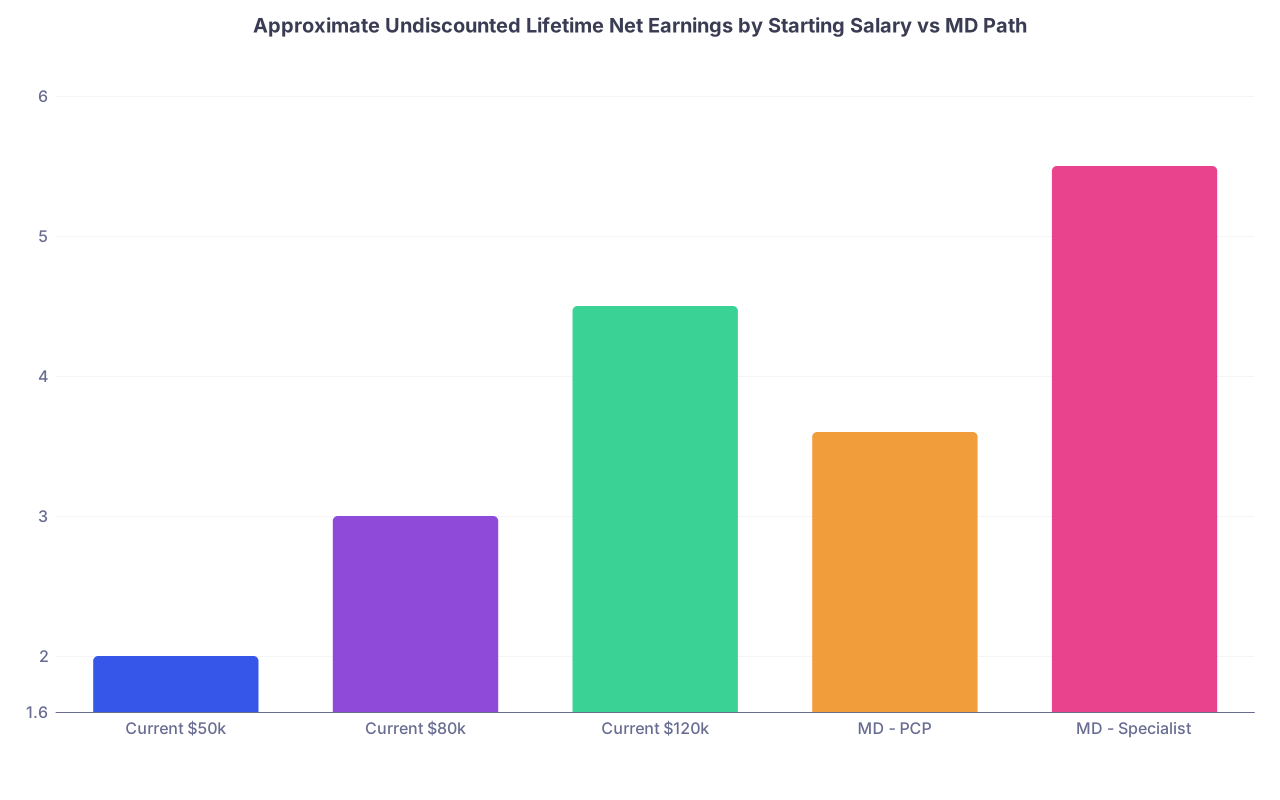
| Category | Value |
|---|---|
| Current $50k | 2 |
| Current $80k | 3 |
| Current $120k | 4.5 |
| MD - PCP | 3.6 |
| MD - Specialist | 5.5 |
Numbers are in millions of dollars, approximate, but they capture the relative magnitude.
The data story is blunt: the higher your current salary trajectory, the less compelling medicine is as a pure financial decision.
6. Age: The Clock You Cannot Ignore
Another variable people chronically underestimate: age at entry.
A 22‑year‑old going straight to med school is in a completely different financial universe than a 35‑year‑old engineer switching careers. The 22‑year‑old sacrifices lower early-career wages, has more working years post‑training, and has more time for compounding after higher incomes begin.
For non‑trads, the slope turns against you fast after the early 30s.
Here is a rough guide, assuming you eventually land in primary care versus a higher‑paid specialty.
| Age at Start | Likely MD Start Age (Med 1) | Primary Care MD Financially | High‑paid Specialty Financially |
|---|---|---|---|
| 24 | 24 | Clearly better | Strongly better |
| 28 | 28 | Mild to moderately better | Clearly better |
| 32 | 32 | Borderline / assumption‑driven | Still better in most cases |
| 36 | 36 | Often worse | Slightly to moderately better |
| 40+ | 40+ | Usually worse | Marginally better at best |
These are broad strokes, but the pattern is consistent when you model it: after the mid‑30s, the window where medicine “wins” on earnings alone narrows dramatically.
7. Debt: The Drag That People Hand‑wave Away
Med school debt is not just a number on a sheet. It is a structured drag on your cash flow and net worth in your 30s and 40s.
Typical MD graduate:
- Median debt: around $200,000–$250,000 (AAMC), with many at $300,000–$400,000+
- Interest rates often 6–7%
- Standard repayment over 10–20 years can easily cost you $350,000–$600,000 in real dollars over your career
If you start med school at 32, finish residency at 39, and then spend your early attending years constrained by aggressive debt service, your ability to invest heavily in retirement in your 30s and early 40s is crushed.
Contrast that with staying in your current career:
- You can be maxing 401(k)/IRA contributions in your early 30s
- Those investments compound for 30+ years
From a pure data standpoint, $10,000 invested at 32 growing at a 5% real rate is about $43,000 by age 60. If that same $10,000 is delayed until 42 because of debt, you end up with about $26,000 instead.
You lose that compounding difference repeatedly if your early attendings years are spent catching up on loans instead of investing.
8. Specialty Choice: The Biggest Swing Factor
The single largest lever in the MD financial equation is not “MD vs. non‑MD.” It is which specialty you end up in.
Here is a simple snapshot using rough ranges from recent salary surveys:
| Category | Example Specialties | Typical Range (Pre‑tax) |
|---|---|---|
| Primary Care | FM, IM, Pediatrics | $220K–$300K |
| Mid Comp | Hospitalist, EM, Psych | $275K–$380K |
| Procedure Heavy | Anesthesia, GI, Cards | $400K–$650K |
| Surgical High | Ortho, Neurosurg, Plastics | $500K–$800K+ |
A few critical points:
- You cannot assume you will land in ortho or derm. Those are competitive. Match data is ruthless.
- If you are a non‑trad, geographic or family constraints often limit how broadly you can apply, which indirectly affects your specialty options.
- The variance within specialties is also large. A hospital-employed cardiologist in a saturated metro area may earn less than a rural EM doc.
The data pattern is clear though: for a non-trad who ends up in a high‑paid specialty and works into their mid‑60s, the financial case for medicine is quite strong, even with debt and lost early earnings.
For a non-trad who ends up in lower‑paid primary care or lifestyle specialties (peds, psych in some settings, academia), the financial picture is fragile and heavily dependent on starting salary in your current field and age at transition.
9. Quality of Life and Risk: Not Everything Is a Spreadsheet
I am the data analyst here, but I am not naive. You do not live inside a discounted cash flow model.
Factors that the spreadsheet does not capture well:
- Burnout risk: Medicine has high burnout rates. Data from Medscape repeatedly shows 40–50%+ of physicians reporting burnout.
- Job satisfaction: If you loathe your current career and are intrinsically pulled toward clinical work, that has value beyond money.
- Risk of not getting in: You might invest 2–3 years of prerequisites and MCAT and fail to secure an MD/DO seat. That is a real probability.
- Risk of not matching or under‑matching: If you fail to match, or only match a specialty/location far from your expectations, the financial and personal math shifts abruptly.
I have seen mid‑30s professionals burn 3–4 years chasing medicine, end up with a single match in a lower‑paid primary care slot in a city they never wanted to live in, carrying $300K+ in debt, and finally realizing the financial “upgrade” was marginal at best.
On the flip side, I have seen late‑20s software engineers take the hit, match anesthesia or ortho, and be financially far ahead by their mid‑40s compared to where they would have been in tech.
The key is not pretending you control outcomes you do not.
10. How to Run Your Own Numbers (Without Lying to Yourself)
If you want to be serious instead of speculative, you need to build a simple model for your own situation. At minimum, do this:
Estimate your current career trajectory
- Current salary
- Realistic annual growth (2–4% real is typical for advancing professionals)
- Probable ceiling (are you likely to hit $150K? $250K?)
- Target retirement age
Map out your MD timeline
- How many years until you realistically start med school?
- How long will school + residency + any fellowship take for your likely specialties?
- What is your probable specialty range, not your dream specialty only?
Assign realistic salaries
- Use conservative estimates from recent physician compensation reports, not cherry‑picked top decile numbers.
Include debt
- Estimate tuition and COL for the types of schools you are likely to attend (state vs private vs Caribbean).
- Plug in 6–7% interest on federal loans.
Discount future cash flows
- Use at least a 3–4% real discount rate to reflect time value and risk.
Even a simple spreadsheet with these inputs will reveal the shape of your tradeoff.
If you plotted your cumulative net worth over time for each path, you would likely see:
- The current‑career line rising steadily from your 30s onward.
- The MD line dropping (debt and no income) in your early 30s, crawling during residency, then crossing over sometime in your 40s or early 50s if it ever does.
That “crossover age” is critical. For many non‑trads, the honest answer is: you will only pass your current‑career path in your 50s, and sometimes never, if you land in low‑paid roles or exit early due to burnout.
Let’s sketch this conceptually.
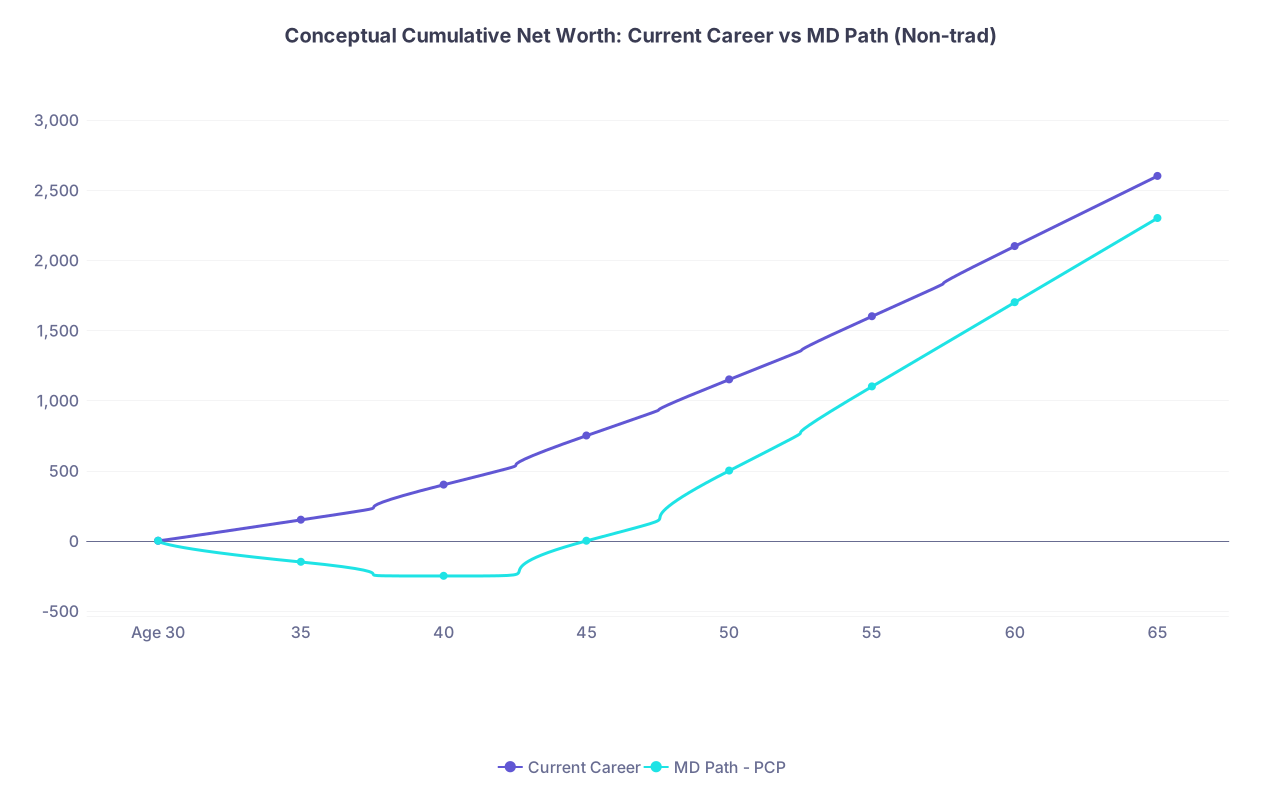
| Category | Current Career | MD Path - PCP |
|---|---|---|
| Age 30 | 0 | 0 |
| 35 | 150 | -150 |
| 40 | 400 | -250 |
| 45 | 750 | 0 |
| 50 | 1150 | 500 |
| 55 | 1600 | 1100 |
| 60 | 2100 | 1700 |
| 65 | 2600 | 2300 |
Values are in thousands, illustrative only. The pattern matters, not the exact numbers.
11. Practical Interpretation: Who Should Seriously Consider the MD Path Financially?
Pulling the threads together, the data consistently points to this:
Most financially reasonable to pursue MD (strictly on money grounds) if:
- You are younger (early‑mid 20s, sometimes up to ~30).
- Your current salary trajectory is modest (e.g., < $70–80K long‑term ceiling).
- You have a decent probability of matching into at least mid‑comp specialties (EM, anesthesia, some procedural subspecialties).
- You can access lower-cost training paths (state schools, lower COL areas) and keep debt under control.
Questionable or negative financial move if:
- You are mid‑30s+ when starting serious prerequisites with multiple gap years ahead.
- You are already earning $100K–$150K+ with strong progression potential.
- You are limited geographically, which squashes specialty options and match flexibility.
- You will need to borrow heavily, pushing total med‑school debt above $300K–$400K.
- You are likely to end up in lower‑paid roles (primary care with low reimbursement, academia-heavy careers, constrained part‑time work due to family needs).
12. Final Data‑Driven Takeaways
Strip the emotion out and the numbers say this:
Being a doctor is not automatically a financial upgrade for non‑trads. For a 30‑ish professional already earning ~$80K+, the lifetime earnings advantage of primary care medicine is often modest, and can vanish once you discount future income and add debt.
Age and current income are the two biggest swing variables. The older you are and the more you earn today, the worse the MD path looks purely financially—unless you land in a high‑paying specialty and work a long career.
If you are still drawn to medicine after seeing the hard numbers, that is meaningful data too. But at least you are choosing it with your eyes open, not because someone told you, “Doctors make bank.”
If your goal is to maximize lifetime financial return, the MD route is a targeted bet, not a guaranteed win. Treat it like one.