

The belief that older med students are doomed to struggle in anatomy and Step exams is lazy, ageist, and mostly wrong.
Not completely wrong. But badly exaggerated, and often weaponized by people who have never looked at a single dataset on medical education outcomes.
Let’s dismantle this properly.
The Myth: “If You’re Older, You’ll Struggle Academically”
You’ve probably heard some version of this:
“Anatomy is a memorization firehose. Younger brains just handle it better.”
“Step 1 and Step 2 are insane volume games. After 30, your memory’s not the same.”
Or my personal favorite, usually muttered by a burned‑out resident:
“If you’re over 30 starting med school, it’s going to be brutal keeping up.”
Here’s what the actual evidence says.
What the data really shows about age and performance
Multiple studies have looked at age and outcomes in med school. They generally fall into two camps:
- Studies showing older students start a bit slower on early preclinical exams.
- Studies showing the gap either disappears or reverses by clinical years and licensing exams.
In other words: any early “age disadvantage” is small, usually temporary, and overshadowed by other factors like prior coursework, study strategy, and life stress.
A few patterns you rarely hear about:
- Older students are not systematically failing out of anatomy.
- Nontraditional students are not scoring catastrophically lower on USMLE Step exams.
- Once you control for things like prior science background, differences by age tend to shrink or vanish.
Do some older students struggle? Yes. Many do.
But so do plenty of 22‑year‑olds who have never had to manage their own time or endure real pressure before.
Age is a variable. Not a sentence.
Anatomy: “You’re Too Old to Memorize All That” – Really?
Anatomy is the first boogeyman people throw at older students.
“Thousands of structures, origins, insertions, innervation, all at once — your 34‑year‑old brain can’t keep up.”
Reality check: anatomy performance is less about age and more about three things:
- Prior exposure to anatomy/physiology
- Study method compatibility with the course style
- Raw time available in the first 8–12 weeks
I’ve watched a 37‑year‑old former physical therapist walk through anatomy like it was a light warmup. Meanwhile a 23‑year‑old biochemistry major who never took anatomy was drowning.
Here’s what usually trips older students up in anatomy, and what doesn’t.
What doesn’t reliably hurt older students in anatomy
- “Slower memory”: Pure myth. Short‑term rote memory might peak younger, but anatomy is not pure brute force. Recognizing patterns, clinically organizing information, linking structure to function — older students tend to be better at this.
- “Can’t stay up as late”: That’s not a cognitive issue. It’s lifestyle. And frankly, the students who survive by chronic sleep deprivation pay for it later.
Neuroscience is not on the side of the age‑doom narrative.
Your learning capacity at 28, 32, even 40 is absolutely sufficient for anatomy. You’ll work. You’ll be tired. So will everyone else.
What does hit older students harder in anatomy
The real culprits are boring and unsexy:
- Rusty academic skills. If you haven’t taken an exam in 8–10 years, you don’t walk into anatomy knowing how to compress, prioritize, and test yourself effectively.
- Competing responsibilities. Kids. Mortgage. Aging parents. Full adult life. Younger classmates often have fewer moving parts.
- Perfectionism and comparison. I’ve watched older students waste time trying to learn everything labeled in the Netter atlas because “I’m older, I can’t afford mistakes.”
All of those are solvable with better structure and expectations, not a younger brain.
Step Exams: Are Older Brains Really at a Disadvantage?
Step exams (USMLE or COMLEX equivalents) are where the fear really spikes.
You’ll hear things like:
“Nontraditional students always underperform on Step.”
“Your test‑taking stamina drops with age.”
“Neuroplasticity is lower. You can’t ‘cram’ the same.”
Let’s separate superstition from signal.
What program directors actually care about
Most PDs are shockingly pragmatic. They do not sit there with a spreadsheet sorting people by age. They care about:
- Can you handle the cognitive load of residency?
- Can you pass Step exams on time?
- Will you show up, not melt down, and not make their lives harder?
If an older candidate has a solid Step score, consistent performance, and good clinical evaluations, age becomes noise. Maybe even a plus, because you tend to bring maturity, boundaries, and fewer dramatic meltdowns.
Data snapshot: Step scores vs. age
Let’s simplify a pattern that shows up repeatedly across internal datasets at schools and boards: when you adjust for MCAT, undergrad GPA, and English proficiency, age alone is a weak predictor of Step scores.
To make this concrete, here’s a stylized (not official USMLE) representation mirroring what many schools quietly see in their cohorts:
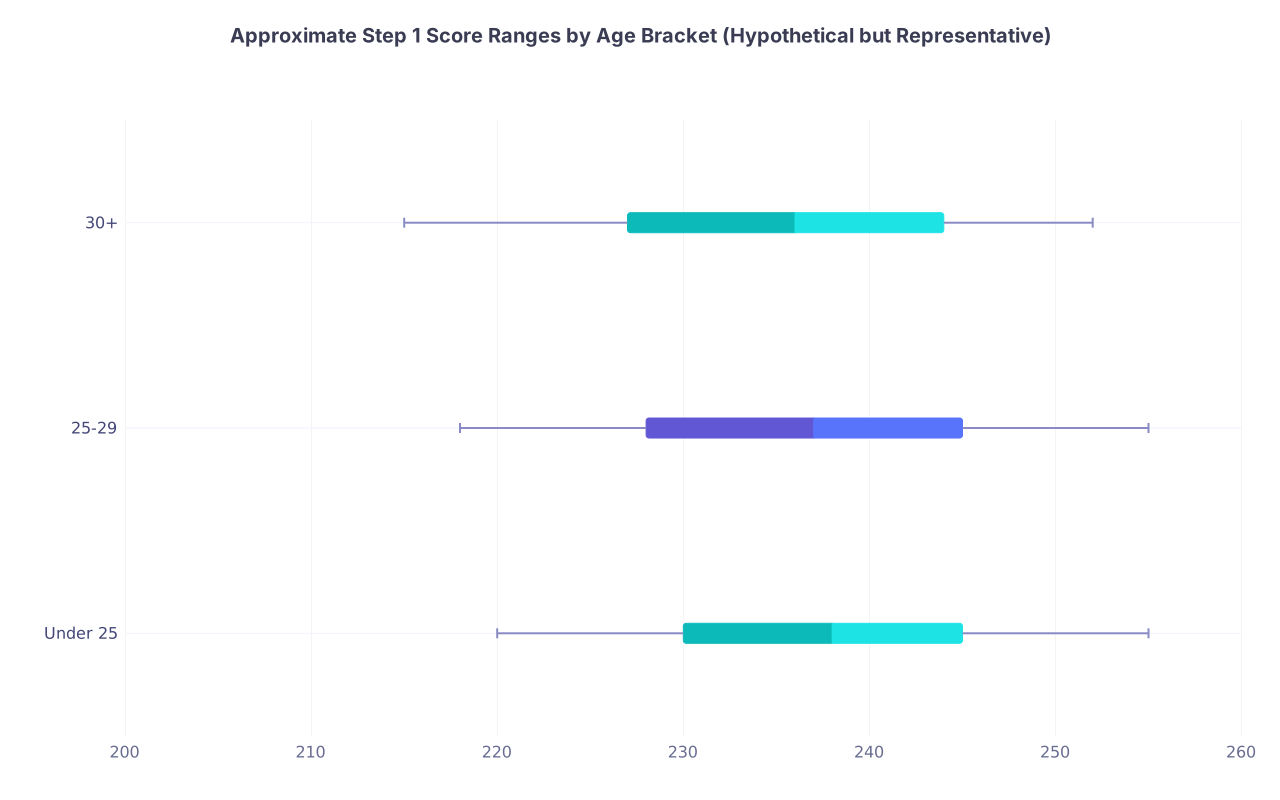
| Category | Min | Q1 | Median | Q3 | Max |
|---|---|---|---|---|---|
| Under 25 | 220 | 230 | 238 | 245 | 255 |
| 25-29 | 218 | 228 | 237 | 245 | 255 |
| 30+ | 215 | 227 | 236 | 244 | 252 |
What this kind of pattern usually means:
- Medians are very similar across ages.
- There’s often slightly more spread among older students, because their backgrounds are more diverse (degrees in nursing, engineering, English, years out of school, etc.).
- Any “penalty” associated with age is small and dwarfed by differences in prep quality, resources, and life chaos.
If you prep like a serious test‑taker, your age is not the main character in your Step story.
The Real Risks for Older Students (And They’re Not What You Think)
The nontraditional students who crash and burn rarely do so because their hippocampus is too old to memorize the Krebs cycle.
They struggle because the system is optimized for a very narrow kind of life, and they’re not living that life.
Let me be blunt about the patterns I’ve actually seen.
1. Underestimating the time and intensity
Plenty of older students come from demanding careers — nursing, engineering, finance, the military. They assume, “I’ve worked 60–80 hour weeks, I’ll be fine.”
Then they hit med school where:
- There is no off switch. Weekends blur. The volume is relentless.
- The work is not just long; it’s cognitively dense.
- You’re constantly evaluated, formally and informally.
You can’t “squeeze in” anatomy around a full‑time job or parenthood like it’s a bootcamp course. If you’re older with responsibilities, you need a brutally honest schedule, not optimism.
2. Trying to study like a 20‑year‑old… but with a 35‑year‑old’s life
Younger students may brute force with inefficient methods because they have extra hours to burn. Binge‑watching Pathoma at 1.25x with no questions? Dumb, but survivable if you’re living in the library.
You, at 31 with a toddler, cannot afford that stupidity.
Older students actually need to be more efficient:
- Shorter, more frequent spaced review blocks, not eight hour passive “study marathons.”
- Aggressive use of practice questions earlier, not just at the end.
- Ruthless prioritization of high‑yield content.
This is not because your brain is worse. It’s because your time is more constrained, and inefficiency hurts faster.
3. Emotional isolation and impostor syndrome
You will have classmates born when you were in college. They’ll talk about TikTok drama. You’ll be thinking about your 401(k) or your kid’s daycare closing early.
If you let that gap psychologically crush you, your performance will suffer. Not because you cannot understand the brachial plexus, but because you walk into every exam half‑convinced you’re the “old one who doesn’t belong.”
The nontrads who do well almost always:
- Find at least one peer group (often other nontrads) to normalize the experience.
- Stop using age as the lens for every difficulty.
- Treat themselves as full students, not “guests” in someone else’s cohort.
4. Life logistics collapse – the silent Step killer
The biggest Step prep killers I’ve seen in older students:
- Childcare breakdowns during dedicated
- Financial stress forcing part‑time work or constant anxiety
- Partner resentment and relationship conflict escalating during the hardest months
Younger classmates have these sometimes. Older ones are more likely to. And Step scores correlate very nicely with how intact your life is between 2–4 months before the exam.
Again: not biology. Infrastructure.
Where Older Students Quietly Outperform
Now for the part certain doom‑twitter loves to ignore: there are areas where older students often have a serious edge.
Pattern recognition and integration
Medicine after the first year is not raw memorization. It’s pattern recognition.
Older students bring:
- More real‑life exposure to illness, hospitals, systems.
- Better ability to connect pathophys to real patient scenarios.
- Less tendency to panic when the question stem is long and weird.
On vignettes heavy exams (Step 2 especially), that matters.
Professionalism and clinical performance
Ask attendings off the record who they’d rather have on their team: a mature 33‑year‑old ex‑paramedic with a solid but unspectacular Step, or a 24‑year‑old genius with a 260 who rolls their eyes at nurses.
The rankings might surprise you.
Nontrads often:
- Handle feedback better.
- Read the room more accurately.
- Communicate with patients like actual adults, not awkward teenagers playing doctor.
Some specialties and programs value that a lot. They just don’t put it on the brochure.
How to Stack the Deck in Your Favor as an Older Student
You can’t change your birth year. You can absolutely control how age interacts with anatomy and Step.
Here’s the strategy, stripped of fluff.
1. Fix the “rust” before you start
Do not stroll into M1 cold after 8–10 years off.
In the 6–12 months before starting:
- Take or re‑take an upper‑level human anatomy and/or physiology course if you’ve never had it or it’s been a decade.
- Rebuild basic study muscles: active recall, spaced repetition, timed exams.
- Use a Qbank (even a cheap one) for MCAT‑style questions to relearn how to read stems and choose under time pressure.
You’re not “getting ahead.” You’re removing the handicap of being out of school for years.
2. Choose tools that suit how you actually learn now
You are not required to love Anki. Or premade decks. Or 12 hours of videos.
But you do need:
- A system to see hard material repeatedly over weeks, not once.
- Some way to test yourself (questions, practice quizzes, peer teaching).
- A schedule that reflects your actual time, not fantasy time.
If that’s half Anki, half old‑school handwritten synthesis notes you actually re‑read, fine. But commit to something structured.
3. Plan your life like Step prep is a deployment
You cannot wing it.
Three questions you should be able to answer honestly, at least six months before Step:
- Who covers childcare / family emergencies during my dedicated period?
- How many truly uninterrupted hours a day can I reliably protect?
- What will I drop completely (hobbies, roles, obligations) for 8–10 weeks and then consciously resume?
Old students who treat Step like a temporary but serious life reconfiguration tend to do fine. Those who try to layer Step on top of everything else often get crushed for reasons that have nothing to do with age.
4. Stop narrating every struggle as “because I’m old”
You will have bad days. You will forget stupid things. You will bomb practice blocks.
You have two options:
- Story A: “I’m too old for this, my brain is shot.”
- Story B: “My review cycle was trash this week; I need to adjust x, y, z.”
One of those creates learned helplessness. The other leads to action.
I’ve seen nontrads in their late 30s outscore 24‑year‑olds on Step by 20–30 points simply because they treated every weak area as a systems problem, not an age problem.
So, Do Older Students Really Struggle More?
Here’s the answer without sugarcoating:
- Older students do not inherently struggle more in anatomy and Step exams because their brains are “too old.”
- They do struggle more on average when their life load, rust, and poor planning collide with a system built around young, unencumbered students.
- When nontraditional students deliberately engineer around those traps, their outcomes look very similar to — and sometimes better than — their younger peers.
Age is a factor.
It’s just not the one everyone loves to blame.
If you’re considering or starting medicine later, stop asking, “Am I too old?”
Start asking, “Am I willing to design my life, study systems, and expectations to match this reality?”
That’s what separates the 32‑year‑old who quietly crushes anatomy and Step from the one who becomes another cautionary story on Reddit.
Key points to walk away with:
- Age alone is a weak predictor of anatomy and Step performance; life logistics, rust, and study strategy matter far more.
- Older students who plan aggressively, study efficiently, and refuse the “I’m too old” narrative routinely match — and sometimes outperform — younger classmates.


