27% of U.S. medical school matriculants are “nontraditional” by age, yet their overall acceptance rate is only marginally higher than traditional applicants with similar stats.
So no, your years as a nurse, PA, EMT, respiratory therapist, or scribe are not your golden ticket.
They help. Sometimes a lot. But this myth that “if I’ve already worked in healthcare, schools will overlook weaker stats or a thin application” is how people burn two or three application cycles and thousands of dollars.
Let’s dismantle this properly.
What the Data Actually Shows (Not What Reddit Tells You)
You’ll see anecdotes everywhere:
“I was a nurse for 10 years, mid-3 GPA, 505 MCAT, got 6 MD acceptances.”
You know what you don’t see? The 20 nurses with similar stats who didn’t get a single interview.
A few realities:
- AAMC data repeatedly shows that GPA and MCAT are still the dominant predictors of MD admission.
- Nontraditional status or prior clinical careers can nudge you up, but they don’t rewrite the laws of selection.
- Committees don’t have a separate “nurse/paramedic/RT” acceptance quota. You’re in the same pool.
Let’s visualize something simple: strong clinical, mediocre stats vs strong stats, average clinical.
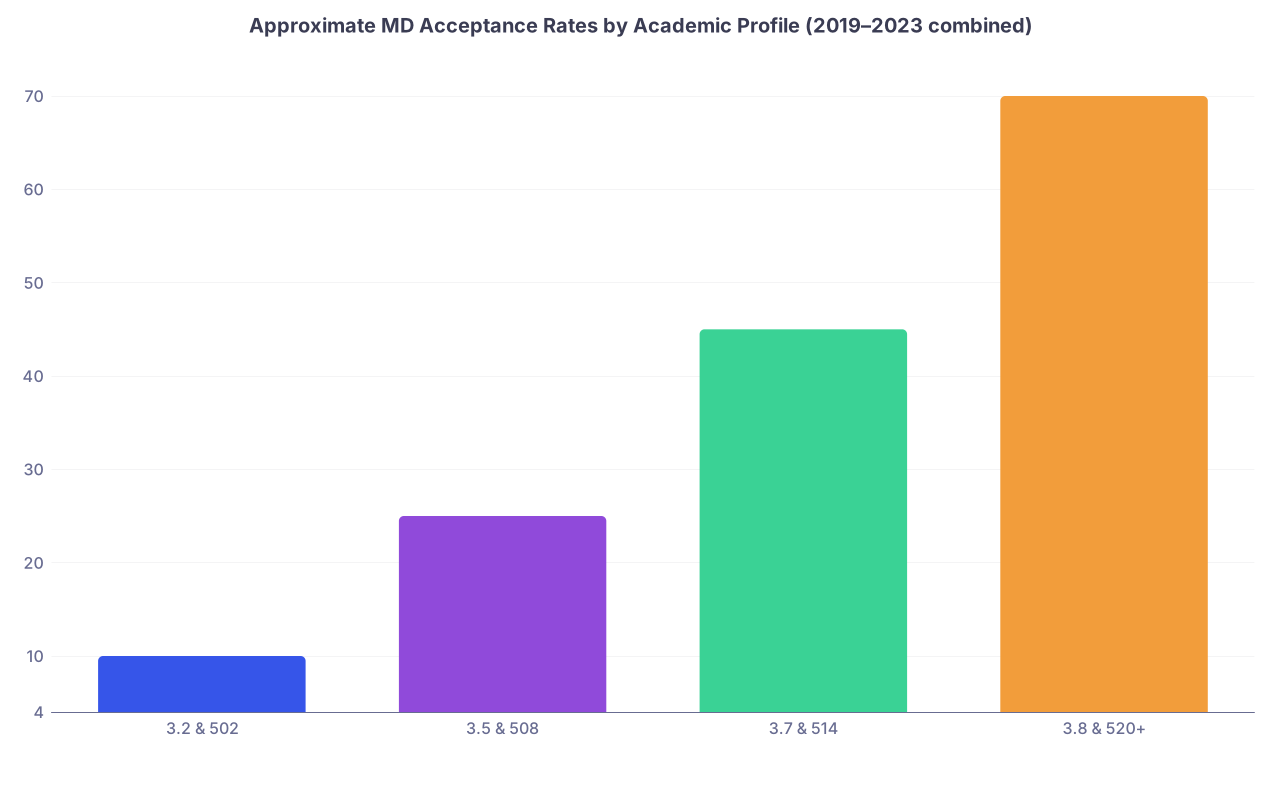
| Category | Value |
|---|---|
| 3.2 & 502 | 10 |
| 3.5 & 508 | 25 |
| 3.7 & 514 | 45 |
| 3.8 & 520+ | 70 |
Those percentages are approximate, derived from AAMC trends. Now here’s the key point:
Being a nurse, PA, EMT, or RT does not magically move you from the first bar to the last. More realistically, it nudges you within your academic bracket. Maybe that 25% range becomes 30–35% for you. Helpful. But not a guarantee, not even close.
I’ve seen admissions committee meetings where someone says, “She’s an ICU nurse, this is real clinical depth,” and the room nods.
I’ve also seen: “He’s an ICU nurse, but a 498 MCAT is too far below our threshold. We’ll be crucified by the dean if we let this through.”
Same background. Different academic realities.
What Committees Actually Think When They See Your Prior Career
Let me translate the polite brochure-speak into what’s said behind closed doors.
When adcoms see a prior clinical career, they often like it—for specific reasons:
- They assume you know what real patients look like, not shadowing-filtered versions.
- They assume you understand night shifts, codes, death, angry families.
- They assume you aren’t picking medicine because of Grey’s Anatomy.
But they also ask:
“If they’ve been in healthcare this long, why are the stats weak?”
Fair or not, they expect mature applicants to show discipline on the academic side too—especially in recent coursework.“Are they running from their current role or toward being a physician?”
A bitter, “I’m just a nurse and want more respect” tone is a massive red flag. I’ve seen that kill applications that were otherwise competitive.“Do they understand that being a doctor is not an upgraded version of their current job?”
If your essays or interviews sound like you think MD is just “RN but with orders” or “paramedic but in an office,” that reads as naïve.
So your background is a lens, not a hall pass. It changes how they interpret the rest of your file. It doesn’t exempt you from scrutiny.
The Biggest Myth: “Clinical Career = Automatic Strength in All Clinical Competencies”
People assume: “I’ve been at the bedside for years. Obviously my clinical exposure box is maxed out. I can focus on everything else.”
That’s not always how it plays out.

Here’s where prior clinical experience helps you:
- Knowing what being around sick, dying, or non-compliant patients actually means.
- Comfort working in teams, under stress.
- Realistic expectations about the grind and loss of glamour.
Here’s where it absolutely does not automatically help:
- Explaining clearly why you now want to be a physician—not just “I want more responsibility.”
- Showing that you can handle hard science coursework now, in your 30s or 40s.
- Demonstrating intellectual curiosity beyond protocols and algorithms.
- Having non-clinical service and leadership. (Yes, they still want that.)
I’ve reviewed personal statements where the entire essay was: “I’ve been a nurse for 8 years. I’ve seen X. I’ve done Y. Therefore, I should be a doctor.”
That’s not a rationale. That’s a résumé in paragraph form.
Common Nontraditional Missteps That Torpedo Applications
This is where prior clinical careers backfire—because people think the experience itself is the narrative. It’s not. It’s raw material. You either shape it or it buries you.
1. Treating Your Prior Role Like a Trump Card
If your vibe (even subtly) is:
- “I’ve already been in the trenches, so I shouldn’t have to jump through all the same hoops,” or
- “College was a long time ago; my grades shouldn’t matter as much”
you’re setting yourself up for silence on interview invites.
Adcoms are sympathetic that you’ve had a life, a job, a family. They are not willing to ignore:
- A 2.9 science GPA with no recent As in upper‑division courses.
- A 498–505 MCAT with no clear remediation or retake plan.
2. No Academic Redemption Arc
If your undergraduate performance was weak, they expect:
- A post-bacc or master’s with strong performance (mostly As).
- Recent, rigorous sciences: biochem, physiology, upper-level bio, not just “Intro Nutrition” online.
- A timeline that shows you systematically fixed your gaps, not that you said “eh, I’ll apply and see what happens.”
If your story is “I was working nights and raising kids, so my grades were bad” and then…you never went back to show you can do better? That explanation doesn’t land. The gap between narrative and evidence is where applications die.
3. Using “Healthcare Burnout” as Your Primary Motivation
You can absolutely talk about burnout. But if you sound like:
- “I’m exhausted as a nurse; being a doctor will give me more control,” or
- “I’m tired of being underappreciated; MDs are respected”
you’ve told them you don’t really understand what physicians deal with.
The honest version that works sounds more like:
- “I saw the limits of my current role…”
- “I’m drawn to diagnostic responsibility and longitudinal decision-making…”
- “I want to own the full arc of patient care…”
Not “I want to escape my current job.”
What Actually Moves the Needle for Clinical-Career Applicants
Let’s stop hand-waving and get specific about what turns “prior clinical” from a nice extra into a true advantage.
| Component | Without Clinical Career | With Strong Clinical Career |
|---|---|---|
| Clinical Exposure | Needs heavy shadowing/volunteer | Often already strong depth & breadth |
| Academic Expectations | High – recent, strong GPA/MCAT | Same – recent, strong GPA/MCAT still needed |
| Narrative Potential | Must build from limited exposure | Rich, but easy to misuse or oversimplify |
| Red Flags | Lack of exposure, immaturity | Arrogance, burnout, unclear “why physician” |
| “Fit” in Interviews | Less real-world context | Often stronger, if reflective and humble |
1. Recent, High-Level Academic Work
The single biggest myth nontraditionals cling to is: “My experience will let them overlook my numbers.”
No. The realistic version is: “My experience will make them interested enough to care about my numbers.”
You need both:
- At least 1–2 years of recent science-heavy coursework.
- A trend line that moves from weak → strong, not from weak → silence.
- An MCAT that aligns with your target tier. Not perfect. But not catastrophic.
If your last serious science class was 10+ years ago, that’s a problem. Your ICU skills don’t prove you can grind through cellular metabolism and memorize immunology pathways.
2. A Story That Evolves Beyond “I Want to Do More”
Almost every healthcare professional writes some version of:
“Over time, I realized my scope of practice limited my ability to fully care for my patients, and I wanted to take on a larger role.”
Fine. But shallow. Everyone says that.
The stronger version looks like this:
- You give concrete examples of specific situations where you hit the limits of your role.
- You show you understand how physicians think differently—diagnostic reasoning, uncertainty, risk–benefit analysis, not just following orders.
- You connect your past to what you’ve done outside of your job: shadowing physicians, research, leadership that isn’t just unit-based staffing committees.
In interviews, you should be able to answer without blinking:
- “Why MD vs NP/PA, especially given your background?”
- “What will be hardest for you about becoming a student again?”
- “What are you giving up by leaving your current role?”
If your only answer is “more autonomy, more knowledge, more responsibility,” you sound like a brochure, not a thinker.
MD vs DO vs “I’ll Just Apply Broadly and See”
Another myth: “With my experience, I won’t need DO; MD schools will love me.”
Reality: plenty of prior RNs, PAs, MTs, RTs end up thriving in DO schools. Not as a consolation prize—but because they were realistic.
Some committees—especially at mid-tier and newer MD schools—truly value nontraditional backgrounds. But they still have dean-mandated score floors. They can’t take everyone they like.
If your stats are borderline for MD, your clinical career does not magically move you from “no chance” to “top-20 contender.” It maybe moves you:
- From “automatic rejection” to “read closely.”
- From “maybe waitlist” to “interview and take seriously.”
That’s it.
Smart clinical-career applicants:
- Apply broadly to both MD and DO.
- Don’t treat DO as beneath them.
- Build an application solid enough that any school looking for maturity and experience sees them as low-risk and high-yield.
How to Actually Use Your Clinical Career as a Weapon, Not a Crutch
You want the short version? Here it is.
Assume your clinical background gives you zero academic forgiveness.
Build your GPA and MCAT as if you’d never stepped foot in a hospital.Write like someone who understands the difference between roles.
Show you get what physicians actually do that’s distinct from your current license.Own your timeline without sounding apologetic or entitled.
“It took me 8 years to decide because I take big decisions slowly and seriously” lands better than “Medicine has always been my passion, but life got in the way.”Let your experience speak in specifics.
Not “I’ve seen suffering.” Everyone writes that.
“I stood at the foot of the bed while the resident walked the family through why we were withdrawing care, and I realized I wanted to be the one owning that conversation” is different.Keep your chip off your shoulder.
If you sit in an interview and radiate resentment toward residents, attendings, or the system, adcoms assume you’ll be a problem as a student.
Years from now, you won’t remember the exact GPA you were trying to outrun or the MCAT curve that scared you. You’ll remember whether you were honest with yourself about what your clinical career could and couldn’t do for you—and whether you did the unglamorous work to build the rest of the application to match it.