
You are in your car, badge still on your belt from a 10-hour shift, sitting in the driveway. You just finished listening to a podcast from an emergency physician who “found medicine” after working in tech. You pause the engine and think: “Is this me? Do I actually want this? Or do I just hate my job?”
You are not going to blow up your career and salary and identity on a vague feeling. You want a system. A way to test whether medicine fits you before you resign, move, and start from scratch.
Good. That is exactly what you should want.
This is the system I give to nontraditional candidates who are serious but not sure. It is not inspirational. It is diagnostic. The goal is simple:
By the end of this process, you should be able to say one of two sentences with conviction:
- “Yes, medicine is worth a 10+ year pivot, with my eyes open.”
- “No, this is interesting, but not worth what it costs me. I am keeping my current lane.”
Let us build that system step by step.
The Core Framework: 5 Tests Before You Quit
You will run medicine through five separate “stress tests” while keeping your current job:
- Reality Test – Do you understand what the day-to-day and the path actually look like?
- Exposure Test – How do you react to real clinical environments and real patients?
- Academic Test – Can you realistically handle the science and standardized testing?
- Lifestyle & Financial Test – Can your life (and the people in it) tolerate the hit?
- Identity & Motivation Test – Are you chasing medicine for the right reasons?
You do not have to “ace” all five. But if you fail more than one or two, you stop. No guilt. You just saved yourself 5–10 years of pain.
We will go through each test with specific actions, time frames, and decision criteria.
Test 1: Reality Test – Getting Past the Fantasy
Right now, you probably have a movie in your head:
- Deep conversations with patients
- Dramatic saves in the ED
- White coat, respect, meaning
Those moments exist. They are not the bulk of the job.
Your first objective: replace the fantasy with actual data.
Step 1: Do a Focused Reality Audit (2–3 weeks)
You are going to treat this like researching a major business investment.
Actions:
Read one full physician memoir and one critical book.
- Pro-medicine-ish examples:
- “When Breath Becomes Air” – Paul Kalanithi
- “Intern” – Sandeep Jauhar
- More critical or nuanced:
- “Doctored” – Sandeep Jauhar
- “The House of God” – Samuel Shem (exaggerated but captures the emotional grind)
- Pro-medicine-ish examples:
Watch long-form interviews, not TikToks.
Target: at least 5–6 hours total over two weeks- Search YouTube for “day in the life internal medicine resident,” “nontraditional medical student,” “physician burnout,” “primary care doctor salary breakdown.”
Talk to 2–3 actual physicians (ideally different specialties).
You are asking three buckets of questions:- “What’s the hardest part of your work week?”
- “What do people get completely wrong about your job?”
- “If you had to start over today, would you do medicine again? Why or why not?”
What you are looking for:
- Consistent themes of:
- Loss of control over schedule
- Administrative burden (EMR, insurance, metrics)
- Emotional toll and burnout risk
- Also: what still keeps them in it. Pay attention to how quickly and how clearly they answer that.
If you cannot tolerate the complaints you hear at this stage, you will not tolerate living them.
Test 2: Exposure Test – Can You Stand the Clinical Reality?
You do not decide if you like swimming by reading pool manuals. You get in the water.
Here is how to “get in” clinically without quitting your job.
Step 2: Structured Clinical Exposure (3–6 months, part-time)
You will run a minimum viable experiment: 4–8 hours per week of real patient-facing time while you keep your career.
Pick one or more of these, depending on your schedule and local options.
1. Shadowing (lowest friction, least real)
- Aim: 20–40 hours spread over 1–2 months
- Try at least 2 different settings:
- Outpatient (primary care, urgent care, specialty clinic)
- Inpatient (hospitalist, surgery, ED)
Pay attention to:
- Your physical reaction to:
- Blood, procedures, bodily fluids
- Pain, distress, death, angry families
- Your emotional reaction to:
- Bored charting time
- Repetition
- Not being the one making decisions (as a student / trainee you will be low on the ladder for years)
2. Hands-on Patient Contact Roles (better test)
Do these evenings/weekends if needed.
Examples:
- Hospital volunteer: ED, inpatient units, transport.
- Medical assistant (MA): Often requires training, but some urgent cares will train.
- EMT basic: Requires course and certification, but very good test if you like acute care.
- CNA: Direct care, physical, sometimes messy, very real.
Timeframe: 3–6 months part-time is enough to tell if your initial romance with medicine survives contact with reality.

How to Evaluate Your Reaction
At the end of every shift, write down:
- 3 things that energized you
- 3 things that drained you
- 1 thing that disturbed you or felt like “too much”
After 10–15 shifts, read back through your notes. Look for patterns.
Huge red flags:
- You dread going in, consistently, not just “I am tired.”
- You feel numb or repelled by sick people, not just nervous.
- You feel more excited by the idea of being a doctor than anything that actually happened.
If the exposure test fails, stop. You do not owe medicine anything.
Test 3: Academic Test – Can You Actually Do the Work?
You may have been a humanities major. Or maybe your last chemistry class was in 2008. That does not disqualify you. But the science and MCAT will.
This test is not about whether you enjoy mitochondria. It is about:
- Can you learn technical content efficiently?
- Can you manage long-term, exam-driven studying while working?
Step 3: Academic Pilot – 90-Day Science & MCAT Trial
Design a 3-month trial where you simulate what premed + MCAT study will feel like.
Part A: One Hard Science Course
Take one real, graded science course with lab if possible:
- Community college or post-bacc
- Choose something foundational:
- General Chemistry I
- Biology I
- Anatomy & Physiology I
Commitment:
- 2–3 evenings a week + weekend study
- Total ~8–12 hours/week
Track:
- How quickly content “clicks”
- How much time you need per chapter to actually master it
- Your actual grades on quizzes / exams
If you are putting in consistent effort and hovering at C-/D, that is a serious warning. You do not need perfection, but you must show that an A-/B+ is achievable with structured effort.
Part B: MCAT Sample Work
Do not buy a full $3,000 course yet. Do this instead:
Get:
- Official AAMC “MCAT Official Guide”
- One set of practice passages from a major company (Blueprint, Kaplan, etc.)
Schedule:
- 5–7 hours/week for 8 weeks on MCAT-style questions
- Focus mostly on:
- CARS passages
- One science section you are weaker in
Metrics to track:
- Baseline performance vs. later weeks (are you improving?)
- How mentally drained you feel after 1–2 hours of dense reading
- Whether you can maintain this along with work and life
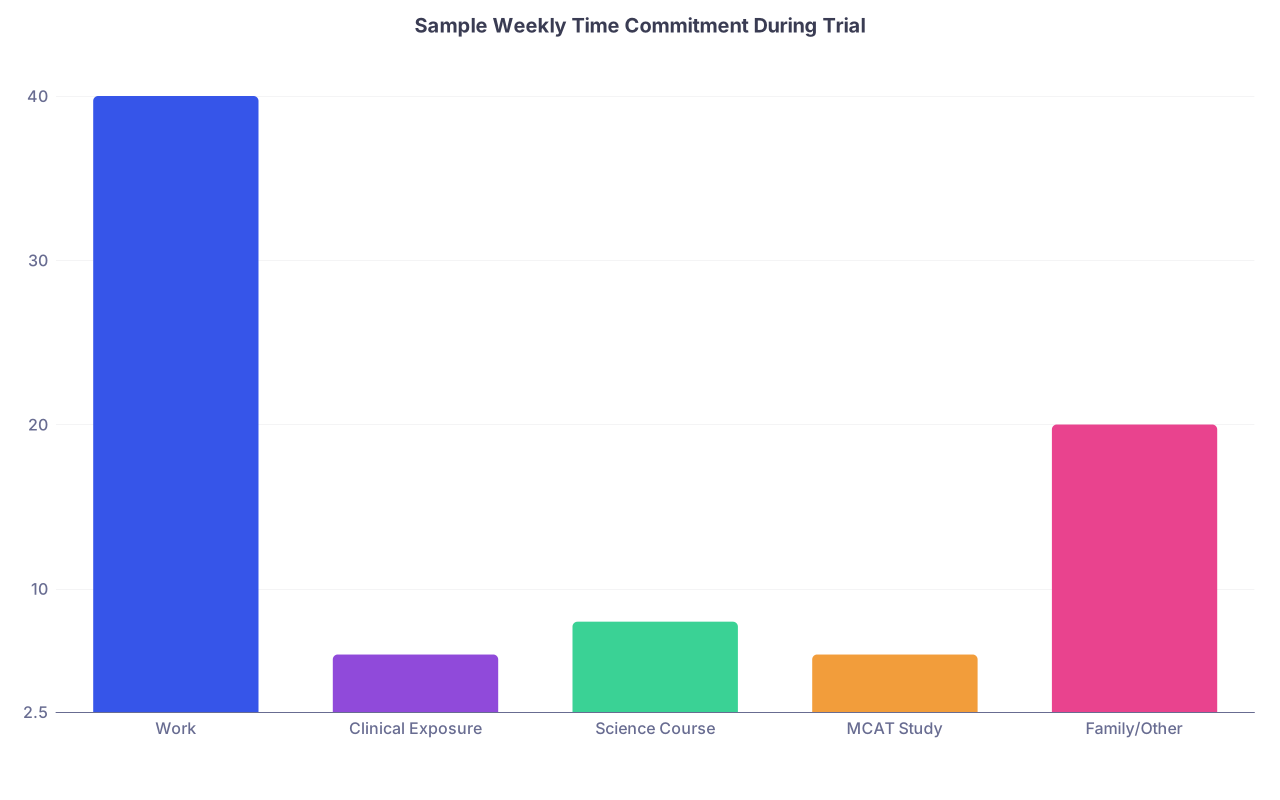
| Category | Value |
|---|---|
| Work | 40 |
| Clinical Exposure | 6 |
| Science Course | 8 |
| MCAT Study | 6 |
| Family/Other | 20 |
If, during this trial:
- Your work performance tanks
- You are constantly sleep-deprived
- Your partner is furious
- Your grades are mediocre despite serious effort
Then full-time premed plus eventual med school is going to be brutal. That does not mean it is impossible, but you should treat it as a major caution light.
Test 4: Lifestyle & Financial Test – Can You Survive the Hit?
This part is where a lot of smart people stick their head in the sand. They leap, then panic halfway through an unpaid third-year rotation while their friends buy houses.
You will not do that.
You will run a financial and lifestyle stress test while you are still fully employed.
Step 4: Build the “Do I Survive This?” Financial Model
You do not need a CFA-level model. You need a back-of-the-envelope that is brutally honest.
A. Map the Timeline
Create a realistic timeline from now until first attending paycheck.
Example for a 30-year-old with no prereqs:
- 2 years: Prereq courses + MCAT + applications (while working, or reduced work)
- 4 years: Medical school (no income, or minor)
- 3–7 years: Residency (low income, high hours)
- Possibly fellowship: +1–3 years (still modest income)
You are looking at roughly 9–13 years until full attending salary.
B. Build the Cash Flow Table
Do a simple 3-phase model:
| Phase | Years | Typical Income Range (USD) | Key Costs |
|---|---|---|---|
| Premed + MCAT | 1–3 | 50–100k (if working) | Tuition per course, MCAT, apps |
| Med School | 4 | 0–25k (side work) | 200–400k tuition + living expenses |
| Residency/Fellowship | 3–7 | 60–80k | Loan repayment starts, relocation |
Now, actually plug in your life:
- Current income
- Current debt (student loans, credit cards, mortgage)
- Dependents (kids, partner, parents)
Run two scenarios:
- Barebones lifestyle (roommates, cheap area, minimal travel)
- “I refuse to completely sacrifice quality of life” scenario
If both numbers look catastrophic, you do not ignore that. You either:
- Stretch your premed timeline to save more
- Target cheaper schools / in-state options aggressively
- Accept that your specialty choice may need to be influenced by debt reality
- Or decide this pivot is not financially rational for your situation
Step 5: Test the Lifestyle Hit Before It Is Permanent
Do a 6–8 week “simulated med school budget” while you still have your salary.
You will:
- Live as if your take-home income is resident-level or lower.
- Bank the difference.
For example:
- If you take home $7,000/month now
- Set an artificial ceiling of $4,000/month
- Try to live on that for 2 months
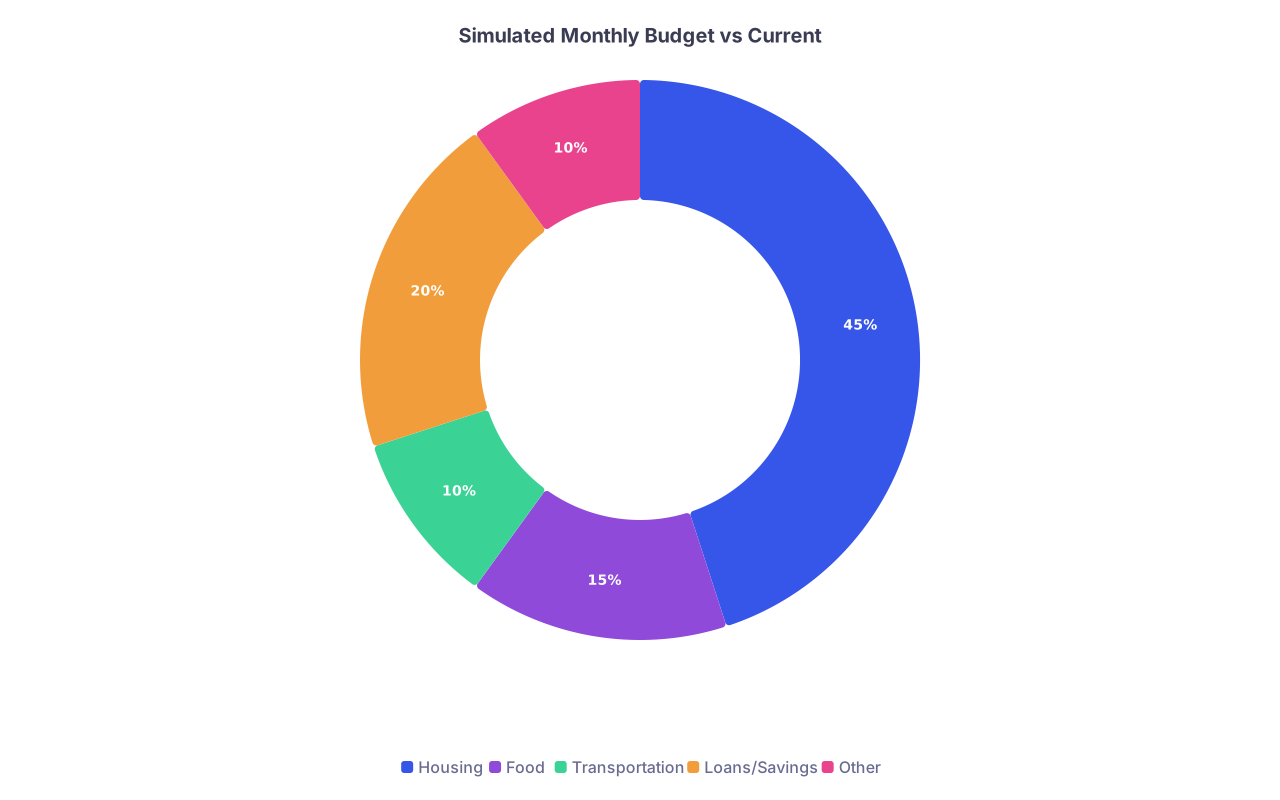
| Category | Value |
|---|---|
| Housing | 1800 |
| Food | 600 |
| Transportation | 400 |
| Loans/Savings | 800 |
| Other | 400 |
This does three things:
- Tests your actual tolerance for a simpler lifestyle.
- Starts building a serious cash buffer.
- Exposes how aligned your partner/family really are with the sacrifice.
If this trial blows up your relationship or your sense of stability, believe that signal.
Test 5: Identity & Motivation Test – Are You Doing This for the Right Reasons?
You might be burned out, underappreciated, or bored where you are. That is not the same as medicine being a good fit. Sometimes people are just running from their current life.
You need to sort this out before you light a match.
Step 6: Deep Motivation Audit (4–6 weeks)
You will run a structured reflection process in parallel with the other tests.
A. Write the “Unfiltered Why” Letter
One evening, no distractions, write a 1–2 page answer to:
“Why am I seriously considering medicine at this stage of my life?”
Be honest. Petty. Ugly even. Common hidden reasons I have seen:
- “I want the prestige I never got in my field.”
- “I hate my job and medicine is the only ‘noble’ exit I can imagine.”
- “My family always wanted a doctor and I want to finally be that person.”
- “I like the idea of being needed and important.”
Nothing wrong with wanting respect or impact. But if those are the primary drivers, you will be miserable when medicine delivers bureaucracy, exhaustion, and delayed gratification instead.
B. Compare Medicine to Other Options
You must ask: “Is medicine the only path that gives me what I want?”
List your top 3–5 values, like:
- Intellectual challenge
- Helping people face-to-face
- Stable, higher income
- Autonomy
- Structured training path
Then brainstorm 3 non-med-school careers that might satisfy 70–80% of that:
- Physician assistant / NP
- Clinical psychology
- Public health (MPH + field work)
- Data science in healthcare
- Health policy, hospital administration
- Social work with specialized training

| Step | Description |
|---|---|
| Step 1 | Current Career Dissatisfaction |
| Step 2 | Consider Health Adjacent Roles |
| Step 3 | Test Medicine System Steps |
| Step 4 | Consider PA/NP or Allied Health |
| Step 5 | Proceed to Formal Premed Path |
| Step 6 | Maintain or Adjust Current Career |
| Step 7 | Need Direct Patient Care? |
| Step 8 | Willing to Train 8-12 Years? |
| Step 9 | Pass 3+ Tests? |
If something like PA, NP, or another allied health path delivers most of what you want with half the debt and years, you must at least test that in parallel.
C. Talk to Future-You (Literally)
Find:
- One physician who started late (switched careers at 28–40)
- One who is clearly burned out or ambivalent
Ask both:
- “Knowing my age and background, what would you warn me about?”
- “What did you underestimate the most?”
If you leave those conversations and still feel clear and drawn to medicine, that is a good sign.
Putting It All Together: The 6–12 Month Decision Protocol
You now have five tests. Here is how to sequence them into a real-world system you can start this month.
Month 0–1: Reality Test + Planning
- Do the reading, interviews, long-form content.
- Roughly map your financial and timeline picture.
- Start early budget adjustments (cut obvious excess).
Decision checkpoint #1:
If at this stage you are more turned off than energized, stop. Do not keep forcing it.
Month 2–4: Exposure + Academic Trial Start
Begin:
- Shadowing and/or volunteer role
- One science course
- Light MCAT practice
Start the motivation audit (unfiltered why, values list).
You should now be feeling the time pressure. That is intentional. Life as a premed and med student is time-poor.
Decision checkpoint #2 questions:
- Can you maintain basic performance at work?
- Are you looking forward to clinical days more often than dreading them?
- Are you passing (not perfecting) your course without imploding?
If yes, continue. If no, pause, not push harder. Reassess whether this is compatible with your reality.
Month 5–8: Intensified Academic + Lifestyle Simulation
- Continue or add second science course if the first went well.
- Increase MCAT study to 8–10 hours/week.
- Do a 6–8 week resident-budget simulation.
- If possible, shift from pure shadowing to more hands-on exposure (volunteer, EMT, MA, CNA).
You should now have:
- Real grades
- Real fatigue levels
- Real relationship stress tests
- Real clinical gut reactions
Decision checkpoint #3 (the big one):
Ask yourself, brutally:
Interest Check
- Has your curiosity about medicine grown with exposure, or faded?
- Do you find yourself wanting to learn more even when tired?
Capacity Check
- Are you at least managing B+ level work in science with structured effort?
- Does the MCAT-style work feel brutally impossible or just challenging?
Cost Tolerance Check
- Could you live like this (or harder) for several years without resenting everyone around you?
- Is your partner (if you have one) still aligned after seeing the budget test and time hit?
Alternative Path Check
- Is there another career path you found in this process that hits most of your motivations with less sacrifice?
- If yes, why are you still choosing medicine over that?
If you cannot give yourself at least a “yes” or strong “probably yes” to 3 out of 4 buckets, medicine is likely not a good fit for you right now.
If You Decide “Yes”: Next Steps Without Quitting Yet
If the system says “medicine fits,” you still do not immediately resign.
Next steps:
- Plan and sequence your remaining prereqs over 1–3 years depending on finances and work.
- Choose one of:
- Keep working full-time and take 1 course at a time
- Drop to part-time work and speed up courses
- Build a concrete MCAT plan once you are halfway through prereqs.
- Keep some clinical exposure going, even one shift a month, to maintain your “why.”
You resign from your current career only when:
- You are about to start full-time post-bacc, or
- You have an acceptance in hand and are months from starting school, or
- You have intentionally chosen a path (e.g., formal post-bacc with structured advising) that demands full-time focus and you have the savings and support to do so.

If You Decide “No”: How to Exit Without Regret
If your conclusion is “Medicine is not worth it for me,” you have still won. You did not waste this year.
Do three things:
Name the truth clearly
- “I like medicine conceptually, but I do not like being around sick people all day.”
- “I want stability and time with my kids more than I want the MD.”
Salvage what you learned
- You may have discovered interest in adjacent fields: public health, mental health, health tech, policy.
- Leverage your clinical exposure and science study for those paths.
Fix what actually drove you to consider medicine
- Hate your current job? Maybe you change companies or roles.
- Crave more meaning? Volunteer in hospice, crisis lines, or healthcare-adjacent roles without changing careers entirely.
- Want intellectual challenge? Grad school, certifications, or new responsibilities in your own field might scratch that itch.
FAQs
1. I am in my late 30s. Is it “too late” for this system to say yes?
No. I have seen people start med school at 40 and be excellent physicians. But the older you are, the more brutal the financial and time cost piece becomes. Use the system. If the financial and lifestyle tests are screaming red and you have kids and dependents, you cannot ignore that.
Age itself is not the limiter. Debt, energy, and family tolerance are.
2. What if I loved the clinical exposure but struggled badly with the science?
That is a common split. It may mean:
- Medicine is not the right role, but healthcare is the right field.
Consider:
- Nursing, PA, NP, respiratory therapy, physical therapy, occupational therapy.
You still get real patient interaction with less punishing academic and timeline demands. If after a year of sincere effort your grades stay low, forcing medical school is a bad bet.
3. How much shadowing or volunteering is “enough” to make a decision?
For fit testing (not admissions):
- Shadowing: 20–40 hours across a few settings is enough to know if you hate the environment.
- Hands-on roles: 50–100 hours over a few months gives you a decent sense of whether being around illness, bureaucracy, and distressed families is something you can tolerate long term.
If you feel totally indifferent or repelled after that much exposure, do not proceed.
4. Should I tell my current employer I am exploring medicine?
Usually, no. Not early. You are running an experiment, not announcing a departure. Tell them only if:
- You are cutting back hours for formal coursework and need schedule accommodations, and
- You are reasonably confident you will apply.
Protect your income and professional relationships until you have actual data from this system and a clear decision.
Key points to walk away with:
- Do not quit your current career on a feeling. Run medicine through structured reality, exposure, academic, financial, and motivation tests first.
- Give yourself 6–12 months of controlled experiments—while still employed—to see if your interest survives contact with real patients, real studying, and real sacrifice.
- A “no” from this system is not failure. It is an informed decision that protects a decade of your life. A “yes” means you can pivot with clear eyes, not fantasy.