
You’re 29. Or 34. Or 41. You’ve got a degree in something that is absolutely not biology, maybe a career, maybe a mortgage. And now you’ve decided you want to be a physician.
You start googling and run into the same mess: post‑bacc options, MCAT timing, “glide years,” committee letters, linkage programs. Everyone says “it depends.” No one tells you what to do when.
I will. Chronologically. With the tradeoffs spelled out.
We’re going to walk from “I just decided on medicine” through finishing a post‑bacc, taking the MCAT, and submitting applications—sequenced properly so you don’t accidentally add an extra year for no reason.
Assumption: you’re a classic career changer
- Little or no hard-science background
- Need at least the core prereqs (Gen Chem, Bio, Orgo, Physics, maybe Biochem)
- You’re not trying to rush so hard you tank your GPA and MCAT just to “avoid” a glide year
If you already have all core prereqs with recent good grades, your path is shorter—but the logic is the same.
Step 0: The 3 Big Sequence Options
Before we go month-by-month, you need the basic map. There are really three main timing patterns.
| Option | Post‑Bacc Timing | MCAT Timing | AMCAS Application Year | Pros | Cons |
|---|---|---|---|---|---|
| A. Standard Glide | 2 years | End of Year 2 | Submit June after Year 2 | More time, stronger prep | 1 glide year before matriculation |
| B. Compressed | 1–1.5 years | End of accelerated plan | Submit June right after | Faster to med school | Heavy load, risk of weaker grades/MCAT |
| C. Linkage | 1–2 years | Fixed window (early) | Apply during post‑bacc | Skip glide year if accepted | Rigid, higher pressure, lose flexibility |
Most career changers should aim for Option A: standard glide. It’s the least self-destructive.
Let’s plan around that. I’ll call this your “Post‑Bacc Timeline” and number years relative to it.
- Post‑Bacc Year 1
- Post‑Bacc Year 2
- Glide Year (between finishing post‑bacc and starting med school)
- Med school starts the August after that
So if Post‑Bacc Year 1 = Fall 2026 start, you’d be aiming to start med school August 2029.
Phase 1: 6–12 Months Before Post‑Bacc Year 1
At this point you should not be signing up for orgo yet. You should be:
- Confirming medicine is actually the right call
- Laying the groundwork so the formal post‑bacc years run clean
6–12 Months Before Starting Post‑Bacc
Focus on four buckets: exposure, academics, finances, and life logistics.
1. Clinical & Shadowing (Baseline Exposure)
Aim: prove to yourself (and eventually adcoms) that you know what you’re walking into.
At this point you should:
- Shadow 2–3 physicians in different settings (e.g., FM clinic, hospitalist, EM)
- Get at least one ongoing clinical gig:
- Part-time medical scribe
- ER tech, CNA, MA (if feasible)
- Hospice volunteer, clinic volunteer with real patient contact
- Log hours and reflections in a simple document (Google Doc, Notion—doesn’t matter, just consistent)
Do not obsess over “is this the perfect clinical experience?” You just need:
- Longitudinal (months, not weekends)
- Patient-facing if possible
- Something you can continue into post‑bacc
2. Academic Reality Check
At this point you should:
- Order all undergrad transcripts and calculate:
- Overall GPA
- Science GPA (even if it’s basically zero—you’ll just see that)
- Identify red flags:
- GPA < 3.3
- Recent academic work >5–7 years old
- Multiple withdrawals or F’s
If your GPA is rough, you need the post‑bacc to be clean and strong. That means: don’t overload, don’t work 60 hours/week, don’t try to DIY a chaotic schedule.
3. Choose Your Post‑Bacc Structure (6–9 Months Before Start)
You’re deciding between:
- Formal career-changer post‑bacc (e.g., Bryn Mawr, Goucher, Scripps, Temple ACMS)
- University-based non-degree coursework as a second bachelor’s/post‑bacc
- Community college for some basics, then 4-year university for higher-level sciences (only if cost/logistics demand it)
At this point you should:
- Make a short list (3–6 programs) with:
- Length (1 vs 2 years)
- Linkage options
- Typical GPA/MCAT for matriculants
- Schedule flexibility (evening vs day classes)
- Start applications for formal programs ~9–12 months ahead of your intended start
If you’re not going formal, you should:
- Contact a local 4-year university pre-health advisor about taking courses as a non-degree student
- Map out which semesters they offer:
- Gen Chem I/II
- Bio I/II
- Physics I/II
- Orgo I/II
- Biochem
4. Financial and Life Setup
At this point you should:
- Build a 2–3 year budget:
- Tuition + fees
- MCAT + applications (budget a few thousand dollars)
- Reduced income if you cut back work
- Decide:
- Keep working full-time with night/weekend classes?
- Part-time work + full course load?
- Quit work for a year or two? (risky but sometimes necessary for GPA rescue)
Do not skip this. I’ve watched people flame out of post‑baccs for money reasons, not academic reasons.
Phase 2: Post‑Bacc Year 1 – Foundations (No MCAT Yet)
At this point you should be starting formal sciences and not touching MCAT content in any serious way.
Month 0 (August): Orientation to Year 1
You’re starting:
- Probably Gen Chem I
- Bio I
- Maybe a math or stats course
At this point you should:
- Meet with the program or pre-health advisor and say explicitly:
“I’m a career changer planning to apply for med school with a glide year. Help me map out which year I’ll take which courses, and when I should take the MCAT.” - Set a realistic workload:
- If full-time: 2–3 hard sciences max to ensure A/A- averages
- If working significant hours: 1–2 sciences
Your single priority right now: dominate these classes. You’re resetting your academic identity.
Post‑Bacc Year 1: Month-by-Month Highlights
Fall (Months 1–4) At this point you should:
- Lock in study systems:
- Daily problem sets in chem
- Active recall for bio (Anki, etc.)
- Continue or start clinical involvement (even 4–6 hrs/week is fine)
- Note potential letter-writers: professors who know your name and see you hustle
Ignore MCAT prep “fomo.” You’re not ready. Content isn’t built yet.
Winter Break (Month 5)
At this point you should:
- Quickly audit where you stand:
- Did you get A/A- in fall sciences?
- Did you survive the schedule while working?
- Adjust spring term if needed:
- Drop a class if your grades suffered
- Or add a class if you crushed it easily
You can lightly browse MCAT content outlines just to understand what’s coming. No serious prep yet.
Spring (Months 6–9)
Common courses now:
- Gen Chem II
- Bio II
- Maybe Physics I or a math/stats course
At this point you should:
- Keep clinical work stable
- Add non-clinical volunteering if you have the bandwidth (tutoring, community center, crisis hotline)
- Start one meaningful “long game” activity you can maintain for 2+ years:
- Research
- Free clinic involvement
- Teaching/mentoring program
End of Post‑Bacc Year 1 (Month 10–11)
Now you’ve got a track record.
At this point you should:
- Meet your advisor again to:
- Confirm Year 2 courses (Orgo I/II, Physics II, Biochem)
- Pick an MCAT target date, usually:
- March–May of Post‑Bacc Year 2 for glide-year plan
- Decide if you need summer courses:
- To finish Physics or Orgo on time before MCAT
- To lighten fall/spring loads
Phase 3: The MCAT Planning Window (End of Year 1 → Mid Year 2)
This is where careers changers usually screw up the sequence. They either:
- Take the MCAT too early (before finishing content like Physics II or Biochem)
- Or too late (after applications open, which weakens their application)
You want: content-complete → 4–6 months focused MCAT prep → MCAT by May of your application year.
Summer Between Year 1 and Year 2
At this point you should:
- Take remaining prereqs if needed:
- Physics I/II or Orgo I if not yet started
- Start light MCAT prep:
- Diagnostic full-length (cold) to see baseline
- Content review based on what you already took:
- Gen Chem, Bio I/II, any Psychology/Sociology, intro physics if completed
Do not grind 40 hours/week on MCAT yet if you’re still mid-content. But you can:
- Learn the test structure
- Start daily CARS practice (this pays off long-term)
Phase 4: Post‑Bacc Year 2 – Full MCAT + Application Prep Year
This is the critical year. Get this sequence wrong and you add an extra cycle.
Big Picture Timeline for Post‑Bacc Year 2 (Glide-Year Plan)
Here’s what an ideal 18-month arc looks like:
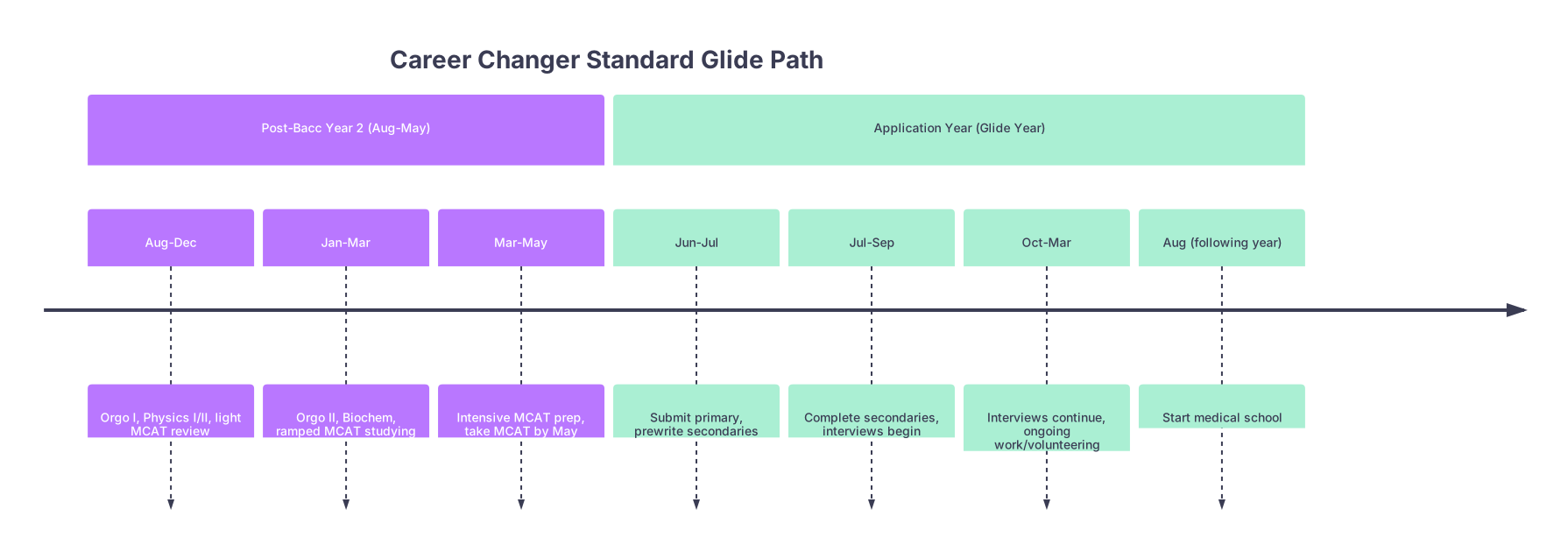
| Period | Event |
|---|---|
| Post-Bacc Year 2 (Aug-May) - Aug-Dec | Orgo I, Physics I/II, light MCAT review |
| Post-Bacc Year 2 (Aug-May) - Jan-Mar | Orgo II, Biochem, ramped MCAT studying |
| Post-Bacc Year 2 (Aug-May) - Mar-May | Intensive MCAT prep, take MCAT by May |
| Application Year (Glide Year) - Jun-Jul | Submit primary, prewrite secondaries |
| Application Year (Glide Year) - Jul-Sep | Complete secondaries, interviews begin |
| Application Year (Glide Year) - Oct-Mar | Interviews continue, ongoing work/volunteering |
| Application Year (Glide Year) - Aug (following year) | Start medical school |
Fall of Post‑Bacc Year 2 (Months 12–15)
Courses typically:
- Orgo I
- Physics (I or II depending on your sequence)
- Maybe a psych/soc course if you still need it
At this point you should:
- Study for class in a way that supports the MCAT:
- Conceptual understanding, not just plug-and-chug
- Start structured but moderate MCAT prep:
- 5–8 hrs/week:
- 2–3 hrs content review
- 2–3 hrs practice questions
- 1–2 hrs CARS
- 5–8 hrs/week:
Also:
- Identify your 3–5 strongest potential LOR writers:
- Science faculty from post‑bacc
- PI or supervisor from research/clinical job
- Employer if relevant to your story (career changer, leadership)
- Tell them your rough timeline: you’ll request letters in late spring for June application.
Winter Break Year 2 (Month 16)
At this point you should:
- Register for a specific MCAT date:
Ideal: March–May of this year - Make a detailed MCAT study schedule backward from that test date:
- 3–4 months of serious prep
- Last month heaviest practice/testing (full-lengths every 7–10 days)
This is also when you:
- Start a personal statement brainstorming doc:
- Bullet stories from your pre-med journey, especially career-change angle
- Rough list schools based on:
- Your likely GPA trend
- Realistic MCAT target
- Geographic/family constraints
Spring of Post‑Bacc Year 2 (Months 17–20): MCAT + Heavy Courses
Courses:
- Orgo II
- Biochem
- Remaining Physics or upper-level science
At this point you should:
- Shift MCAT prep to 10–15 hrs/week:
- Content review should taper by ~6–8 weeks before your test
- UWorld or AAMC questions become central
- Weekly CARS passages
You’re still protecting your GPA first. A 3.9 post‑bacc GPA + MCAT in May is better than a 3.3 post‑bacc with a random March test.
Some weeks will be ugly. Midterms + MCAT practice exams at the same time. This is normal. But if your class grades start to slip, back off MCAT hours first.
MCAT Month (Target: March–May of Post‑Bacc Year 2)
At this point you should:
- Take 5–8 full-length practice exams under strict conditions
- Dial down work/volunteering if possible for the 2–3 weeks right before test day
- Aim to test no later than:
- Late May if applying that June
Your actual test date matters because:
- Scores take ~1 month to release
- You can submit AMCAS before scores arrive, but you want a sense of your performance before finalizing school lists
Phase 5: Application Launch – The “Glide Year” Summer
You just survived Orgo II and Biochem and took the MCAT. You’re wrecked. Too bad, the application clock doesn’t care.
May: Finish Classes, Finalize Letter Requests
At this point you should:
- Lock in your LORs:
- Send formal requests with:
- Your CV
- Draft of personal statement
- List of schools (or at least the level/type)
- Deadlines (early July is safe)
- Send formal requests with:
- Clean up your activities log:
- All clinical, non-clinical, research, leadership
- Hours, dates, supervisor names
June: Submit AMCAS (Primary Application)
AMCAS opens in May for data entry, submissions start in early June.
At this point you should:
- Have a final personal statement
- Have activities written with clear impact and reflection
- Submit AMCAS in the first 2–3 weeks of June
This is your main advantage as a career changer who planned correctly:
- You finish your post‑bacc
- You already took the MCAT
- You’re ready to apply early in a very competitive process
Phase 6: The Glide Year – What You Do While You Wait
You’ll submit applications June–July. You’ll (hopefully) start med school 14 months later. That’s the glide year.
Summer of Glide Year (Immediately After AMCAS Submission)
At this point you should:
- Prewrite secondary essays:
- Use school prompts from prior years (80–90% repeat)
- Turn around secondaries within 1–2 weeks of receiving them
- Maintain or ramp up your most meaningful activities:
- Clinical job
- Research
- Volunteering
Your story now is continuity and growth while you wait, not “I stopped everything when I hit submit.”
Fall–Spring of Glide Year
At this point you should:
- Go on interviews (hopefully)
- Keep working and volunteering at a reasonable level
- Avoid big risky shifts (e.g., moving across the country mid-cycle for fun)
This is also your safety net:
- If your apps underperform because your GPA/MCAT were weaker than ideal, you’ll know by late winter
- You can then use the remainder of the glide year to:
- Add more upper-level sciences
- Retake MCAT (if truly necessary)
- Prepare to reapply strategically
Variations: Accelerated, Linkages, and Late Deciders
Not everyone fits the clean two-year + glide model. Here’s where other patterns make sense.
1. Compressed Post‑Bacc (12–18 Months Total)
This can work if:
- You have high academic horsepower
- You can essentially not work or only minimally work
- You’re okay with a brutal year
Sequence:
- Year 1:
- Fall: Chem I, Bio I, Physics I
- Spring: Chem II, Bio II, Physics II
- Summer: Orgo I, maybe some psych/soc
- Fall: Orgo II, Biochem + MCAT prep
- MCAT: Jan–March
- Apply June of that same year
Risks:
- One bad semester tanks a huge part of your science GPA
- Very little room for life crises
I only recommend this if your prior academic record is strong and stable and your life is unusually flexible.
2. Linkage Programs
Linkage = apply to med school during post‑bacc and skip the glide year if accepted.
Sequence (typical):
- Post‑Bacc Year 1: crush courses, do MCAT prep
- Post‑Bacc Year 2:
- Early: take MCAT
- Mid: apply through linkage to a specific school
- Late: if accepted, start med school right after post‑bacc ends
At this point you should consider linkage only if:
- You’re okay with committing early to a limited school list
- You perform near the top of your post‑bacc cohort
- Your life can handle going straight from post‑bacc into med school without a break
Linkage adds pressure. Miss the metrics and you have to pivot back to the standard cycle anyway.
3. Late Deciders Mid-Post‑Bacc
If you only decide “I’m serious about med school” halfway through your DIY science coursework, the rule is:
At this point you should:
- Stop freelancing the plan and fix your sequence:
- Identify when you’ll be truly content-complete for MCAT
- Work backward 4–6 months
- Decide on the earliest reasonable application year
Trying to squeeze your MCAT and application “this year” when you’re mid-Orgo I and working full-time is how people end up retaking exams and reapplying.
Where You Are and What Matters
If you made it here, you probably care enough to do this right. So I’ll keep the summary short:
- At this point—before starting anything formal—you should build exposure and a realistic 2–3 year academic plan. Do not sprint into Orgo without a map.
- During your post‑bacc, you should guard your GPA first, then build MCAT content, then time your MCAT for late in Year 2 with a clear, structured prep window.
- For the application cycle, you should treat the glide year as an asset, not a punishment: a year where you apply early, keep building your story, and arrive at med school with momentum instead of exhaustion.