
The worst career mistake I see nontraditional premeds make is quitting their job at the wrong time. Too early, and they torch savings and spike anxiety. Too late, and they sabotage the MCAT and the application cycle. There is a better way: treat the decision like a 12‑month project, not a 2‑week panic.
You’re not just asking “Should I quit?”
You’re really asking: “Exactly when can I safely pull the ripcord without blowing up my chances or my bank account?”
Let’s build that, month by month.
The 12‑Month Overview: Big Picture Before the Details
At this point, you should stop thinking in vague seasons (“next year,” “sometime before apps”) and start thinking in months.
Assume this anchor: you plan to submit your primary application in June of Year 2. Here’s the high‑level arc, counting backward from that June and forward after it.
| Month (relative) | Primary Focus | Job Status Goal |
|---|---|---|
| -12 to -9 | Exploration & baseline | Keep job, gather data |
| -9 to -6 | Commit to timeline, save | Keep job, cut expenses |
| -6 to -3 | MCAT heavy prep | Consider reducing hours |
| -3 to -1 | MCAT + application prep | Part-time or flexible if possible |
| 0 (June) | Primary submission | Minimum hours, high focus |
| +1 to +3 | Secondaries | Reduced/flexible schedule |
| +4 to +9 | Interviews | Work that allows time off |
We’ll walk this as if you’re 12 months out from your intended application June. If your timing’s different, shift everything relative to your own “Month 0.”
Months -12 to -9: Stop Fantasizing, Start Measuring
At this point you should not quit. You probably don’t even have enough information to justify it.
Your goals during these 3 months
Map your real constraints.
You need numbers and commitments on paper, not vibes in your head.Decide your MCAT window.
Without a test date range, the rest of the timeline is nonsense.Test whether your current job is survivable through the MCAT.
Do this, month by month.
Month -12: Reality Inventory
You’re starting the “can I actually pull this off?” phase.
You should:
- Pull 12 months of bank statements and build a brutally honest monthly budget:
- Average rent/mortgage
- Utilities
- Food (not the fantasy number—what you actually spend)
- Insurance (health, car, disability if you have it)
- Debt minimums (loans, cards)
- Transportation (gas, transit, maintenance)
- Non‑negotiables (childcare, support for family)
Now calculate:
- Bare‑bones survival number (no travel, minimal eating out)
- Current savings
- How many months of expense runway you actually have if you had zero income
You should also:
- List current obligations:
- Work hours + commute
- Family care
- Existing classes
- Volunteer/clinical/shadowing
If this feels uncomfortable, good. People who skip this step are the ones emailing me in November saying, “I think I quit too early.”
Month -11: Academic & Experience Baseline
Now you check whether your application is actually in quitting‑worthy shape.
At this point you should:
- Audit your prereqs:
- Which are done?
- Which are missing or expired (more than ~7–10 years old at some schools)?
- Pull your exact GPA numbers:
- Cumulative
- Science (BCPM)
- List your clinical + nonclinical experience hours:
- Direct patient contact
- Shadowing
- Volunteering
- Work relevant to medicine (EMT, scribe, RN, MA, etc.)
You’re looking for this rough threshold:
If you quit your job later, will your application be competitive enough to justify the hit?
If your GPA is 3.1 with no post‑bacc and minimal clinical, quitting a job to “study full-time” for the MCAT is the wrong battle. You need coursework and experience before you need full‑time study.
Month -10: MCAT Diagnostic & Job Stress Test
Now you test whether your job and MCAT prep can even coexist.
You should:
- Take a full‑length MCAT diagnostic under real test conditions.
- Use AAMC or a reputable company.
- Time it correctly. Quiet environment. No pausing.
- Start a light prep schedule while working your normal job:
- Example: 8–10 hrs/week (2 hours weeknights, 4 hours weekend)
Track for 3–4 weeks:
- Are you consistently hitting those hours?
- Is your job leaving you too drained to do meaningful work?
- What does your diagnostic score look like relative to your target schools?
If, after a month, you cannot protect even 8 hours/week of real studying, your job may need to change eventually. Not now—but that’s your first yellow flag.
Months -9 to -6: Commit to the Plan, Build Your War Chest
At this point you should stop seeing your job as “the enemy” and start seeing it as “MCAT funding + application funding.” It’s a tool.
Month -9: Decide Your MCAT Target Window
Everything revolves around your MCAT date. Set a target month, not “sometime next year.”
Typical nontrad pattern:
- Study start: ~6 months before test
- MCAT month: -4 to -3 relative to June application (so February–March test for June app)
So if June is Month 0, many nontrads aim for MCAT around Month -4 or -3.
By the end of Month -9 you should:
- Choose a 3–4 week MCAT window you’re aiming for
- Decide if you’ll:
- Keep working full-time; or
- Aim to shift to part-time/PRN around Month -4; or
- Quit entirely around Month -3 or -2
Do not schedule the official MCAT yet if your foundation is shaky. But do schedule your life around that window.
Month -8: Savings and Expense Surgery
This is the ugly, unglamorous part. It’s also what makes quitting later possible.
At this point you should:
Set a savings goal:
- How many months of bare‑bones expenses do you want banked before reducing/quitting?
- Common realistic target: 3–6 months.
Start aggressive but realistic cuts:
- Kill unused subscriptions.
- Move, if you can, to cheaper housing or a roommate.
- Lock in cheaper phone/internet.
- Reduce car usage if your city allows it.
Track your savings rate each month. This number matters more than your MCAT score right now because it buys you time later.
Month -7: Test a “Mini‑Quit” Schedule
Before you ever resign, you run the simulation.
You should:
- Pick 2–3 weeks where you behave as if you’ve already reduced hours:
- Wake up earlier or reclaim evenings.
- Block out 15–20 hrs/week of MCAT prep.
- Still keep your current job and obligations.
Ask yourself:
- Can I maintain this pace without crashing?
- Where exactly does my job crowd out studying?
- What time of day am I actually sharp enough for MCAT work?
If the only way you can hit 15–20 hrs is by chronically sleep‑depriving yourself, you now have evidence that and when job reduction will become necessary.
Months -6 to -3: MCAT Takes the Wheel, Job Starts to Move
This is when most nontraditional premeds make their biggest mistake: they jump straight from full‑time chaos to zero income. That’s rarely optimal.
Month -6: Formal Study Plan + Employer Reality Check
Now you’re entering serious study territory.
At this point you should:
Lock a formal MCAT study plan:
- Weekly hours target (example: 15–20)
- Content vs. practice question balance
- Planned full‑length exams
Have a candid internal conversation:
- “If I keep this job unchanged, can I execute this plan for 3 straight months?”
- Answer honestly, using your Month -7 mini‑test data.
If the answer is clearly “no,” you’re not quitting yet—but you need to prepare your employer.
You might:
- Ask about:
- Going from 1.0 FTE → 0.8 or 0.6
- Compressed workweek
- Remote days if it cuts your commute
Do not frame it as “I might quit soon.” Frame it as, “I’m starting a long‑term education plan and exploring schedule adjustments.”
Month -5: First Hard Decision Point
By now, you’ve been studying while working for a while. The data is real.
You should:
- Take another full‑length MCAT and compare to your diagnostic.
- Look at:
- Score trajectory
- Burnout level
- Financial runway progress
Here’s the blunt threshold:
- If you’re seeing progress, can consistently hit your study hours, and your finances are fragile → do not quit yet.
- If you’re stalled or regressing, can’t hit study hours despite discipline, and you have at least 3–4 months of runway saved → it may be time to target a future quit date, usually 8–12 weeks before your exam.
Notice: you’re still not quitting this month. You’re setting the quit date.
Month -4: Lock MCAT Date & Set Quit/Reduction Date
At this point you should:
- Register for the actual MCAT in Month -3 or -4.
- Decide on one of these by a specific calendar date:
- Keep full‑time work through exam
- Drop to part‑time X weeks before exam
- Fully quit Y weeks before exam
What I’ve seen work best for nontrads:
- Keep some income if at all possible.
- Move to part‑time 6–8 weeks before MCAT instead of total zero.
- Keep benefits (especially health insurance) if your employer offers it at reduced hours.
Remember, admission committees don’t reward financial chaos. They reward good MCATs and mature planning.
Month -3: Execution Month — Many Quit Here (Partially)
If you planned to reduce or quit, this is where it usually happens.
At this point you should:
- Trigger whatever you agreed with your employer:
- Drop to 2–3 days/week
- Move to PRN or per diem if in healthcare
- Ramp MCAT hours to 25–30 hours/week if you’re within ~6 weeks of test day.
The question here isn’t “Should I work?”
It’s “What’s the minimum work hours that keep me afloat and protect my MCAT?”
For many, that’s 1–3 shifts/week, not zero.
Months -3 to -1: MCAT, Application Pieces, and the “Do I Quit Fully?” Question
The 4‑Week MCAT Crunch (Often -2 to -1)
Once you’re within 4 weeks of the MCAT, you reassess.
You should:
- Look at your last 2–3 full‑length practice exam scores:
- Are you within 3–5 points of your target?
- Are you steadily improving?
- Check your fatigue and mental state.
If you’re still working 20+ hours/week and your scores are flat, this is when you might:
- Temporarily take unpaid leave if possible.
- Or, if you’ve specifically saved for this sprint, fully quit 3–4 weeks before the exam.
But again: no one gets bonus points for suffering. If your scores are already strong and your mental health is stable, you might keep a small work schedule.
Immediate Post‑MCAT (Weeks after exam, still around -1)
You’re tempted to celebrate and then panic. Instead, you should use this transitional window smartly.
At this point you should:
- Decide if you:
- Stay reduced/part‑time
- Resume more hours
- Remain fully off work through primary application
Guideline:
- If your savings can’t reasonably get you through MCAT → June submission → 2–3 months after, consider ramping back some work.
- If you’re strong financially and you still have substantial application work (essays, experiences, school list) → staying part‑time or off temporarily might be the better academic play.
Month 0 (June): Primary Submission and Employment Strategy
This month is nontrivial. The primary isn’t “just a form.” It’s a project.
At this point you should:
- Have your personal statement drafted before June.
- Finalize activities descriptions.
- Submit early in the month if possible.
On the job front, the main questions:
- Are you staying in your current role for another year if you don’t get in?
- Does your current job:
- Offer any schedule flexibility for secondaries and interviews?
- Align reasonably with medicine (clinical, service, etc.)?
If you fully quit before June and have no plan beyond “I’ll figure it out once secondaries arrive,” that’s how you end up financially stuck in October.
If you must quit now because of a toxic or unsustainable situation, fine. Just be honest that you’ll likely need new, more flexible work within a few months.
Months +1 to +3: Secondary Season — Sneaky Heavy Workload
At this point you should expect 2–3 intense months of writing. It’s basically another part‑time job.
You should:
- Budget 10–15 hours/week for:
- Secondaries
- School‑specific questions
- Tailoring experiences
Employment during this window:
- Ideal: Flexible, predictable part‑time.
- Acceptable: Full‑time if:
- You’re fast at essays
- You have prewritten common prompts
- Risky: Zero job, dwindling savings, no backup plan.
This is where a lot of nontrads email me saying, “I wish I’d gone part‑time instead of quitting entirely. I didn’t realize how long the process is.”
Months +4 to +9: Interviews and The Long Wait
Now the question shifts from “When do I quit?” to “Do I need to re‑enter the workforce while I’m still an applicant?”
Interview Season (typically +4 to +8)
At this point you should:
- Have a job that allows:
- Random weekdays off for interviews (often on short notice)
- Some travel flexibility
- Consider:
- PRN healthcare roles
- Contract/remote work
- Temp or gig‑based projects
Quitting just for interviews is rarely necessary unless you’re drowning and your boss is inflexible. You can usually negotiate with reasonable employers if you’re transparent and professional.
If You Don’t Get the Cycle You Wanted
You might face:
- No interviews
- Waitlists only
- Late‑cycle rejections
At that point (often around +9 to +12), you should absolutely be working or actively searching for a job if you’re not already. Reapplying is expensive, and having a gap year with no work and no clear reason looks bad.
A Simple “Should I Quit Now?” Decision Flow
Here’s the logic I’d use with you across the table.

| Step | Description |
|---|---|
| Step 1 | Thinking of quitting job |
| Step 2 | Do NOT quit. Build savings and plan. |
| Step 3 | Consider reducing hours, not quitting. |
| Step 4 | Keep current schedule or slight reduction. |
| Step 5 | Reduce hours 6-8 weeks pre-MCAT. |
| Step 6 | Delay MCAT or adjust timeline. |
| Step 7 | Consider quitting 3-4 weeks pre-MCAT. |
| Step 8 | MCAT within 3 months? |
| Step 9 | Financial runway >= 6 months? |
| Step 10 | Practice scores near target? |
| Step 11 | Can you reduce to part-time? |
| Step 12 | Runway >= 3-4 months? |
How Your Time Actually Shifts: Study vs Work
To make this concrete, here’s how time tends to reallocate across the year if you do this correctly.
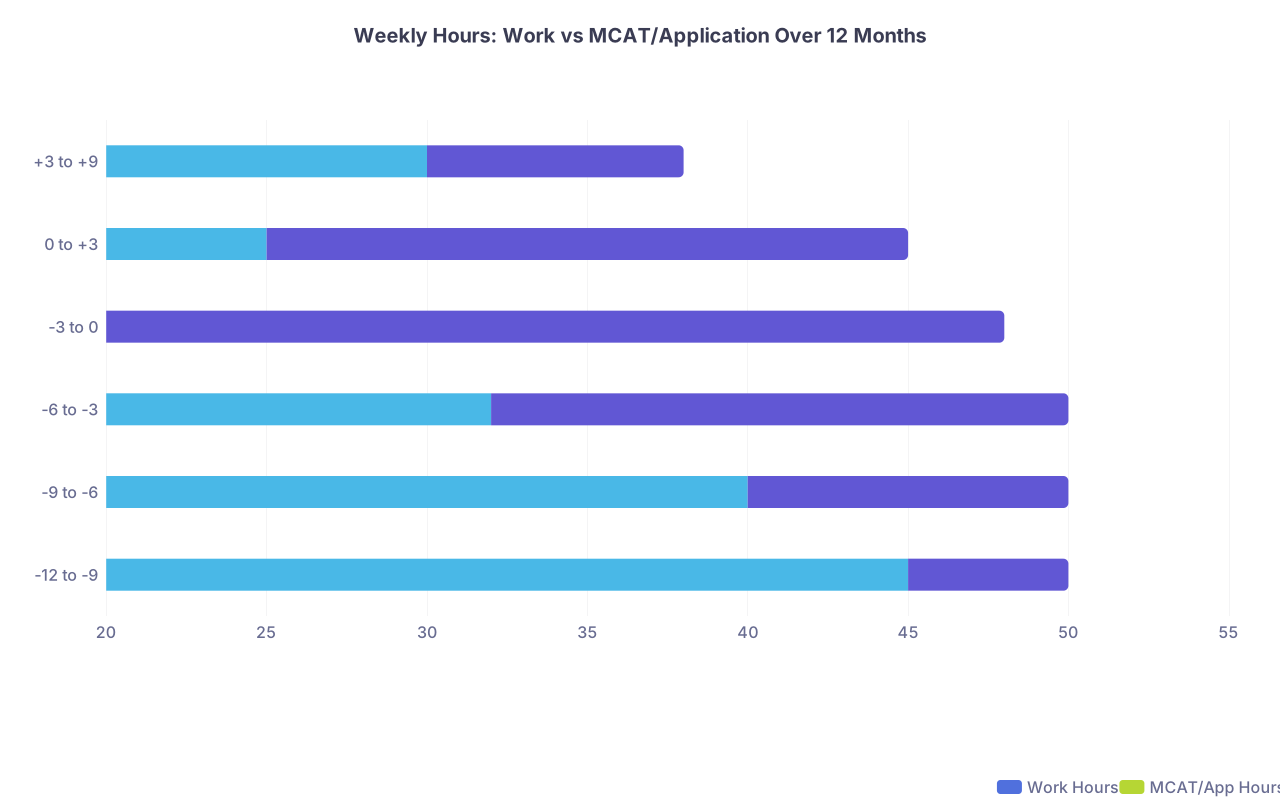
| Category | Work Hours | MCAT/App Hours |
|---|---|---|
| -12 to -9 | 45 | 5 |
| -9 to -6 | 40 | 10 |
| -6 to -3 | 32 | 18 |
| -3 to 0 | 20 | 28 |
| 0 to +3 | 25 | 20 |
| +3 to +9 | 30 | 8 |
Notice what’s missing: a huge block of zero work. For most nontrads, that’s not realistic or even optimal.
Practical Red Flags: When Quitting Now Is Just Wrong
I’ll be blunt. At this point, you should not quit your job if:
- You have less than 3 months of bare‑bones expenses saved and no reliable backup.
- You haven’t taken a single full‑length practice MCAT.
- You don’t have a clear application year (just “someday”).
- You still need significant prereq coursework or a full post‑bacc.
- You have dependents and no clear plan for healthcare coverage.
Yes, people quit under those conditions. No, it doesn’t magically signal “commitment” to an admissions committee. It just looks impulsive when paired with weak scores or a thrown‑together app.
Strategic Alternatives to a Hard Quit
Before you write the dramatic resignation email, at this point you should have at least tried:
- Internal transfer to a less demanding role or shift.
- Reduced FTE: 0.6–0.8 instead of 1.0.
- Remote or hybrid work to reclaim commute time.
- Moving to a healthcare adjacent job with easier scheduling: scribe, MA, CNA, ED tech, etc.
None of this is as emotionally satisfying as “walking away to chase the dream.”
But the people who make it to M1 didn’t optimize for drama. They optimized for bandwidth and runway.
Final Snapshot: The “Right Time” to Quit
Boiling this down to what actually matters:
Tie quitting to a specific milestone.
Usually 4–12 weeks before your MCAT or at a defined secondary/interview phase. Never “just because I’m tired of this job.”Let your numbers decide, not your feelings.
Savings runway, MCAT practice scores, weekly hours you can actually study. Those three metrics should drive your decision.Prefer reduction over total exit, whenever possible.
Part‑time work with benefits beats romanticized unemployment. You want enough space to study, not a complete free fall.
Time your exit like a professional, not like someone who just snapped on a bad Monday. That’s the difference between “I sacrificed for medicine” and “I burned out before I ever applied.”