
The worst way to change careers into medicine is to “see how it goes” year by year. You will lose time, money, and momentum. You need a 5‑year campaign plan, not vibes.
Here is that plan—broken down year by year, then month by month—so you know exactly what you should be doing at each point between “I think I want to be a doctor” and your first day of medical school.
Year 1: Clarify, Commit, and Build the Foundation
At this point you should not be signing up for the MCAT. You should be proving to yourself that medicine is the right move and mapping the hard constraints: time, money, prerequisites, and family.
Months 1–3: Reality Check and Commitment
At this point you should:
- Run a cold, honest feasibility check.
- Pressure‑test your motivation.
- Sketch the 5‑year arc.
Concrete steps:
Clinical Exposure (bare minimum: 20–30 hours this quarter)
- Shadow at least 2 different physicians:
- One outpatient (family med, internal med).
- One hospital-based (hospitalist, EM, surgery clinic).
- Aim for:
- 2–3 full shadow days.
- Or 6–8 half days.
- Your question list for each physician:
- “What’s the hardest part of this job that YouTube premeds never talk about?”
- “What would make this career a bad fit for someone?”
- If you come away thinking “I am not sure I want this,” good. Better now than after $20k in applications.
- Shadow at least 2 different physicians:
-
- List:
- Income
- Debts (interest rates, minimums)
- Savings
- Dependents / partner’s income
- Build a rough 5‑year budget:
- Years 1–3: working + premed costs (courses, MCAT, applications).
- Years 4–5: ramp‑down income + medical school start.
- Talk with:
- Partner or family stakeholders.
- If possible, a fee‑only financial planner for a 1–2 hour consult.
- List:
Academic Records Pull
- Request all prior transcripts:
- Undergrad.
- Community college.
- Any graduate work.
- Build a quick GPA calculator (or use an online AMCAS GPA tool).
- cGPA.
- Science GPA (BCPM).
- Request all prior transcripts:
Decision Point by End of Month 3
- After shadowing and financial/academic review, write a one‑page “Why medicine, why now, what will I sacrifice?” document.
- If you cannot argue convincingly to yourself, pause. Do not drift into Year 2 half‑committed.
Months 4–6: Map Prereqs and Timelines
At this point you should be designing your academic recovery or completion plan, not guessing course by course.
Steps:
Gap Analysis for Prerequisites Typical U.S. requirements:
- 1 year general chemistry with lab
- 1 year biology with lab
- 1 year physics with lab
- 1 year organic chemistry with lab (or 1 orgo + 1 biochem for some schools)
- 1 semester biochemistry
- 1–2 semesters math (stats and/or calc)
- 1–2 semesters English / writing-intensive courses
Program Choice: DIY vs Formal Postbac
| Option | Best For | Pros | Cons |
|---|---|---|---|
| DIY at local college | Budget‑conscious, self‑directed | Cheap, flexible, stay employed | Less advising, less structure |
| Formal career‑changer | Few/no sciences completed | Built‑in advising, cohort | Expensive, often full‑time |
| Academic enhancer SMP | Low GPA but sciences done | GPA repair, linkage options | Intense, can hurt if you tank |
3–4 Year Academic Plan
- Decide target matriculation year.
- Backwards plan:
- MCAT date (12–18 months before matriculation).
- Coursework completion before MCAT.
- Application cycle year.
Initial Volunteering
- Start low‑dose exposure:
- 2–4 hours per week:
- Hospital volunteer.
- Free clinic.
- Nursing home / hospice.
- 2–4 hours per week:
- Start low‑dose exposure:
Months 7–12: Start Coursework and Consistent Clinical Service
By the end of Year 1, you should have:
- Completed at least 1–2 prerequisite courses with strong grades.
- Established a consistent clinical/volunteer schedule.
Steps:
Launch First Semester of Sciences
- If you lack most sciences:
- Start with: General Chemistry I + Biology I.
- If you are rusty but not new:
- Consider retaking a key course you bombed (<B–), but do not repeat everything without strategy.
- If you lack most sciences:
Study Rhythm While Working
- Weekly target:
- 15–20 focused study hours.
- Non‑negotiables:
- Dedicated weeknight blocks (2–3 evenings).
- One larger weekend block (4–6 hours).
- Weekly target:
Build Early Relationships with Professors
- Go to office hours monthly.
- Ask for feedback on your study approach.
- This is the groundwork for future letters.
Clinical and Non‑Clinical Volunteering
- Clinical: 2–4 hours/week.
- Non‑clinical (underserved populations, advocacy, education): 2 hours/week.
- By end of Year 1, aim for:
- 75–100 clinical hours.
- 50+ non‑clinical hours.
Year 2: Academic Momentum and MCAT Positioning
At this point you should be in “student mode” again and building an upward GPA trend.
Months 13–18: Stack the Core Sciences
You are now in the grind.
Course plan (example for someone working 30–40 hours/week):
- Semester 1:
- General Chem II
- Biology II
- Semester 2:
- Organic Chem I
- Physics I
Goals:
- Target A or A– in every class. B+ should be your floor, not your goal.
- Keep weekly:
- 12–18 hours of study.
- 3–4 hours clinical.
- 2 hours non‑clinical.
Key habits at this stage:
- Every exam:
- 2 days later, review mistakes and create an “error log”.
- Every course:
- One brief check‑in with professor midway through the term about your performance.
Months 19–24: Finish Cores and Time MCAT
By now you should see whether your academic plan is working. If your job is crushing you and grades are slipping, you adjust now, not during the MCAT year.
Course plan (example):
- Semester 3:
- Organic Chem II
- Physics II
- Semester 4:
- Biochemistry
- Statistics or upper‑level bio (physiology, cell biology)
MCAT timing:
- You should not schedule the MCAT until:
- You have completed:
- General chemistry
- Organic chemistry
- Physics
- Biology
- Biochem in progress or completed is strongly preferred.
- You have completed:
Typical sequence for a 5‑year plan:
- End of Year 2: finish core sciences.
- Year 3: MCAT prep + upper‑level coursework.
- Year 4: Application year.
- Year 5: First year of medical school.
Year 3: MCAT and Application Prep Year
This is the pivotal year. At this point you should be transitioning from “course survival” to “application strategy.”
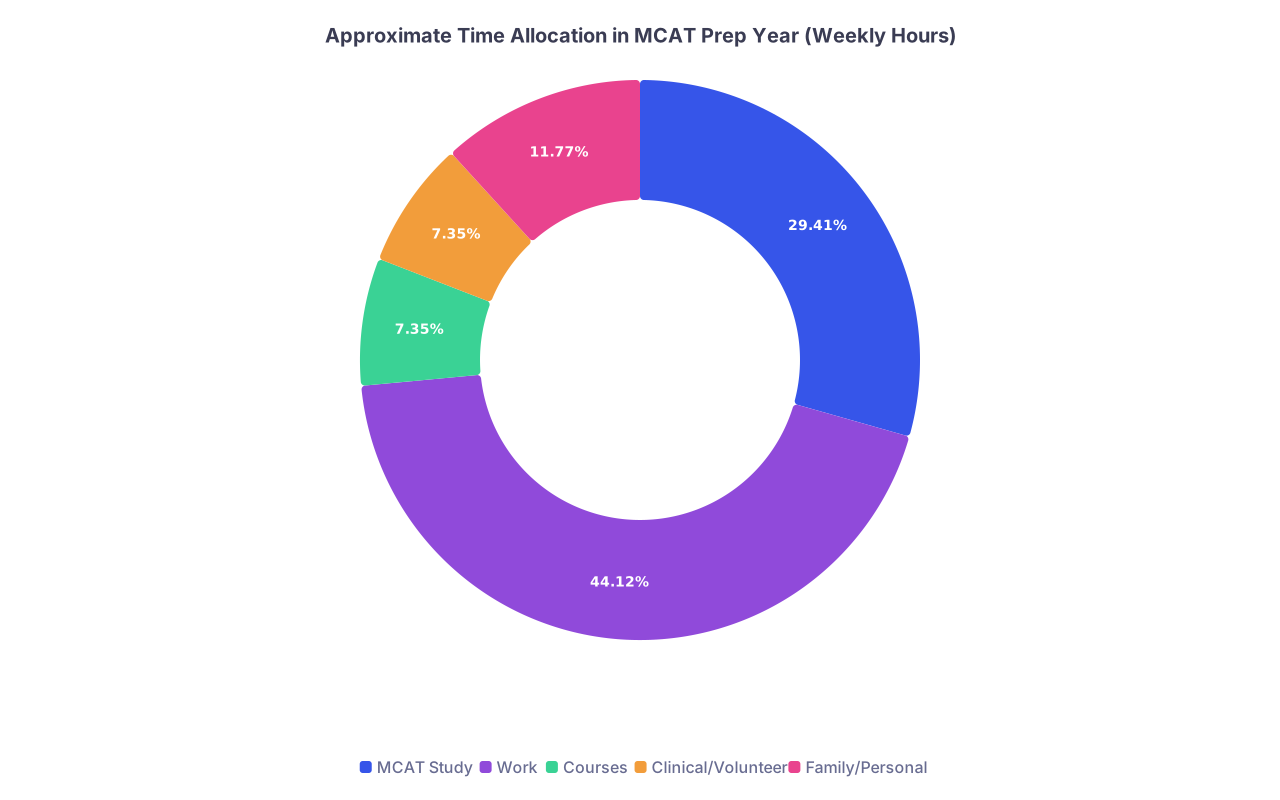
| Category | Value |
|---|---|
| MCAT Study | 20 |
| Work | 30 |
| Courses | 5 |
| Clinical/Volunteer | 5 |
| Family/Personal | 8 |
Months 25–30: Build the MCAT Machine
You are 12–18 months out from intended matriculation. This is when the serious MCAT work begins.
Diagnostic and Study Plan (Month 25)
- Take a full‑length diagnostic under timed conditions:
- AAMC FL or a high‑quality third‑party.
- Diagnose:
- Content gaps.
- Stamina.
- Timing issues.
- Take a full‑length diagnostic under timed conditions:
MCAT Study Schedule (6–9 months total) Working full‑time? Aim for:
- First 3–4 months:
- 12–15 hours/week:
- Content review.
- 30–40 questions per day (mixed).
- 12–15 hours/week:
- Next 2–3 months:
- 15–20 hours/week:
- Heavy practice.
- 2–3 full‑lengths/month.
- 15–20 hours/week:
- Final 4–6 weeks:
- 20–25 hours/week if you can arrange PTO or reduced hours.
- Continue Experiences (Do not drop them completely)
- Clinical: 3–4 hours/week.
- Non‑clinical: 1–2 hours/week.
- Your application will look weak if you vanish from service for a year.
Months 31–33: MCAT Peak and Application Drafting
At this point you should be within 2 months of your MCAT date and starting your personal statement.
MCAT Peak Phase
- Full‑length exams:
- Every 1–2 weeks.
- Post‑exam:
- Spend as much time reviewing as taking the test (6–8 hours review per FL).
- Target:
- Consistent scores at or above your goal range (say, 510+ or 515+ depending on your school list).
- Full‑length exams:
Core Application Documents (Start 3–4 months before submission)
Draft:
- Personal statement.
- Work & Activities entries:
- 3 “most meaningful” with reflection.
- Update your CV.
Get at least:
- One physician reviewer (ideally someone who knows you).
- One strong writer (mentor, professor) to look at your personal statement.
Identify Letter Writers You should have:
- 2 science professors (recent, with A/A– if possible).
- 1 non‑science professor or supervisor.
- 1 physician (MD/DO).
- Optional: research PI or long‑term volunteer supervisor.
Ask now, not two weeks before your deadline.
Months 34–36: Sit for MCAT and Prep for Application Launch
Timeline:
- MCAT ideally taken:
- January–April of the application year (Year 3 if you are applying to start med school in Year 5).
- After MCAT:
- Lighten MCAT workload, refocus on application.
You should finish Year 3 with:
- MCAT complete (or scheduled very early Year 4 at the latest).
- Solid ongoing clinical and non‑clinical activities.
- Drafts of personal statement and activities section.
Year 4: Application, Interviews, and Transition Out of Old Career
This year is about execution. The “story” you have built for three years has to show up cleanly in AMCAS/AACOMAS and in interviews.
Months 37–39: Primary Application Season
At this point you should be preparing to submit your primary application as early as possible.
Tasks:
Finalize School List
- Analyze:
- Your cGPA and sGPA.
- Your MCAT score.
- State of residence.
- Rough guidelines:
- 15–25 schools for most non‑trads.
- Mix of:
- In‑state publics.
- Mission‑fit privates.
- A realistic spread, not just top‑10 fantasies.
- Analyze:
Polish and Submit Primary (May–June)
- AMCAS opens in May; submission starts late May/early June.
- Goal:
- Submit within the first 2–3 weeks after submissions open.
- Before submission:
- Proof every entry.
- Confirm transcripts received.
- Check letters are requested (they can arrive slightly later but request early).
Secondary Essay Prep
- Build a “secondary essay bank”:
- Diversity.
- Why this school.
- Challenge/failure.
- Service to underserved.
- When secondaries arrive (June–August), aim for:
- Turnaround in 7–10 days per school.
- Build a “secondary essay bank”:
Months 40–45: Interview Season and Career Wind‑Down Planning
At this point you should be fielding interview invites or reassessing.
Interview Preparation (August–February)
- Mock interviews:
- At least 2–3:
- One with traditional Q&A.
- One MMI style if relevant.
- At least 2–3:
- Practice:
- Your story as a non‑traditional applicant.
- How you handle:
- Career change questions.
- Age / life stage questions.
- “Why now?”
- Mock interviews:
Monitor Application Health
- If by November you have:
- No interview invites:
- Re‑examine:
- School list.
- MCAT/GPA vs medians.
- Letters and personal statement quality.
- Begin quiet planning for a potential reapply cycle.
- Re‑examine:
- No interview invites:
- If by November you have:
Practical Transition Planning Once you have at least 1–2 promising interviews or an acceptance, start practical exit strategy from your current career.
Consider:
- Notice period at work.
- Health insurance bridge.
- Saving an “MS1 cushion”:
- 3–6 months of living expenses if possible.
- Relocation planning if schools are not local.
Months 46–48: Decisions, Financial Aid, and Pre‑Matriculation
By the end of Year 4 you should:
- Have acceptances or a clear plan for reapplication.
If accepted:
Confirm Enrollment and Aid
- Submit:
- Deposits.
- Financial aid forms.
- Compare:
- Scholarship offers.
- Cost of living.
- Loan packages.
- Submit:
-
- Ideally:
- Finish full‑time work 4–8 weeks before MS1.
- Use that gap for:
- Moving.
- Family transitions.
- Rest. (You will not get real rest again for a while.)
- Ideally:
Early Academic Prep (Light)
- You do not need to pre‑study anatomy extensively.
- But you can:
- Refresh basic physiology.
- Review medical terminology.
- Complete any pre‑matric online modules your school provides.
Year 5: The On‑Ramp to Your First Day of Med School
This is the execution of the landing. At this point you should prioritize stability and bandwidth rather than squeezing in “one last project” at your old job.
Months 49–54: Final 6 Months Before MS1
Focus shifts from getting in to being ready to function as a student again.
Work and Income Plan
- Taper off:
- Most people should be out of full‑time work no later than 1 month before classes.
- If you must work:
- Part‑time or flexible remote arrangements only.
- Hard stop date clearly set.
- Taper off:
Life Infrastructure
- Housing secured 2–3 months before start.
- Childcare arrangements (if applicable) tested in advance.
- Transportation (car, public transit) sorted.
Health and Logistics
- Complete:
- Required vaccinations.
- Physical exam.
- Get:
- Health insurance aligned with med school start.
- Disability insurance quotes (if possible, some get this during school or after).
- Complete:
-
- Talk to:
- Current non‑traditional MS1/MS2s at your school.
- Ask specifically:
- “What surprised you academically?”
- “What did you wish You had set up before day one?”
- Talk to:
Months 55–60: The Final 3 Months and First Day
The last quarter of this 5‑year path is not about heroics. It is about margin.
Month 55–57: Tidy Loose Ends
- Pay off or consolidate small debts where feasible.
- Close out:
- Side gigs.
- Client‑facing responsibilities.
- Create:
- Simple budget for MS1 year with realistic numbers.
Month 58: Soft Academic Warm‑Up
- 3–4 hours/week max:
- Light review of:
- Biochem basics (amino acids, enzymes).
- Physiology basics (cardio, renal overviews).
- Light review of:
- The goal is familiarity, not mastery.
- 3–4 hours/week max:
Month 59: Arrival and Orientation Prep
- Move 2–3 weeks before classes if relocating.
- Walk the campus.
- Set up:
- Study space at home.
- Note‑taking system (tablet, laptop, etc.).
- Skim:
- Student handbook.
- Any syllabi you receive early.
Month 60: Orientation and First Week
At this point you should:
- Know why you are here.
- Have your logistics stable.
- Be mentally ready to be a beginner again.
Your checklist the week before classes:
- Laptop and essential software ready.
- Financial aid disbursed or in process.
- Class schedule and key deadlines in your calendar.
- Support system informed (partner, family, close friends know your likely availability).
You walk into day one not as someone who “somehow made it,” but as someone who executed a multi‑year plan with intention.
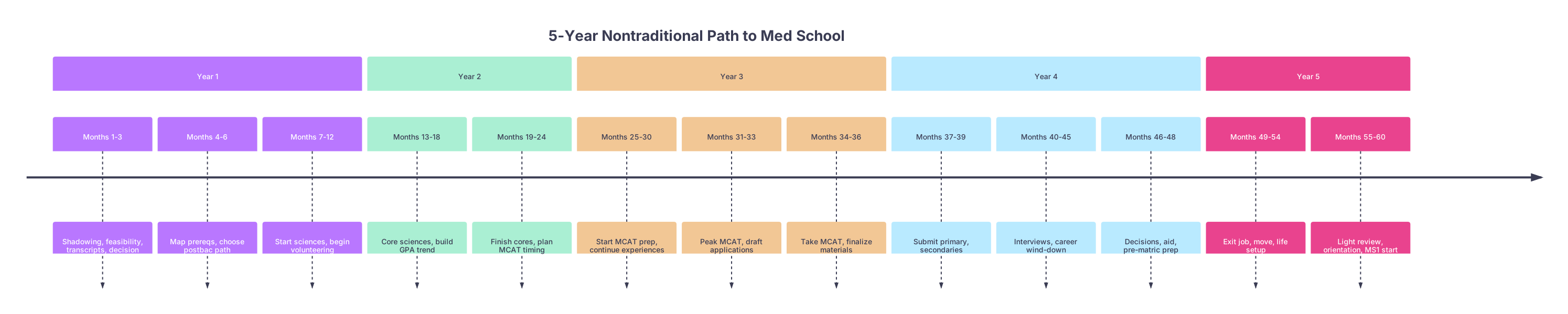
| Period | Event |
|---|---|
| Year 1 - Months 1-3 | Shadowing, feasibility, transcripts, decision |
| Year 1 - Months 4-6 | Map prereqs, choose postbac path |
| Year 1 - Months 7-12 | Start sciences, begin volunteering |
| Year 2 - Months 13-18 | Core sciences, build GPA trend |
| Year 2 - Months 19-24 | Finish cores, plan MCAT timing |
| Year 3 - Months 25-30 | Start MCAT prep, continue experiences |
| Year 3 - Months 31-33 | Peak MCAT, draft applications |
| Year 3 - Months 34-36 | Take MCAT, finalize materials |
| Year 4 - Months 37-39 | Submit primary, secondaries |
| Year 4 - Months 40-45 | Interviews, career wind-down |
| Year 4 - Months 46-48 | Decisions, aid, pre-matric prep |
| Year 5 - Months 49-54 | Exit job, move, life setup |
| Year 5 - Months 55-60 | Light review, orientation, MS1 start |
The 5‑year plan only works if you turn it into a 5‑day plan, then a 5‑hour plan.
Your actionable next step today: pull your transcripts and write down, in one place, your current cGPA, sGPA, and the exact list of prerequisite courses you are missing. That single page becomes the starting point of your actual timeline, not just the idea of one.