
The standard med school timeline was not built for people with a full-time job and dependents. If you follow “traditional” advice as an older, working premed, you will burn out or miss critical deadlines.
Here is the cycle as it actually works when you are not 21, living on campus, swimming in free time.
Big-Picture Calendar: What Happens When
Let me anchor you first, then we go month-by-month and week-by-week.
Assume you want to start medical school in August 2028. That means:
- Your application cycle runs May 2027 – March 2028
- Your “prep year” runs June 2026 – April 2027
At a high level, your time breaks down like this:
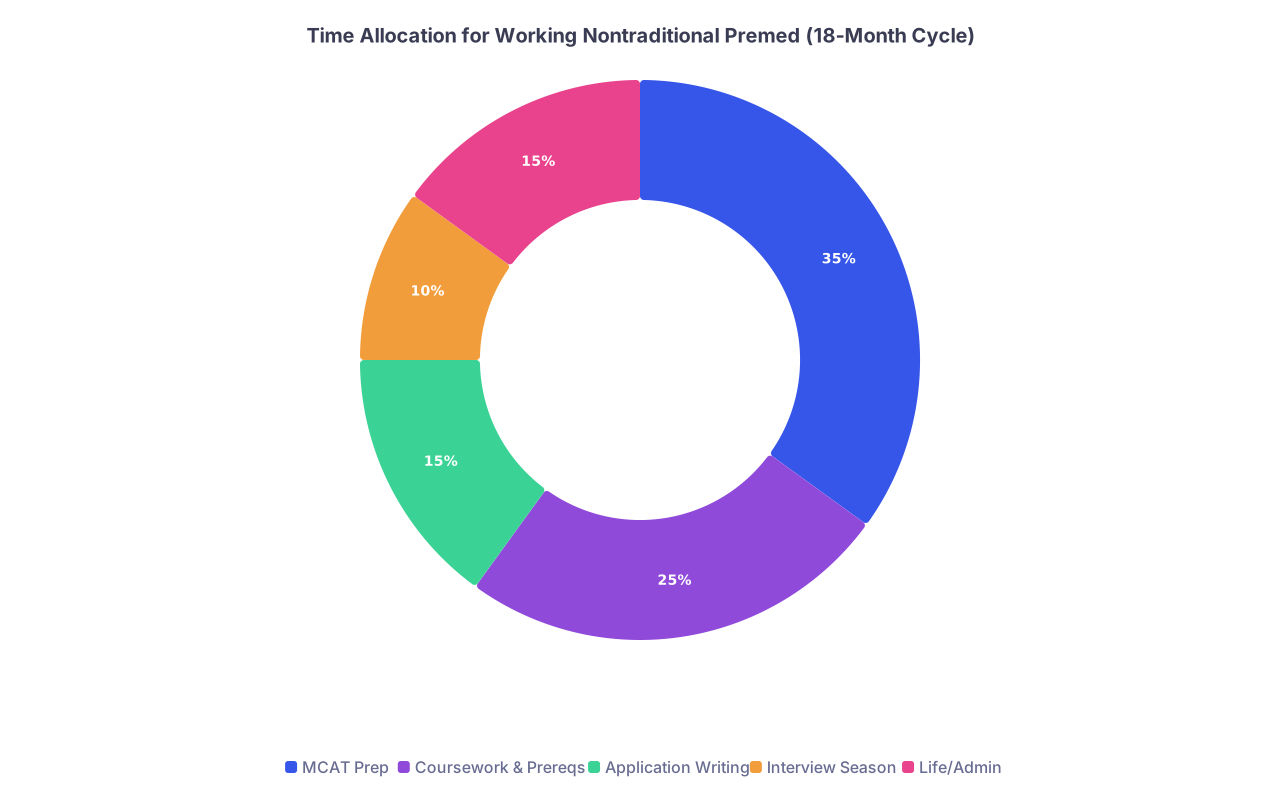
| Category | Value |
|---|---|
| MCAT Prep | 35 |
| Coursework & Prereqs | 25 |
| Application Writing | 15 |
| Interview Season | 10 |
| Life/Admin | 15 |
Roughly:
- 12–18 months before: Fix prerequisites, build clinical hours, plan finances
- 9–12 months before: Dedicated MCAT prep
- 3–6 months before: Application writing, letters, logistics
- May–July of application year: Submit primary + secondaries
- August–February: Interview season while working
- March: Acceptance / waitlist decisions and final planning
Now let’s walk it chronologically with the reality of a 40-hour work week (or more), maybe kids, and a body that does not enjoy all-nighters anymore.
Phase 1 (15–12 Months Before Submitting): Reality Check and Infrastructure
Goal of this phase: Decide if the next 2–3 years are actually feasible and build the scaffolding so you do not implode mid-cycle.
Assume you plan to submit your primary in June 2027. This phase is March–June 2026.
At this point you should…
Month -15 (March 2026): “Brutal Audit” Month
Do a hard numbers check
- Cumulative GPA, science GPA (approximate is fine)
- Any post-bacc or recent coursework
- Prior attempts at MCAT, if any
- Debt load and monthly obligations
Sketch a realistic weekly bandwidth
- Write out your actual week in hours:
- Work: 40–50 hours
- Commute: ? hours
- Family obligations: ? hours
- Sleep you actually need: 7–8 hours/night
- Whatever is left is your ceiling for MCAT + coursework + volunteering. Not your target. Your ceiling.
- Write out your actual week in hours:
Draft a 2-year calendar
- Put in:
- Busy work seasons (quarter close, teaching terms, travel)
- Major family events / known crunches
- Any pregnancy, new baby, elder care issues you can anticipate
- Mark May–July 2027 as “application fire zone” and Oct 2027–Jan 2028 as “interview volatility”.
- Put in:
If the calendar already looks impossible, that is your signal to push your target cycle back instead of pretending you can do three full-time jobs.
Month -14 (April 2026): Prerequisites and Gap Analysis
At this point you should:
- Request all old transcripts (community college, old bachelor’s, random online courses). Do not guess about your GPA from memory.
- Map your completed courses to standard med school prerequisites:
- 1 year general chemistry with lab
- 1 year biology with lab
- 1 year physics with lab
- 1 year organic chem ± biochemistry
- Some combination of psychology, sociology, statistics, writing
| Background | Typical Missing Courses |
|---|---|
| Business/Finance | Bio, Chem, Physics, Orgo |
| Engineering | Bio, Orgo, Psych, Soc |
| Nursing/Allied Health | Physics, full Orgo sequence |
| Humanities/Social Sciences | Chem, Physics, higher-level Bio |
- Decide: Formal post-bacc, DIY post-bacc, or just 1–2 targeted courses?
At this point, you should not enroll in a full-time post-bacc if you have a full-time job and family. That combo consistently ends badly.
Month -13 (May 2026): Finances and Schedule Redesign
You need money and time. Those are the two currencies of this process.
Build a med school budget for the next 3 years
- Application cycle costs (ballpark):
- Primaries for 20 schools: $1200–$1500
- Secondaries for 20 schools: $1500–$2500
- MCAT + prep: $350–$3000
- Interview travel (if not all virtual): highly variable, $500–$5000
- Tuition later is a separate monster. Right now we are just talking application runway.
- Application cycle costs (ballpark):
Make one aggressive schedule change now Options I have seen work:
- Move to 0.8 FTE and accept lower income
- Negotiate 1–2 WFH days to reclaim commute time
- Shift to 4x10s and free a full weekday for classes and MCAT
Do not plan to “study MCAT from 9 pm–1 am every day” for a year. That is fantasy.
Month -12 (June 2026): Commit to a Timeline
By now you should have:
- A realistic target application year (e.g., June 2027, not a vague “sometime soon”)
- A plan for any remaining prerequisites over the next 12 months
- A rough MCAT month (e.g., March or April 2027)
Lock those in and write them where you see them daily. Vague plans evaporate under real life.
Phase 2 (12–6 Months Before Submitting): Coursework, Clinical Exposure, Early MCAT Foundation
This is June–December 2026 in our example. You are not in heavy MCAT mode yet. You are building the base.
Months -12 to -10 (June–August 2026): Stabilize Classes + Work
At this point you should:
Be enrolled in no more than 2 science courses per term while working full-time.
I have watched too many 35-year-olds sign up for 3 labs + 40-hour job. They tank one or more classes and dig a hole.Start or formalize clinical exposure:
- Scribe (even 1 shift/week)
- ED volunteer, hospice, primary care clinic
- MA or CNA if you already have credentials
You are aiming for consistent, modest hours, not heroic short bursts. For a working adult, 4–6 clinical hours/week for a year beats “100 hours in a month” and then nothing.
Months -9 to -8 (September–October 2026): Light MCAT Warm-Up
You do not start grinding 4-hour practice blocks yet. But you do not wait until January cold.
At this point you should:
Do a diagnostic MCAT under timed conditions (no, you will not like the score; that is fine).
Identify your weakest content areas and match them to your current or future coursework:
- Weak physics? Maybe take algebra-based physics this fall.
- Weak biochem? Schedule that before MCAT-heavy season if possible.
Establish 3 short weekly habits:
- 3 x 30–45 minutes of CARS passages
- 2 x 30 minutes of Anki or spaced repetition for whichever class you are in that maps to MCAT (e.g., bio)
- 1 x 60 minutes on premed “admin”: reading school websites, understanding AMCAS/AACOMAS, researching non-trad friendly schools
Phase 3 (6–1 Months Before Submitting): MCAT-Centric Season
This is January–May 2027 if you plan to submit June 2027. Here is where older applicants either make it or stall out.
Month -6 (January 2027): Flip to MCAT as Top Academic Priority
At this point you should:
- Block 10–15 hours/week for MCAT. Non-negotiable. If you cannot find that in your real schedule, you are not ready to test this cycle.
- Pick an MCAT test date no later than late April or early May. June MCAT is already risky for a working nontrad because score delays push your application completeness into July/August.
Your weekly structure might look like:
| Day | Morning | Evening (After Work) |
|---|---|---|
| Mon | — | 2 hrs content review |
| Tue | 30 min CARS | 1.5 hrs practice Qs |
| Wed | — | 2 hrs content review |
| Thu | 30 min Anki | 1.5 hrs timed passages |
| Fri | — | Light review or rest |
| Sat | 3–4 hrs block | Full sections / mixed blocks |
| Sun | 2–3 hrs block | Review + planning |
If that schedule is impossible, delay the test or lighten your work temporarily.
Months -5 to -4 (February–March 2027): Ramp Intensity
At this point you should:
- Transition from 60–70% content / 30–40% practice to the opposite.
- Do 1–2 half-length practice exams in late February, then full-lengths every 2–3 weeks in March.
Track your scores. The trend matters more than any single test.
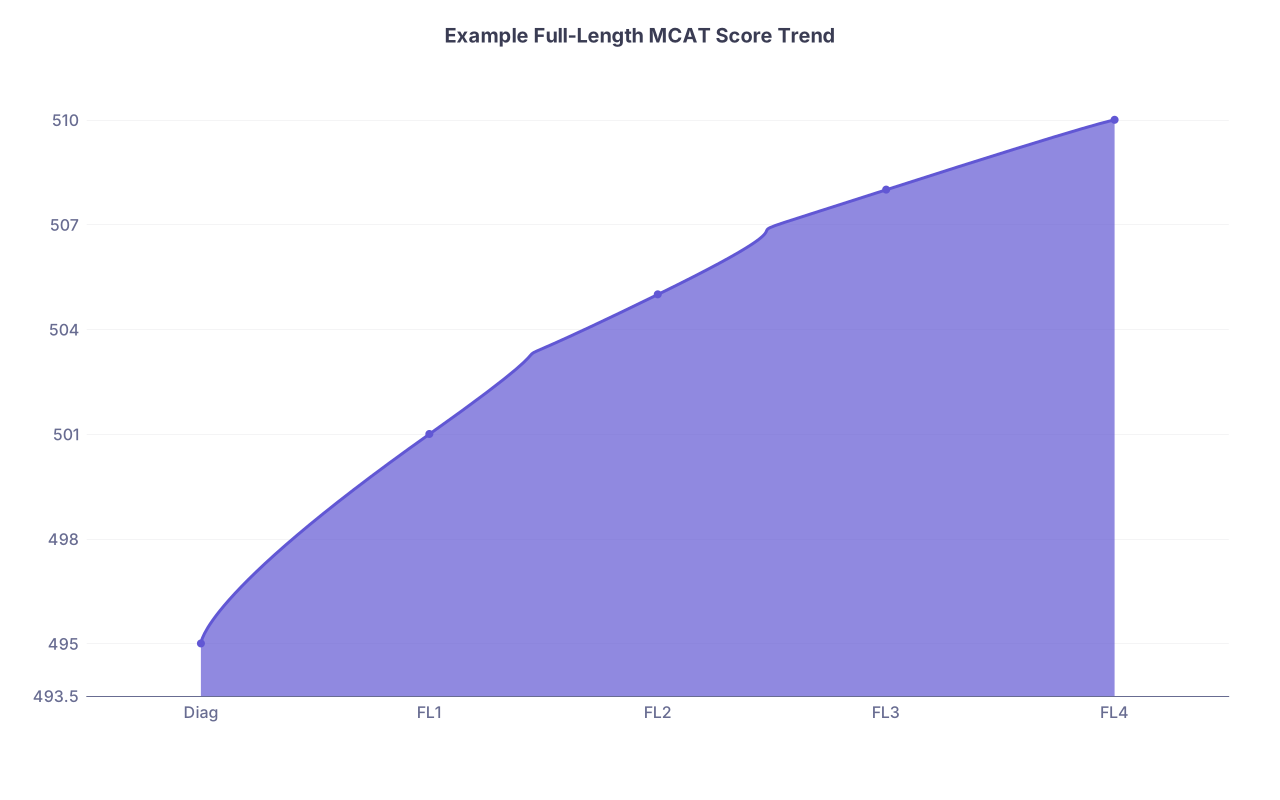
| Category | Value |
|---|---|
| Diag | 495 |
| FL1 | 501 |
| FL2 | 505 |
| FL3 | 508 |
| FL4 | 510 |
If you are not within ~5 points of your target by mid-March, you make an adult decision:
- Move the test back and accept later completion of your application, or
- Push the entire cycle back a year and spare yourself the chaos
Older applicants who force a weak MCAT “just to apply” usually end up reapplying. That is far more expensive and time-consuming.
Month -3 (April 2027): Final MCAT Push and Application Skeleton
This month is rough. You are:
- Working
- Finishing MCAT heavy practice
- Starting application writing
At this point you should:
- Have 2–3 full-length exams under your belt with stable scores.
- Start drafting:
- AMCAS/AACOMAS work & activities entries
- A brain-dump list for your personal statement (stories, turning points, clinical experiences)
Keep writing time short—maybe 2 evenings per week. Your MCAT performance still takes priority.
Month -2 (May 2027): MCAT Done, Immediately Reallocate Time
Let us say you take MCAT early May.
Week 1–2 after the test:
- Rest a bit. 3–4 days where you are not “studying” anything.
- Then reassign most of your old MCAT hours to application writing.
At this point you should:
- Have a solid personal statement draft by end of May
- Have all major activities described in at least rough bullet form
You do not wait for the MCAT score to start applications. That is too late for a working adult who cannot crank 6-hour writing marathons on demand.
Phase 4 (Application Submission: May–August of Application Year)
Now we are in May–August 2027. This is where the “Timeline Guide” voice really matters because every week counts.
Late May – Early June 2027: Primary Application Finalization
At this point you should, in order:
Week 1–2 of June:
- Finalize:
- Personal statement
- Work & activities (15 entries max, 3 most meaningful)
- Build a balanced school list with a strong nontraditional lens:
- Consider DO vs MD mix
- Look for schools that mention:
- Holistic review
- Older students / career changers
- Part-time work allowed pre-matriculation (rare but exists)
By Mid-June:
- Submit your primary application (AMCAS/AACOMAS).
Submitting in late July because work is busy is how older applicants drift into the “late pool.”
Letters of Recommendation Timing
At this point you should already have:
- Asked letter writers by March or April
- Sent them:
- Your CV / resume
- Draft personal statement
- Bullet points about your work with them
If letters are not in by July, you start sending polite but direct reminders. Your age does not buy you any slack with missing letters.
July–August 2027: Secondary Essay Marathon (While Working)
Secondaries will pile up quickly. You cannot write each one from scratch after a full work day without losing your mind.
At this point you should:
Create a library of 3–4 core essays:
- Why medicine?
- Why this school?
- Diversity / adversity
- Significant challenge / failure
Set a weekly quota:
For example, 3–5 schools per week depending on your list size.
That usually means:- 60–90 minutes each weekday evening
- 3–4 hours on one weekend day
If a school’s secondary sits untouched for more than 3 weeks, your odds drop. Aim to return each within 7–10 days while accepting that life may push a few to 14 days.
Phase 5 (Interview Season While Working: September – February)
This is the phase everyone underestimates. It is not just “a few days off work.” It is unpredictability.
September–November 2027: Interview Invitations and Logistics
At this point you should:
- Have told your employer something. Two common scripts:
- “I am applying to graduate programs this year, there may be a few interview days over the next several months.”
- For medicine specifically, if you are comfortable: “I am in the process of applying to medical school; interviews will mostly be during weekdays.”
- Block a few floating PTO days each month that you can move as invites come.
You might get:
- Several invites clustered in 3 weeks
- Nothing for a month
- A same-week interview request that forces a hard choice with work
If travel is required and you have dependents, you need:
- Backup childcare plan
- A travel budget with some buffer so you are not deciding based purely on flight prices
December 2027 – February 2028: Final Interviews and Waiting
By this point you should:
- Keep working as usual
- Keep your performance solid; you might need your job for another year if you have to reapply or choose a later start
Do not mentally quit your career before you have an acceptance in hand. I have seen people check out at work in December, then end up reapplying and spending a miserable year with a burned bridge behind them.
Phase 6 (Post-Acceptance or Re-Strategizing: March and Beyond)
Match/decision time for most med schools is March–April 2028 for an August start.
If You Are Accepted
At this point you should:
- Give your employer 3–4 months notice if possible, especially if you are senior.
- Finalize:
- Housing near school
- Childcare transitions
- Debt management / forbearance plans
You also need to shift your identity mentally from “working adult student” to “full-time medical student” which is surprisingly jarring for many older applicants.
If You Are Waitlisted or Not Accepted
You are not “back to square one.” But you do need a structured post-mortem within 4–6 weeks.
At this point you should:
- Analyze honestly:
- Was it GPA? MCAT? Late application? Weak school list? Limited clinical?
- Decide early (by June) whether you will:
- Reapply immediately with targeted fixes, or
- Take 1–2 years to significantly strengthen your profile
Do not drift for a year in “maybe I will reapply” limbo. That kills momentum.
Visualizing Your Two-Year Plan
Here is the whole thing condensed into a simple timeline:
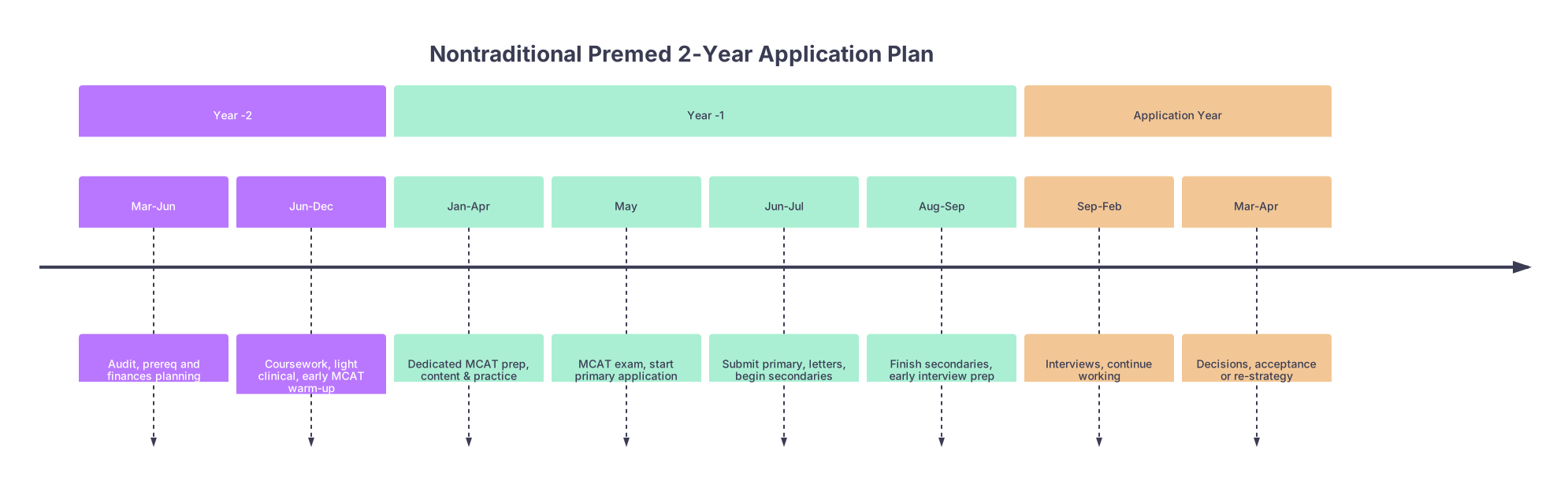
| Period | Event |
|---|---|
| Year -2 - Mar-Jun | Audit, prereq and finances planning |
| Year -2 - Jun-Dec | Coursework, light clinical, early MCAT warm-up |
| Year -1 - Jan-Apr | Dedicated MCAT prep, content & practice |
| Year -1 - May | MCAT exam, start primary application |
| Year -1 - Jun-Jul | Submit primary, letters, begin secondaries |
| Year -1 - Aug-Sep | Finish secondaries, early interview prep |
| Application Year - Sep-Feb | Interviews, continue working |
| Application Year - Mar-Apr | Decisions, acceptance or re-strategy |
Final Checkpoints
If you skimmed everything, here is what matters:
- Lock your timeline 12–18 months in advance. As a working, older premed you cannot improvise your way through MCAT + applications.
- Protect your bandwidth ruthlessly. One full-time job plus 10–15 MCAT hours is already near the limit; add courses and volunteering carefully.
- Front-load decisions, not suffering. Move the test, shift a cycle, or cut work hours early rather than dragging yourself through a doomed, exhausted application year.