
It's Sunday night, 9:45 p.m. Your work calendar for the week is already packed. Standing meetings. Commute. Maybe kids’ activities. You know you need clinical experience for medical school, but right now even doing laundry feels like a major project. And yet, application deadlines are not going to move for your schedule.
You are here: employed full-time (or close to it), serious about medicine, and trying to figure out how to build enough clinical exposure without blowing up your job or your sanity.
Let’s build this as a 12‑week, week‑by‑week plan, with clear actions and realistic time blocks for someone with a busy schedule.
Week 0: Baseline Reality Check (You Are Here)
This is the pre‑week. You do it now, before you try to “add” anything.
At this point you should…
Audit your schedule (brutally).
Take one typical week and map it hour by hour:- Work hours (including commute)
- Sleep (target 7 hours; less than 6 is a long‑term problem)
- Fixed obligations (kids, caregiving, classes)
- Flexible blocks (evenings, early mornings, weekends)
You are hunting for:
- One weekday evening you can consistently free (3–4 hours)
- One half‑day on the weekend (4–5 hours)
If you cannot find 7–8 hours/week, you are not ready to add clinical experience yet. You need to cut something first.
Clarify your clinical target.
For nontraditionals, I push for:- 100–150 hours of clinical experience before applying, minimum
- With at least 30–40 hours of direct patient contact (not just filing charts or answering phones)
With 12 weeks at ~8 hours/week, you can hit ~96 hours. That is enough to get started or strengthen an already modest base.
Decide which path(s) fit your life right now.
Common Clinical Experience Options for Busy Nontraditionals Option Training Time Typical Shift Length Patient Contact Level Hospital Volunteer 2–6 weeks 3–4 hours Low–Moderate Clinical Scribe 2–4 weeks 4–8 hours High (indirect) CNA / MA (later phase) Months 8–12 hours High (direct) Hospice Volunteer 4–8 weeks 2–4 hours High (direct) Free Clinic Volunteer 1–4 weeks 3–5 hours Moderate–High For a 12‑week build with a busy work schedule, the most realistic:
- Hospital volunteer
- Scribe (if you can handle 6–8 hour shifts)
- Hospice or free clinic roles that offer evening/weekend shifts
Week 1–2: Infrastructure and Applications
For these two weeks, you are not “getting hours.” You are building the system that will give you hours.
Week 1: Target and Apply
Goal: Submit multiple clinical experience applications and lock down a future role.
At this point you should…
Carve out 2 focused evening sessions (90–120 minutes).
Use them for pure research and outreach:- Search: “hospital volunteer program [your city]”
- “medical scribe jobs part‑time [your city or remote]”
- “free clinic volunteer [county]”
- “hospice volunteer opportunities [your city]”
Prioritize roles with evening/weekend options.
If a program only offers Monday–Friday 8–4, ignore it. You cannot out‑schedule your job.Send out 5–10 applications/inquiries.
Minimum:- 2 hospital volunteer programs
- 2–3 scribe companies or clinics
- 1–2 hospice or free clinics
Do not send one and “wait to see what happens.” That is how you lose three months.
Week 2: Paperwork and Pre‑Onboarding
Goal: Push every promising opportunity to the “start date scheduled” stage.
At this point you should…
Handle administrative junk immediately.
The biggest nontraditional failure point is letting forms sit in your inbox.- TB test, immunization records
- Background checks, drug screens
- Volunteer orientation scheduling
Block:
- One evening (2 hours) for forms
- One short morning or lunch break for a TB test / lab draw
Negotiate schedule early and clearly.
When programs ask for availability:- Offer one weekday evening (e.g., Tue 5–9 p.m.)
- Offer one weekend block (e.g., Sat 8 a.m.–12 p.m. or Sun 1–5 p.m.)
- Explicitly say: “I work full‑time so I need stable recurring shifts.”
Lock in start dates.
The goal by end of Week 2:- You have at least one role with a firm start date in Week 3–4
- You know initial training/orientation dates
If nothing has firmed up by the end of Week 2, send polite follow‑ups and apply to more places. No waiting.
Week 3–4: Onboarding and First Clinical Shifts
This is where people either commit or quietly disappear. You will commit.
Week 3: Orientation and Shadowing‑Lite
Goal: Complete orientation and get physically inside the clinical environment.
At this point you should…
Plan for 1–2 orientation blocks.
Usually 2–4 hours each. Could be:- Hospital orientation (badges, HIPAA, safety)
- Scribe company training (EMR, templates)
Put them in your calendar like a work meeting. Non‑negotiable.
Use orientation time deliberately.
While you are being walked around:- Note where physicians, nurses, and ancillary staff actually spend time
- Notice the pace and workflow (chaotic ED vs slower outpatient)
- Start collecting questions: “What is hardest about this job?” “What makes a good premed here?”
Set expectations with your job and family.
This week, you warn people:- “I am starting hospital volunteering; I will be out Tuesday evenings 5–9 for the next few months.”
- Adjust one or two nonessential commitments now. Drop things if you need to.
Week 4: First Real Shifts
Goal: Complete 2 real clinical shifts (6–8 hours total).
At this point you should…
Do not overbook your first week.
Schedule:- 1 weekday evening shift (3–4 hours)
- 1 weekend shift (3–4 hours)
More than that, and you will hate everything by Friday.
Treat these shifts like paid work.
- Show up 10–15 minutes early
- Stay off your phone unless job‑related
- Introduce yourself to every nurse, tech, and physician you interact with:
- “Hi, I am [Name], I work full‑time in [field], but I am here as a volunteer/scribe because I am applying to medical school.”
Start a clinical log.
After each shift, 10 minutes, no excuses:- 2–3 patients or moments that stood out
- What your role was
- What you learned about:
- The physician’s work
- Health system realities
- Your own reaction (bored, energized, intimidated)
This log will save you when you write your personal statement and activity descriptions.
Week 5–6: Stabilize the Routine and Build Volume
Weeks 5–6 are about making this sustainable. Not heroic.
Week 5: Lock the Weekly Template
By Week 5, your schedule should have a default template. Something like:
- Tuesday 5–9 p.m. – Hospital volunteer shift
- Saturday 9 a.m.–1 p.m. – Free clinic or scribe shift
8 hours per week. Repeatable.
At this point you should…
Commit to a 4‑week block at that schedule.
Tell the coordinator: “You can count on me for these shifts for the next month.” Reliability is currency.Narrow your focus to one primary site.
Two different hospitals + a free clinic + a random shadowing doctor? That sounds impressive but usually just dilutes impact when your time is scarce.
One main clinical site + occasional extras is more realistic.Begin very light relationship building.
During slower moments:- Ask the charge nurse: “Are there tasks that would be more helpful for you that I am allowed to do?”
- Briefly ask a resident or attending after a case: “What made that case challenging from your perspective?”
You are not trying to impress. You are trying to learn and be useful.
Week 6: Add Intentional Reflection
Same ~8 hours of shifts. Different mindset.
At this point you should…
After each shift, answer three questions in your log:
- What did I see that confirmed I want to do this?
- What did I see that made me question this path?
- How did physicians behave when things went badly?
Start noticing patterns.
Maybe you:- Gravitate toward acute, fast‑moving cases
- Prefer continuity in outpatient settings
- Are more affected by end‑of‑life care than you expected
These observations become the backbone of your “why medicine” story later.
Check in with your energy.
If you are:- Missing work deadlines
- Constantly exhausted, snappy at family
- Dreading shifts
You do not push more hours yet. You stabilize here.
Week 7–8: Smart Expansion and Depth
If by Week 7 you are holding your routine without breaking, you can consider stepping it up. Carefully.
Week 7: Evaluate and Adjust
At this point you should…
Review your cumulative hours.
Approximate:- Weeks 3–4: ~12 hours
- Weeks 5–6: ~16 hours
- Total so far: ~28 hours
Less than that? You likely missed shifts. Fix the schedule, not your guilt.
Decide: intensity vs duration.
You have two levers:
- Intensity: Increase to 10–12 hours/week for the next month
- Duration: Keep 8 hours/week longer (beyond 12 weeks)
For most full‑time workers, I recommend:
- Stay at ~8 hours/week but commit for 4–6 months rather than spike and crash
Ask about role expansion.
Once trust is built:- “I have been here a couple of months and would love to take on any additional patient‑facing tasks that are allowed for volunteers/scribes.”
Examples:
- Escorting patients
- Helping with intake (under supervision)
- Observing procedures more closely
Week 8: Add Either One Shadowing Stream or One New Setting
Do not add both. Remember, you have a job.
Options:
Short, focused shadowing thread:
- One physician, 3–4 mornings across a month (you take half‑days off work)
- Total: 12–16 hours of classic shadowing
Add a different clinical environment once a month:
- If you are in the ED, add one primary care clinic Saturday
- If you are outpatient, add one ED or inpatient experience
At this point you should…
Schedule specific dates, not vague intentions.
“Shadow Dr. X sometime in March” is code for “never.”
Put on the calendar:- “Shadow Dr. Lee – Internal Medicine, Fri Mar 7, 8 a.m.–12 p.m.”
Clarify expectations with the physician.
- Confirm dress code
- Ask about patient consent for shadowing
- Confirm whether you can ask questions during or only after visits
Continue your core weekly shifts.
The shadowing or extra setting is layering, not replacing.
Week 9–10: Leverage Experience into Competence and Context
By now you should have 40–60+ hours. Enough to stop feeling like an absolute outsider.
Week 9: Observe the System, Not Just the Medicine
At this point you should…
Use one or two shifts to focus on non‑medical dynamics.
Pay attention to:- How often staff talk about insurance and prior auth headaches
- How nurses and physicians communicate under pressure
- Where things break: delayed labs, missing orders, confused family members
Start translating experiences into “application language.”
For each log entry, add one line:- “What skill or trait did I use here that is relevant to medicine?”
Examples: - De‑escalating an anxious family member → communication and empathy
- Staying calm during chaotic ED triage → composure and prioritization
- “What skill or trait did I use here that is relevant to medicine?”
Identify 2–3 physicians you might eventually ask for a letter (longer‑term).
You do not ask yet. You observe:- Who has actually seen you show up reliably
- Who has talked with you about your goals more than once
- Who teaches, not just treats
Week 10: Tighten the Narrative
You are still doing your ~8 hours/week. But now you start building the story that will live in your application.
At this point you should…
Draft a one‑paragraph “why medicine (so far)” summary.
Pull from your log. Attempt:- 4–6 sentences
- One or two specific clinical moments
- One early reflection: “Initially I thought X; I realized Y.”
Identify gaps in your exposure.
Ask:- Have I seen chronic disease management?
- Have I seen acute care?
- Have I seen end‑of‑life / serious illness conversations?
If there is a glaring gap, plan 2–3 targeted shifts in that setting over the next month (maybe a hospice or palliative observation day).
Check your work‑life balance again.
If your job performance is tanking, you scale back temporarily to one weekly shift. Med schools will not reward you for getting fired.
Week 11–12: Consolidate, Decide, and Plan Beyond 12 Weeks
By Week 11, you are not a tourist anymore. You have enough exposure to make some real decisions.
Week 11: Decide What Happens Next
At this point you should…
Set a clear target for total hours before you apply.
Based on your situation:- If you already had 50–100 hours pre‑Week 0, your 12‑week block may be enough
- If you started from zero, aim for:
- 150–200 hours over 6–9 months total
Choose one of three paths:
- Maintain: Continue ~8 hours/week at current site for another 12+ weeks
- Deepen: Add a more advanced role over the next 6–12 months (CNA, MA, ED tech if feasible)
- Diversify lightly: Keep your core, add 1 new environment every 4–6 weeks
Ask for feedback from someone on the inside.
Example script for a nurse or physician you know reasonably well:- “I am applying to medical school in [year]. You have seen me here for a couple of months now. From your perspective, what should I focus on improving or seeing more of before I apply?”
Then shut up and listen. They will see blind spots you cannot.
Week 12: Formal Reflection and System Reset
You have done 12 weeks of work. You do not just stumble into Week 13.
At this point you should…
Calculate your exact hours.
From sign‑in sheets or approximate logs:- Total clinical hours
- How many were “direct patient contact” vs administrative or purely observational
Write a 1–2 page reflection for yourself.
Not for AMCAS yet. For you.- Top 3 moments that pushed you toward medicine
- Top 3 moments that made you hesitate or question this path
- How your view of physicians changed from Week 1 to Week 12
- What you now know you need to see or test next (e.g., night shifts, primary care, surgery)
Reset your schedule for the next 12 weeks.
Decide:- Which shift(s) will stay fixed
- What your absolute ceiling is for weekly hours
- Whether you will add any structured shadowing days
Put the next 4 weeks of shifts into your calendar today, not “later.”
Visualizing Your 12‑Week Build
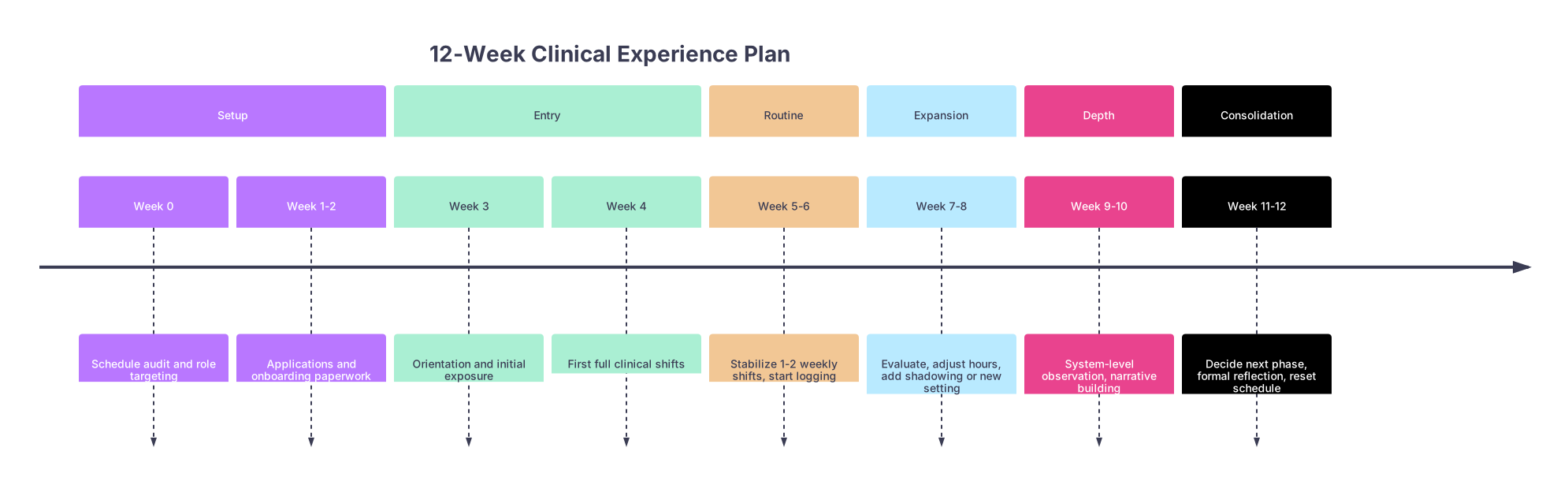
| Period | Event |
|---|---|
| Setup - Week 0 | Schedule audit and role targeting |
| Setup - Week 1-2 | Applications and onboarding paperwork |
| Entry - Week 3 | Orientation and initial exposure |
| Entry - Week 4 | First full clinical shifts |
| Routine - Week 5-6 | Stabilize 1-2 weekly shifts, start logging |
| Expansion - Week 7-8 | Evaluate, adjust hours, add shadowing or new setting |
| Depth - Week 9-10 | System-level observation, narrative building |
| Consolidation - Week 11-12 | Decide next phase, formal reflection, reset schedule |
Sample Weekly Template for a 40‑Hour Worker
To make this less abstract, here is a realistic pattern I have seen work.

| Category | Value |
|---|---|
| Work + Commute | 50 |
| Sleep | 49 |
| Clinical Experience | 8 |
| Family/Personal | 35 |
| Misc/Buffer | 26 |
This assumes:
- 50 hours work + commute
- 7 hours sleep per night
- 8 hours clinical
- 35 hours family/personal
- 26 hours miscellaneous/buffer
The point: you are not inventing time. You are reallocating it, on purpose.
Common Failure Points (and When They Happen)
You are not special. The pitfalls are predictable.
Weeks 1–2: People “research opportunities” endlessly and never submit applications.
Fix: Set a hard cap—10 opportunities researched, 5 applied. Then stop.Weeks 3–4: Orientation gets scheduled twice, then work gets busy, and they cancel.
Fix: Treat clinical start like an exam. You do not cancel unless you are truly sick.Weeks 5–6: Fatigue hits. Shifts feel thankless and boring.
Fix: Add structure—logs, questions to ask, skills to observe. Boredom often equals unintentionality.Weeks 7–8: Overconfidence → over‑commitment.
Fix: Cap clinical time. Busy professionals crash when they try to “make up for lost time” by doubling hours overnight.Weeks 9–12: No reflection. People rack up hours but cannot articulate what they learned.
Fix: Weekly 15‑minute reflection block. Non‑negotiable.
Your Action for Today
Do not “decide to start this plan.” That is vague. Instead:
Tonight, open your calendar and block one specific 2‑hour slot this week labeled: “Clinical Experience Search & Applications.”
In that block, you will:
- Identify at least 5 realistic opportunities
- Submit at least 3 actual applications or inquiry emails
Once that is on the calendar, this 12‑week plan is no longer theoretical. It has a start date.