
What actually happens to your life when you start 80‑hour weeks in your 40s with a mortgage, aging parents, and maybe teenagers at home?
Let’s kill the fantasy first.
There’s a very popular story online:
“You’re older, you’re wiser, you have better time management skills, so residency will be easier for you than for the 25‑year‑olds.”
That’s fiction.
You might handle the emotional nonsense better. You might have fewer identity crises. But the logistics? The sleep? The energy? The family demands? Reality is harsher at 42 than at 26. And pretending otherwise is how people end up burned out, resentful, and blindsided.
I’m going to walk through what the data shows, what I’ve seen older trainees run into over and over again, and where the real—not Instagram—version of “work–life balance” actually lands for 40‑something residents and fellows.
Not to scare you off. To let you prepare like an adult instead of fantasizing like a premed on Reddit.
Myth #1: “Once I’m in residency, things will stabilize.”
You hear this a lot from career changers:
“If I can just get through MCAT, applications, and med school with kids/a job/loans… residency will at least be steady.”
Steady? Yes. Balanced? No.
The schedule is predictable in the sense that you will predictably be exhausted.
Let’s get concrete.
| Category | Typical 20s Resident | Typical 40s Resident |
|---|---|---|
| Clinical hours (peak months) | 60–80/week | 60–80/week |
| Sleep debt recovery capacity | Higher | Lower |
| Non-work obligations | Few (often) | Kids, spouse, parents, mortgage |
| Financial cushion | Often minimal, but fewer dependents | Often negative with dependents |
| Flexibility for last-minute schedule changes | Higher | Much lower |
Same hours. Very different lives.
Studies of resident workloads (especially in surgery, internal medicine, and OB/GYN) consistently show work weeks hovering in the 60–80 hour range during busy rotations, even after duty hour “reforms.” ACGME caps are not the same thing as humane schedules.
The “stability” people feel in residency is mostly:
- No longer dealing with exams and trying to match
- Having one defined role instead of a rotating carousel of preclinical/clinical demands
- Getting a paycheck (even if it’s thin)
But your time away from work is narrower, and in your 40s, that off‑time is already spoken for: kids’ sports, medical appointments (yours and your parents’), financial planning, actual house maintenance, relationship repair.
Translation: stability in identity. Not in hours, energy, or actual balance.
Myth #2: “My life experience will make residency easier.”
Partly true. Mostly misapplied.
Yes, being older helps in a few ways:
- You tend to care less about impressing every attending.
- You’re usually better at setting micro‑boundaries with toxic people.
- You may have done other demanding work (law, engineering, military) that gives you perspective.
That emotional scaffolding matters.
But your body does not care that you used to manage a team at Google. It cares that you’re on your 5th night in a row, trying to remember if you signed that chemo order, while your 7‑year‑old’s parent‑teacher conference is happening without you.
Let’s be blunt: physiologically, night shifts hit harder in your 40s.
There’s decent sleep science behind this. Older adults:
- Take longer to recover from circadian disruption
- Accumulate sleep debt faster
- Show more impairments in reaction time and mood with sleep loss than younger adults
Residency doesn’t adjust for that. The call schedule doesn’t say, “Oh, you’re 43? We’ll give you lighter nights.” You’re in the same pool. Often on the same ICU nights as people 15 years younger.
Where age really helps is decisions like:
- Not staying an extra two hours to tweak a presentation that’s already fine
- Declining the 8th “optional” research project that’s code for free labor
- Not losing your mind when a patient screams at you
But that’s psychological stamina. It does not eliminate the very real physical and logistical tax.
Myth #3: “If I plan well enough, I can have it all: family, residency, and a life.”
You can have a good life. You cannot have a balanced life.
Not in the usual sense of equal buckets: work, family, hobbies, self‑care, social, rest.
For 40‑something residents/fellows, what actually happens looks more like time triage.
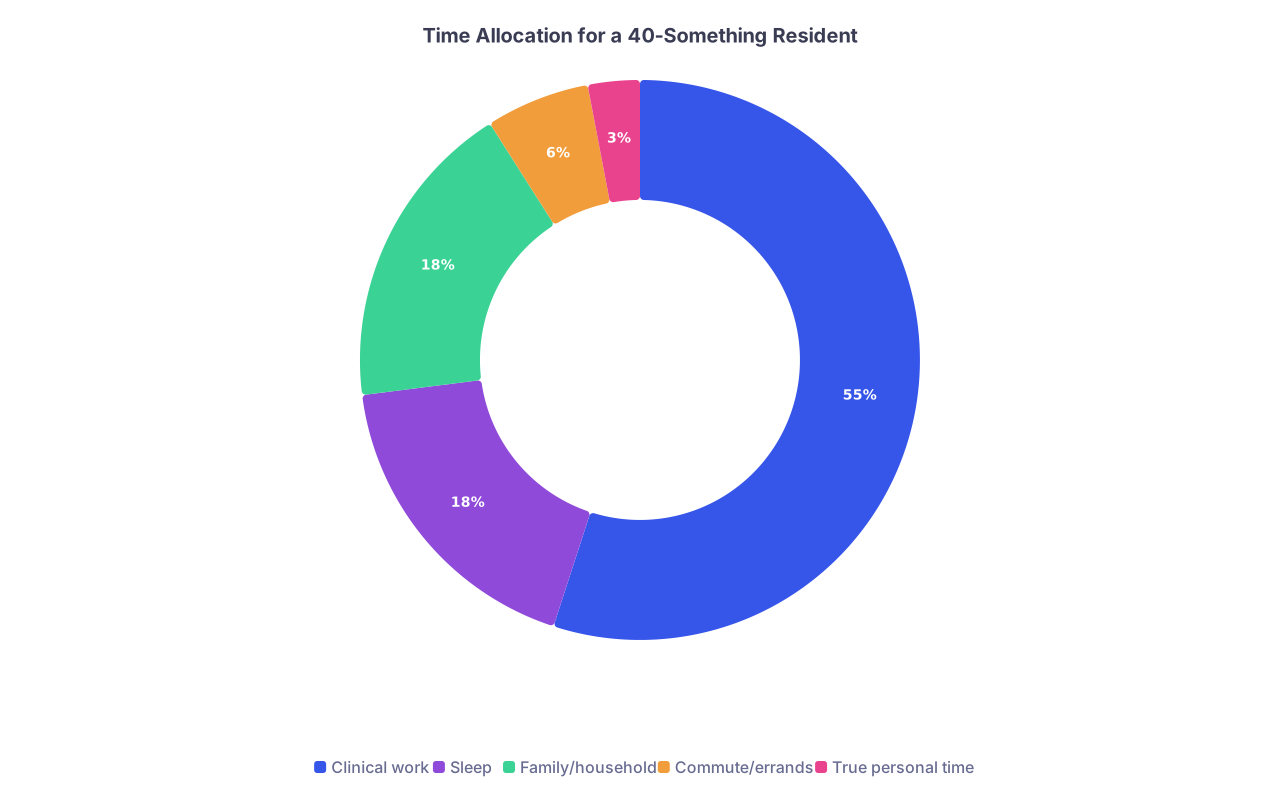
| Category | Value |
|---|---|
| Clinical work | 55 |
| Sleep | 18 |
| Family/household | 18 |
| Commute/errands | 6 |
| True personal time | 3 |
This is based on what I repeatedly see when people actually track their time in tough rotations:
- 55% of waking time: work (including notes, sign‑out, “staying late to not drown tomorrow”)
- 18%: sleep (and 6–7 hours/night is generous on some services)
- 18%: family and household logistics
- 6%: commuting and random errands
- 3%: genuine “this is just for me” time
That 3% is what people romanticize as “balance.” The yoga class, the book, the long walk, the friend you actually talk to rather than text “sorry super busy” for the 10th time.
If you go in expecting a life that looks like your current 9‑to‑5 with kids… you’ll feel like you’re failing at everything. Constantly.
If you go in understanding that for several years your life will be:
- Deeply unbalanced toward work
- Intermittently miserable
- But still compatible with long‑term happiness if you structure it intentionally
…then you’re closer to reality.
What actually breaks for 40‑something residents and fellows
This is where the myth‑busting gets uncomfortable.
It’s not just “I’m tired.” Lots of people are tired.
Here’s what actually blows up in practice for older trainees:
1. Relationships
I’ve watched marriages stress‑fracture in PGY‑2 more than any other year. Especially when one partner is not in medicine.
Common pattern:
- Partner believed: “We’ve already survived you working full‑time + post‑bacc + MCAT + applications. Residency can’t be worse.”
- Then they meet 28‑hour calls.
- They meet “I’m post‑call and technically home but I’m useless.”
- They meet “holiday coverage” and “I can’t come to the wedding; I’m on nights.”
Resentment builds fastest when expectations are wrong.
You do not fix this with one heartfelt conversation. You fix it by:
- Showing your spouse an honest call schedule before you apply
- Having numbers: what your take‑home pay will actually be, what childcare costs in your city, what backup plans exist
- Agreeing on non‑negotiables: maybe you always attend one kid event per month, or Friday dinner is sacred unless you are literally in the hospital
Notice I didn’t say “date night every week.” People promise that. Then it dies in month two.
2. Parenting
Let’s kill the “I’ll finally be more available once school is done” myth.
Residency is less flexible than preclinical med school for most parents, not more.
In preclinical, many schools increasingly use recorded lectures, hybrid learning, or looser attendance. You can watch lectures at 9 p.m. after the kids sleep. You can move your study hours around.
Residency is not like that. A kid with a 103°F fever at 11 a.m. on a Tuesday? You’re on a ward team with 18 patients and cross‑covering. You can’t just leave. Someone else has to show up. Your partner, your childcare, or your retired neighbor.
I’ve seen older residents who were previously the “default parent” go through an identity earthquake when they become the parent who misses:
- First day of school
- Recitals
- Most pediatrician visits
And if you’re a mother in your 40s who’s pregnant or breastfeeding during residency, you are essentially playing life on “hard mode.” Pumping between cases or on 10‑minute breaks, arranging leave, renegotiating schedules—none of that is simple, no matter how supportive a program claims to be.
3. Physical and mental health
You’re not 24 anymore. You don’t bounce back the same way.
The reality for many 40‑something residents:
- Weight gain, hypertension, or new metabolic issues within 2–3 years (check resident clinic stats; it’s not pretty)
- Old injuries (back, knees, neck) flaring with long OR days or endless standing
- Sleep fragmentation that doesn’t fully normalize even on golden weekends
On the mental side, one big lie is “I’ve been through hard things already, so I won’t burn out.”
You might cope better. But burnout isn’t a character flaw; it’s arithmetic:
High demand + low control + misaligned reward = burnout.
Residency nails all three. Age doesn’t immunize you. In fact, older trainees often have more cognitive dissonance:
You left a stable job, decent salary, maybe even leadership. Now you’re asked to justify every Tylenol order as if you’re 22 and clueless. That mismatch eats at people.
Where older residents actually have an edge
I’m not here to talk you out of this path. I’m here to torch the Pinterest version and replace it with the unvarnished one—and the places you genuinely do better.
Here’s what I routinely see 40‑something residents/fellows do better than their younger peers:
Boundary setting with nonsense
You’re less likely to volunteer for unpaid, uncredited “extra” when it doesn’t serve your goals. That protects your time—even if only slightly.Patient communication
Middle‑aged resident with life experience versus 25‑year‑old who’s never dealt with death, divorce, or chronic illness in their own circle? Patients feel the difference. Attendings notice.Long‑term perspective
You don’t lose your mind over a single mediocre evaluation or one shelf score. You care, but you don’t catastrophize. That protects your mental health.Strategic sacrifice
You know when it’s worth taking a hit now to buy leverage later. Doing an extra year of fellowship for lifestyle or location, for example, often makes more sense when you actually understand things like school districts and spouse careers.
So no, being older isn’t a disadvantage across the board. But your advantage is in judgment, not in magically making an 80‑hour week feel like 40.
The financial myth: “At least as an older resident I’ll be more responsible with money.”
You might be more responsible. You’ll also have more things pulling on that money.
The salary is the same as for your 27‑year‑old co‑intern. The obligations are not.
- Mortgage instead of rent split three ways
- Kids’ expenses
- Possibly your parents’ expenses
- Existing career change debt (post‑bacc, prior grad degrees)
Responsible doesn’t mean comfortable. I’ve seen 42‑year‑old residents making $62k in a high‑cost city with:
- $2500/month rent or mortgage
- $500–$1500/month childcare
- $500–$1000/month in educational debt minimums
There’s your resident salary. Gone.
You don’t buy work–life balance here. You buy relief from some future financial pressure if you pick a specialty and job that pay reasonably well and let you work into your 60s.
Which brings up another point nobody likes to say out loud: if you start residency at 42 and finish fellowship at 48, you have maybe 15–20 good clinical years before your own health, energy, or burnout risk starts to land differently.
You cannot afford to “wing it” financially during training the way some 25‑year‑olds do.
What realistic “balance” looks like in your 40s
If you’re still reading, you’re probably serious. So here’s the version that actually works for many older residents and fellows.
Not balance. Deliberate imbalance with guardrails.
Accept that work will dominate for several years.
Not forever, but more than you want. Instead of fantasizing about normalcy, decide intentionally what you’re willing to let go of. Hobbies. Trips. Volunteering. PTA roles. You can’t keep them all.Protect a tiny, non‑negotiable core.
This might be:- One family meal per week where you’re actually present
- One 30–45 minute exercise block three times per week
- A therapy appointment twice a month
Not 10 things. Two or three. Anchors, not decorations.
Outsource without guilt.
Cleaning service, grocery delivery, after‑school care. Yes, it’s money you “could save.” But you’re in a time‑critical window: midlife, limited earning years post‑training, kids growing fast. Buying back time is not a luxury; it’s survival.Use your age strategically with your program.
You don’t demand special treatment. But you do communicate like an adult:- Give program leadership early notice of major life events (pregnancy, parent illness)
- Ask about schedule swaps well ahead, not the week before
- Be clear: “I can stay late tonight, but I need to leave on time tomorrow for [specific reason].”
A lot of chiefs and PDs will work with you if you’re reliable and transparent. What they hate is last‑minute chaos.
Pick your specialty and training environment ruthlessly.
The fantasy: “Passion over everything.”
The reality in your 40s: passion and a sustainable path.Look at actual call structures, clinic templates, vacation policies where graduates end up working. Talk to graduates in their 50s from that specialty. Would they do it again?
A quick reality flowchart
Here’s what the decision process often ends up looking like for older trainees—if they’re honest.

| Step | Description |
|---|---|
| Step 1 | Considering medicine in 40s |
| Step 2 | Reconsider path or choose limited retraining |
| Step 3 | Serious risk of relationship damage |
| Step 4 | Delay start, reduce debt, build savings |
| Step 5 | Proceed, pick specialty with eyes open |
| Step 6 | Willing to accept 5-8 years of imbalance? |
| Step 7 | Family/partner on board? |
| Step 8 | Financial runway for worst-case? |
Most people skip straight from A to H. Then act surprised when everything in the middle explodes.
So, should a 40‑something even do this?
Here’s the most honest answer you’ll get:
For some people in their 40s, starting residency is one of the best decisions they ever make. For others, it wrecks their finances, their marriage, or their health, and they quietly wish they’d stayed where they were.
The difference is not “grit.” It’s alignment.
- Aligned expectations with reality
- Aligned family support with actual schedules
- Aligned specialty choice with age, energy, and goals
- Aligned finances with the short, brutal runway of training
If you walk into this thinking “I’ll prove that you can have it all at 45, even in residency,” you’re picking a fight with math and biology. You’ll lose.
If you walk in thinking “For several years, my life will tilt heavily toward work. I will consciously protect a few relationships and habits, accept that other things wait, and build toward a post‑training life that actually is balanced,” then you have a real shot.
Years from now, you probably will not remember the exact rotation that broke your sleep or the month you lived on call‑room coffee. You will remember whether the trade—time, money, strain—felt like it served a life you actually wanted, or someone else’s idea of what success in medicine is supposed to look like.