
The belief that your MBA, JD, PhD, or fancy corporate title will “fast-track” you into medicine is wrong. Painfully, expensively wrong.
If you’re a career changer eyeing med school, let me be blunt: the system does not care that you were a senior manager at McKinsey, a VP at Goldman, or that you have an MBA from Wharton. It cares about two things first: hard science coursework and objective metrics. Everything else is secondary.
I’m not saying your previous life is worthless. I am saying it’s not a shortcut. And pretending it is will cost you years and tens of thousands of dollars.
Let’s dismantle the myths properly.
Myth 1: “My MBA / prior graduate degree will make me stand out to adcoms”
It will make you different. That’s not the same as competitive.
Medical schools are not hunting for generic 22-year-olds who went straight through. They do like non-traditional students. But they like non-trads who have already done the exact same hard stuff as traditional applicants: premed sciences, MCAT, clinical work, consistent academics.
Here’s what actually happens when committees see your MBA, MPH, or other non-science grad degree:
- They scan your undergraduate GPA, especially in sciences.
- They look at your MCAT.
- Only then do they consider the “extras” like graduate work, leadership, consulting, entrepreneurship.
If your undergraduate record is weak or ancient, and your science background is minimal, the MBA is not a patch. At best it’s a nice complement after the basics check out.
Adcoms have been burned too many times by “smart, accomplished professionals” who simply cannot survive medical school biochemistry, physiology, or Step exams because they never rebuilt their academic foundation. So they default to the data.
You know what actually moves the needle more than your business school brand name? A strong upward trend in hard science courses at a real university and an MCAT that matches the schools you’re targeting.
Not as sexy. Much more predictive.
Myth 2: “Any master’s will ‘boost’ my GPA and compensate for old grades”
This one is everywhere. It’s also mostly false for MD admissions.
You’ll hear people say, “Do a master’s, it’ll fix your GPA.” Here’s the ugly fine print: for AMCAS (MD), your undergrad GPA and your grad GPA are reported separately. They don’t get averaged into one magical new number that erases your 2.8 in college.
You may see something like:
- Undergraduate BCPM (science) GPA: 3.1
- Undergraduate overall GPA: 3.2
- Graduate GPA: 3.9
Adcoms do not read that as: “Ah, basically a 3.55.” They read it as: “Undergrad academics were mediocre; grad school better. Why?”
If your graduate program is not rigorous, medically relevant, and backed by strong MCAT performance, the “3.9” from a generic MBA, MPH-lite, or online master’s is a soft signal at best.
And here’s context you won’t see on program marketing materials: grade inflation in many professional and online master’s programs is rampant. Committees know this. A 3.8+ in a lightly quantitative management program doesn’t carry the same weight as a 3.8 in upper-level biochemistry or a reputable SMP (special master’s program) that mirrors M1 coursework.
For DO schools (AACOMAS), grade replacement used to be a partial workaround, but that’s gone. They also separate undergrad and graduate GPAs now. So no, your MBA is not a GPA eraser there either.
If you want your academics to be re-evaluated, you rebuild undergraduate-level science performance or do a legitimate, rigorous post-bacc / SMP with strong outcomes. Not a random master’s that feels “prestigious.”
Myth 3: “My consulting/finance/tech career shows I can handle med school rigor”
It shows you can handle a certain kind of rigor. Deadlines, clients, 80-hour weeks, messy projects. That’s real. But it’s not academic rigor in the specific way med schools are screening for.
I’ve watched plenty of high-achieving professionals walk straight into Orgo or Physics after ten years out of school and get punched in the face by the first exam. Their reaction is always the same: “I used to be good at this.” Yes. Used to. Before the cognitive muscle atrophied and your responsibilities shifted to PowerPoints, budgets, or legal memos.
Medical school is relentless spaced recall, conceptual stacking, and high-stakes, high-speed testing on dense material. The best proxy for that is not your ability to run a team at Google. It’s:
- Recent performance in upper-level sciences
- MCAT score
- (For some programs) performance in a med-school-style SMP
Your prior career is a strong narrative strength: maturity, systems thinking, leadership, perspective. Adcoms do like those. But they will not override weak academic evidence. They won’t say, “Well, the MCAT is 503, but they were a director of operations, so it’s fine.”
You’re not competing against kids with no experience. You’re competing against people with solid science transcripts and compelling stories. Your old title helps you in the storytelling arena, not in the metrics arena.
What the data and patterns actually show
Let’s talk patterns I’ve seen and that admissions officers quietly acknowledge.
Career changers who successfully break in typically share a few traits:
- They accept, early, that there is no real shortcut.
- They put serious time into a structured post-bacc or equivalent hard science sequence.
- They treat the MCAT like a second job and respect how brutal it is.
- They get deep, consistent clinical exposure, not token shadowing.
- They do not waste money on degrees they secretly hope will “impress” their way around weak stats.
And there’s another group: people who try to hack the system. They stack credentials that sound good—MBA, MPH, MHA, EdD—without fixing the underlying problem: no recent, strong evidence they can do brutal science at speed.
Those applications are easy for committees to defer or reject. Fancy letters with no data behind them.
Here’s the distilled reality: for most MD/DO programs, the strongest predictors of getting invited into the pipeline are the boring ones—GPA trajectory and MCAT—plus evidence you know what you’re getting into (clinical and shadowing) and won’t flame out.
Your MBA is a nice sidebar. Not the main story.
The “shortcut” routes people talk about—and what’s actually true
You’ll see this stuff in forums and at networking events. Let’s dissect a few of the greatest hits.
“I’ll do an MBA + healthcare focus and go the MD/MBA route”
The myth: schools will be impressed you “speak the language of business” and want you to help fix healthcare.
Reality: MD/MBA programs overwhelmingly admit people who already proved they can do medicine. Usually the MBA comes as a dual degree while they’re in med school, not as a premed application booster. The causal arrow goes the other way.
If you walk in with an MBA only, they don’t think “Future physician-leader.” They think “Okay, now show me you can survive M1.”
“I’ll get an MPH to prove commitment to healthcare”
MPH can be valuable if:
- You already have or are building a solid science/MCAT foundation
- You’re genuinely interested in population health, policy, epi
- You use it to produce real work: research, publications, meaningful public health projects
But as a GPA fix or “shortcut credential,” it’s weak. A 3.9 MPH with a 3.0 undergrad and a 503 MCAT is not a strong MD applicant. It just isn’t.
“I’ll do an online master’s to show recent academics while I work”
If it’s an easy, non-science program with heavy grade inflation, adcoms can sniff that out instantly. They see thousands of transcripts a year. They know which programs hand out A’s for breathing.
If you must work full-time, you’re better off taking one or two real, in-person (or rigorous accredited online) upper-level science courses per term and getting A’s than hiding in a soft master’s hoping the new GPA shines.
What actually works for career changers
If you’re serious and not just daydreaming, your path looks more like rebuilding than shortcutting. It’s slower. It’s also the path that actually leads to an acceptance instead of 3 years of sunk cost and LinkedIn posts about “the journey.”
Here’s the backbone, stripped of fluff:
Audit your academic record honestly.
Not your ego version. The real one. What’s your cumulative undergrad GPA? Science GPA? How long ago? Any F’s, W’s, patterns of inconsistency?Rebuild or build your sciences properly.
If you lack prereqs or your old grades are weak, you need:- General chemistry
- Organic chemistry
- Biology
- Physics
- Plus ideally some upper-level: biochemistry, physiology, cell bio, etc.
A formal career-changer post-bacc or a DIY at a 4-year school is far more valuable than a random business master’s. Strong A’s here move the needle more than any management course ever will.
Crush the MCAT like your future depends on it—because it does.
This is not “I’ll fit in some studying after work” territory. Career changers who succeed often take a lighter work schedule or dedicated months to prep. A 515+ can completely reframe a mediocre older GPA if paired with recent A’s in serious sciences.Get sustained clinical exposure.
Not two weekends shadowing your cousin’s friend. I mean months to years of consistent work: scribe, MA, ED tech, CNA, hospice volunteer, free clinic coordinator. Show, with your time, that you understand medicine’s actual daily grind.Leverage your prior career intelligently—but as seasoning, not the base.
Your operations background? Great for quality improvement projects. Your consulting experience? Great for health systems analysis. Your teaching career? Great for patient education or med ed. Weave that into your personal statement and activities after the metrics line up.
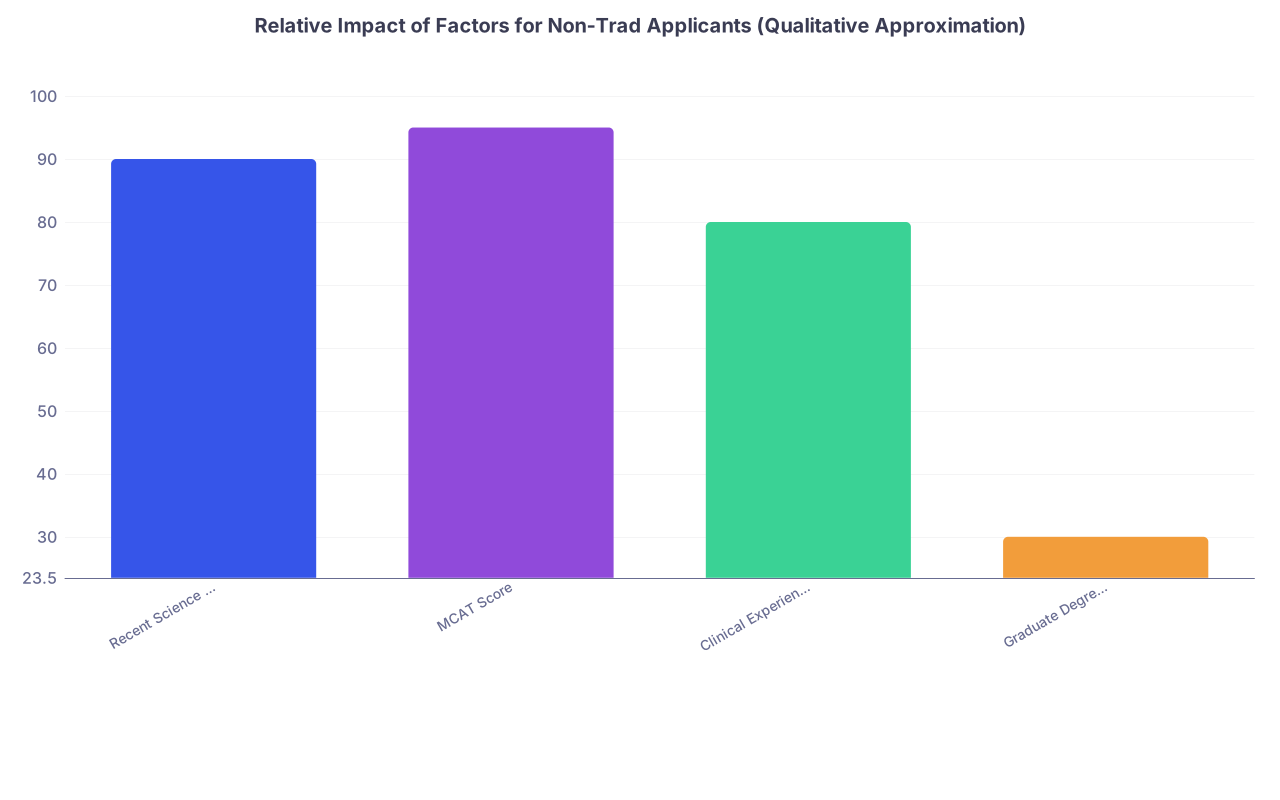
| Category | Value |
|---|---|
| Recent Science GPA | 90 |
| MCAT Score | 95 |
| Clinical Experience | 80 |
| Graduate Degree (e.g., MBA) | 30 |
The numbers above aren’t from a single study—they’re a rough, reality-based weighting of what I consistently see matter. The MBA is nice-to-have. The rest are must-have.
The uncomfortable emotional part nobody talks about
A big reason people chase “shortcuts” is psychological, not rational.
You’ve already built social capital and confidence in another field. You’re used to being competent, respected, even “senior.” Going back to undergrad chemistry labs with 19-year-olds feels humiliating. So you look for high-status ways around it: prestigious master’s programs, branded business schools, policy degrees.
I get it. But medicine doesn’t care about your pride. It cares whether you can grind through brute-force memorization, handle mind-numbing details, and sit for 7.5-hour exams without coming apart.
You have to be willing to look like a beginner again. To be the 35-year-old who can’t remember basic trig in physics. To re-learn how to study. To get your ego kicked in by a midterm and come back better.
People who cannot stomach that reality are the ones most vulnerable to the MBA-fix fantasy. Because it lets them stay in a world where they already know how to win.

| Step | Description |
|---|---|
| Step 1 | Decide to pursue medicine |
| Step 2 | Audit old transcripts |
| Step 3 | Post-bacc or DIY sciences |
| Step 4 | Targeted upper-level sciences as needed |
| Step 5 | Take MCAT after review |
| Step 6 | Gain sustained clinical experience |
| Step 7 | Apply strategically with realistic school list |
| Step 8 | Sciences strong and recent? |
Notice what’s missing. No “Get MBA” node. Because it’s optional at best.
When can an MBA or other degree reasonably help?
Let me be fair. There are situations where prior grad work can amplify an already-solid profile.
Your MBA / MPH / MHA / PhD can help if:
- You already fixed your science GPA with recent A’s
- You already have a competitive MCAT
- Your grad work directly supports a clear, coherent narrative: health policy, hospital admin, healthcare startup work, outcomes research, etc.
- You’ve used that background to do serious, sustained projects, not just pad your CV
Then, sure. A prior career in healthcare consulting plus an MBA focused on health systems, plus a paper or two in health policy, backed by a 514 MCAT and fresh 3.8 in post-bacc sciences—that’s a compelling package.
But note the order: the MBA enhances. It does not rescue.
FAQ (exactly 4 questions)
1. Should I finish my MBA before starting my post-bacc if I’ve already started it?
If you’re deep in the MBA and it’s paid for or heavily subsidized, finish it while planning your science rebuild. But do not delay the science and MCAT just to “stack degrees.” Adcoms will not care that you finished the MBA if your prerequisites and MCAT timeline get pushed back unnecessarily. If you’re early in the MBA and paying full freight, I’d seriously question continuing unless it clearly serves your long-term plans even if medicine doesn’t work out.
2. Will a high graduate GPA offset a low undergraduate GPA on its own?
No. For MD schools, undergrad and grad GPAs are separate, and the undergrad record still carries more weight—especially your science GPA. A high grad GPA can show academic maturity, but only if paired with either: recent strong undergrad-level sciences or a rigorous, medically relevant grad program (SMP, hard sciences, quantitative public health) and a solid MCAT. An MBA alone with a 3.9 will not erase a 2.8 undergrad.
3. Is a formal post-bacc necessary, or can I just take classes on my own?
You don’t need a formal post-bacc. A DIY path at a reputable 4-year institution can absolutely work, and many career changers go that route cheaper and more flexibly. Formal post-baccs mainly add structure, advising, and sometimes linkage possibilities. What matters is: real, graded, rigorous science coursework with A-level performance—recently. Not the branding of the program itself.
4. What if I’m older (mid-30s or 40s)? Does the lack of shortcuts make it not worth it?
Age doesn’t create shortcuts, but it also doesn’t automatically close doors. Programs do admit people in their late 30s and 40s. The question is more practical: can you afford 7–10+ years of training, delayed income, and lifestyle constraints? If the answer is yes, then the same rules apply: rebuild your academics, crush the MCAT, get deep clinical exposure. Your age and prior career can actually be a narrative strength—if you do the unglamorous groundwork like everyone else.
Key points:
- Your MBA or prior non-science graduate degree is not a shortcut to medicine; at best it’s a side bonus after you’ve proven yourself in hard sciences and on the MCAT.
- The real “gatekeepers” for career changers are recent, strong science coursework, a competitive MCAT, and sustained clinical exposure—not extra letters after your name.
- If you’re serious, stop hunting for hacks and start rebuilding the fundamentals. That’s the only “shortcut” that actually works.