
The belief that your brain is “too old” for the MCAT after 35 is wrong. Not just a little off—flat wrong, and often used as an excuse or a gatekeeping tool by people who never looked at the data.
If you’re over 35 and eyeing the MCAT, you’re not fighting some catastrophic cognitive cliff. You’re fighting myths, bad anecdotes, and a system built around 22-year-olds with no kids and flexible schedules.
Let’s walk through what actually changes with age, what doesn’t, what the evidence says about cognition and test performance, and how to play to your strengths instead of surrendering to a story that was never true.
Myth #1: “Your Brain Peaks in Your 20s, So MCAT Scores Must Drop After 30”
This is the classic line: “The MCAT is a young person’s game.” People say it like it’s a law of physics.
Here’s the problem: they’re confusing average population trends with individual potential and ignoring half the picture.
What the cognitive science actually shows
You’ve probably seen those oversimplified graphs online: “fluid intelligence” declines with age, “crystallized intelligence” goes up. People interpret this as “I’m worse at tests now.”
Not that simple.
Broad strokes from cognitive aging research:
- Speed of pure processing tends to peak in your 20s and declines gradually after 30.
- Working memory and multitasking get somewhat less efficient with age, especially under distraction.
- Vocabulary, domain knowledge, reasoning based on experience, and pattern recognition in familiar domains improve through midlife and often well beyond.
The MCAT is not a pure speed or reaction-time test. It’s a reading-intensive, reasoning-heavy exam that heavily leverages:
- Prior knowledge
- Ability to integrate information
- Strategy and test-taking skills
- Emotional regulation under stress
Those lean more on crystallized intelligence and executive function than raw twitch-speed.
Translation? The part of cognition that helps a 19-year-old react in 0.2 seconds on a video game is not the thing that gets you questions right on a 7-passage CARS section.
What the MCAT is actually testing
If the MCAT were a digit-symbol substitution test or a simple reaction-time measure, older age would be a bigger liability.
But look at the blueprint:
- Heavy reading load
- Multi-step reasoning
- Data and graph interpretation
- Applying concepts to new situations, not just recall
You know who does well with that? People who’ve read a lot, solved complex problems, and had to think under pressure in real life.
Which describes a decent chunk of people over 35.
Myth #2: “There’s Proof Older Test Takers Score Lower”
This one usually comes from someone who glanced at an AAMC data table once and drew the wrong conclusion.
What the limited data actually suggests
The AAMC doesn’t publish gorgeous, clean “score by age” distributions every year in a way that non-statisticians can easily interpret. But we do have some clues:
- Nontraditional applicants (often older) are a minority of test takers.
- A lot of them are coming from weaker academic foundations: lower undergrad GPAs, long gaps since science courses, more life obligations.
- When you control for academic preparation (GPA, science coursework) and practice test performance, the age effect on standardized test scores tends to shrink—sometimes to almost nothing.
In other words, when someone says, “Older people tend to score lower,” they’re usually not accounting for:
- How long it’s been since that person saw basic chemistry or physics
- Whether they’re working full-time or raising kids while studying
- Whether they have time for multiple full-length practice exams
That’s not biology. That’s circumstance.
If you take a 37-year-old with:
- Recent pre-reqs
- A structured, realistic study plan
- Enough time to do 6–10 full-length practice tests
and compare them to a 22-year-old with the same inputs, you don’t see some dramatic “age penalty.” You see people doing about as well as their preparation predicts.
Myth #3: “At 35+, It’s Too Late to ‘Rewire’ Your Brain for Science”
This myth sounds smart. “Neuroplasticity declines with age, so you can’t learn as efficiently.” People toss that line around like they just left a neuroscience conference.
Reality: adult brains are very plastic. They just remodel differently.
Neuroscience literature over the last 20 years has repeatedly shown:
- Adults absolutely retain the ability to grow new connections and strengthen networks with focused, repeated practice.
- Learning in adults is more about deliberate practice + meaning + motivation than sheer exposure.
- Older learners often do better when they connect new material to existing frameworks and real-world context—something nontraditional students are actually good at.
You might not brute-force memorize 300 flashcards a night like a 19-year-old cramming for orgo. But you’re often better at:
- Seeing patterns across topics
- Applying a mechanism logically instead of memorizing every exception
- Choosing efficient study strategies instead of doing busywork
The MCAT rewards that.
The Real Challenges After 35 (And They’re Not Your Neurons)
Your biggest barriers aren’t cognitive decay. They’re structural.
Let’s spell them out honestly.
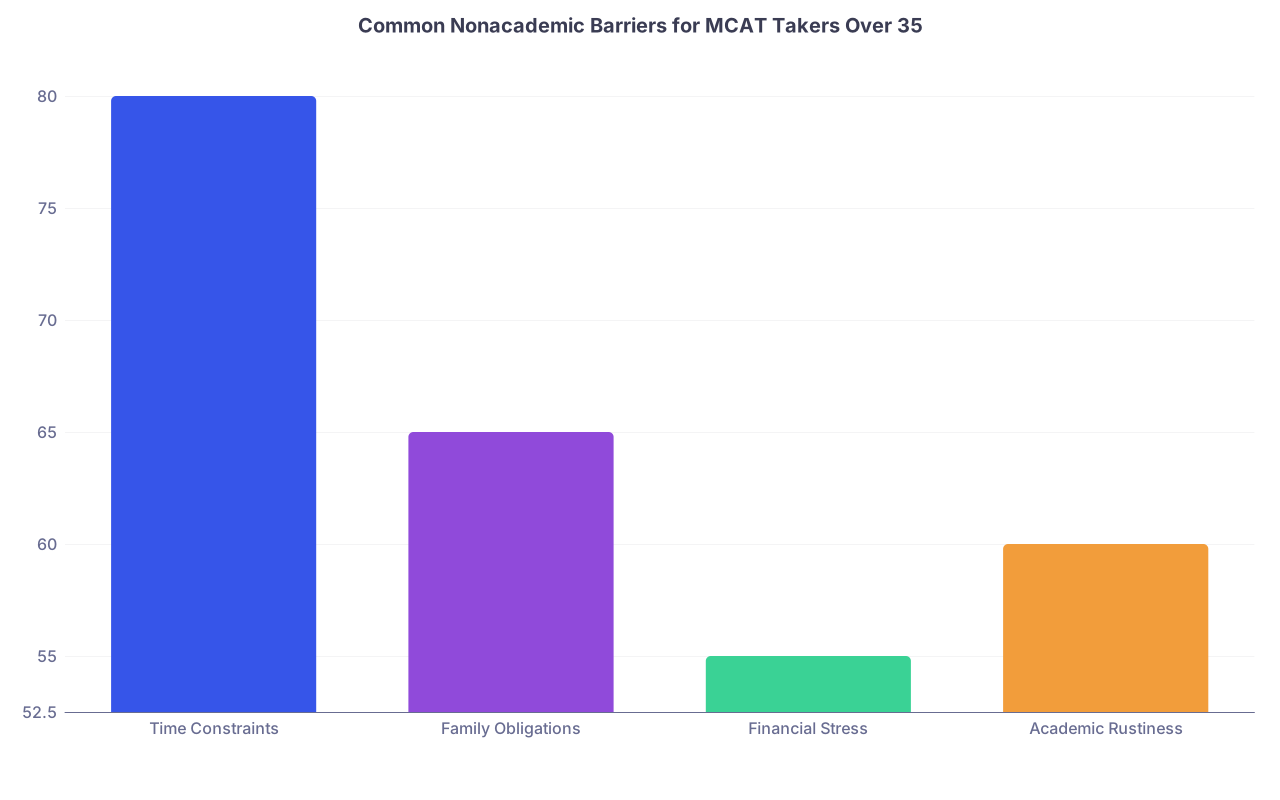
| Category | Value |
|---|---|
| Time Constraints | 80 |
| Family Obligations | 65 |
| Financial Stress | 55 |
| Academic Rustiness | 60 |
No, those numbers aren’t from a specific AAMC study; they’re a realistic reflection of what older students report constantly.
Time is the real enemy
You’re not in a dorm. You might be:
- Working 40+ hours
- Managing childcare
- Supporting aging parents
- Doing all of that while trying to remember what a carbonyl group is
You can’t just “study 8 hours a day for 3 months” like some Reddit posts casually suggest.
So you need:
- Longer runway (6–12 months instead of 2–3)
- Fewer but higher-quality hours per week
- Ruthless prioritization of high-yield topics and practice
That’s not an age problem. That’s a logistics problem.
Academic rustiness gets mislabeled as “decline”
If you last saw physics when Obama was still a senator, yes, it feels brutal at first. That’s not dementia. That’s disuse.
Here’s the pattern I’ve watched over and over:
- Months 1–2: “I’m stupid. I don’t remember anything. What was a mole again?”
- Months 3–4: “Okay, this is starting to click. I can follow passages now.”
- Months 5–7: “My scores are actually moving. I’m not guessing anymore.”
Rust comes off. Slowly. With repetition. You’re not broken; you’re just deconditioned, like someone who hasn’t run in years trying to sprint a 5k on day one.
Strategy: How to Study for the MCAT After 35 Without Delusion
Let me be blunt: you don’t get to study like a college junior. If you try, you’ll burn out, crash, and then say, “See? I’m too old.”
You have to study like an adult.
1. Accept a longer timeline
A realistic framework for many people over 35:
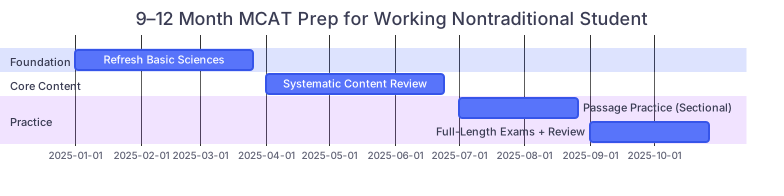
| Task | Details |
|---|---|
| Foundation: Refresh Basic Sciences | a1, 2025-01, 12w |
| Core Content: Systematic Content Review | a2, 2025-04, 12w |
| Practice: Passage Practice (Sectional) | a3, 2025-07, 8w |
| Practice: Full-Length Exams + Review | a4, 2025-09, 8w |
Could you cram it into 3–4 months? Maybe, if you’re part-time at work or have unusual flexibility. But most nontrads I’ve seen succeed plan for 9–12 months and do not apologize for it.
2. Design study around your actual life, not someone else’s fantasy
A working 38-year-old with two kids and a mortgage cannot copy a 10-hour/day study schedule from an MCAT forum.
Instead:
- Protect 2–3 hour blocks a few times a week where your phone is off, email is closed, and you’re unreachable.
- Use “micro-blocks” (20–40 minutes) for Anki, quick passage practice, and light review.
- Tie study to existing routines: CARS passage with morning coffee, discrete questions at lunch, review at night.
It’s not glamorous. It works.
3. Lean into your strengths
Older students routinely underestimate what they’re good at.
Strengths I see again and again in 35+ MCAT takers:
- CARS and reasoning: you’ve read more, lived more, seen more arguments and perspectives.
- Self-awareness: you can tell when you’re mentally checked out and stop, instead of staring at a screen for 3 fake “study hours.”
- Emotional resilience: life has kicked you harder than an organic chemistry midterm.
Use that.
If your CARS is naturally strong, don’t neglect it—but recognize you may not need to spend 50% of your time there the way a 20-year-old engineering major might.
If you know you need sleep to function, don’t play the unhealthy “up till 2 a.m. every night” game. That’s how you guarantee cognitive underperformance at any age.
Myth #4: “Admissions Committees See Your Age and Expect a Lower Score”
No. They see your age and expect you to be a grown-up about your choices.
They’re not thinking, “Poor thing, their elderly brain can’t hit a 510.” They’re thinking:
- “If you’re 38 and applying, show us you can handle the academics now.”
- “We don’t care that you got a 2.7 in freshman biology 16 years ago; what did you do recently?”
- “Do you have a story that hangs together, or is this a midlife crisis with an MCAT registration?”
For nontrads, the MCAT often becomes more important, not less, because it’s:
- A recent, directly comparable data point across all ages
- Evidence that your current cognitive performance is competitive
- A way to neutralize old, messy transcripts
You’re not graded on a curve by age. You’re held to the same standard. That sounds harsh, but it’s actually good news: the bar is clear.
If you hit a solid score—say, 508–512+ depending on your target range—you’ve already rebutted the “too old” narrative for any committee member who was tempted to believe it.
Myth #5: “If I Don’t Hit a 520+, It Proves I’m Too Old”
Perfectionism masquerading as science. Let’s kill that too.
You’ll hear:
- “Nontrads need a 520+ to overcome their age.”
- “If you’re older, you have to be exceptional to stand a chance.”
Reality is more annoying and less dramatic.
Med schools admit:
- Plenty of 22-year-olds with 509–515
- Plenty of nontrads with similar scores who have strong stories, solid recent coursework, and coherent reasons for medicine
Could a sky-high score help offset other weaknesses? Of course. For anyone, at any age.
But the idea that a 38-year-old with a 511, recent A’s in post-bacc science courses, strong clinical experience, and a coherent narrative is “too old” for admissions is more about bias than biology.
Practical Adjustments to Account for Real (Not Imaginary) Age Effects
I said earlier that age-related changes exist. They do. You just need to address them intelligently instead of dramatically.
Here’s where age does nudge how you should prep:
Processing speed & fatigue
- You may need more breaks in long study sessions.
- You may need to start endurance training (full-length exams) earlier to adapt.
- You might benefit from strict sleep discipline more than you did at 22.
Working memory vs. external systems
- Offload more to written notes, checklists, and spaced repetition.
- Don’t rely on “I’ll just remember that later.” Use Anki or some spaced system.
Recovery time
- Pulling repeated late nights will tank your performance faster now than it did 15 years ago.
- Build rest days and lower-intensity days into your plan on purpose.
None of those mean “you can’t score high.” They mean you have to train like an older athlete: smarter, more deliberate, less “all-nighter heroics.”
A Quick Reality Check Table
Let’s put the myths and realities side by side.
| Topic | Common Myth | What the Evidence and Experience Actually Show |
|---|---|---|
| Cognitive Ability | “Your brain is too old after 35 to compete.” | Processing speed drops gradually, but reasoning, vocabulary, and domain knowledge remain strong or improve. MCAT rewards those strengths. |
| MCAT Scores | “Older test takers score lower because of age.” | Apparent differences are mostly driven by preparation, time constraints, and academic gaps, not age biology. Well-prepared older students score competitively. |
| Neuroplasticity | “You can’t relearn hard science after 35.” | Adult neuroplasticity is real. You can absolutely rebuild science knowledge with structured, repeated practice and context. |
| Admissions | “Schools secretly penalize age with higher MCAT expectations.” | Schools care about recent performance and coherence. A strong recent MCAT + coursework can *mitigate* old academic issues, not worsen them. |
| Study Style | “Just copy what 22-year-olds do.” | Nontrads need longer timelines, more structure, and schedules that respect work/family. Different approach, same endpoint. |
The Honest Bottom Line
You’re not too old for the MCAT at 35, 40, or even older. You’re too old for fantasies.
You’re too old to pretend you can wing it with two weeks of content review and luck.
Too old to believe some Reddit thread telling you a single bad practice test proves cognitive decline.
Too old to blame “aging” for what is actually under-preparation, exhaustion, or a chaotic schedule.
But you are absolutely young enough to:
- Relearn the sciences
- Train your brain to handle dense passages and multi-step reasoning
- Hit a score that makes admissions committees take you seriously
If you respect the reality of your life, build a schedule that matches it, and stop using age as an all-purpose explanation for every struggle, the MCAT becomes what it is for everyone else: hard, but beatable.
Years from now, you won’t remember how many times you told yourself you were “too old.” You’ll remember the moment you stopped believing it and started acting like someone who still has a lot of mind—and a lot of career—left.