
The way most people “wing” their transition from a full‑time job to premed coursework is reckless and expensive. You are going to do it with a plan.
You are not a 19‑year‑old with unlimited time and parental bailout money. You have rent or a mortgage, maybe a partner, maybe kids, and a resume that already means something. So your transition has to be controlled, staged, and brutally realistic.
Here is a step‑by‑step, practical roadmap from full‑time career to serious premed coursework without blowing up your life in the process.
Step 1: Get Clear on the Academic Gap (Reality Check First, Not Last)
You cannot plan the transition until you know exactly what coursework you are missing and what your starting line looks like.
1.1 Audit Your Current Academic Record
Pull every transcript you have. Old, messy, community college, that random summer course ten years ago. All of it.
You need to identify:
- How many credits you already have
- Your cumulative GPA
- Science GPA (biology, chemistry, physics, math – “BCPM”)
- Which prerequisites you have or have not completed
Typical medical school prerequisites (varies by school, but this is a solid baseline):
- 2 semesters of general biology with labs
- 2 semesters of general chemistry with labs
- 2 semesters of organic chemistry with labs
- 1 semester of biochemistry
- 2 semesters of physics with labs
- 2 semesters of college writing / English
- 1–2 semesters of math/statistics (often at least one semester of calculus or statistics)
- Some schools: psychology, sociology, or other social science
Now classify yourself:
Category A – Strong student, recent science background
You already have most prerequisites with decent grades (B+ and above), maybe need a few refreshers or advanced coursework.Category B – Old coursework or weak grades
Science courses are >7–10 years old, or GPA is below ~3.4, especially in science.Category C – Almost starting from scratch
Different major with minimal science, maybe no chemistry or physics.
Your category determines whether you need:
- A DIY post‑bacc
- A formal post‑bacc
- A Special Master’s Program (SMP) later on
- Or simply targeted coursework to fill gaps
If you are Category B or C with a weak GPA, pretending “a couple classes” will fix it is delusional. You need a structured plan, likely 2–3 years of part‑time and then full‑time academic work.
Step 2: Make the Money Plan Before You Touch Your Job
People blow this step off and then panic‑quit or overextend. Do not do that.
You must figure out how you will survive financially for 2–4 years of lower income plus tuition.
2.1 Build a Bare-Bones Budget
Create two budgets:
- Current reality – income vs spending right now
- Premed transition reality – expected income when you cut hours + tuition + fees
Strip your expenses down:
- Fixed: rent/mortgage, utilities, insurance, minimum debt payments
- Variable: food, transportation, childcare, discretionary
Now calculate three critical numbers:
- How much you absolutely must earn per month to stay solvent
- How much you can save per month before you start classes
- How many months of living expenses you can stockpile
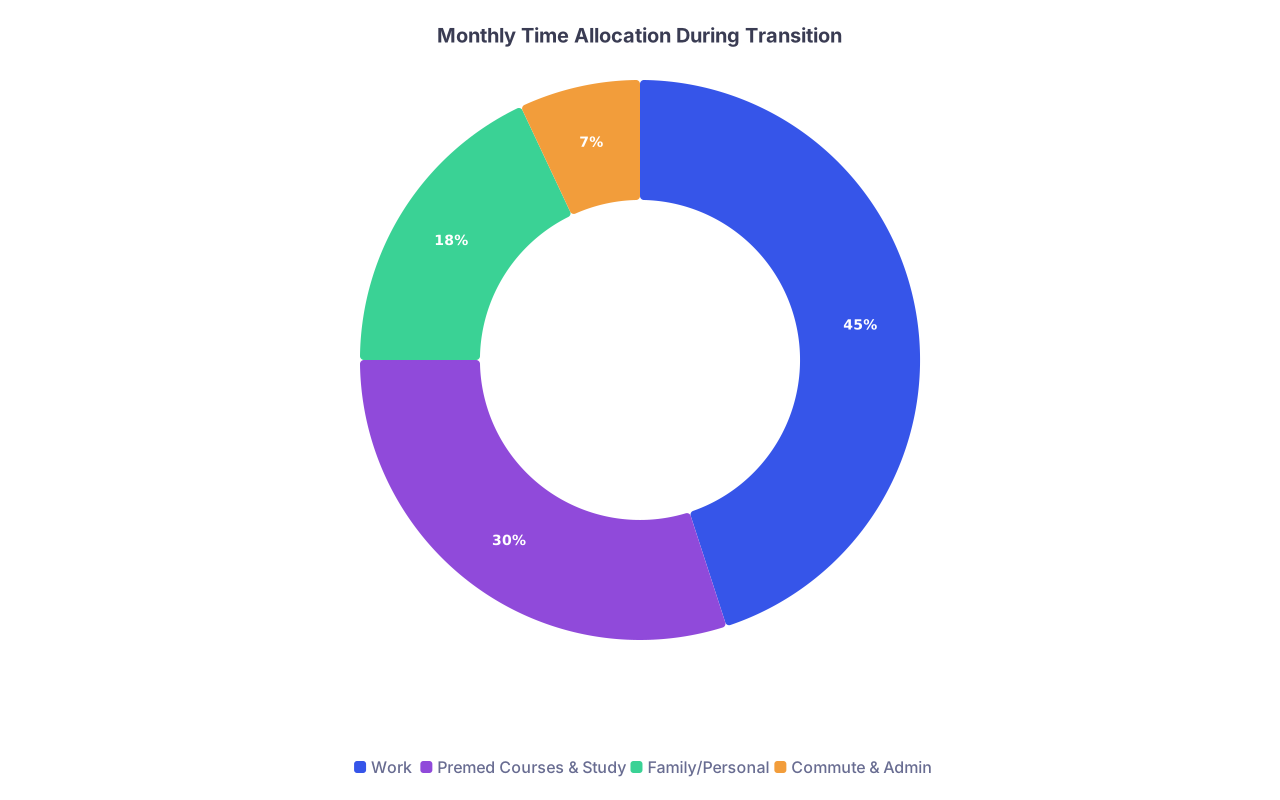
| Category | Value |
|---|---|
| Work | 45 |
| Premed Courses & Study | 30 |
| Family/Personal | 18 |
| Commute & Admin | 7 |
This is a typical pattern I see in non‑trads who actually make it work. Work hours drop. Study hours rise. Life is tight but not impossible.
2.2 Decide on Your Financial Strategy
You have a few levers. Use them intentionally:
Savings buffer
Aim for at least 6–12 months of bare‑bones living expenses before going part‑time. If you cannot realistically save that, you either stay full‑time longer or you adjust lifestyle now.Spouse/partner income
Sit down and have the uncomfortable talk. What can they realistically cover? For how long? Under what conditions? Spell it out like a business agreement.Debt strategy
- High‑interest consumer debt? Attack it before tuition bills start.
- Student loans from prior degree? Investigate income‑driven repayment or deferment timing.
Work format
Identify roles that can convert to:- 0.8 FTE (4 days/week)
- Remote or hybrid work
- Evening/weekend shifts
The goal: protect weekday daytime blocks for lab and in‑person classes later.
If your numbers make it painfully clear that a transition in the next 12 months is impossible, that is not failure. That is data. You extend your runway: one more year of full‑time work + aggressive saving while you start one evening class.
Step 3: Choose the Right Academic Path (Not All Post‑Baccs Are Equal)
Your next mistake would be jumping into the wrong educational setup because the brochure looked nice.
There are three main options.
| Path Type | Best For | Structure | Cost Level |
|---|---|---|---|
| DIY Post‑Bacc | Budget-conscious, flexible schedules | Highly flexible | Low–Medium |
| Formal Post‑Bacc | Need structure, advising, linkage | Cohort-based | Medium–High |
| Special Master’s | GPA repair with strong undergrad done | Full-time grad | High |
3.1 DIY Post‑Bacc (At a Local University or Community College)
Good when:
- You are working while taking courses
- You need flexibility with nights/weekends
- Your GPA is not a disaster, you mainly need prereqs or recent science proof
How to do it right:
- Prefer a 4‑year university or strong state school if possible
- If you use community college, supplement later with some upper‑level sciences at a 4‑year institution
- Keep a consistent upward trend in rigor and grades (aim for A/A‑ across the board)
3.2 Formal Post‑Bacc Program
Good when:
- You want structured advising, committee letters, MCAT support
- You are willing to go mostly or fully part‑time at work or quit eventually
- You can afford higher tuition
Some offer linkage to specific med schools if you perform well. That can cut a year off your application timeline. But do not bank on it; admission is not guaranteed.
3.3 Special Master’s Program (SMP)
This is not step one. This is for:
- People with a completed undergrad and a lower GPA who need serious academic rehabilitation and proof they can handle medical‑school‑level coursework.
If you are still in the “haven’t done my prereqs” phase, SMP comes much later, if at all.
For now, your focus is: where can you start taking 1–2 science courses while still employed?
Step 4: Transition Your Work Schedule in Stages (Not All at Once)
You do not go straight from 40–50 hours per week and no classes to 12 credits of chemistry and physics. That is how people fail organic chemistry, get burned out, and bail.
You phase it.
4.1 Stage 1 – Test Semester While Full‑Time
Duration: 1 semester (or quarter)
Goal: Prove you can pull an A in a single science course while working full‑time.
Pick:
- 1 science class with lab (e.g., General Chemistry I, Biology I)
- Or, if you are rusty: Pre‑calculus or intro chemistry as a warm‑up
You are not doing this for the credit alone. You are testing:
- Study systems
- Time management
- Sleep and stress tolerance
- How your employer reacts to schedule constraints
If you cannot pull an A (or very strong A‑) in this stage, something must change before you increase course load: either your work hours, your study habits, or both.
4.2 Stage 2 – Reduce Work Hours, Add a Second Course
Duration: 1–2 semesters
New structure:
- Drop to 0.8 FTE or 0.6–0.7 if finances allow
- Take 2 science courses per term (usually one with lab, one without if you are smart about workload)
This stage is when you see if this life is tolerable. Many non‑trads live here for 12–24 months.
Ideal weekly shape:
- 25–35 hours work
- 2 classes + 2 labs
- 20–25 hours study
You will not have a lot of “free time”. That is the tradeoff.
4.3 Stage 3 – Full Academic Focus (If/When Needed)
You hit this stage if:
- You must do a formal post‑bacc or SMP that is full‑time
- Or you want to crush upper‑level science courses and MCAT in one focused year
Here, you may:
- Quit work or drop to minimal per‑diem / very part‑time
- Take 12–15 credits of science
- Treat school as your full‑time job (40–50 hours/week of class+study)
This is where that financial runway from Step 2 saves you.
Step 5: Build a Weekly System That Actually Works
The schedule on paper is meaningless unless you have a weekly operating system.
Here is what I see work again and again for working non‑trads.
5.1 Lock In Non‑Negotiable Time Blocks
You need three categories:
- Class / lab – obviously fixed
- Study and review – scheduled like a second job
- Life maintenance – groceries, laundry, meal prep, time with partner/kids
A sample weekly skeleton (Stage 2, two classes, 0.7 FTE job):
Mon–Fri:
- 8:00–3:00 – Work
- 4:00–6:00 – Class or lab (2–3 days/week)
- 7:30–10:00 – Study (3 days/week)
Sat:
- 9:00–1:00 – Deep study (problem sets, practice exams)
- Afternoon – Errands, family
Sun:
- 9:00–12:00 – Review prior week, preview upcoming material
- Afternoon/Evening – Rest, low‑intensity prep (flashcards, readings)
You treat study blocks like meetings with your boss. They are not optional.
5.2 Use the Right Study Approach for Science as an Adult
You do not have the luxury to brute‑force this with endless repetition.
Key principles:
- Active recall – flashcards, self‑quizzing, teaching a concept out loud
- Spaced repetition – revisiting material over days/weeks, not cramming
- Deliberate problem solving – especially for physics, chemistry, statistics
Tools that actually help:
- Anki or similar spaced repetition app
- Structured problem sets beyond what is assigned (from good textbooks or prep books)
- Study groups only if they are efficient and focused (no social hour disguised as “group work”)
You aim for consistency, not heroic all‑nighters.
Step 6: Time Your MCAT and Application Wisely
People get this wrong constantly: they rush the MCAT and then apply with weak scores and half‑baked coursework. You are going to align things logically.
6.1 Finish the Core MCAT Prereqs First
Bare minimum before serious MCAT prep:
- 2 semesters of general chemistry
- 2 semesters of organic chemistry
- 2 semesters of biology
- 1 semester of biochemistry
- 2 semesters of physics
- Intro psychology and sociology (strongly recommended)
Can you “self‑study” gaps? Yes. But if you are already coming from a non‑science background, trying to self‑teach entire disciplines while holding a job is asking for a mediocre score.
6.2 Build an 8–12 Month MCAT Window Around Your Schedule
If you are still working part‑time:
- Plan for 8–12 months of MCAT prep at 10–15 hours/week
- Then a final 8–10 week intensive period where work is lighter, if possible
If you move to full‑time school:
- You can compress MCAT prep into 4–6 months at 20–25 hours/week
Either way, the sequence is:
- Finish (or nearly finish) prereqs
- Start content review + light practice
- Ramp up practice exams, switch from learning to performance
- Take MCAT when your last 4–5 practice tests stabilize at or above your target
You should not pick a test date because it “fits your calendar.” You pick it because your practice metrics justify it.
Step 7: Layer In Clinical, Shadowing, and Volunteering Without Implosion
Yes, you need clinical exposure and service. No, you do not stack them all at once at the beginning.
7.1 Minimum Targets (Over 2–3 Years)
- Clinical experience (paid or volunteer): 150–300+ hours
- Physician shadowing: 40–80+ hours, across at least 2–3 specialties if possible
- Non‑clinical service: ongoing involvement in something service‑oriented
The good news: as a working adult, you may already have relevant experience (nursing, EMS, PT aide, MA, etc.). That counts.
7.2 Where to Insert These in the Timeline
Early (Year 1):
- Occasional shadowing days (take PTO when needed)
- Low‑intensity volunteering once or twice a month
Middle (Year 2):
- If you change jobs, consider a clinical role (scribe, EMT, MA, CNA) that doubles as income and clinical exposure
- Maintain 2–4 hours/week of something clinical
Late (MCAT/Application Year):
- Do not overload new commitments
- Keep existing roles steady, but protect MCAT study and class performance
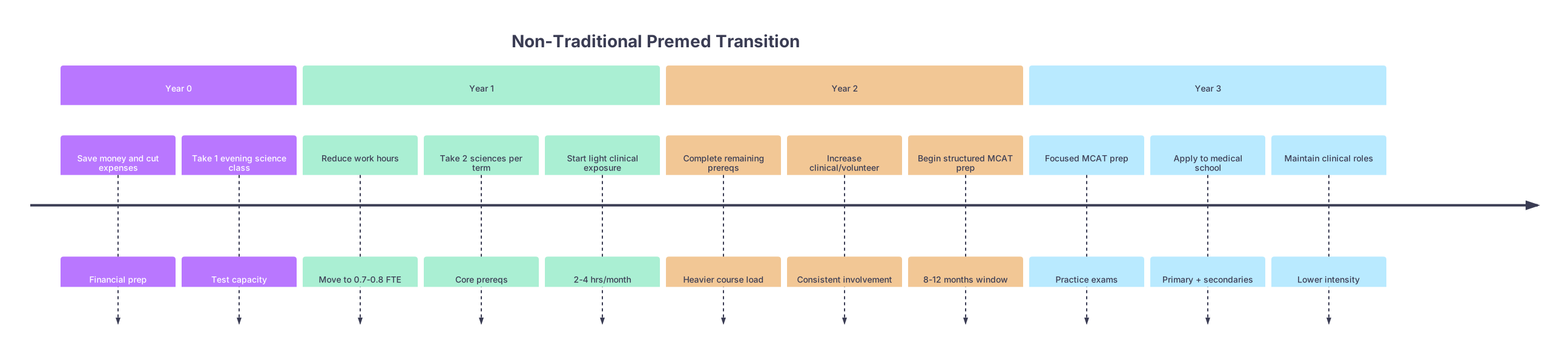
| Period | Event |
|---|---|
| Year 0 - Save money and cut expenses | Financial prep |
| Year 0 - Take 1 evening science class | Test capacity |
| Year 1 - Reduce work hours | Move to 0.7-0.8 FTE |
| Year 1 - Take 2 sciences per term | Core prereqs |
| Year 1 - Start light clinical exposure | 2-4 hrs/month |
| Year 2 - Complete remaining prereqs | Heavier course load |
| Year 2 - Increase clinical/volunteer | Consistent involvement |
| Year 2 - Begin structured MCAT prep | 8-12 months window |
| Year 3 - Focused MCAT prep | Practice exams |
| Year 3 - Apply to medical school | Primary + secondaries |
| Year 3 - Maintain clinical roles | Lower intensity |
This staggered approach avoids the classic disaster: new job + new classes + MCAT + massive volunteering in the same year. That is how people come apart.
Step 8: Decide When To Actually Leave Full‑Time Work
This is the part that keeps you up at night. “When do I actually quit?”
You quit (or significantly cut back) when three conditions are met:
Financial runway is real, not fantasy
- You have at least 6–12 months of back‑up funds
- Or a partner’s income can reliably cover essentials
- Your high‑interest debts are under control
Academic demand justifies it
- You are moving into heavy upper‑level science or a full‑time post‑bacc / SMP
- Or you are entering intense MCAT prep and cannot progress on 0.7–0.8 FTE work
You have proven discipline
- Prior semesters show A/A‑ level performance with partial work
- You have an actual weekly system that you stick to
You do not quit just because you are tired of your job and “want to focus on school.” Medical school will be harder than your premed courses. If you cannot handle structured grind now, you will not magically handle it later.
Step 9: Manage Relationships, Burnout, and the Long Game
This path is stressful. Pretending otherwise is dishonest.
You have to protect the parts of your life that matter, or you will resent medicine before you even get in.
9.1 Communicate Like an Adult With People Affected
Partners, kids, close family. They need:
- A clear timeline of what the next 3–5 years will look like
- Concrete changes they will notice (less free time, more studying, lower income)
- Opportunities to opt in, support, and also set boundaries
You do not dump the news on them after you have already enrolled and quit.
9.2 Build Recovery into the System
You will burn out if you:
- Study every night until midnight
- Refuse to block off one real day of rest per week
- Say yes to every extra shift, volunteer request, and family obligation
Minimums I push non‑trads to keep:
- One unplugged block of 4–6 hours weekly that is not hijacked by studying or chores
- Protecting 7 hours of sleep most nights outside exam emergencies
- Some light exercise 2–3 times a week — walk, weights, anything
Treat these as non‑negotiable maintenance. Like oil changes for your brain.
A Sample 3‑Year Transition Plan
To make this concrete, here is a realistic outline for someone mid‑30s, working full‑time, with a non‑science bachelor’s and minimal prereqs.
Year 0 (Planning + Test Run)
- Full‑time work
- Aggressive saving, cut lifestyle burn
- Pay down high‑interest debt
- Take 1 evening class (General Chem I)
- Shadow 1–2 days over the year
Year 1 (Serious Coursework, Reduced Work)
- Drop to 0.8 FTE at work
- Fall: General Chem II + Bio I
- Spring: Bio II + Physics I
- Summer: Physics II + maybe Psych or Soc online
- 2–4 hours/week clinical volunteering or per‑diem clinical job
Year 2 (Finish Prereqs + Start MCAT)
- Work 0.6–0.7 FTE or transition to clinical role
- Fall: Organic Chem I + upper‑level Bio (e.g. Cell Bio)
- Spring: Organic Chem II + Biochemistry
- Start MCAT content review in Spring (10 hrs/week)
- Summer: MCAT intensive (20–25 hrs/week), reduce work further
- Take MCAT late summer / early fall when practice scores justify it
Year 3 (Application Year)
- Light coursework if needed (extra upper‑level sciences)
- Maintain 10–15 hrs/week clinical/volunteer
- Submit primary applications in June
- Secondaries June–August
- Interviews Fall–Winter
- Continue modest work hours until matriculation
Is this the only way? No. But it is a sane, survivable version for many working adults.