Most mid‑career DIY post‑baccs fail for one simple reason: people treat them like “more classes” instead of a strategic, surgical project. You are not “going back to school.” You are building an admissions weapon.
Let me walk you through how to do this like an adult with bills, responsibilities, and limited time—not like a 19‑year‑old with a dining hall meal plan.
Step 1: Get Brutally Clear on Your Starting Point
You cannot design a useful DIY post‑bacc until you answer three questions with data, not vibes.
1. What does your academic record actually look like on paper?
Pull every transcript. Not the unofficial memory version. The real thing.
You want:
- All undergrad transcripts (including that community college summer class you forgot about)
- Any graduate transcripts
- Course titles, credits, and letter grades
- Term by term breakdown
Then calculate:
- Cumulative undergraduate GPA
- BCPM (science) GPA – Biology, Chemistry, Physics, Math. This is the one that matters for med school screens.
- Trend:
- Early years vs later years
- Any sharp drops (work, illness, disaster semester)
If you do not know your exact BCPM GPA, stop everything and calculate it. Guessing is how people design the wrong post‑bacc.
| Metric | What It Includes | Why It Matters |
|---|---|---|
| Cumulative GPA | All undergrad coursework | Global first screen at many schools |
| BCPM GPA | Biology, Chemistry, Physics, Math | Core “can you do the science” signal |
| Recent GPA (last 30–40 credits) | Most recent upper‑division work | Shows current ability & trend |
Rule of thumb:
- If cumulative GPA ≥ 3.5 and BCPM ≥ 3.4 with an upward trend, you are in “optimization” territory.
- If cumulative GPA 3.0–3.4 or BCPM < 3.2, you are in “repair and prove it” territory.
- If cumulative < 3.0, this is a salvage mission. It is still possible, but you must be very intentional and probably go longer.
2. Are you a career‑changer or an academic‑repairer?
The DIY structure is different depending on which camp you are in:
Career‑changer:
- Little or no science background
- Often humanities, business, law, social sciences, arts
- Need all core prereqs plus MCAT prep
Academic‑repairer:
- You already took many science courses
- Grades are weak, scattered, or old
- Need to show mastery now with upper‑level science, possibly selective repeats
Many mid‑career people are both. For example: a 35‑year‑old with a 3.0 biology degree from 10 years ago and poor grades in orgo and physics. In that case, think of your DIY plan as:
- Strategic repair + advanced proof + MCAT scaffold
3. What is your real‑life constraint box?
This is where mid‑career changes everything. You are juggling:
- Full‑time work? Shift‑based or 9–5?
- Partner? Kids? Caregiving?
- Commute time?
- Financial buffer (or lack of one)?
If you pretend you can take 16 credits while working 50 hours and parenting two toddlers, your GPA will answer for you. Harshly.
Write your constraints down:
- Max credits per term you can realistically handle and still get A’s
(For most full‑time professionals: 6–8 credits. Maybe 10 if hybrid/online and flexible.) - Ideal class times (evening, weekend, early morning)
- Commute radius for in‑person labs
Now you have your inputs. Next we design the actual machine.
Step 2: Choose the Right DIY Post‑Bacc Structure (Not All Credits Are Equal)
You do not need a formal post‑bacc program to impress admissions. You need a coherent pattern of recent, rigorous, A‑level science work.
Here are the main build options.
Option A: Local University as a Non‑Degree or Second‑Bachelor Student
This is the most common and usually the most powerful option.
You apply to take classes as:
- Non‑degree / non‑matriculated student
- “Second bachelor’s” student (if the institution structures it this way)
Pros:
- Strong institutional name can help (regional publics are fine; it does not need to be Ivy)
- Access to in‑person labs
- Direct relationships with professors → letters of recommendation
- Appears clear and clean on AMCAS / AACOMAS
Cons:
- Harder to get priority registration
- Schedules may be unfriendly for workers
- Tuition can be steep if out of state
This route is ideal if you live near a 4‑year university and can reliably get to campus evenings or early mornings.
Option B: Community College + Targeted 4‑Year Coursework
This gets sneered at by people who do not actually read admissions data. Used properly, it works.
The smart pattern:
- Use community college for:
- Foundational coursework if you are a career‑changer (Gen Chem I, basic Bio I)
- Courses that are logistically impossible at the 4‑year (scheduling, cost)
- Then show you can excel at a 4‑year in upper‑division sciences and/or some core prereqs
This hybrid model is especially practical for mid‑career students with:
- Tight finances
- Kids or eldercare responsibilities
- Rural locations
The key is balance. A full premed record entirely at a community college raises more questions. A mixed but clearly upward path with strong 4‑year performance looks deliberate and mature.
Option C: University Extension or “Continuing Studies” Programs
Think Columbia GS, Harvard Extension, UCLA Extension, local state U continuing ed.
Good for:
- Evening and weekend classes
- Access to “regular” faculty in many cases
- Structured certificates that can mimic formal post‑baccs without the price tag
You are still essentially DIY, but you get a ready‑made course list and sometimes advising. Quality varies by institution.
Option D: Online Courses (Use With Caution)
Fully online lecture content can be useful for content prep and sometimes for non‑lab requirements, but many medical schools still prefer or require:
- In‑person labs
- Regionally accredited, brick‑and‑mortar institutions
So you can:
- Use online courses to spread out your load
- Take some non‑lab sciences online from a respected university
- But anchor your record with in‑person, graded coursework
If you build your entire science record out of random online offerings, you are building on sand.
Step 3: Nail the Core Question – What Courses, In What Order, Over How Long?
Let us build the spine of your DIY post‑bacc.
The Non‑Negotiable Premed Prereqs
Most allopathic (MD) and osteopathic (DO) schools expect some version of:
- 2 semesters of General Chemistry with lab
- 2 semesters of Organic Chemistry with lab
(Some schools accept 1 orgo + 1 biochem instead of 2 orgo. Check targets later.) - 2 semesters of Biology with lab
- 2 semesters of Physics with lab (algebra‑based is usually fine)
- 1 semester of Biochemistry
- 1–2 semesters of English / Writing‑intensive
- 1 semester of Statistics or Math (Calc recommended for some schools, but often not required)
On top of that, the MCAT effectively requires:
- Cell bio
- Molecular genetics
- Physiology
- Intro psychology and sociology
So the real question is: What do you already have, at what quality, and how long ago?
If You Are a Career‑Changer (Minimal Science)
You need to build a 2–3 year part‑time sequence that respects working adulthood.
Target: 30–40 credits of solid science with majority A’s.
Sample 3‑Year Part‑Time Plan (Working Full‑Time, Evenings/Weekends):
Year 1:
- Fall:
- General Chemistry I + Lab (4)
- Intro Biology I + Lab (4)
- Spring:
- General Chemistry II + Lab (4)
- Intro Biology II + Lab (4)
- Summer (optional if you can handle it):
- Intro Psychology (3) – online or in person
Year 2:
- Fall:
- Organic Chemistry I + Lab (4)
- Physics I + Lab (4)
- Spring:
- Organic Chemistry II + Lab (4)
- Physics II + Lab (4)
- Summer:
- Intro Sociology (3) – online fine
Year 3:
- Fall:
- Biochemistry (3–4)
- Upper‑level Biology (Cell Bio / Physiology) (3–4)
- Spring:
- Upper‑level Biology (Molecular Biology / Genetics) (3–4)
- Statistics (3)
- MCAT:
- Study during Year 3; take MCAT late spring/early summer
- Apply in that same cycle if grades and experience are ready
If 8 credits per term is too much, stretch to 3.5–4 years. The key is not speed. It is clean, consistent excellence.
If You Are an Academic‑Repairer (Science Background, Weak or Old)
Your job is different. You must show:
- Recent (last 2–3 years) A‑level performance in rigorous upper‑level sciences
- Thoughtful handling of any course repeats
You do not fix a 2.9 BCPM by retaking Gen Chem I three times. You fix it by:
- Earning A’s in 30–40 credits of upper‑division work:
- Biochemistry
- Physiology
- Cell Biology
- Molecular Biology
- Microbiology
- Immunology
- Genetics
- Advanced human anatomy (if offered at 4‑year level)
Strategic repeats:
- Retake only:
- Absolute disasters (D/F in a key premed prereq)
- Courses clearly required by target schools that you bombed
Then build a new upward trend on top of them.
Example 2‑Year Repair Plan (Working Professional, Prior Bio Major):
Year 1:
- Fall:
- Biochemistry (3–4)
- Physiology (3–4)
- Spring:
- Cell Biology (3–4)
- Genetics (3–4)
- Summer:
- Statistics (3) or Psych/Soc
Year 2:
- Fall:
- Immunology (3–4)
- Microbiology (3–4)
- Spring:
- Advanced elective (Neurobiology / Molecular Techniques) (3–4)
- Any essential repeat (Orgo II retake, for instance) if needed
MCAT prep overlaid across Year 2.
Step 4: Build a Weekly Schedule That You Can Actually Survive
Here is where mid‑career reality destroys most people: they design beautiful course lists and ignore Tuesday at 9:15 pm, when they are staring at a problem set after a 10‑hour workday.
You want to engineer your week.
1. Decide your “Academic Core Hours” per week
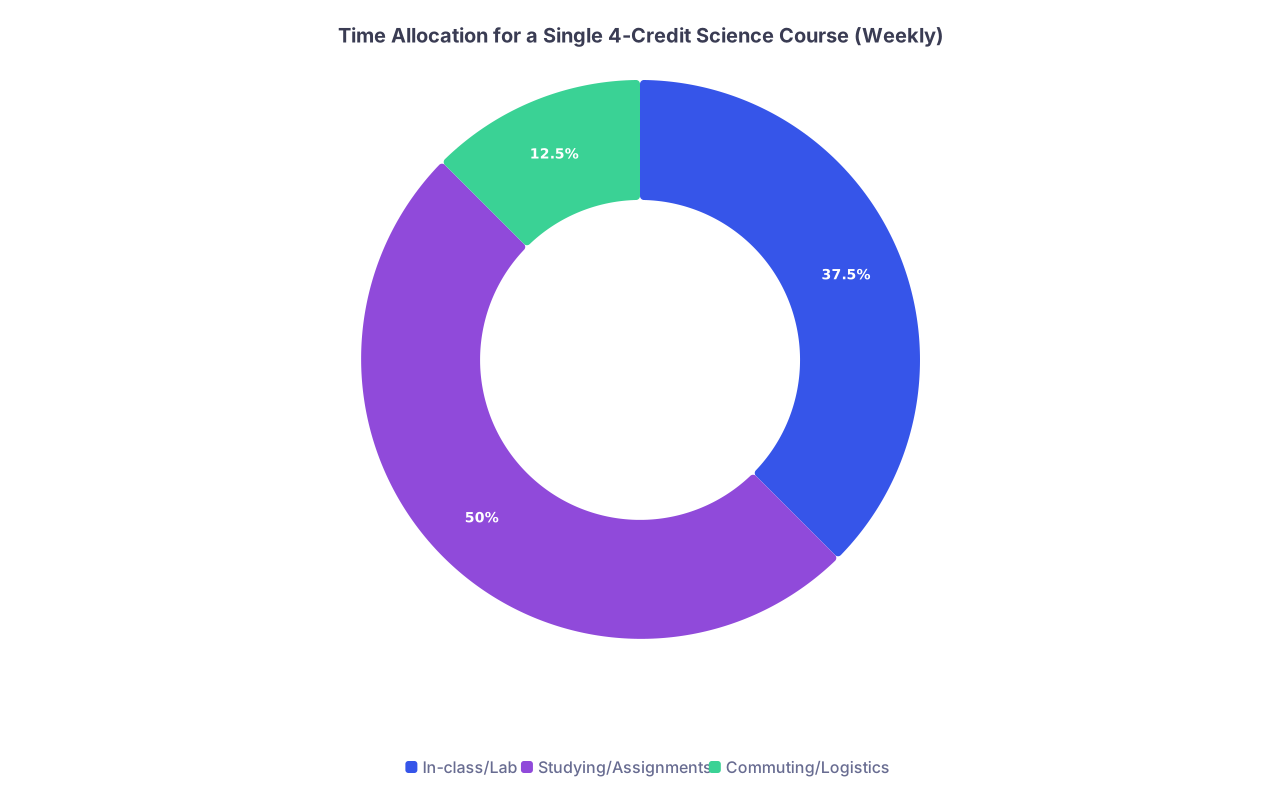
For each 3–4 credit science course with lab, expect:
- 3–4 hours in lecture
- 2–3 hours in lab
- 6–9 hours outside work
So one 4‑credit lab science is ~12–16 hours/week of real work.
Most full‑time professionals can do:
- 1 heavy science course + maybe 1 lighter course
OR - 2 sciences if:
- Work hours are truly flexible
- Home responsibilities are low or well‑supported
You are not weak if you max out at 1 class. You are honest. Admissions committees like honest transcripts.
2. Map a Prototype Week
Let us say you work 8–5, Monday–Friday, with a 30–40 minute commute.
Prototype with one heavy science course:
- Mon:
- Work 8–5
- Class 6–8 pm
- Tue:
- Work 8–5
- Study block 7–9 pm (problem sets, reading)
- Wed:
- Work 8–5
- Lab 6–9 pm
- Thu:
- Work 8–5
- Study block 7–9 pm
- Sat:
- 3–4 hour study block (morning)
- Sun:
- 2–3 hour lighter review / MCAT‑adjacent work
Now add in family, chores, life. Still viable? If not, you adjust credits down, not effort down.
| Category | Value |
|---|---|
| In-class/Lab | 6 |
| Studying/Assignments | 8 |
| Commuting/Logistics | 2 |
3. Protect Non‑Negotiable Sleep
You cannot out‑willpower chronic sleep deprivation for two to three years and expect high MCAT performance. Build your schedule with:
- 7 hours minimum sleep target
- 1 protected night off from school each week for relationship sanity
If the math does not work, you scale down. Simple as that.
Step 5: Intentionally Design for MCAT Readiness (Not “I’ll Cram Later”)
The worst post‑bacc mistake: treat the MCAT as a separate future problem. It is not. It is a through‑line.
Design your DIY sequence so by the time you start serious MCAT prep, you have:
- Completed:
- Gen Chem I & II
- Orgo I & II (or I + Biochem where accepted)
- Bio I & II
- Physics I & II
- Biochemistry
- Ideally also:
- Cell Biology
- Physiology
- Intro Psych & Soc
Then block your MCAT plan:
- 6–9 months before test date:
- Light, consistent review (Anki, short videos, keeping notes from classes MCAT‑friendly)
- 4–6 months before test date:
- Formal MCAT study (target 10–15 hrs/week if working, 20+ hrs if able to reduce work)
Sequence smartly:
- Do not schedule your heaviest upper‑level science term at the exact same time as peak MCAT prep, unless you have cut work hours.
- Many mid‑career students succeed with:
- Year 1–2: Course‑heavy, MCAT‑light
- Year 3: Course‑lighter term + MCAT‑heavy
Step 6: Use the DIY Structure to Generate Strong Letters and a Coherent Story
Your courses are not just about grades. They are also where you will get:
- Recent academic letters of recommendation
- Evidence that you function at a high level in a classroom again
Plan for letters from:
- 1–2 science professors (ideally at a 4‑year institution)
- 1 non‑science professor (if possible)
- 1 professional supervisor in your current field (for character / work ethic)
This means:
- Take smaller classes when possible over giant lectures
- Go to office hours at least a few times each term
- Be the adult in the room: on time, prepared, asking good questions, turning in high‑quality work
Then, when you need a letter:
- Ask 2–3 months before you apply
- Provide:
- Your CV / resume
- A draft of your personal statement
- A brief summary of work you did in their class (papers, projects, grades)
- Clear instructions for AMCAS / AACOMAS letter submission
Your DIY structure should deliberately place you in front of professors likely to remember you positively.
Step 7: Integrate Clinical, Shadowing, and Volunteering Without Burning Out
You cannot disappear into coursework for three years and emerge with straight A’s and zero clinical experience. That is a different kind of failure.
You need parallel tracks:
- Clinical exposure (seeing real patients in real settings)
- Shadowing physicians
- Service / volunteering, ideally with some continuity and population focus
But you also cannot work 50 hrs, take 8 credits, and volunteer 10 hrs/wk forever.
So you design phases.

| Step | Description |
|---|---|
| Step 1 | Year 1 Start |
| Step 2 | Light clinical exposure 4 hrs/wk |
| Step 3 | Year 2: Add shadowing blocks |
| Step 4 | Year 2-3: Increase clinical hours 6-8 hrs/wk |
| Step 5 | MCAT Prep Phase: Reduce volunteering, focus on study |
| Step 6 | Application Year: Maintain minimal longitudinal activities |
Phase pattern:
- Year 1:
- Coursework: Heavy foundation
- Clinical: 3–4 hrs/week max (one 4‑hour shift)
- Shadowing: Occasional half‑days during vacation / flex time
- Year 2:
- Coursework: Moderate/heavy depending on plan
- Clinical: 4–6 hrs/week (one 4‑hour shift + some flexibility)
- Shadowing: Target specific specialties of interest
- Year 3 / MCAT year:
- Coursework: Slightly lighter
- Clinical: Maintain 4 hrs/week consistent role
- Shadowing: Occasional, not dominant
- MCAT: 10–15 hrs/week
Clinical roles that work well for mid‑career adults:
- Medical assistant (if you can get trained or certified)
- ED scribe (shifts often evenings/nights)
- Patient care technician (after short training programs)
- Hospice volunteer
- Clinic volunteer in free clinics or FQHC settings
Do not try to “collect” a dozen random experiences. Build 1–3 long‑term, credible ones.
Step 8: Keep a Running Record and Translate It into an Application Narrative
A DIY post‑bacc is not just a stack of transcripts. It is the backbone of your story:
- “I realized medicine was the right path for me at 35 after X.”
- “I tested that interest with Y clinical experiences.”
- “I then built a structured academic plan while working full‑time to prove I could excel in the sciences.”
- “Here is the evidence: a 3‑year upward trend with A‑level work, strong MCAT, and meaningful service.”
To make this easy later:
- Keep a simple spreadsheet:
- Courses, term, grade, professor name, contact info, key projects
- Clinical hours, supervisor contact, key takeaways or memorable cases
- Volunteering details, roles, and dates
- After each term, spend 30 minutes writing:
- 3–4 bullet points on what you learned academically
- 3–4 lines on what you learned about yourself in balancing work + study
You will thank yourself when you are filling out AMCAS work/activities and secondaries two years from now.
Step 9: Sanity‑Check Your Plan Against Realistic School Targets
You are not building this in a vacuum. You are building it for specific types of schools.
Before you lock your plan:
Identify:
- Your state schools
- 5–10 private MD schools with reasonable ranges for your eventual stats
- Several DO schools
Read:
- Their prerequisite pages
- Their “who we admit” sections
- Any guidance on community college, online coursework, or age of prerequisites
Adjust your plan if:
- A key target school requires a particular course (e.g., 2 semesters of English, specific math)
- A school strongly prefers 4‑year institution science coursework for certain classes — then prioritize those at a 4‑year
| Category | Value |
|---|---|
| Cumulative GPA | 3.5 |
| BCPM GPA | 3.4 |
| Recent 40 Credits | 3.7 |
| MCAT (Total) | 510 |
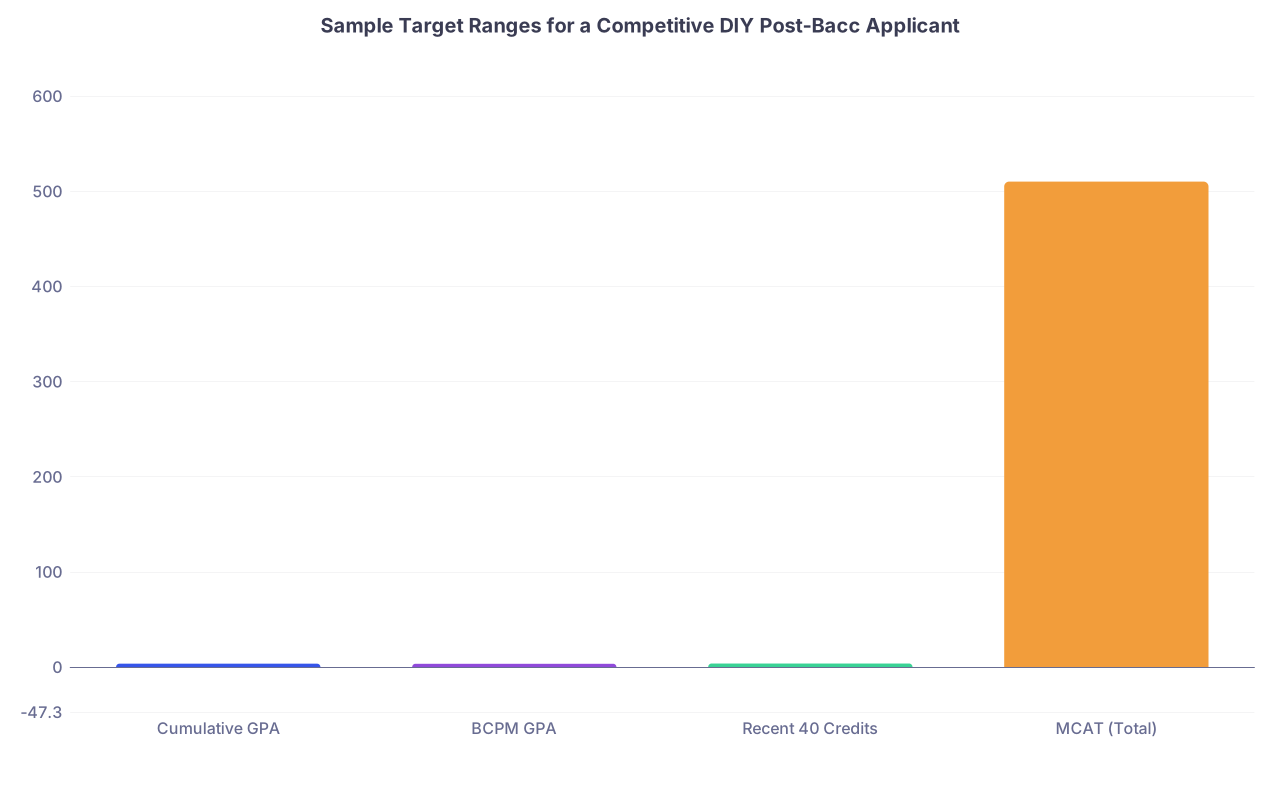
These are not hard cutoffs, but if your plan cannot plausibly get you near these numbers, you either:
- Extend the time frame
- Add more upper‑division credits
- Or recalibrate where you apply (e.g., more DO, fewer hyper‑selective MDs)
Step 10: Make One Hard Decision: Work Load vs. Time to Application
Every mid‑career premed runs into the same tension:
- “I want to apply soon.”
vs - “I cannot cut my work hours.”
You cannot have both maximum speed and maximum safety. Pick one to prioritize.
If you must keep full‑time work:
- Accept a 3–4 year runway from first class to application submission
- Take 4–8 credits/term, no more, so you can consistently get A’s
- Use that extra time to build very strong clinical exposure and a solid MCAT
If you can cut back work hours (e.g., to 0.6–0.8 FTE, or move to a more flexible/remote role):
- You can compress coursework and MCAT into 2–3 years
- But you must still schedule protected study time like it is a second job
I have seen more careers torpedoed by people trying to do a “1.5‑year sprint” than any other single mistake. A bad post‑bacc GPA is incredibly hard to explain away later.
So be ruthless: design for A’s, not for speed.
Step 11: Common DIY Post‑Bacc Mistakes (And How to Avoid Them)
Let me call out a few patterns I see over and over:
Random Course Shopping
- Problem: Taking a scattered handful of sciences over 5–7 years with gaps and no clear trend.
- Fix: Commit to an actual plan: number of credits, sequence, and timeline.
Ignoring BCPM GPA
- Problem: “My overall GPA is 3.5 so I’m fine,” when BCPM is 3.0.
- Fix: Build your plan around lifting BCPM specifically with solid science performance.
Too Much Community College, No 4‑Year Anchor
- Problem: Entire premed path at CC as a mid‑career changers, no proof at 4‑year level.
- Fix: Use CC strategically, then transition to a 4‑year for upper‑division or at least some prereqs.
No MCAT Alignment
- Problem: Finishing key MCAT prerequisites after taking the MCAT.
- Fix: Ensure you will have completed core sciences before your MCAT test date.
Absence of Letters
- Problem: Great grades, but no professor knows you.
- Fix: Intentionally choose some smaller classes; build relationships from day one.
Life Denial
- Problem: Pretending you have 30 spare hours/week that you do not.
- Fix: Time‑block your life honestly before you enroll. If it does not fit, scale back coursework.
Your Action Step for Today
Do not “think about” a DIY post‑bacc. Start building it.
Today, do this:
- Pull every transcript you have and calculate:
- Cumulative GPA
- BCPM GPA
- On one sheet of paper, write:
- Career‑changer, academic‑repairer, or both?
- Max credits/term you can handle while guaranteeing A‑level effort
- Open the website of the nearest 4‑year university and community college:
- Find evening or part‑time science offerings for the next term
- Draft a 2‑term course plan that fits your real schedule
If you cannot get those three things done, you are not ready to commit. If you can, you have just built the skeleton of your DIY post‑bacc. Now you refine, extend, and execute.