
Most nontraditional applicants waste their best industry contacts on weak, generic letters. You are not going to be one of them.
If you have real work experience—tech, finance, consulting, engineering, military, teaching—you’re sitting on a gold mine for medical school letters of recommendation (LORs). The problem is that most people never convert those contacts into the kind of letters that admissions committees actually remember.
Let me be blunt:
- “To whom it may concern, X is a hard worker and team player…” is worthless.
- “I trusted this person with seven-figure clients and with my own reputation, and they never once failed me” gets attention.
Your job is to move your industry contacts from the first category to the second.
Here is how to do it, step by step.
1. Understand When Industry Letters Help—and When They Hurt
Industry letters are a double-edged sword. Used well, they prove maturity, responsibility, and real-world competence. Used badly, they scream “I could not get strong academic or clinical support.”
You need to know the ground rules.
What medical schools actually want
Broadly, schools want:
- Academic letters
- Science faculty letters
- (Often) a physician or clinical supervisor letter
- Then: “Other” letters that add dimension
Your industry contacts sit in that “other” bucket. They supplement, not replace:
- Required science faculty letters
- A strong academic letter vouching for your performance in recent coursework
- Any required committee letter or health professions committee packet
If you try to substitute your former boss for a required science faculty letter, schools will either:
- Reject your app as incomplete, or
- Assume you are hiding mediocre academic performance
So you structure it this way:
- Use professors and clinicians to prove: “I can survive and excel in medical school.”
- Use industry contacts to prove: “I am already operating as a responsible professional adult.”
When an industry LOR is a clear asset
An industry letter can be extremely helpful when:
- You have 2+ years of full-time work experience
- You had meaningful responsibility: leading projects, managing people, handling sensitive information, dealing with conflict
- Your recommender is fairly senior or clearly respected (director, VP, major, founder, PI-equivalent)
- You can draw a clear line from your prior career to medicine: skills, values, service, leadership
The more your past role touches any of these, the more valuable the letter:
- Leadership
- High-stakes decision making
- Communication with non-experts
- Teaching or mentoring
- Ethical challenges / integrity under pressure
- Longitudinal relationships (clients, patients, students, etc.)
When an industry LOR is a liability
You are shooting yourself in the foot if:
- The letter clearly replaces a missing required letter
- The recommender barely knows you
- The job was trivial and short-term and the letter says nothing beyond “good worker”
- The tone is generic, template-like, or written by someone with poor written communication skills
- The contents emphasize money, prestige, or competition with zero reference to service, empathy, or growth
If you are not sure whether an industry recommender is strong enough, assume they are not—and do the work I will outline below to build them up, or choose someone else.
2. Audit Your Network and Pick the Right Recommenders
You probably have more options than you think. But you need to be strategic. Not everyone should write for you.
Step 1: Build a short list
List everyone from your professional life who might plausibly write a letter:
- Direct managers and supervisors
- Project leads you reported to
- Senior colleagues who mentored you
- Clients or partners who worked with you for > 6 months
- Military superiors (O-3 and up usually write the strongest letters; NCOs can be powerful if they supervised you closely)
- Startup founders or cofounders you reported directly to
For each name, answer:
- How long did we work together?
- How directly did they supervise me?
- Did they see me under stress or pressure?
- Did they ever praise me specifically for something meaningful? (Not just “nice job,” but “You handled that situation better than most senior staff.”)
- Would they recognize my name and respond to my email today?
If you cannot answer “yes” to that last one, they are off the list.
Step 2: Rank them ruthlessly
You are looking for depth of relationship and credibility of position.
Rough rule:
- Long-term direct supervisor (1–3 years) who trusted you with real responsibility
- Senior colleague / project lead who saw you in the trenches
- A client or external partner who saw your integrity and reliability
- Distant senior person who barely knows you but has a fancy title (usually not worth it)
Pick 2–3 industry recommenders max. You do not need a dozen letters. You need 3–5 total, with at most 2 from industry.
3. Rebuild the Relationship Before You Ask
The fastest way to get a weak letter is to disappear for two years and then send: “Hope you’re well, can you write me a strong recommendation for med school?”
Do not do that.
You are running a re-engagement campaign, not a drive‑by ask.
Step-by-step relationship reset (takes 2–6 weeks)
-
Short, direct, and specific. Something like:
Subject: Quick update & would love your perspective
Hi [Name],
I have been thinking about our work on [specific project/team] recently and how much I learned from your approach to [specific skill they modeled].
Since we last worked together, I have [brief career update: finished X role, started post-bacc, began clinical volunteering]. I am now preparing to apply to medical school for the [year] cycle.
I would really value your perspective on this transition given your experience with [leadership/mentoring/people changing careers]. If you have 20–30 minutes in the next couple of weeks, I would love to catch up and get your thoughts.
Best,
[Your Name] Schedule a call or meeting
Zoom, phone, coffee. Face-to-face (even virtual) changes everything.
Use the meeting to:
- Share your genuine reasoning for medicine
- Reflect on what you learned in their organization
- Connect specific experiences they witnessed to traits that matter in medicine
- Ask for advice on the transition, not the letter (yet)
Example lines that I have heard work well:
- “When we handled that crisis with the [client/hospital/system outage], that was my first taste of working in high-stakes situations where communication and calm mattered more than being the smartest person in the room. That is exactly what I see in medicine.”
- “You once told me that reliability beats brilliance over the long term. That stuck, and I see that mindset all over healthcare.”
Follow up within 24 hours
Short email:
- Thank them
- Reflect one key takeaway from the conversation
- Mention that you will be in touch as your application timeline firms up
This does three things:
- Reminds them who you are and why you respected them
- Shows that you are serious and thoughtful about this change
- Softens the ground for a later, explicit letter request
4. Ask for a Strong Letter the Right Way
Now you move from “relationship” to “ask.” The wording matters.
Your goal: An honest strong letter
You are not begging for any letter. You are checking whether they can genuinely and comfortably write a strong one. You want them to say “no” if the answer is “meh.”
Use language like this:
I am putting together my medical school applications for the upcoming cycle, and I am hoping to include 1–2 letters from former supervisors who can speak to my work ethic, integrity, and growth in a professional setting.
Would you feel comfortable writing a strong, detailed recommendation based on our work together at [Company/Unit]? If you have any hesitation, I completely understand—my priority is to have letters from people who know my work very well.
If they hesitate at all—vague answers, “Sure, send me a draft and I’ll sign it,” clear discomfort—you thank them and move on. That is not your strongest letter.
If they say yes enthusiastically, you proceed.
5. Make It Easy for Them to Write a Powerful Letter
Most industry supervisors do not know what a medical school LOR should look like. Their default is a bland corporate reference. Your job is to give them the raw material and structure to do better.
You are not writing your own letter. You are providing:
- Context
- Reminders of specific stories
- A clear framing of what medical schools care about
Send a “Letter Packet” – but keep it tight
Once they agree, send a single email with:
- Your current CV or resume
- A 1–2 page “LOR guide” specifically for them
- Your personal statement draft (or at least a one‑page “Why medicine / my path” summary)
- Timeline and logistics (deadlines, how letters are submitted, etc.)
Here is what that “LOR guide” should contain.
A. Quick context
- Brief recap of when and how you worked together
- Your role(s) and any promotions or major projects
- 3–5 bullet points: “Things you directly saw me do”
Example:
- Managed 18 client accounts with annual revenue of $3M+
- Led cross-functional incident response when X system failed for 24 hours
- Trained 4 new hires on [software/process]
- Volunteered to mentor new interns each summer
- Selected to present at [internal conference / leadership offsite]
B. A simple structure they can follow
Spell this out explicitly. Something like:
A helpful structure many medical school recommenders use:
- How you know me (role, duration, context)
- The scope of my responsibilities and what was at stake
- 2–3 specific stories that illustrate:
- Reliability under pressure
- Communication and teamwork
- Integrity and ownership of mistakes
- Growth over time
- Comparison to peers (“top X%” of people you have supervised in [timeframe])
- Clear closing endorsement (“I would trust them with…”)
Most professionals appreciate being told exactly what will help.
C. Traits to emphasize (translated to med‑school language)
Give them a short list of traits you would be happy to have highlighted, framed in their language:
- “Handled high-stress situations calmly and logically” → resilience, composure
- “Owned their mistakes and fixed them quickly” → integrity, accountability
- “Explained complex issues clearly to nontechnical clients” → communication, teaching
- “Persisted through tedious, unglamorous work without complaining” → perseverance, professionalism
- “Built trust quickly with skeptical stakeholders” → empathy, relationship-building
- “Sought feedback and improved visibly over time” → coachability, growth mindset
Tell them:
You definitely do not need to cover all of these. 2–3 in depth, tied to specific examples you remember, would be most useful.
D. Specific stories you remind them of
Do some work for them here. List 3–6 concrete moments you remember:
- The Friday night outage where you stayed until 2 a.m. to support the team
- The hostile client you turned around over six months
- The new hire you mentored who later got promoted
- The ethical line you refused to cross, even when it made the project harder
Write one or two sentences per story, not paragraphs. Just enough to jog their memory:
“The time we handled the data discrepancy in the Q3 report and you had me personally call the client to explain the error and our correction plan. That was the first time I realized how much you trusted me with high‑stakes conversations.”
They will remember the details; you are just lighting up the neurons.
6. Align Industry Letters with Your Narrative
The strongest applications read like they were written about one real person, not five different versions of you. Industry letters should support—not contradict—your story.
Build a clear “story spine”
You want your personal statement, activities, and letters to all point towards a coherent version of you:
- Former [industry role] who:
- Took responsibility early
- Found meaning in [service/teaching/problem-solving]
- Hit a ceiling where the work felt too far from tangible human impact
- Sought out clinical exposure and realized medicine fits the same core motivations, just applied to people instead of [data/clients/systems]
Share that with your recommenders directly, in plain English. Example:
The thread I am trying to highlight for admissions is:
- I took on significant responsibility early in my career
- I cared most about the human side of my work—mentoring, difficult conversations, helping people in stressful situations
- Over time, that motivated me to move toward work where the “human” component is front and center, which I found through [clinical volunteering, scribing, EMT work, etc.]
If any of that resonates with how you saw me professionally, feel free to emphasize those pieces.
You are not scripting them. You are aligning their natural perspective with your overall narrative.
7. Timing, Logistics, and Preventing Last‑Minute Disasters
People in industry are busy. Their calendars are brutal. If you treat their letter like an afterthought, they will, too.
Basic logistics checklist
- Ask at least 6–8 weeks before the first deadline
- Set a “soft” deadline 2–3 weeks before the real one
- Use AMCAS/AACOMAS/TMDSAS letter IDs or a service like Interfolio to avoid confusion
- Confirm the correct email and whether their organization has firewalls that block automated links
- Offer to send calendar reminders if they would like
A simple timeline that works
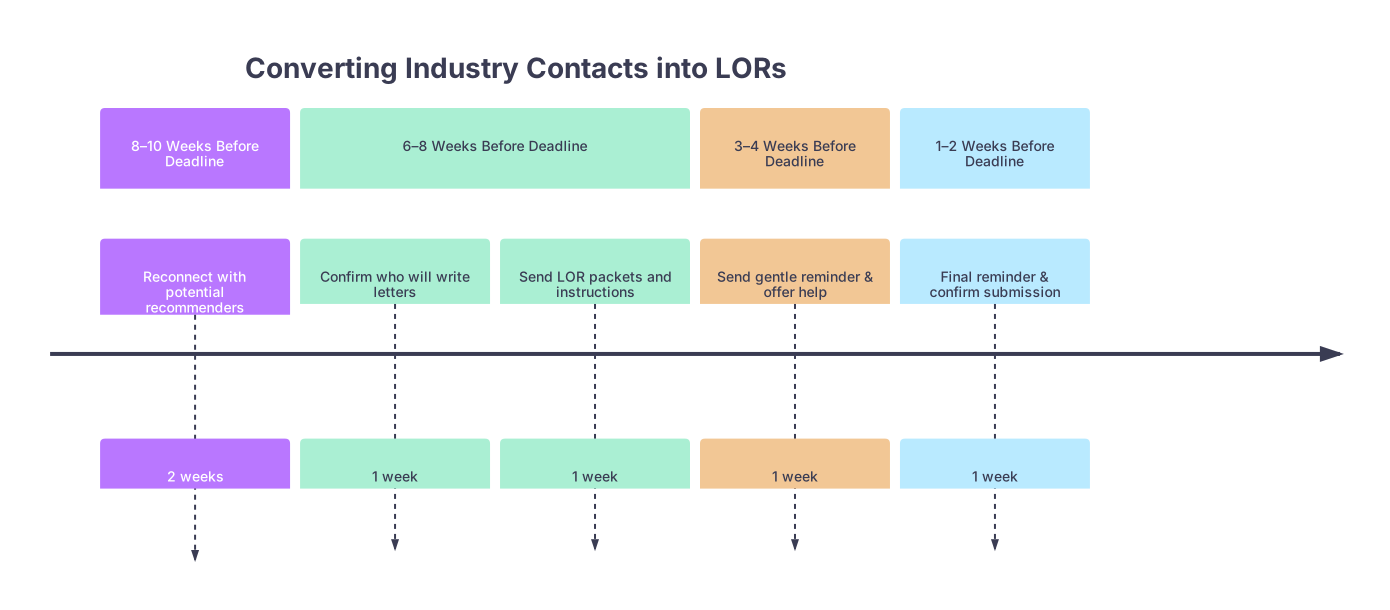
| Period | Event |
|---|---|
| 8–10 Weeks Before Deadline - Reconnect with potential recommenders | 2 weeks |
| 6–8 Weeks Before Deadline - Confirm who will write letters | 1 week |
| 6–8 Weeks Before Deadline - Send LOR packets and instructions | 1 week |
| 3–4 Weeks Before Deadline - Send gentle reminder & offer help | 1 week |
| 1–2 Weeks Before Deadline - Final reminder & confirm submission | 1 week |
How to follow up without being annoying
People stall. They forget. You follow up.
Two weeks after sending the packet (if you have not seen the letter marked as received):
Hi [Name],
Just a quick note to see if you had any questions about the med school recommendation letter or the submission system.
No rush on my end—the formal deadline is [date], but I wanted to make sure the link and instructions came through clearly. I appreciate your time on this very much.
Best,
[Your Name]
If you get close to your soft deadline and still nothing, a more direct version:
Hi [Name],
I wanted to check in about the letter as my application timeline is moving forward. If your schedule has changed and it would be difficult to complete the letter, please let me know—I absolutely understand and can make alternate plans.
If you are still able to write it, I am very grateful and happy to resend any materials that would make the process easier.
Best,
[Your Name]
Give them an easy out. Better a late honest “no” than a rushed, low‑quality letter.
8. Special Cases: Startups, Military, and Teaching
Not all industry is the same. A few high‑yield scenarios and how to handle them.
Startups and small companies
Pros:
- You often had outsized responsibility
- Founders or early employees know you well
- You likely did a bit of everything
Cons:
- Titles may not impress committees
- Organizations may sound unfamiliar or unstable
Solution:
- Have the recommender emphasize scope not title: budgets, team size, users affected, consequences of failure
- Make sure they explain the environment: fast-paced, ambiguous, resource‑limited
- Ask them to clarify your role from day one vs. later—adcoms like visible growth
Example line you might suggest they include:
“Despite having the title ‘Analyst,’ [Name] functioned as the de facto project manager for our three largest clients by the end of their second year.”
Military
Military letters can be incredibly strong if done correctly.
Key points:
- Choose someone who directly supervised you, not just the highest rank you can reach
- Ask them to translate military jargon into civilian terms
- Emphasize responsibility, chain of command, and the real consequences of failure
- Ask for at least one story that highlights calm under pressure or moral courage
Teaching / Education
Former teachers, principals, or department heads can speak to:
- Communication with diverse groups
- Patience and empathy
- Conflict resolution
- Longitudinal relationships
Ask them to include:
- Class sizes, demographics
- Specific students or families you impacted
- Evidence of going “beyond the job description”
9. How Industry Letters Fit into Your Overall LOR Strategy
You need to see the whole picture. Here is how industry letters usually slot in for a nontraditional applicant.
| Letter Type | Source | Purpose |
|---|---|---|
| Science Faculty | Recent biology/chem professor | Prove academic readiness and study skills |
| Non-Science or Grad Faculty | Humanities or grad supervisor | Show writing, analysis, and classroom presence |
| Clinical/Physician | Doctor or clinical supervisor | Demonstrate fit for patient care environment |
| Industry Supervisor #1 | Direct manager (2+ years) | Prove maturity, reliability, leadership |
| Industry Supervisor #2 or Other | Senior colleague/mentor | Add depth on teamwork, ethics, communication |
If your academic record is older or weaker, industry letters do not replace academic proof. You will still need:
- Recent coursework with strong grades
- At least one professor who can say: “They came back to school after X years and outperformed my traditional students”
The industry letters then say: “This is not a fluke. This is who they are across settings.”
10. After the Letter: Maintain and Close the Loop
You are not done when the letter is submitted.
Thank them properly
Bare minimum:
- A detailed thank you email as soon as you confirm the letter is in
- A handwritten note if you can manage it (yes, old‑school, but it stands out)
Mention specifically:
- What you appreciated about working with them
- One or two ways their mentorship shaped how you approach medicine
- That you will keep them posted on outcomes
Update them on results
When you:
- Get your first interview
- Get your first acceptance
- Decide where you are going
Send an update:
I wanted to share the good news that I have been accepted to [School] and will be starting in [month/year]. Your letter and your mentorship over the years have been a crucial part of making this possible. Thank you again for investing your time and trust in me.
That one email cements the relationship for life. You might need them again—for scholarships, specialty applications, or future roles.
11. Common Mistakes You Are Not Going to Make
Quick list so you can spot your own bad habits:
- Waiting until April or May to contact recommenders for a June application
- Picking the most prestigious title instead of the person who actually knows you
- Sending a vague request with no context, no CV, no deadlines
- Letting an industry letter substitute for required academic letters
- Asking someone who barely remembers you and hoping for the best
- Being so “polite” that you never send reminders and your app is incomplete
- Ignoring the narrative: letters that each tell a different, disconnected story
If you catch yourself doing any of these, stop and correct. You still have time.
The Short Version: How to Actually Convert Contacts into Strong Letters
- Use industry letters as supplements, not substitutes. They prove maturity and professionalism, not whether you can survive biochem.
- Pick recommenders who truly know your work and saw you under pressure. Deep relationship beats fancy title every time.
- Do the grunt work so they can write a real letter. Rebuild the relationship, provide targeted context and stories, and guide them toward traits that matter in medicine.