
The biggest waste I see nontraditional students make is this: they park their teaching and leadership experience at the door the moment they enter a small‑group room.
Why Your Teaching and Leadership Past Is Not “Extra” — It Is Your Edge
If you have a background in teaching, coaching, tutoring, military leadership, management, or running teams, you are already built for small‑group learning. Problem-based learning (PBL), TBL, case discussions, clinical skills groups — all of these environments reward exactly the skills you have been paid to use.
The problem is most nontraditional students do one of two things:
- They overcompensate and dominate the room, trying to “run” the session like a classroom.
- They underplay their experience, sit quietly, and try to “blend in” like a fresh‑out‑college 21‑year‑old.
Both approaches are wrong.
The goal is to translate your teaching and leadership background into three specific competencies:
- Structuring messy discussions without taking over.
- Elevating your group’s learning without turning into “the tutor.”
- Signaling professionalism and maturity that faculty actually trust.
Let me break this down in concrete, medical‑school‑level detail.
Understanding Small‑Group Learning in Medicine: What Is Actually Being Tested
Most premeds think small‑group = “talk about the case” and “get the right answer.” That is naïve. In actual medical curricula, small‑group learning is a structured assessment of:
- How you reason clinically.
- How you communicate in a team.
- How you manage conflict and ambiguity.
- How you handle not being the smartest person in the room.
Your teaching and leadership background matters because small‑group sessions are designed to surface behavior under social and cognitive load.
Here is how medical schools usually frame it internally (they will not say it this bluntly to you):
| Domain | What Faculty Look For | What Fails You |
|---|---|---|
| Knowledge Use | Applying facts to cases, not just reciting | Flexing trivia, derailing into minutiae |
| Team Interaction | Listening, inviting input, sharing airtime | Dominating, interrupting, withdrawing |
| Professionalism | Preparedness, respect, time management | Chronic late, side-convos, eye‑rolling |
| Reasoning Process | Clear, stepwise thinking, transparent rationale | Hand‑wavy guesses, hiding uncertainty |
| Leadership Potential | Calm structure, conflict management, accountability | Power grabs, passive victim behavior |
Where does your past fit?
- Former teacher? You already know how to scaffold complex topics.
- Former coach or manager? You know how to keep a group focused and move them toward a goal.
- Military or corporate leadership? You understand chain of command, de‑escalation, and accountability.
- Peer tutor, RA, or club president? You already mediated petty conflicts. Same thing, different stakes.
You are not starting from zero. You are starting 10 yards ahead. You just need to stop running the wrong direction.
Translating Teaching Skills into Small‑Group Excellence
Let’s strip the education‑school jargon and focus on moves you can actually use in a PBL room tomorrow.
1. Use “Framing” to Save Time and Show Maturity
Good teachers frame a session: “Today we’re going to do X, Y, Z.” You can do the small‑group version without being bossy.
Example, at the start of a case:
- “We probably want to first clarify the stem, then generate a problem list, then decide what we want to read before next session. Does that structure work for everyone?”
You did three things here:
- You imposed light structure.
- You made it collaborative (“does that work for everyone?”).
- You signaled you understand the learning objectives without flexing knowledge.
This is leadership, not control. Students and tutors will remember the difference.
2. Ask Teacher‑Level Questions, Not “Gunner” Questions
Your years teaching or leading have given you better instincts about questions. Use that.
Bad question (gunner vibe):
“Shouldn’t we also be considering less common causes of nephritic syndrome like anti‑GBM disease and ANCA‑associated vasculitis?”
Better question (teacher vibe):
“Before we go down too many rabbit holes, what is the simplest unifying diagnosis that explains the hematuria, hypertension, and RBC casts?”
You are nudging the group back to first principles. That is exactly what strong small‑group facilitators do.
You can also use “contrast” questions you learned teaching:
- “What finding here pushes us away from pneumonia and more toward PE?”
- “If this were sepsis instead of anaphylaxis, what would you expect to be different on exam?”
These questions expose reasoning without putting any single student on the spot.
3. Apply Classroom Techniques: Check‑Back and Summarize
You already know two teaching moves that are pure gold in PBL:
- Check‑back: Testing understanding without humiliation.
- Summarize: Compressing chaos into a coherent thread.
Examples:
Check‑back (peer‑to‑peer):
“So I’m hearing that we think this is pre‑renal AKI driven by volume loss. Are we all on the same page about why the BUN:Cr ratio supports that?”
Summarize:
“Just to recap before we move on: the main problems we’ve identified are chest pain with exertion, new shortness of breath, and risk factors like smoking and diabetes. Our working diagnosis is stable angina, but we want to rule out ACS.”
These moves are subtle leadership. Faculty notice. They often quietly annotate, “Helps group stay organized. Strong potential leader.”
4. Use Your “Explainer” Muscle Carefully
If you have taught before, you’re probably good at breaking things down. The risk in med school is you become the group’s unpaid lecture substitute. That backfires long‑term.
Better pattern:
- Offer a partial explanation, then open it up.
- Use analogies, not monologues.
- Explicitly invite correction.
For example:
“I think of preload as how much the ventricle is stretched before it contracts. So a patient who is volume overloaded has high preload. Does anyone see it differently or want to add nuance?”
You are:
- Sharing your understanding.
- Making space for others.
- Modeling that even “experienced” people expect to be corrected.
This is how you avoid the “know‑it‑all ex‑teacher” stereotype that some tutors absolutely hate.
Translating Leadership Background into Group Dynamics and Professionalism
Leadership experience is not just “I was in charge.” It is habit. How you manage people, time, expectations, and conflict. Small‑group learning in medical school is a quiet but brutal test of those habits.
1. Run the Clock Without Acting Like a Manager
Most groups waste absurd chunks of time on tangents or case‑stem wordsmithing. If you have ever run a staff meeting or platoon brief, you know this pain.
Use those instincts. But soft.
Time‑awareness lines you can steal:
- “We have about 20 minutes left. Do we want to spend most of that on differential or on planning learning issues?”
- “We are deep in the pathophys, which is great, but we still have not addressed management. Should we pivot?”
You are not ordering anyone around. You are making the invisible constraint (time) visible.
This is a leadership micro‑skill. It will save your future attending’s sanity on rounds.
2. De‑escalate Conflict Like You Have Done a Hundred Times Before
You have already broken up fights, defused tense meetings, or handled passive‑aggressive emails. Small‑group conflict is milder, but just as toxic if you ignore it.
Typical scenario:
One student constantly interrupts. Another shuts down. The tutor is either oblivious or conflict‑avoidant.
Your move:
- “I want to make sure we hear from people who have not had much airtime yet. [Name], how are you thinking about this case?”
- If someone is steamrolling: “Hold on, I want to pause you there so we can see if others are thinking along the same lines or something different.”
You are not attacking the talkative student. You are reframing it as airtime balance. Most people accept that correction without a fight.
If it gets worse (rare but it happens):
- Talk to the tutor after: “Our group dynamic feels off; I’m not sure everyone feels comfortable speaking. Is that something we could address together next session?”
That is a very “grown‑up in the room” move. Nontrad advantage.
3. Use Project‑Management Habits for Learning Issues and Follow‑Through
Leadership roles teach you follow‑through: assigning tasks, clarifying ownership, closing loops. PBL and TBL quietly test this every week.
Instead of the vague “we’ll all just read about it,” try:
- “We have four learning issues. Anyone want to take pathophys? I’m happy to take diagnostics if that works.”
- “I can summarize the manager’s perspective on this topic — someone else want to cover patient communication?”
You do not need a Gantt chart in your OneNote (please don’t). But you should be the person who naturally says at the end:
- “Before we leave, can we just confirm who’s covering what for next time?”
That is leadership, disguised as logistics.
4. Read the Room Like You Read a Team
Good leaders read energy: who is checked out, who is overwhelmed, who is itching to speak. Use that.
Look for:
- The student with notes open but has not spoken once.
- The one whose facial expression screams “I disagree” but says nothing.
- The one scrolling or doing Anki in the corner.
Then adjust your own behavior. For example:
- Direct but gentle: “We have not heard from you yet — anything you want to add or any part that feels confusing?”
- Protective: If someone keeps getting interrupted: “I want to come back to what you were saying a minute ago, I do not think we fully heard you.”
That is the subtle stuff faculty remember when writing narrative comments.
Concrete Small‑Group Scenarios and How to Play Them as a Nontrad
Let me walk you through situations I have seen over and over — and how your teaching/leadership background should shape your behavior.
Scenario 1: The Silent Tutor
Tutor logs on. Says, “Ok, go ahead.” Then stares. Does not guide. Barely reacts.
Most groups either flounder or a gunner takes over. You are not going to do that.
You:
- Take 30 seconds and say: “How about we start by someone reading the stem aloud, then we can identify key problems, then brainstorm a differential?”
- If everyone stares: “I can read the stem to get us started.”
You just turned chaos into light structure without hijacking content. Tutor probably writes: “Student provides effective, unobtrusive leadership.”
Scenario 2: The Dominant Peer
One student talks 60–70% of the time. Correct most of the time. Annoying always.
Bad response from a leader‑type nontrad: Cross‑examine them, publicly “prove” they’re wrong at some point. Power play. Childish.
Better moves:
- Redirect airtime: “That is a good point. Before we go deeper, what do other people think about that explanation?”
- Use future structure: “For this next problem, how about someone else starts us off and we all add on?”
If they ignore these soft boundaries repeatedly and the tutor stays asleep, then you take it offline:
- “Hey, I notice we are leaning on you a lot because you know a ton, which is great. I also think a few people are staying quiet. Maybe we can both help make more room for them next time?”
This is how adults handle it. Use the fact you have lived more life.
Scenario 3: You Actually Know This Cold
Let’s say you were an ICU nurse, paramedic, or respiratory therapist. Now you are in a small group about shock and resuscitation. You know the material better than the tutor.
Your instinct might be to perform. Run the show. Answer everything.
Wrong.
The correct play:
- Share experience in short, focused bursts tied to concepts, not war stories.
- Do not correct the tutor publicly unless patient safety or outright wrong physiology is at stake.
Example:
“When I worked nights in the ICU, we saw that when we overshot fluids in septic shock, patients’ respiratory status could tank. That really made Starling curves real for me. So I think what the case is trying to get at is how we balance perfusion with the risk of pulmonary edema.”
You contributed depth without making it a personal anecdote festival.
If the tutor says something actually incorrect:
- “I thought the Surviving Sepsis Campaign reconsidered that fluid amount in the most recent guidelines — am I misremembering?”
You give them a save‑face option.
Faculty remember who corrects with humility versus who corrects to score points.
Scenario 4: Group Is Disorganized Between Sessions
Everyone forgets who was supposed to present what. People show up half‑prepared. Spiral of mediocrity.
You have probably fixed this dynamic in a job before. Do it again, lightly:
End of session:
- “Let me just jot this down so we are clear: [Name] covering pathophys, I’ll do diagnostics, [Name] doing treatment. I will email a quick summary so we all remember.”
If your school uses Slack, GroupMe, or LMS messaging:
- Send a 3‑sentence recap. Not a manifesto.
You quietly become “the reliable one.” That reputation follows you to clinicals, research, and letters.
Strategic Benefits: How This Pays Off in Applications and Evaluations
Nontraditional students frequently worry: “Will my age or background hurt me?” In small‑group heavy curricula, your background is a selling point — if you exploit it correctly.
How Faculty Actually Talk About You
Behind closed doors, comments sound like this:
- “She is the one who always keeps the group on track but never dominates.”
- “He clearly has life experience — de‑escalated a group conflict in a way I would expect from a resident.”
- “Very strong potential for chief resident down the line. Others gravitate toward them.”
Teaching/leadership backgrounds help generate exactly these comments when you:
- Show consistency across many sessions.
- Demonstrate humility despite knowing how groups work.
- Protect others’ learning, not just your own performance.
Those comments go into:
- Dean’s letters (MSPE).
- Scholarship nominations.
- Selection for peer‑teaching roles and tutoring positions.
How to Surface Your Background Without Flexing
You do not need to start every introduction with “As a former teacher…” That gets old.
Better: Let your behavior show it. Then, when asked directly in:
- Office hours: “You facilitate so well — have you taught before?”
- Evaluations: “Describe a time you contributed to your small group’s success.”
- Interviews: “How has your previous career shaped your approach to medicine?”
Then you connect the dots explicitly:
- “I taught high school science for five years, which trained me to break down complex material and read group dynamics. In small‑group settings here, I use those same skills to help keep discussions focused and inclusive, without substituting my voice for others’.”
That is what you want on record.
How to Prepare Before Starting: Concrete Steps as a Premed or Incoming M1
You can start building these muscles before you ever see a PBL room.
1. Seek Real Group‑Facilitation Experience Now
If you are still premed:
- Lead a small tutoring group instead of only doing 1‑on‑1.
- Volunteer to run case discussions in a pre‑health club.
- TA for discussion‑based courses, not just grading roles.
If you are coming from industry:
- Volunteer to run a small journal club in a healthcare setting.
- Lead case‑review meetings if you are already in a clinical job.
You are practicing exactly the micro‑skills med schools value: framing, summarizing, managing talk‑time, handling minor conflict.
2. Watch How Good Facilitators Talk
Do this intentionally:
- Sit in on case conferences (M&M, tumor board, etc.) at your local hospital if you can.
- Watch how good attendings or senior residents keep discussion from spiraling.
Pay attention to phrases, not just content:
- “Let’s anchor this to the main question…”
- “Before we move on, I want to make sure we are all aligned on X.”
- “I’m going to pause here, because I sense some disagreement — let us bring that out.”
Steal shamelessly.
3. Practice “Think‑Aloud” Reasoning
Good group contributors externalize their reasoning. They do not just give an answer; they walk through their steps. Your teaching background probably trained you to do this for others. Apply it to your own thinking.
Example pattern:
- “Given the fever and murmur, I am worried about endocarditis. My first step is to ask: what are the highest‑yield risk factors? IV drug use, prosthetic valve, previous valvular disease. We only have one of those clearly in the stem, so I think the case wants us to latch onto X…”
You just taught your group how to think, not just what to think.
4. Learn to Shut Up on Purpose
This is crucial.
Former teachers and leaders talk too much by habit. They fill silence. They rescue awkwardness.
You need to unlearn some of that.
Set a simple rule for yourself for the first few weeks:
- Do not be the first to answer more than 1–2 times per session.
- After you speak, wait until at least two other people have contributed before you chime in again, unless the group is truly stuck.
You will feel underutilized. Good. Longer term, you can relax those constraints once you know the group dynamic.
Visual Snapshot: Where Nontrads Shine in Small‑Group Settings
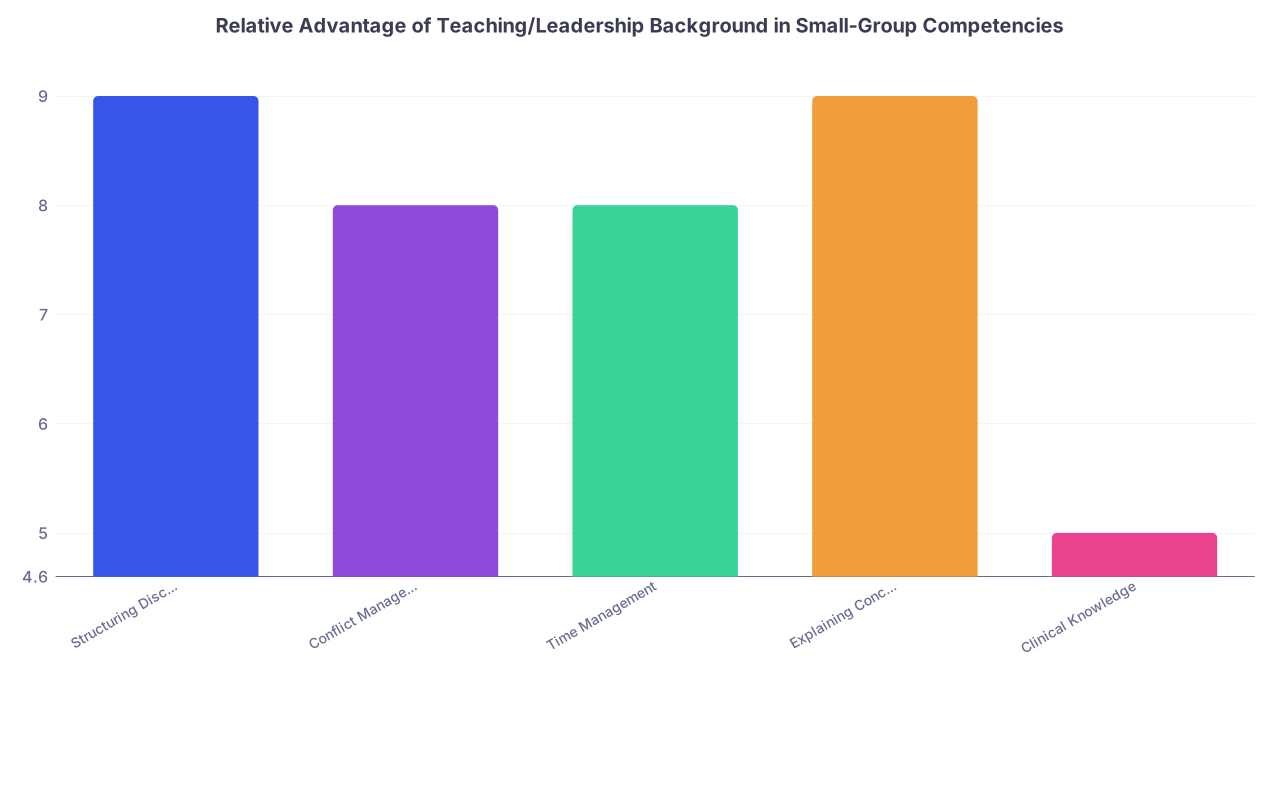
| Category | Value |
|---|---|
| Structuring Discussion | 9 |
| Conflict Management | 8 |
| Time Management | 8 |
| Explaining Concepts | 9 |
| Clinical Knowledge | 5 |
Interpretation: your edge is not that you know more medicine. It is that you know how to run the room.
A Simple Mental Model to Use Each Session
Think of every small‑group session as three overlapping roles. You can lean into all three without overdoing it:
- The Architect — you help build structure: agenda, sequence, recap.
- The Amplifier — you make others’ ideas clearer, louder, and more connected.
- The Adult — you maintain professionalism, manage tension, and protect the group’s purpose.
If you are a nontraditional student with teaching or leadership in your past, you are already trained in all three. Stop pretending you aren’t.
One Last Tool: A Session Flow You Can Memorize
Here is a straightforward flow you can mentally carry into any PBL/TBL/small‑group case:

| Step | Description |
|---|---|
| Step 1 | Start of Session |
| Step 2 | Lightly propose structure |
| Step 3 | Invite others to refine plan |
| Step 4 | Participate selectively in discussion |
| Step 5 | Ask clarifying & contrast questions |
| Step 6 | Summarize key points mid-session |
| Step 7 | Notice & rebalance airtime |
| Step 8 | Help assign learning issues |
| Step 9 | Confirm follow-through plan |
You are not doing all of this every session. But you should recognize which parts you are naturally good at and which you tend to skip.
FAQ (Exactly 6 Questions)
1. If I have a teaching background, how do I avoid becoming the “group tutor” and resenting it?
Set clear internal boundaries. You can explain concepts briefly, but you are not responsible for others’ entire understanding. Use questions and partial explanations instead of full mini‑lectures. If classmates start saying, “Can you just teach us this before the exam?” you redirect: “I’m happy to share how I’m thinking about it in group, but I need to protect my own study time too.”
2. I was a military officer / manager and people say I come off as too intense. How do I dial it back in small groups?
Watch your tone and body language first. Sit back slightly, keep your volume moderate, soften directives into options: “One way we could do this is…” instead of “We need to…” Limit how often you “summarize where we are” early on; let the group breathe before you structure everything. If you trust a classmate, ask for honest feedback after a few sessions.
3. What if my group is completely unmotivated and I feel like the only adult in the room?
You cannot fix motivation for everyone, and it is not your job. You can, however, keep standards for yourself: show up prepared, contribute constructively, and maintain professionalism. Offer light structure and follow‑through once or twice. If the group repeatedly refuses to engage, talk to the tutor or course director rather than martyring yourself as the group’s engine.
4. Will faculty see my taking a leadership role as trying to outshine others?
They will if you make everything about you. They will not if your leadership consistently creates space for others, improves organization, and reduces tension. Faculty are very good at telling the difference between “status‑seeking” and “service‑oriented” behavior. When in doubt, ask yourself: “Did what I just did make someone else’s learning easier?” If yes, you are on the right track.
5. How can I practice these skills if my undergrad does not use PBL or small‑group formats?
Simulate it. Form a 4–6 person study group around practice cases (even simple textbook cases). Volunteer to facilitate one session: propose an agenda, keep an eye on time, summarize periodically, and invite quiet peers to speak. Rotate facilitators so you can also watch others and see what works. Clinical volunteering settings with huddles or team meetings are also excellent observation labs.
6. I am worried my age will make me stand out too much in small groups. Should I try to act more like a traditional student?
No. Trying to imitate 21‑year‑olds usually looks forced and slightly ridiculous. Lean into your maturity: be prepared, be calm, avoid drama, and use your experience to stabilize the group, not dominate it. You do not need to mention your age at all; let your behavior speak. When faculty describe you later as “steady, thoughtful, reliable,” that beats “blends in” every time.
Key points:
- Your teaching and leadership background is not extra; it is the exact skill set small‑group learning rewards when used with restraint and humility.
- Focus on structure, questions, summaries, and airtime balance — not on showing you know more.
- Play the long game: consistent, quiet leadership in small groups translates directly into stronger evaluations, trust from faculty, and real clinical readiness.