
You are 34. Your kid’s finally asleep. Your partner’s watching something on Netflix in the next room. You’ve got a lukewarm mug of tea next to your laptop and a blank document titled: “Personal Statement – Second Act.”
You are not writing the standard “I shadowed a doctor at 19 and fell in love with medicine” essay. You are trying to explain why, after a decade in another career, you are walking away from stability and starting over.
And you know this: if you do this badly, it will sound like a midlife crisis. Or a vague calling. Or a thinly veiled escape from burnout.
Let me walk you through how to do it properly. Structurally. Deliberately. So your second act looks like a decision, not a detour.
What Makes a “Second Act” Personal Statement Different
You are not a traditional 21‑year‑old biology major. That is your biggest liability and your biggest asset.
Admissions committees will read your essay with three specific questions in mind:
- Why now?
- Why medicine specifically (and not “helping people” in general)?
- Can this person actually survive and thrive in medical training at this stage of life?
If you do not answer those explicitly, they will fill in the gaps themselves. Usually not in your favor.
Here’s the twist: most nontraditional applicants try to write like traditional applicants. They trim out the “weird” career story, minimize their age, and then end up with a generic essay that wildly undersells their trajectory.
Bad strategy.
Your “second act” statement has to do three things at once:
- Embrace your prior career and life experience as central, not peripheral
- Show a clear, evidence-backed pivot to medicine
- Prove durability: that you understand what you are signing up for and can handle it
To do that, you need a structure built for a second-act narrative, not a first-act coming-of-age story.
The Core Framework: The 5-Block Second Act Structure
We are going to use a five-block structure. Think of it as architectural framing. You can decorate later. The bones come first.
The five blocks:
- Present Tension – Where you are now and the pressure point that makes change unavoidable
- Origin Thread – The earlier signals that medicine (or its core elements) have shown up before
- The Cracking Point – The moment(s) where your first career stopped fitting and medicine started making sense
- Evidence of Fit – Concrete things you have done that prove alignment with medicine
- Forward Trajectory – How your first act + this decision position you for training and beyond
Let’s go block by block.
Block 1: Present Tension – Start Where You Are Now
Do not start with a childhood story. Or some “when I was 6, I knew…” nonsense. You are an adult with a decade of life behind you. Start in the present.
Your opening should:
- Place us in your current world (career, responsibilities, life stage)
- Show the friction between who you are now and who you are trying to become
- Hint that continuing on the current path is no longer acceptable
This is not about drama. It is about pressure.
Example skeletons (you will need to write your own, but note the structure):
“On a Tuesday morning in the ICU waiting room, I was the only engineer in a sea of families speaking to physicians. I could interpret ventilator readouts more easily than I could interpret my father’s prognosis. When the attending asked if there were questions, I realized every meaningful question was about people, not numbers—and I was on the wrong side of that conversation.”
“At 3 a.m., on the eleventh consecutive night shift, I finished de-escalating a psychotic patient in the ER hallway. My job title said ‘security officer,’ but lately I had been the first one talking, calming, listening. When the resident thanked me for preventing another restraint order, I felt a flash of sharp clarity: I was acting at the edge of a role I no longer wanted to stand outside of.”
Key points:
- Drop us into a specific moment. Time, place, stakes.
- Make it current or very recent. This is a “now” pivot, not nostalgia.
- Show the mismatch between your formal role and the work that actually pulls at you.
Avoid:
- Overexplaining in the first paragraph.
- Announcing, “And that’s when I decided to become a doctor.” Too fast. You need to show the arc, not jump to the title.
Your first block is 1–2 paragraphs. Tight. Sensory. Present tense is fine for the opening vignette; you can shift to past afterwards.
Block 2: Origin Thread – Show This Is Not Random
Second-act applicants get dinged when their decision looks sudden, reactive, or purely circumstantial.
You fix that by showing a thread—recurring elements in your life that line up with medicine: problem-solving around human suffering, fascination with biology, comfort in crisis, long-term work with vulnerable populations.
You are not trying to prove “I have always wanted to be a doctor.” That is not credible and not necessary. You are proving: The seeds were there. I just did not act on them earlier.
Some useful moves in this block:
- One or two earlier experiences that echo medical themes
- A pattern from your prior career that maps onto physician work
- A short reflection that connects this thread to your present tension
Example structures:
The “background hum” model:
“Medicine was not foreign to me. During my eight years as a paramedic, I loved the physiology, the rapid decisions, the privilege of being present in the worst days of people’s lives. Yet I convinced myself that the physician role was for someone who started down that path at 18, not 30. Instead, I advanced into administration, trading patients for spreadsheets, until that ICU waiting room made it impossible to ignore how much of myself I had left behind.”The “parallel track” model:
“Even while I climbed the ranks in corporate finance, my weekends kept drifting toward a different world. First, as a hospice volunteer after my grandmother’s death, then as a long-term mentor for patients in a free clinic’s chronic disease program, I found myself looking forward less to quarterly earnings and more to Tuesday evenings in clinic hallways.”
You do not need to recount every health-related experience you have ever had. One or two well-chosen and linked to the present are enough. This block is about continuity, not volume.
Block 3: The Cracking Point – Why You Left Your First Act
This is where most nontraditional essays fall apart.
They either:
- Trash their previous career (“I realized corporate law was soulless and empty”)
- Or stay so vague you cannot tell what actually changed (“I wanted more meaning”)
Admissions committees are reading this block for risk. Are you running from something (burnout, dissatisfaction, personal crisis) more than you are running to medicine?
You need to talk about the crack without sounding unstable or impulsive.
Aim for:
- Respectful honesty about what your first career gave you
- Clear articulation of why it became insufficient
- A measured, thoughtful pivot, not an explosion
Good framing looks like:
- Acknowledge the strengths and skills you gained (leadership, communication, systems thinking, resilience).
- Then articulate the mismatch: what part of you remained underused or unsatisfied.
- Then describe the decision to actively explore medicine before fully committing (shadowing, courses, clinical work, etc.).
Example:
“I spent nine years as a high school biology teacher, and I do not regret those years. I learned to explain complex systems to anxious teenagers, to manage crises, to keep a room of thirty people moving in the same direction. But as our school partnered with a community health center, I found my energy shifting from the classroom to the exam room. I stayed late to translate discharge instructions, listened to parents describe the same uncontrolled asthma I had seen derail students’ attendance, and realized that my favorite ‘lessons’ were now conversations about how bodies break and heal. The more I leaned into that work, the more limited my role as ‘teacher’ felt.”
Subtext: you are not running away from your first act. You are outgrowing it.
Stay away from:
- Bitterness or contempt for your previous field
- Overpersonal drama (e.g., “After my divorce, I realized I had to start over, so I chose medicine”) unless you can tie it very tightly to your professional arc and resilience
This block should end with you standing at the pivot: you know your previous life is not enough, and you are about to test whether medicine is truly the right next step.
Block 4: Evidence of Fit – Proving You Belong in Medicine
This is the most important section for a second-act applicant.
Your age, your story, your “calling” do not mean much without hard evidence that you can handle the demands and that you have actually seen what real medicine looks like.
You need three categories of evidence:
- Academic readiness
- Clinical exposure and responsibility
- Behavioral traits that align with training (grit, humility, teamwork, teachability)
1. Academic Readiness
Silent assumption in many committees: “This person has been out of school for 10+ years. Can they still do real science?”
You must answer this without sounding defensive. Examples:
- “Returning to formal coursework after twelve years in journalism was humbling. I enrolled in a part-time post-baccalaureate program while working full-time, relearning how to study while mastering organic chemistry and physiology. The discipline I once used to meet investigative deadlines now went into spaced repetition flashcards and structured problem sets. My 3.8 in the program and MCAT preparation required the same consistency and focus I brought to years of multi-source reporting.”
Do not just state the GPA. Explain what the process demanded of you as an adult learner with competing responsibilities.
2. Clinical Exposure and Responsibility
Shadowing alone is weak for a second-act applicant. You should have some role that puts you in the system: scribe, MA, EMT, RN, NP, LCSW, RT, paramedic, health coach, care coordinator, etc.
You want to show:
- You have seen the unglamorous side: long hours, bureaucracy, difficult patients
- You still want in
- You understand, at least at a basic level, what the physician’s role is vs everyone else’s
Example:
“As a medical scribe in a busy community ED, I documented the quiet 3 a.m. conversations where attendings admitted uncertainty, the rapid team choreography during codes, and the fatigue that settled in around hour ten of a shift. I watched physicians toggle between complex diagnostic reasoning and simple, human tasks: sitting down, holding a hand, apologizing for delays they did not cause. The work did not romanticize medicine for me; it made it concrete. Exhausting at times, bounded by imperfect systems—yet still the work I wanted.”
3. Behavioral Traits
Here you mine your first career for transferable skills that actually matter in residency:
- Managing competing priorities
- Giving and receiving critical feedback
- Owning mistakes in high-stakes environments
- Leading teams under stress
You do not need to list them as bullet points. Weave them into short, pointed examples.
For instance:
“My decade in the military taught me to make decisions with incomplete information, to accept responsibility publicly when I was wrong, and to debrief every outcome, favorable or not. These habits have carried into my work in the hospital, where I seek feedback from nurses after every shift and review each complex case with the resident I scribe for.”
This block should be the largest in your essay. It is where you justify the risk the school is taking by betting on a second-act applicant.
Block 5: Forward Trajectory – Convincing Them You Are a Good Long-Term Bet
Your closing cannot just be “I want to help people as a doctor.” That is noise.
You are answering: given everything I have just told you, why am I particularly well-suited for medical training now, and what kind of physician might emerge from this second act?
Do not lock yourself into a specialty if you are not sure. Saying “I will be a neurosurgeon” in your mid-30s with no neurosurgery exposure looks naive. But you can describe the type of problems and communities you are drawn to.
Effective moves here:
- Show you understand the length and difficulty of the road ahead
- Tie your first-act skills to specific aspects of training or physician work
- Sketch a plausible, grounded future—rooted in what you have already done, not fantasy
Example:
“I am under no illusion that returning to the bottom of a hierarchy in my late thirties will be easy. I will be older than many interns. My peers will be sacrificing their twenties; I will be reconfiguring an entire family’s routines. Yet the years I spent building a career before medicine are not wasted. They have made me more disciplined with time, more honest about my limits, and more anchored in why this work matters. I expect to bring that perspective into residency, particularly in community hospitals like the one where I now work—places where the line between medicine and the social determinants of health is thin and constantly crossed.”
You want to end not with a grand flourish, but with a steady, grounded forward look. Confident, not grandiose.
Structural Pitfalls Specific to Second-Act Essays
Let me be blunt about what I see repeatedly in nontraditional personal statements that sinks them.
1. The Overloaded Life Story
You do not have to tell every chapter: childhood, undergrad, first job, second job, marriage, kids, illness, volunteer work, all stacked in narrative order.
Remember the five blocks: present tension → origin thread → cracking point → evidence → trajectory. Anything that does not serve those goes.
If your essay reads like a LinkedIn timeline, you have failed.
2. The Trauma Dump
Yes, many second-act applicants come to medicine via serious personal or family illness, loss, or trauma.
The problem is when the essay becomes about the trauma rather than about your decision, growth, and actions.
If you include difficult experiences:
- Focus on what you did in response, not the blow-by-blow details
- Keep clinical boundaries; you are not in therapy, you are applying for a professional role
- Tie the experience explicitly to skills, insight, or actions that matter for being a physician
3. Overcompensating for Age
You do not need to repeatedly emphasize how “old” you are, how “late” you started, or how “different” you are. Mention it once if relevant (e.g., parenting, caring for aging parents), then show that you can still execute.
If you sound defensive about your age, the committee will read that as insecurity. If you sound matter-of-fact and action-oriented, they will read it as maturity.
A Concrete Outline You Can Actually Use
Here is a bare-bones outline you can map your story onto. Do not write to word count first; write to clarity. Then trim.
| Section | Purpose | Approx. Length |
|---|---|---|
| 1. Present Tension | Drop us into your current world and the pressure to change | 1–2 paragraphs |
| 2. Origin Thread | Show this is a coherent evolution, not a random jump | 1–2 paragraphs |
| 3. Cracking Point | Describe why your first act was no longer enough | 1–2 paragraphs |
| 4. Evidence of Fit | Prove academic readiness, clinical exposure, and behavioral fit | 3–4 paragraphs |
| 5. Forward Trajectory | Show you understand the road ahead and your role in it | 1–2 paragraphs |
This usually lands you in the 750–900 word range, which fits most MD/DO prompts.
Process: How to Draft This Without Losing Your Mind
You are juggling work, maybe kids, maybe aging parents, and now this essay. You do not have unlimited time.
Here is a very straightforward process that works well for second-act applicants.

| Step | Description |
|---|---|
| Step 1 | Brain-dump stories |
| Step 2 | Sort into 5 blocks |
| Step 3 | Choose 1-2 key stories per block |
| Step 4 | Write ugly first draft |
| Step 5 | Cut repetition and resume-content |
| Step 6 | Layer in reflection and forward look |
| Step 7 | Get targeted feedback from 1-2 readers |
| Step 8 | Polish language and tighten |
A few specifics:
- Brain-dump first: list 10–15 moments from your adult life that feel relevant (a case, a decision point, a course, a conversation). No editing.
- Then assign each to one of the 5 blocks. If it does not fit anywhere, it probably does not belong.
- Draft in block order. Do not fuss over perfect sentences on the first pass. Get the bones down.
- On revision 1, remove anything that sounds like your CV or AMCAS activities section. If it is already elsewhere in the application, only keep it here if you are providing interpretation, not repetition.
- On revision 2, check for balance: are you spending 80% of your essay in your old career and only 20% touching medicine? Flip that ratio.
What a Strong Second-Act Essay Feels Like to a Reader
When I read a second-act statement that works, a few things stand out:
- I can see the applicant clearly in their prior world. Specific job, responsibilities, decisions.
- I understand, in concrete terms, why staying in that world stopped making sense.
- I see a tested commitment to medicine, not just shadowing + vibes.
- I finish the essay feeling that this person knows exactly what they are stepping into and has the spine to handle it.
The emotional tone is not breathless inspiration. It is steady conviction.
That is what you are aiming for.
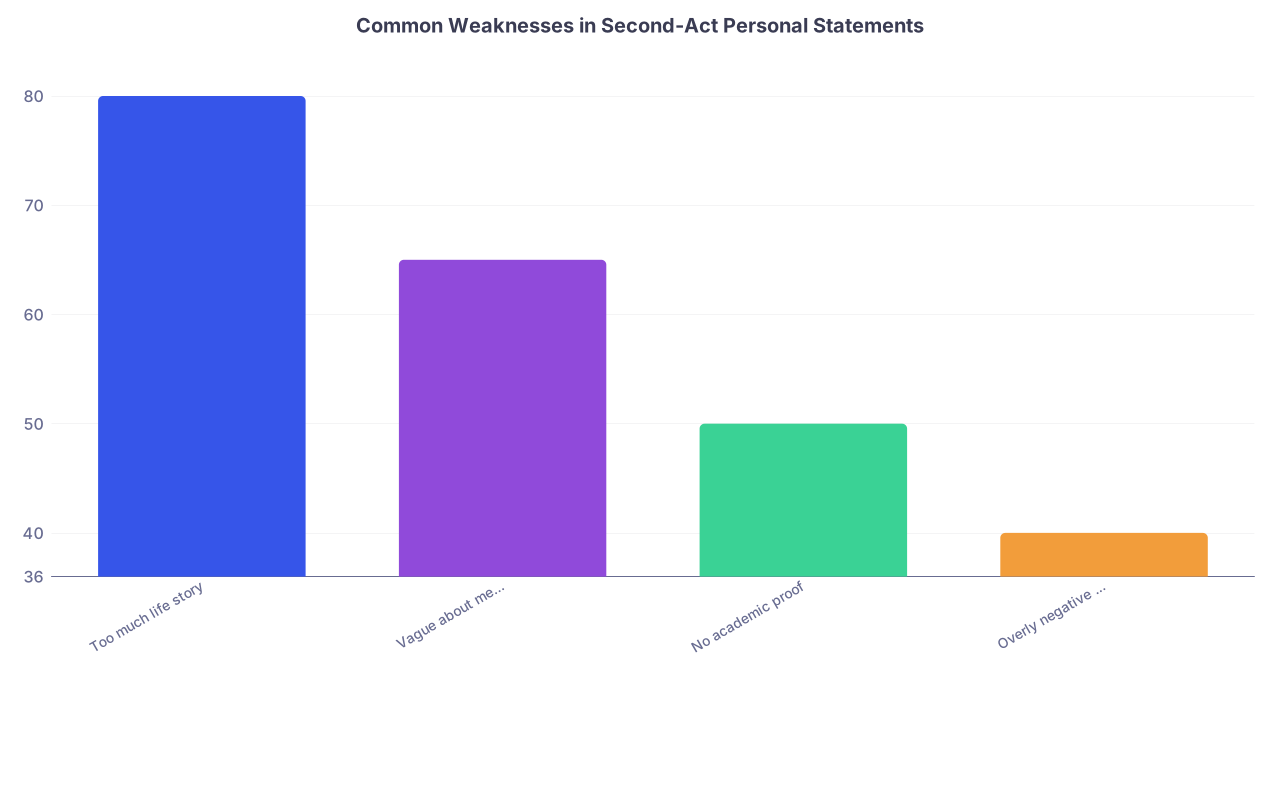
| Category | Value |
|---|---|
| Too much life story | 80 |
| Vague about medicine | 65 |
| No academic proof | 50 |
| Overly negative about past career | 40 |
Interpretation of that chart, since you cannot see the actual bars: roughly 80% of weak second-act essays I see are overloaded with life chronology. Around two-thirds are fuzzy about what medicine actually is day-to-day. Half fail to address academic readiness after a gap. And about 40% spend too much energy slamming their old career instead of owning the pivot.
You can avoid all of that by obeying the structure we just walked through.
FAQ (Exactly 4 Questions)
1. Should I explicitly mention my age or the fact that I am older?
You do not need to state your exact age; they can see your graduation year and work history. Reference age only where it affects context: parenting, caring for family, financial responsibilities. Something like, “Returning to full-time study in my mid-thirties while raising two children required…” is fine. Do not apologize for being older. Show how it shaped your discipline, perspective, and priorities.
2. How much of my previous career should I include?
Use the “30% rule” as a rough guide: no more than about a third of your essay should live fully in your pre-medicine career world. The rest must engage directly with medicine—exploration, academics, clinical work, reflection, and future trajectory. If a job detail does not illuminate your decision, your skills, or your fitness for medicine, cut it.
3. What if my earlier academic record is weak? Will my story compensate?
No. A compelling second-act narrative cannot paper over a poor academic foundation. You need recent, strong coursework and an MCAT that demonstrates current capacity. In your essay, you can briefly own earlier underperformance, then emphasize the concrete steps you took as an adult—post-bacc, retaken courses, structured study—to prove that those earlier grades do not reflect your current ability.
4. Is it risky to mention family responsibilities (kids, spouse, caregiving)?
It is only risky if you frame them as obstacles you are unsure you can manage. You can and should acknowledge real responsibilities, but pair them with demonstrated planning and past performance. For example: “Balancing full-time work, evening science courses, and caring for my father during chemotherapy forced me to become ruthless with time and clear about priorities. That experience is part of why I am confident I can handle the competing demands of medical training with my family’s support.”
Key points to walk away with:
- Use a structure built for a second act, not a college-kid origin story: present tension, origin thread, cracking point, evidence, trajectory.
- Respect your first career, but do not let it dominate. The bulk of your essay must prove you understand medicine and can handle it now.
- Write with calm conviction, not apology. You are not asking permission to start over. You are presenting a well-argued case that your second act belongs in medicine.