
You are 45, with a serious career behind you. Maybe you built software teams, ran operations for a mid‑size company, taught at a university, or led a lab in industry. Now you are staring down the “clinical exposure and volunteering” section of premed advice and thinking: I am not spending my evenings wiping down stretchers like a college freshman… am I?
You are also smart enough to know this: if you get your volunteering choices wrong, adcoms will quietly downgrade you as “tourist,” “bucket‑list applicant,” or “midlife crisis.” You do not get the same grace a 20‑year‑old gets. Your choices either support your narrative or shred it.
Let me be blunt: late‑career, high‑skill premeds need to play an entirely different volunteering game. You have leverage. You also have more scrutiny. Use both strategically.
Let’s break this down specifically.
1. What Adcoms Actually Look For In Your Volunteering (When You’re 35+)
For a typical 20‑year‑old, schools ask: “Can this person function around sick humans and not bolt?” For you, the questions shift:
- Does this person genuinely understand modern clinical realities, or are they romanticizing medicine?
- Have they tested their decision in the real world, with meaningful patient contact, not just “health‑adjacent” roles?
- Are they capable of humility and learning in environments where they are no longer the expert?
- Are they consistent and durable enough to justify a massive late‑career pivot?
Translate that into concrete expectations. For late‑career applicants, strong files usually show:
- Substantial longitudinal clinical volunteering or employment (12–24 months, not a 3‑month sprint)
- Clear, regular patient contact (not just “in the hospital building”)
- At least one role where your prior skills were obviously leveraged to improve something
- Evidence that you can work in teams and take direction from people younger and less accomplished than you on paper
The mistake I see over and over: high‑skill professionals avoid “low‑status” roles, chase board appointments or “strategic advisory” posts at health nonprofits, then are shocked when interviewers are skeptical.
If your experience never involved:
- Being in the room with a scared patient
- Doing something repetitive and unglamorous for the sake of patient care
- Taking direction from an MA, RN, or coordinator
…then you did not actually show readiness for the realities of medicine. You showed ego protection.
2. Clinical vs Non‑Clinical Volunteering: Your Mix Shouldn’t Look Like a 20‑Year‑Old’s
You do not need a giant list of small, scattered roles. You need a tight, coherent portfolio that makes sense given your past life.
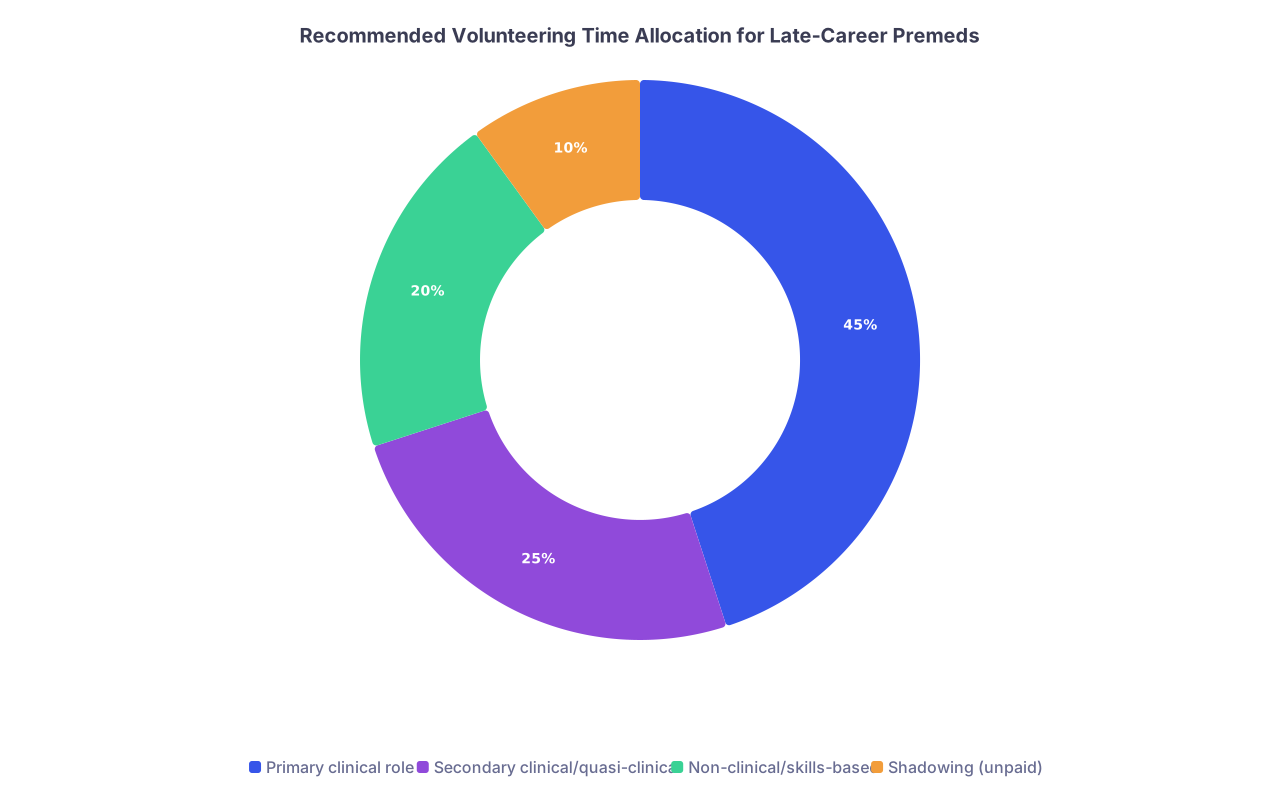
Here is the structure I recommend for late‑career, high‑skill applicants:
- Anchor: 1 primary longitudinal clinical role (12+ months)
- Support: 1–2 additional clinical or quasi‑clinical roles that show variety or deeper responsibility
- Supplement: 1–2 non‑clinical or skills‑heavy volunteer roles that leverage your background and demonstrate leadership/impact
| Category | Value |
|---|---|
| Primary clinical role | 45 |
| Secondary clinical/quasi-clinical | 25 |
| Non-clinical/skills-based | 20 |
| Shadowing (unpaid) | 10 |
Think in hours but also in story. A reasonable target mix over 18–24 months:
- 200–350 hours – primary clinical volunteering or part‑time clinical job
- 75–150 hours – secondary clinical or quasi‑clinical role
- 50–150 hours – targeted, skills‑based non‑clinical service
- 40–80 hours – classic physician shadowing (this is not “volunteering” but it matters)
The point is not to hit magic numbers; the point is that your activities collectively answer: “Yes, I know what day‑to‑day medicine feels like, I have been around patients regularly, and I care enough to show up consistently.”
3. High‑Yield Clinical Volunteering Roles For Late‑Career Applicants
You have more maturity, more schedule constraints, and usually more options than undergrads. Some roles are far more efficient for you.
3.1 Hospital or Clinic Volunteer – But Upgraded
The baseline: transport, front desk, visitor navigator, stocking supplies. These are fine but generic. If this is all you can get, still useful. However, you should aim higher by being intentional about:
- Setting: Community hospital vs academic center vs safety‑net clinic
- Department: ED, oncology, geriatrics, palliative, inpatient medicine
- Responsibility: Can you move into more patient‑facing or project‑oriented tasks over time?
How you upgrade it:
- Start as a standard volunteer. Learn the flow. Show up reliably.
- After 3–6 months, approach the volunteer coordinator:
- “In my prior work I managed data/processes/projects. Are there quality or workflow projects you wish someone had time for that I could help with around patient intake, patient education materials, or tracking outcomes for this volunteer program?”
- You are not asking for special treatment on day one. You are demonstrating value and initiative after proving reliability.
Adcom framing later: “Originally started transporting patients in the ED. Over time, assumed responsibility for triaging non‑urgent visitor questions, translating discharge instructions into plain‑language handouts, and piloting a check‑in workflow that reduced patient confusion at triage.”
That sounds like a mature person who both does basic work and improves systems. Very different from “ED volunteer, 200 hours, stocked linens and blankets.”
3.2 Free Clinic / Community Health Center Volunteer
If you want one role that does a ton of narrative work for you, this is it. Especially if there is a gap between your prior life (industry, corporate, academia) and underserved communities.
Key advantages:
- Repetitive, real patient interactions. Intake, vital signs (once trained), social needs screening, phone triage.
- Strong mission signal: access, equity, social determinants of health.
- Usually more flexible about leveraging your non‑medical skills once they trust you.
Typical late‑career pattern that works extremely well:
- Start as intake volunteer: checking patients in, updating demographics, basic screening questions.
- Over several months, build trust: reliable presence, good patient rapport.
- Then, you pitch one thing that uses your background:
- If you are from tech: patient portal onboarding support, metrics for no‑show rates, simplified digital forms.
- If from business/operations: logistics for med supply donations, inventory processes, scheduling optimization.
- If from education: designing patient education modules, group classes, simplified instructions.
Notice the order: first you’re a body doing intake. Later you layer on your Ivy‑League‑MBA‑magic. If you walk in leading with “strategy,” you will look like a consultant, not a future physician.
4. Shadowing vs Volunteering: You Need Both, But They Play Different Roles
Shadowing is passive. Volunteering is active. Both are required, but you cannot “shadow your way” into demonstrating service and commitment.
For late‑career applicants:
Shadowing:
- Confirms specialty fit, gives you language and realism for essays/interviews.
- Needs to include at least one primary care or generalist setting.
- Ideally includes a physician who can comment on your maturity and interactions with staff and patients.
Volunteering:
- Shows you will do unglamorous work consistently.
- Provides stories of direct contribution, not just observation.
A solid pattern: 1–2 physicians you shadow regularly across several months (even half‑days here and there), embedded within a long‑term volunteering role in the same or similar setting.
5. Strategic Use Of Your High‑Skill Background
This is the part most late‑career people either underplay (trying to “blend in with the undergrads”) or overplay (trying to be an unpaid executive instead of a volunteer).
Your prior skills should:
- Amplify your impact
- Show you understand systems
- Demonstrate leadership and initiative
But they must never:
- Replace direct patient contact
- Make you look allergic to basic tasks
- Turn into “consulting” with no patient‑proximal experience
Let’s look at concrete pairings.
| Prior Background | Clinical Role | Skills-Based Add-On Project |
|---|---|---|
| Software / Product | Free clinic intake / patient portal | Build simple dashboards, optimize portal workflows |
| Operations / Management | Hospital volunteer in ED or inpatient | Streamline supply chain, improve shift handoffs docs |
| [Teaching / Academia](https://residencyadvisor.com/resources/nontraditional-path-medicine/using-teaching-and-leadership-backgrounds-to-excel-in-smallgroup-learning) | Clinic volunteer + health education | Design patient classes, training materials |
| Finance / Consulting | Community clinic or nonprofit board | Budgeting help, but only after core patient exposure |
| Design / Communications | Clinic front desk / navigator | Redesign signage, patient handouts, website content |
The workflow you want:
- Anchor yourself in a patient‑facing role.
- Ask staff periodically what drives them nuts.
- Offer to tackle a clearly scoped project using your skills, with them as content owners.
- Implement, get feedback, iterate.
On your application, you then have:
- Hours of patient contact
- Concrete system‑level improvements
- A clear narrative of “I already think and act like a physician who cares about systems and people.”
6. Time Constraints, Age, And How Much Is “Enough”
You are probably juggling work, maybe children, aging parents, and prerequisite courses. You will never match the 600+ volunteering hours of a college senior who lives five minutes from campus hospital.
Fortunately, admissions committees are not blind. They do adjust expectations. They do not, however, give you a pass on clinical exposure.
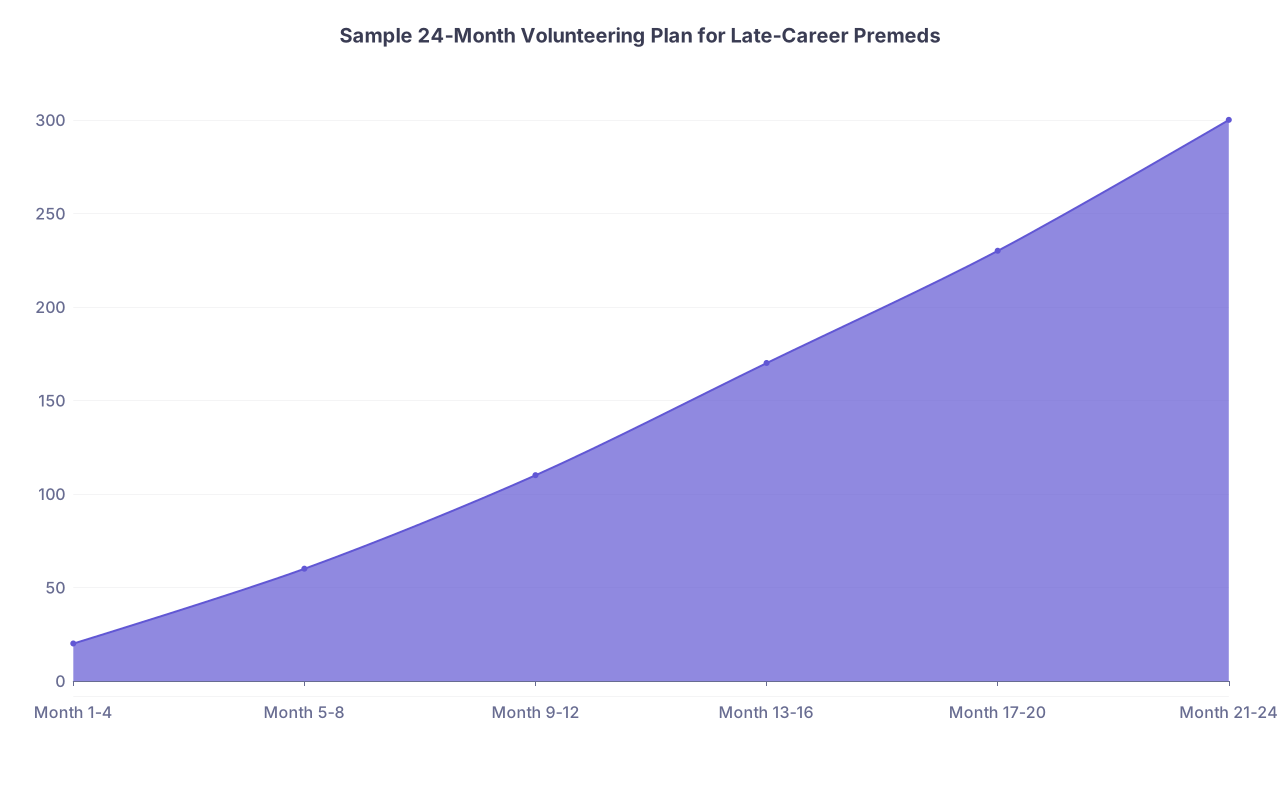
Realistic, solid targets for a late‑career applicant preparing over ~2 years:
| Category | Value |
|---|---|
| Month 1-4 | 20 |
| Month 5-8 | 60 |
| Month 9-12 | 110 |
| Month 13-16 | 170 |
| Month 17-20 | 230 |
| Month 21-24 | 300 |
This might look like:
- Year 1
- 3–4 hours/week as a free clinic volunteer (intake, patient flow)
- Occasional shadowing blocks (1–2 half‑days/month)
- Year 2
- Continue same clinic (demonstrating commitment)
- Add a secondary role: hospital volunteering, hospice, or a project‑based skills role (e.g., data or quality improvement support)
Total at the end:
- 250–350 hours of genuine clinical engagement
- 50–100 hours of “plus” skills‑based contributions
- 40–80 hours of structured shadowing
That is enough when combined with a coherent story, strong academics, and good letters. Not spectacular on paper compared to gunners, but more mature and believable.
What is not enough:
- 60 hours of generic hospital volunteering done 10 years ago
- 20 hours shadowing one friend who is a cardiologist
- Board membership at a health nonprofit with zero patient exposure
7. High‑Yield Settings That Specifically Strengthen Your Narrative
You are not choosing at random. You are building a spine for your eventual “Why medicine, why now, why you” story.
Here are settings that consistently carry weight for late‑career applicants.
7.1 Safety‑Net / Underserved Care
Community health centers, FQHCs, mobile clinics, street medicine teams, migrant clinics, free dental/vision days. These do several things at once:
- Expose you to resource‑limited care and patient complexity
- Undercut any suspicion that this is a vanity project
- Provide high‑density patient contact per hour of your time
If your current or past career was high socioeconomic status—finance, tech, law—these experiences matter heavily. They rebalance your image.
7.2 Hospice and Palliative Adjacent Roles
Hospice volunteers, inpatient palliative support, bereavement programs. Late‑career applicants often handle these spaces very well:
- You have more life experience. You have probably lost people. You understand mortality more concretely.
- These experiences reassure adcoms that you are not in this for glam procedural work alone.
- They give you deep, reflective narratives that adcoms remember. Carefully.
Be cautious not to write trauma narratives solely for shock value. Reflective, grounded, and specific is the bar.
7.3 Longitudinal Primary Care Exposure
Chronic disease management, longitudinal relationships, mundane follow‑ups. This is what real medicine looks like most of the time.
Serving in:
- Primary care clinics
- Geriatrics clinics
- VA outpatient clinics
…shows you understand the grind, not just the drama.
8. How To Actually Land These Roles (When You’re Not A College Kid)
You do not have a pre‑health office spoon‑feeding you sign‑up links. You have to do this like any other professional relationship building.
Start with:
- Local hospital volunteer services page – formal application process
- Federally Qualified Health Centers (FQHCs) in your area – email the volunteer coordinator or practice manager
- Free clinics – many are run by local medical societies, churches, or nonprofits; look at county medical society websites
- Hospice organizations – most have structured volunteer programs
Your email should not sound like a college sophomore asking for “clinical hours.” It should sound like a professional offering time and respect.
Template skeleton:
My name is [X]. I live in [city], and I am currently completing the academic prerequisites to apply to medical school as a career‑changing applicant.
I am specifically looking for a long‑term, patient‑facing volunteer role where I can support your team’s work and learn more about day‑to‑day clinical care. I am available [X hours/week, specific times].
My previous background is in [field], where I have experience with [very short list: e.g., operations, data management, bilingual communication]. For a volunteer role, I am completely comfortable starting with basic tasks such as intake, way‑finding, or stocking, and then taking on more responsibility if appropriate over time.
Would you be open to a brief conversation about whether there might be a fit?
Polite, specific, not entitled. That usually gets you a meeting.
9. How To Avoid The Classic Late‑Career Volunteering Pitfalls
I see the same five errors repeatedly.
9.1 Over‑Executive Syndrome
You aim straight for:
- Advisory boards
- Strategy committees
- “Innovation council” roles
And then wonder why adcoms do not buy your clinical interest. If your only “healthcare” involvement is at the 30,000‑foot level, you look like someone hedging, not committing.
Solution: Refuse any high‑level role that does not come after you have substantial ground‑level time in a clinical environment.
9.2 Overcrowded, Shallow CV
You sign up for:
- A hospital shift once a month
- A mobile clinic event every quarter
- A health hackathon twice a year
Each sounds cool in isolation. Collectively, they look like a tourist itinerary.
Solution: Anchor in one or two long‑term commitments. Add occasional diversity on top. Not the other way around.
9.3 Using “Work” As A Substitute For Clinical Volunteering
You worked in biotech. Or health IT. Or health policy. You assume that counts as “clinical exposure.”
It does not. It may help your application, but it does not answer the question: “Can this person function in a room with sick humans, families, and staff?”
Solution: Explicitly carve out clinical roles even if your day job is health‑adjacent.
9.4 Waiting Too Long To Start
I see people finish all their prereqs and MCAT, then panic when they realize they have 30 hours of volunteering. You cannot compress genuine longitudinal experience into 3 months.
Solution: As soon as you’re sure medicine is a serious possibility, start one recurring clinical role, even if it is only 2–3 hours per week.
9.5 Writing About Yourself As Savior
Late‑career professionals sometimes write about “transforming” organizations, “revolutionizing” workflows, or “fixing” broken clinics in their personal statements.
Adcoms hate this. It comes off as paternalistic and tone‑deaf.
Solution: Emphasize:
- What you learned from staff and patients
- How you collaborated
- Concrete but modest improvements, framed as “supporting the team,” not “rescuing” them
10. How To Frame Your Volunteering In Essays And Interviews
You are not listing tasks. You are proving three things:
- I understand the lived reality of patient care.
- I have tested my fit for this work over time.
- I bring transferable skills without needing to be center stage.
Use structure. For a major volunteering experience, a compact way to present it:
- Context: Where, who you served, how often.
- Role evolution: How your responsibilities changed over time.
- One or two specific patient or system stories that changed your thinking.
- Reflection: What this taught you about the physician role, about yourself, and about why now.
Example for a late‑career applicant who did free clinic intake + data work:
For the past two years, I have volunteered weekly at a free clinic serving largely uninsured, Spanish‑speaking adults. I started by checking patients in, confirming medication lists, and translating basic instructions. Many visits felt routine until one patient, a 58‑year‑old with uncontrolled diabetes, returned after being hospitalized with DKA.
Sitting with him for intake, I realized he had never understood his sliding‑scale insulin regimen. Our “education” had been a handout he could not read. That conversation pushed me to work with our clinicians to rewrite our discharge instructions at a fifth‑grade reading level and test them with patients. I used my product background to track readmission‑related visits for three months after we rolled out the new materials; we saw fewer urgent follow‑ups tied to medication confusion.
The experience crystallized what I want my future practice to be: face‑to‑face conversations with individual patients, backed by thoughtful, data‑informed systems that make it easier for them to succeed outside the clinic.
Notice the ratio: plenty of patient contact, some system improvement, and clear internal shift.
11. Example Pathways For Different Late‑Career Profiles
To make this painfully concrete, here are sample volunteering “archetypes” that work.
11.1 The Senior Software Engineer (Age 38)
- Year 1:
- 3 hours/week: free clinic intake and front desk.
- 1 half‑day/month: shadowing a primary care physician in same clinic.
- Year 2:
- Continue same shifts.
- Small project: help clinic build a basic dashboard using existing EHR exports to track no‑shows and medication refill gaps.
- Add 4 hours/month: volunteer at a hospice organization doing companionship visits.
Narrative: “From writing code to sitting beside patients, I saw where technical thinking helps and where it is irrelevant. I chose to move toward direct care rather than stay behind the systems.”
11.2 The Corporate Operations Director (Age 45)
- Year 1:
- 4 hours/week: hospital volunteer in inpatient medicine, assisting with patient transport, discharges, and family support.
- Year 2:
- Continue that role.
- Project: streamline weekend discharge packet organization for the floor, collaborating with nurses and case managers.
- 1–2 days/month: shadow hospitalist and primary care physician.
Narrative: “I understand throughput and logistics from the boardroom side; now I have seen their consequences on the patient side. I want to own not just the process, but the conversation at the bedside.”
11.3 The University Lecturer (Age 50)
- Year 1:
- 3 hours/week: volunteer in a community clinic as a medical assistant trainee (vitals, rooming, documentation support).
- Year 2:
- Continue clinical work.
- Develop a group education class for patients with new diabetes diagnoses, then teach it monthly alongside the clinic nurse.
- Limited but focused shadowing with the clinic’s family physician.
Narrative: “Teaching physiology to undergraduates was abstract. Teaching diet, meds, and glucometer use to a patient whose vision is fading is not. That transition is why I am changing paths.”
FAQ (Exactly 4 Questions)
1. How late is “too late” to start clinical volunteering if I want to apply in the next cycle?
If you are less than 6–9 months from submitting your application and have close to zero clinical volunteering, you are in trouble. You can technically apply, but your file will look undercooked. For late‑career applicants especially, a year of consistent engagement is the practical minimum. In that situation, I usually advise delaying one cycle, building 9–12 solid months of clinical experience, and then applying with a stronger narrative and fewer question marks.
2. Does paid clinical work (scribe, MA, CNA) “count” the same as volunteering for late‑career applicants?
Yes, often it is better. Paid clinical roles show that someone besides you thinks you are worth training and trusting around patients. For a late‑career applicant, part‑time work as a scribe or MA, combined with limited but thoughtful volunteering, can be more powerful than purely volunteer roles. The key is patient proximity and longitudinal involvement, not the paycheck status.
3. I already work full‑time in healthcare (non‑clinical). Do I still need separate volunteering?
Almost always, yes. Working in a health‑adjacent corporate role, analytics team, or policy environment is not the same as being in a patient room. You can reduce the volume compared with someone completely outside healthcare, but you still need explicit, repeated clinical exposure where you interact with patients and clinical staff in direct care settings. That is what convinces adcoms you understand the day‑to‑day human reality of medicine.
4. How do I explain “starting at the bottom” as a mid‑career professional without sounding defensive?
You do not apologize; you own it. Frame it as a deliberate choice: you wanted to see medicine from the ground level up, not as an executive or consultant. Describe concrete examples of taking direction from younger staff, learning basic tasks, and discovering what you had previously underestimated. That humility, combined with the maturity of your prior career, is exactly what reassures admissions committees that you understand what you are walking into.
Key takeaways:
You are not trying to mimic a 20‑year‑old’s activity list. You are proving, through a small number of well‑chosen, long‑term roles, that you can show up for patients, work in the trenches, and still bring your previous life’s skills to bear without overshadowing the core work of medicine. If your volunteering shows humility, longitudinal commitment, and smart use of your background, you are on the right track.